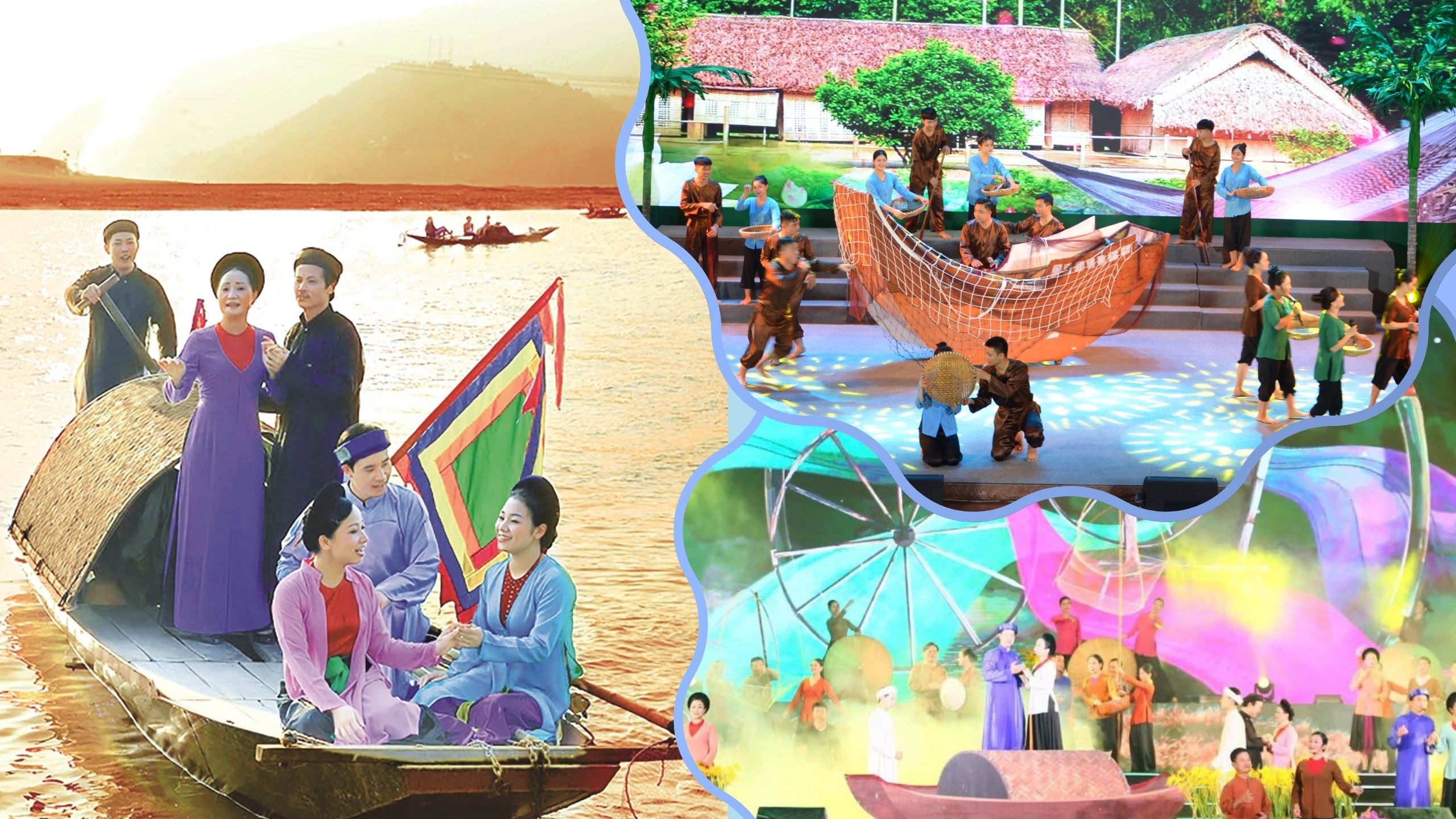
Vi and Giam folk songs of Nghe Tinh, also known as Nghe Tinh Vi and Giam folk songs, are a distinctive form of traditional folk performing art created, practiced, and passed down through generations by communities in Nghe An and Ha Tinh provinces. Without elaborate musical accompaniment, Vi and Giam songs are primarily performed through simple yet deeply emotional singing, closely associated with agricultural work, family life, and the spiritual world of the people of Nghe Tinh.
From songs sung beside looms, in rice fields, along riverbanks, or during community gatherings at night, Vi and Giam have become an intimate means of expressing the feelings of the people of Nghe. The lyrics convey love for the homeland, family affection, romantic love, moral values, social conduct, and reflections on life. Over time, this folk singing tradition has continued to develop and become an important cultural symbol of Vietnam’s North Central region.
According to the results of an inventory conducted in 2012, there were 75 Vi and Giam folk song groups with approximately 1,500 members in Nghe An and Ha Tinh. Folk singing practices and transmission activities were carried out in many localities, including 15 districts in Nghe An and 12 districts in Ha Tinh.
Origins and Performance Environment
Vi and Giam are two forms of folk singing without instrumental accompaniment. They developed within the working and social environments of the people of Nghe Tinh. People sang while farming, transplanting rice, rowing boats, hauling timber, weaving, making baskets, producing conical hats, milling rice, lulling children, or participating in courtship gatherings between young men and women.
Because they are closely associated with specific occupations and circumstances, many melodies are named after their performance environments, such as Vi Phuong Vai, or weaving-group Vi; Vi Phuong Non, or conical-hat-making-group Vi; Vi Phuong Dan, or basket-making-group Vi; Vi Phuong Cui, or firewood-collecting Vi; Vi Treo Non, Vi sung while climbing mountains; Vi Do Dua, Vi sung while rowing boats; as well as Giam Ru, lullaby Giam; Giam Ke, narrative Giam; Giam Khuyen, instructive Giam; Giam Ve, rhyming or satirical Giam; and many other forms.
In traditional life, Vi and Giam were often performed alternately, which is why the two forms are collectively known as Vi and Giam folk songs. They were not originally intended solely for the stage, but functioned first and foremost as an artistic means of communication. Through singing, people expressed their thoughts and emotions, exchanged experiences, and demonstrated flexibility and ingenuity in verbal responses.
Vi and Giam can be performed in three basic forms: solo singing, responsive singing, and organized singing sessions. In courtship singing sessions, there are usually three main stages: introductory singing, responsive singing, and concluding or bonding songs. Each side generally consists of at least two or three people, with one person taking the lead while the others provide vocal support and create harmony.
This singing style is both spontaneous and governed by certain conventions. Performers must know how to select words, improvise lyrics, respond to one another, and shape the melody according to the circumstances, the person being addressed, and the emotional state of the singer.
Characteristics of Vi Singing
Vi singing has a relatively free melodic structure and depends greatly on the lyrics, local intonation, performance context, and the emotions of the singer. Vi lyrics are often composed in six-eight verse, alternating six-eight verse, variations of six-eight verse, or other flexible forms of folk poetry.
The vocal range of Vi is generally not very wide, but its expressive capacity is highly diverse. Within the same melody, singers may alter the rhythm, prolong certain words, or emphasize particular phrases to convey shyness, humor, tenderness, affection, contemplation, or playfulness.
Among the various forms of Vi singing, Vi Phuong Vai is considered the one with the most clearly defined rules and procedures. A typical singing session consists of three stages:
- The first stage includes introductory singing, greetings, congratulatory songs, and questions.
- The second stage consists of riddles and responsive singing, in which performers must solve the questions and provide suitable replies.
- The final stage includes invitation songs, bonding songs, and farewell songs.
Through these singing sessions, participants demonstrate not only their vocal abilities but also their knowledge, quick thinking, linguistic skills, and charm in communication.
Characteristics of Giam Singing
Unlike Vi, Giam is a form of rhythmic speech-singing with a clear beat and tempo. It often features strong and weak beats and is commonly performed in 3/4 or 6/8 time. Giam lyrics are generally based on five-syllable verse, consisting of multiple stanzas and resembling folk rhymes, ballads, or narrative poetry.
A common form of Giam contains five lines in each stanza, with the final line repeating the preceding line. This creates a distinctive structural feature of the genre. Giam includes various forms such as Giam Ke, Giam Noi, Giam Ve, Giam Nam Nu, Giam Cua Quyen, Giam Ru, and Giam Xam.
Giam Nam Nu, or male-and-female Giam singing, may be performed in small groups of two or three people, groups of five to seven, or larger gatherings depending on the circumstances. Its performance sequence is generally divided into three stages like Vi singing, although the steps are not necessarily as complete or strictly regulated.
Lyrics and Cultural Values
One of the outstanding values of Nghe Tinh Vi and Giam folk songs lies in their rich, vivid, concise, memorable, and easily transmitted lyrics. The songs reflect many aspects of life, from labor and production to social customs, romantic relationships, family affection, and love for the homeland and the nation.
The lyrics often express respect for parents, loyalty, solidarity, and ethical behavior within the community. Many songs contain advice and educational messages, encouraging people to be compassionate, preserve their dignity, remain faithful in relationships, and fulfill their responsibilities toward their families and villages.
Vi and Giam also clearly reflect the personality of the people of Nghe Tinh: simple yet profound, straightforward yet emotional, hardworking, resilient, and deeply conscious of their homeland and origins. The use of local dialect does not limit the songs’ appeal. On the contrary, it gives Vi and Giam a distinctive character and an unmistakable regional identity.
This folk repertoire is also the collective result of creativity contributed by Confucian scholars, academic figures, intellectuals, and patriotic individuals throughout different historical periods. Through the lyrics, listeners can recognize traces of historical stages, social changes, and people’s reflections on life.
An important characteristic of Vi and Giam is the ability to improvise and create new lyrics. Singers can use familiar melodies as a foundation for composing content suitable for contemporary events, circumstances, or social issues. This flexibility prevents the folk tradition from becoming confined to the past and allows it to adapt continuously to modern life.
Vi and Giam folk songs have also inspired many modern musical compositions, songs, musical dramas, and artistic programs. Elements from the traditional melodies have been incorporated into stage performances, radio and television programs, cultural and social events, and tourism promotion activities, enriching the spiritual life of the community.
Preservation and Promotion in Contemporary Life
Alongside economic, social, and environmental changes, the traditional performance spaces of Vi and Giam have also undergone significant transformation. Former craft villages, riverbanks, rice fields, and traditional working environments have gradually become less common, causing some original performance contexts to decline.
Today, Vi and Giam are practiced not only by traditional artisans, their descendants, and farmers in rural communities, but also by civil servants, public employees, members of the armed forces, retirees, students, and people from many other social groups. Folk song clubs have been established in communes, wards, agencies, schools, cultural institutions, and community organizations.
In addition to direct oral transmission, teaching and preservation are carried out through audio recordings, video documentation, written collections, musical notation, and the creation of folk cultural databases. Competitions, festivals, exchange programs, and Vi and Giam performances are organized at commune, district, provincial, and regional levels, providing opportunities for artisans to meet, exchange knowledge, and inspire younger generations.
In Hung Tan Commune, folk artists and club members have actively collected and documented old melodies, folk verses, Giam songs, excerpts, and traditional narratives. The club has gathered many valuable works, contributing to the folk cultural archives of Nghe An Province.
Alongside preserving ancient melodies, some artisans also compose and adapt new lyrics based on traditional tunes, selecting themes that are close to contemporary life and more accessible to younger audiences. Many new works have been written, staged, and performed, helping bring Vi and Giam closer to the public today.
Transmission activities in schools have also received increasing attention. Some folk song clubs cooperate with schools to organize regular extracurricular activities, helping students become familiar with traditional melodies, understand the meaning of the lyrics, and gradually learn to perform Vi and Giam. This is an important approach to ensuring continuity between generations.
However, the staging of folk songs must be carried out carefully. According to practitioners, bringing Vi and Giam to stages, pedestrian streets, festivals, and tourism programs is necessary to expand public access. Nevertheless, it is important to avoid distorting the melodies, altering the lyrics, or separating the folk songs from their community-based cultural foundations.
Preservation can only be truly effective when it both safeguards the core values of the tradition and creates performance environments compatible with modern life. Folk song clubs, artisans, and local communities need support in funding, documentation, training, promotion, performance organization, and connections with cultural tourism activities.
Nghe Tinh Vi and Giam folk songs are a living heritage that survives through natural practice and transmission from one person to another. Lullabies, responsive Vi songs, and narrative Giam verses have been passed down from grandparents and parents to children through work and daily life. This method of transmission gives the heritage its enduring vitality.
Vi and Giam are not merely voices from the past. They are also means of moral education, nurturing love for the homeland, strengthening community awareness, and conveying positive standards of social conduct. Through direct performance, singers and listeners share the same space, emotions, and stories, allowing the tradition to spread naturally throughout society.
With outstanding historical, cultural, artistic, and scientific values, Nghe Tinh Vi and Giam folk songs have been included in Vietnam’s National Intangible Cultural Heritage List. The heritage was subsequently submitted to UNESCO and inscribed on the Representative List of the Intangible Cultural Heritage of Humanity in 2014.
Today, Vi and Giam folk songs continue to be preserved, practiced, creatively developed, and promoted by communities in Nghe An and Ha Tinh through folk song clubs, schools, artistic festivals, cultural exchanges, and tourism activities. From humble working environments, the melodies of Vi and Giam have reached the stage and a wider audience while retaining their essential character as the voice of the soul of the people of Nghe Tinh.
Heritage Information
- Heritage name: Vi and Giam Folk Songs of Nghe Tinh
- Alternative name: Nghe Tinh Vi and Giam Folk Songs
- Heritage category: Folk performing arts
- Location: Nghe An Province and Ha Tinh Province, Vietnam
- Performance spaces: Villages, family homes, rice fields, riverbanks, craft villages, folk song clubs, schools, stages, and cultural events
- Period of practice: Throughout the year, associated with agricultural work, community life, and cultural activities
- Cultural bearers: Communities in Nghe An and Ha Tinh
- Distinctive features: Unaccompanied singing consisting of two forms, Vi and Giam, characterized by improvisation, responsive singing, and verbal exchange
- Year included in Vietnam’s National Intangible Cultural Heritage List: 2012
- Year inscribed by UNESCO: 2014
- Outstanding values: Artistic, historical, cultural, educational, linguistic, communal, and regional identity values
- Related recognition document: Decision No. 5079/QD-BVHTTDL dated December 27, 2012