


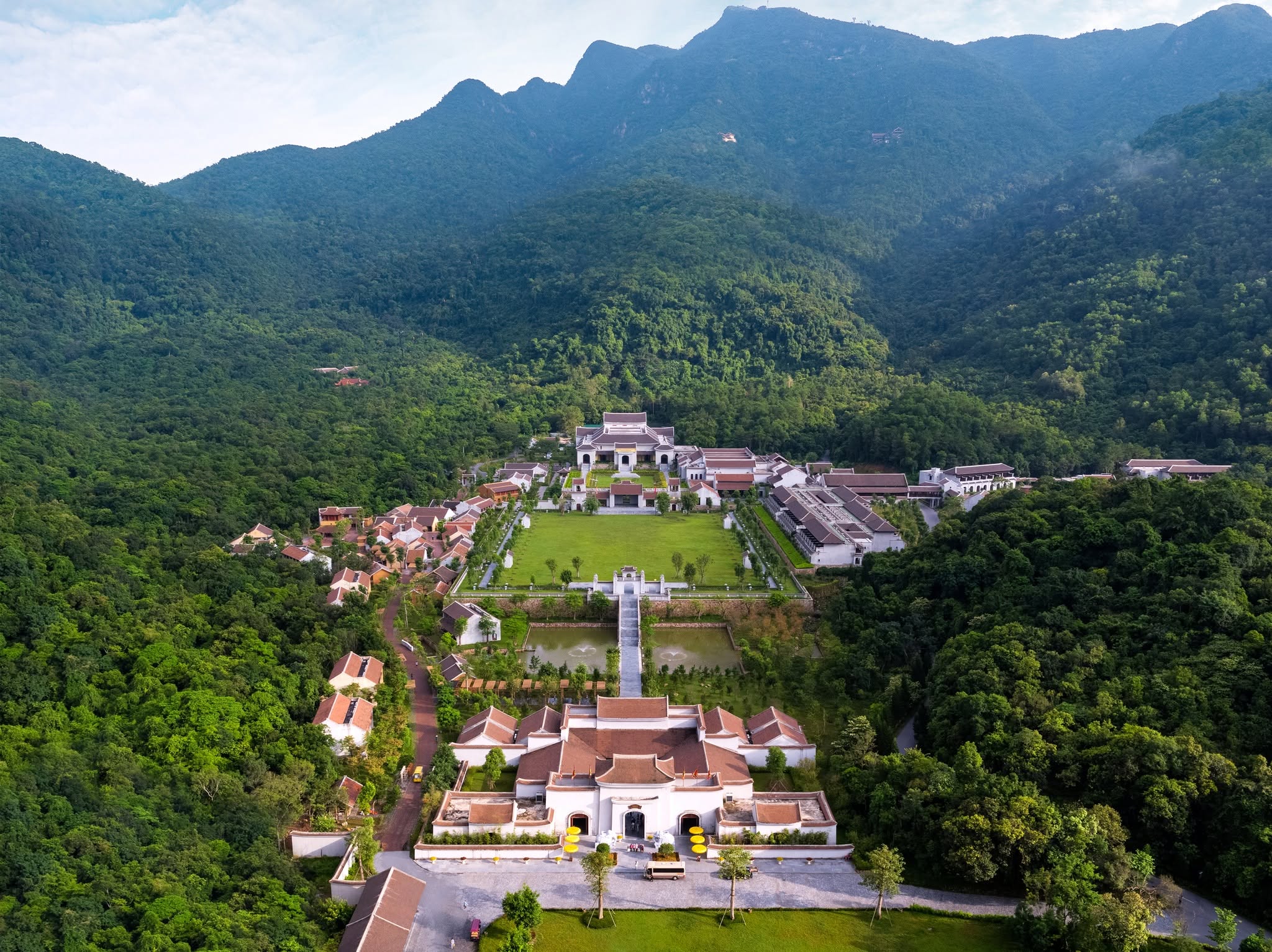
Yen Tu is one of Vietnam’s most distinctive cultural, historical, and Buddhist landscapes. Here, the mountain environment is closely associated with the Tran Dynasty and the formation and development of the Truc Lam Zen tradition.
For Vietnamese people, Yen Tu is more than a sacred mountain or a famous pilgrimage destination. It is closely associated with Emperor Tran Nhan Tong, the king who gave up the throne to pursue Buddhist practice and laid the foundation for a distinctly Vietnamese Zen tradition.
The value of Yen Tu comes from the combination of history, religion, architecture, archaeology, and natural landscape. Across the mountain range are pagodas, hermitages, stupas, pilgrimage paths, archaeological remains, streams, waterfalls, bamboo forests, and ancient trees that have developed together over many centuries.
In 2012, the Prime Minister recognized Yen Tu as a Special National Relic under Decision No. 1419/QD-TTg dated September 27, 2012. In 2025, the Yen Tu-Vinh Nghiem-Con Son and Kiep Bac Complex was inscribed on the UNESCO World Heritage List under criteria (iii) and (vi). The trans-provincial heritage complex includes numerous sites directly associated with the formation, development, and spread of the Truc Lam Zen tradition.
Tran Nhan Tong and the Birth of Truc Lam Zen
The history of Yen Tu is closely associated with Tran Nhan Tong (1258-1308), the third emperor of the Tran Dynasty. He ascended the throne in 1278, at a time when Dai Viet faced major challenges from the Mongol-Yuan invasions.
During the wars of 1285 and 1288, the Tran court and the army and people of Dai Viet successfully defeated the Mongol-Yuan forces. Tran Nhan Tong is remembered not only as a ruler but also as an influential figure in Vietnamese intellectual, cultural, and Buddhist history.
In 1293, he abdicated in favor of his son Tran Anh Tong and became a retired emperor. He subsequently devoted increasing amounts of time to Buddhist practice and study. In 1299, he formally went to Yen Tu to pursue religious life and adopted the title Truc Lam Dai Si.
From Yen Tu, he developed a Zen tradition with distinctive characteristics rooted in Dai Viet society, later known as Truc Lam Yen Tu Zen. Tran Nhan Tong became its First Patriarch, followed by Phap Loa and Huyen Quang, collectively known as the Three Patriarchs of Truc Lam.
One of the defining features of Truc Lam is its engaged approach to religious life. Spiritual practice was not necessarily understood as withdrawing completely from society. Instead, it emphasized self-cultivation, ethical conduct, personal responsibility, and contributions to the wider community.
This combination of spiritual practice, moral philosophy, and social responsibility gave Truc Lam a distinctive place in Vietnamese Buddhist history. UNESCO recognizes Truc Lam as a unique Vietnamese Zen tradition that originated in the Yen Tu area and subsequently spread to other Buddhist centers.
For this reason, the story of Yen Tu should not be reduced to that of a king who became a monk. More importantly, it is the story of a ruler who experienced war and political responsibility before turning toward religious practice and establishing a Zen tradition that continued to influence Vietnamese culture for centuries.
The Mountain Landscape and Pilgrimage Route
Yen Tu forms part of the Dong Trieu mountain arc, characterized by forests, streams, waterfalls, rocky terrain, and diverse geological features. These natural conditions shaped the development of the religious landscape. Rather than being separated from nature, temples and hermitages were built according to the contours of the mountains.
The Yen Tu area covers approximately 2,686 hectares, including about 1,736 hectares of natural forest. The ecosystem reflects the characteristics of northeastern Vietnam and supports a variety of plant and animal species.
Ancient trees are among the most distinctive features of the pilgrimage route. Numerous old trees, particularly ironwood and pine-like trees known locally as xich tung, line sections of the mountain path. Some are believed to be around 700 years old and are traditionally associated with the development of the Truc Lam Buddhist landscape.
Bamboo forests are another characteristic element. Together, the ancient trees and bamboo create a distinctive visual identity for Yen Tu and contribute to the symbolism associated with the name Truc Lam, literally referring to a bamboo forest.
The pilgrimage route itself is an important part of the heritage. From the foothills to the summit, visitors pass through a sequence of temples, stupas, hermitages, forests, streams, and archaeological remains. The journey is therefore not simply a climb to visit temples. It is a cultural landscape in which architecture, history, religion, and nature are connected along the mountain.
Among the important sites on the lower sections of the route are Bi Thuong Pagoda, Suoi Tam Pagoda, Cam Thuc Pagoda, Lan Pagoda and the Truc Lam Yen Tu Zen Monastery, as well as Giai Oan Pagoda.
Lan Pagoda has a history dating to the Tran Dynasty and was once an important temple in the Yen Tu system. In 2002, the Truc Lam Yen Tu Zen Monastery was established on the site, with major structures including the three-entrance gate, main sanctuary, ancestral house, bell tower, drum tower, exhibition building, guest house, and monastic quarters.
Giai Oan Pagoda stands beside the Giai Oan Stream and is associated with legends surrounding Tran Nhan Tong’s decision to leave royal life. These stories are part of the local cultural tradition and should be understood as folklore rather than established historical fact.
Further up the mountain are the Huong Thap area, Hoa Yen Pagoda, the Huệ Quang Tower Garden, Bao Sai Pagoda, Van Tieu Pagoda, and numerous archaeological remains.
Hoa Yen Pagoda, Huệ Quang Tower Garden and the Upper Mountain
Hoa Yen Pagoda is one of the most important stops on the Yen Tu pilgrimage route and is closely associated with the history of Truc Lam Zen.
Situated halfway up the mountain, the pagoda illustrates the characteristic relationship between Buddhist architecture and the natural landscape. The buildings follow the terrain, with the forest and mountains forming an integral part of the religious setting.
Nearby, the Huệ Quang Tower Garden, also known as the Patriarchs’ Tower Garden, is one of the most significant places for understanding the history of Truc Lam. The area contains numerous stupas and tombs associated with generations of Buddhist practitioners.
At its center is the Huệ Quang Tower, associated with Emperor Tran Nhan Tong. The stone tower is an important architectural and religious landmark, while the surrounding monuments reflect the long tradition of Buddhist practice on Yen Tu.
The area also provides an opportunity to introduce the Three Patriarchs of Truc Lam: Tran Nhan Tong, Phap Loa, and Huyen Quang. Their succession demonstrates that Yen Tu was not simply the place where one ruler practiced Buddhism, but the starting point of an organized Zen tradition that was transmitted and developed over subsequent generations.
Beyond Hoa Yen are several sites where only foundations or archaeological remains survive. Thien Dinh Hermitage, Thung Hermitage, Duoc Hermitage, and other ruins provide evidence that the historical network of religious buildings on Yen Tu was once considerably larger than what visitors see today.
Mot Mai Pagoda is particularly distinctive. Built against the mountainside, part of the structure extends into a rock shelter while the other part opens toward the outside. Its unusual form reflects how religious architecture was adapted to the natural terrain.
These remains are important because they demonstrate that Yen Tu’s historical religious landscape consisted not only of major temples but also of small hermitages, stupas, meditation spaces, and other structures distributed throughout the mountain.
Dong Pagoda and the Cultural Landscape of Yen Tu
Dong Pagoda stands at the highest point of the traditional Yen Tu pilgrimage route and is perhaps the most recognizable symbol of the mountain.
The pagoda is cast in bronze and has a simple rectangular layout resting on a bronze platform. Its square structure has four roofs, with traditional roof tiles and dragon-shaped decorative elements at the corners. The building faces southwest and covers approximately 20 square meters, with a height of about 3.35 meters from the floor to the roof.
Dong Pagoda should be understood as the culmination of the pilgrimage rather than as an isolated monument. Before reaching the summit, visitors pass through forests, ancient trees, bamboo groves, temples, hermitages, stupas, and archaeological remains.
Other natural landmarks include Ngu Doi Waterfall, Vang Waterfall, Bac Waterfall, Cong Troi, the Pine Path, bamboo forests, and the summit of Yen Tu. These features are essential to the identity of the site because Yen Tu was not constructed by separating architecture from nature. Religious buildings were integrated into the mountain environment.
The Yen Tu Festival is held annually during the spring pilgrimage season, traditionally beginning on the tenth day of the first lunar month. Pilgrims come to worship Buddha, pay their respects to Tran Nhan Tong and the Three Patriarchs of Truc Lam, and participate in religious and cultural activities.
The continuing pilgrimage and religious practices demonstrate that Yen Tu remains a living cultural landscape rather than simply an archaeological or architectural site.
World Heritage Significance
The recognition of Yen Tu as a Special National Relic in 2012 marked an important stage in the preservation of its historical, religious, architectural, archaeological, and natural values.
In 2025, the Yen Tu-Vinh Nghiem-Con Son and Kiep Bac Complex was inscribed on the UNESCO World Heritage List. The heritage complex extends beyond Yen Tu and includes sites across the northeastern region of Vietnam associated with the formation and spread of the Truc Lam Zen tradition.
UNESCO recognizes the complex under criteria (iii) and (vi), reflecting its exceptional testimony to the Truc Lam cultural tradition and its direct association with important spiritual, intellectual, and cultural traditions in Vietnamese history.
Yen Tu can therefore be understood through four interconnected layers of value.
First is its historical value, particularly its association with the Tran Dynasty and Tran Nhan Tong.
Second is its Buddhist value, as the birthplace and principal spiritual landscape of Truc Lam Zen, a distinctly Vietnamese tradition that continues to exist today.
Third is its architectural and archaeological value, represented by temples, stupas, hermitages, foundations, ruins, and other remains spanning different historical periods.
Finally, there is its landscape and ecological value. Mountains, forests, streams, waterfalls, ancient trees, bamboo, and religious architecture form a cultural landscape in which human activity and the natural environment have developed together.
The significance of Yen Tu ultimately lies in this unity of people, history, spirituality, architecture, and nature. It is the place where an emperor chose a life of religious practice, where the Truc Lam Zen tradition took shape, and where generations of pilgrims have continued to walk through the same mountain landscape.
More than seven centuries after Tran Nhan Tong began his religious life here, Yen Tu remains both a sacred destination and a living cultural heritage of Vietnam. Its temples, stupas, forests, pilgrimage paths, archaeological remains, and spiritual traditions together preserve the story of a distinctly Vietnamese Buddhist tradition and the landscape in which it was born.


