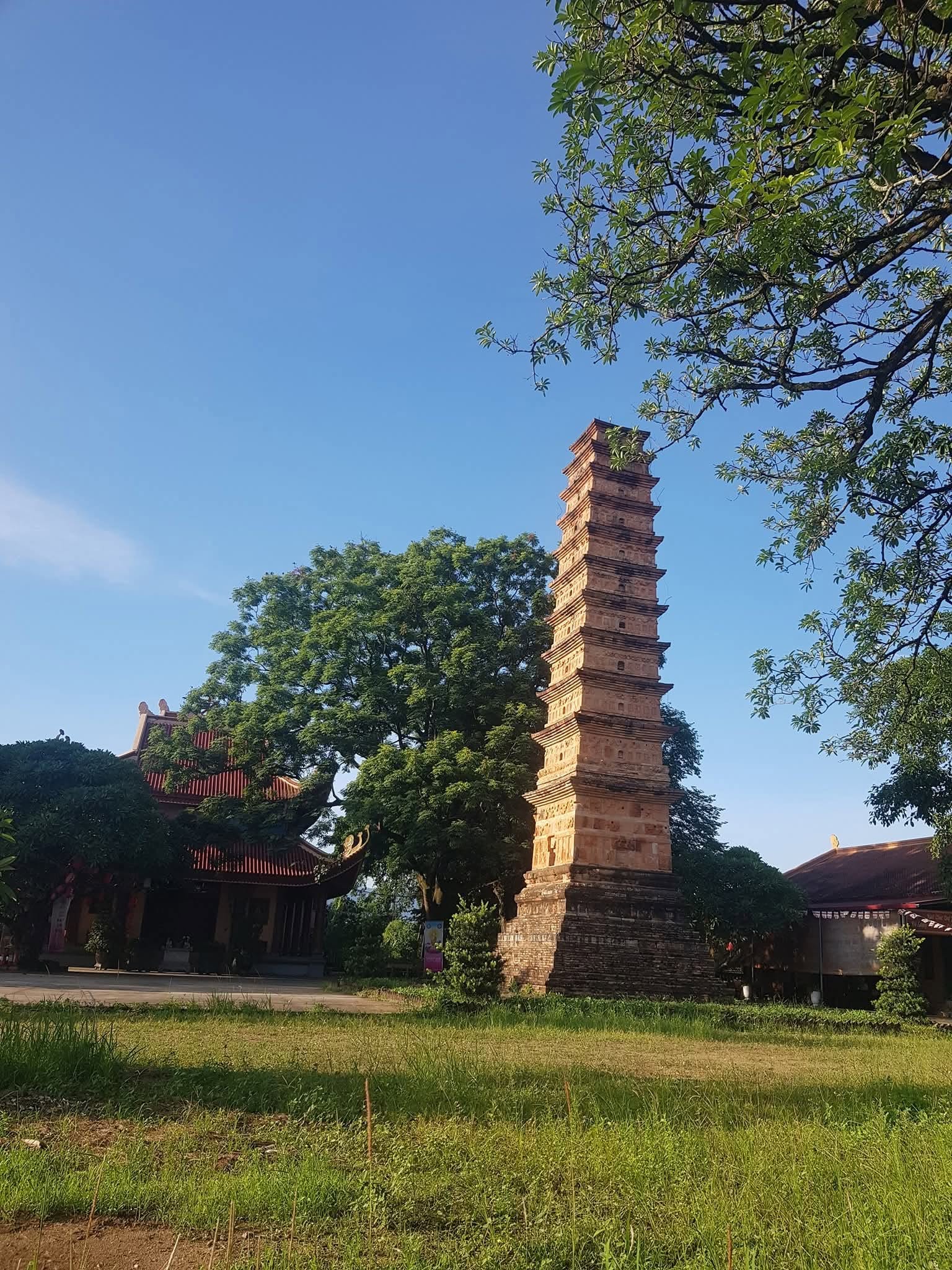
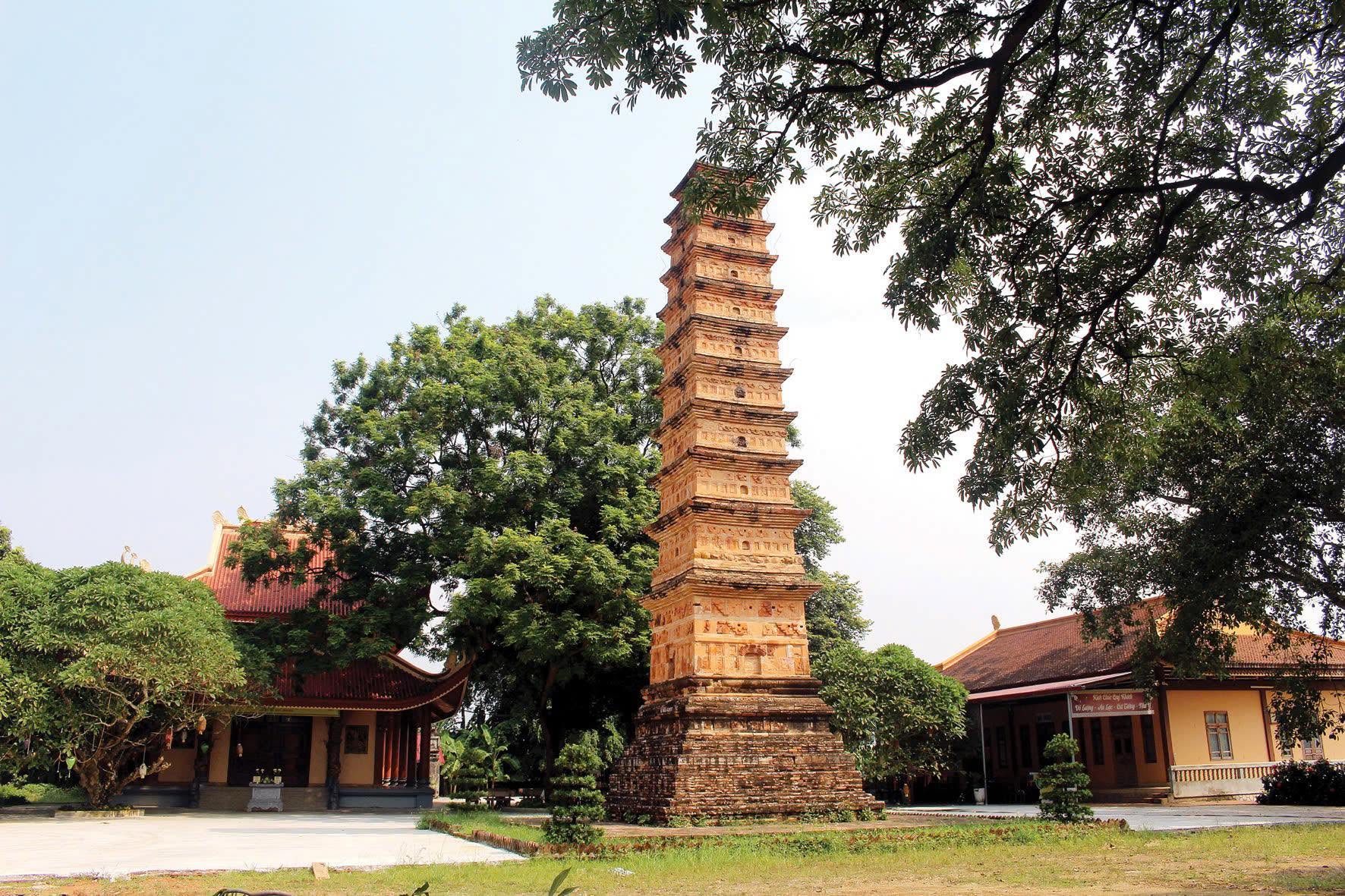
Bình Sơn Tower, also known as Then Tower, Then Pagoda Tower, or Vĩnh Khánh Pagoda Tower, is located within the grounds of Vĩnh Khánh Pagoda in Tam Sơn Commune, Phú Thọ Province. It is an exceptional Buddhist architectural monument with significant historical, architectural, artistic, and construction-engineering value, reflecting a long period of development that extended from approximately the fourteenth to the sixteenth century.
Bình Sơn Tower stands on a broad, elevated mound within the pagoda grounds. The protected area of the monument covers approximately 17,200 square meters, including Bình Sơn Tower, the old Three Jewels Hall, the new Three Jewels Hall, Mực Well, the guesthouse, lotus pond, entrance gate, and other supporting structures.
Within the overall monument complex, Bình Sơn Tower is the most prominent structure. Built entirely of unglazed fired bricks and decorated with a rich variety of ornamental motifs, the tower is an important source of evidence for the study of Vietnamese Buddhist architecture and decorative art across different historical periods.
Bình Sơn Tower and the Art of Brick Architecture
Bình Sơn Tower currently stands approximately 16.5 meters high, consisting of 11 tower levels and a base platform. The original finial has been lost, meaning that the tower may once have been taller than it is today. The tower has a square plan that gradually narrows toward the top. The sides of the lowest level measure approximately 4.45 meters, while those of the eleventh level measure only about 1.55 meters.
The entire structure was built with unglazed fired bricks. The lower levels, particularly the base and the area up to the second level, retain a relatively complete decorative system. The ornamental surfaces feature chrysanthemums, lotus petals, bodhi leaves, plain-faced floral designs, relief-carved dragons, and the lions playing with a ball motif.
As the tower rises and its footprint becomes progressively narrower, the density and scale of the decoration decrease accordingly. This gradual reduction creates a clear architectural rhythm, giving the tower a balanced, upward-reaching appearance.
Three Types of Bricks Used in Bình Sơn Tower
The bricks used to construct Bình Sơn Tower can be divided into three principal groups.
Plain structural bricks come in various sizes and are generally rectangular, with unadorned surfaces and slightly uneven thicknesses. They were commonly used to build the base platform, create projecting horizontal moldings, or fill the joints and recesses formed by the inner facing bricks.
Decorated box-shaped bricks were mainly used around the base and along the decorative bands. The outer surface of these bricks is larger than the inner contact surface. Their shaping and ornamentation were executed with considerable care, indicating a sophisticated multi-stage production process.
Decorative bricks used for the shaft and upper levels differ in both form and function from those found at the base. They were used to construct the higher sections of the tower and helped create the distinctive ornamental system and architectural rhythm visible throughout the structure.
The use of different brick types, each with its own shape, function, and degree of ornamentation, demonstrates that the construction of Bình Sơn Tower was carefully organized. The bricks were not merely building materials. They also played a direct role in shaping and decorating the architecture.
Structures within the Monument Complex
In addition to Bình Sơn Tower, the Vĩnh Khánh Pagoda monument complex contains several structures serving religious activities and community life.
The Old Three Jewels Hall
The old Three Jewels Hall underwent major restoration in 1976 and was rebuilt approximately 20 meters behind its former location. The building has a Đinh-shaped plan, covering approximately 131.5 square meters, and consists of a five-bay front hall and a three-bay rear sanctuary.
The front hall measures approximately 7.55 by 13.12 meters, while the rear sanctuary measures about 5.74 by 7.6 meters. Two bronze pillar structures stand in front of the building, projecting approximately 6 meters outward and forming a shape resembling the arms of a throne.
The floor is paved with red bricks and raised approximately 0.32 meters above the courtyard. Most of the worship statues are made of painted earthen material. The majority date from the late nineteenth to the early twentieth century, while several others belong to the twentieth century.
The New Three Jewels Hall
The new Three Jewels Hall was built in 2012 on the site of the former Three Jewels Hall. It follows a Buddhist monastic architectural style and has a rectangular plan measuring approximately 13.85 by 22.85 meters.
The interior is spacious and open. The structure is built of reinforced concrete, while the roof is divided into several layers, creating a tiered roof form and finished with cylindrical roof tiles.
Mực Well
Mực Well is located within the monument grounds and is associated with a local legend concerning an ancient tower. According to the legend, the site was once the base of an old tower that was blue in color. After the tower disappeared, it left behind a deep depression resembling a circular well.
Over time, the shape of the well has changed and no longer retains the round form described in the legend.
Guesthouse and Lotus Pond
The guesthouse was built in 2012 and covers approximately 283.5 square meters. It has a single-rectangular-bay plan and uses upturned roof corners, reflecting elements of traditional Vietnamese architectural language.
The lotus pond is located in the garden in front of Bình Sơn Tower. Although lotus plants are now cultivated there, the pond does not yet have a complete embankment system, resulting in ongoing erosion along its edges.
The entrance gate to the monument complex consists of four brick-built pillars with a pair of iron gates in the center. The two side entrances are temporarily fenced with branches and bamboo, primarily for site protection.
Distinctive Decorative Motifs
One of the most outstanding features of Bình Sơn Tower is its system of brick ornamentation. The motifs appear in different forms and degrees of relief, creating a distinctive visual identity for each architectural level.
Lions Playing with a Ball
The lions playing with a ball motif is one of the most notable decorative features of Bình Sơn Tower. It differs from the pearl-biting crocodile-like creatures often seen on the bases of Lý Dynasty Buddha statues.
The lions-playing-with-a-ball motif became common in Vietnamese art from approximately the seventeenth century and continued to evolve in later periods. Its presence at Bình Sơn is an important factor to consider when examining the chronology and development of the tower’s decorative system.
Dragons
The dragons at Bình Sơn Tower display distinctive characteristics. They have horns, with their bodies curving into circular forms and their heads facing inward. Their bodies follow sinuous, wave-like curves rather than twisting into tightly interlocked knots. The legs extend outward or cross over the body to create a sense of movement, while the ridges along their backs form serrated patterns.
One foreleg is often raised to grasp a section of the dragon’s hair, creating a particularly animated pose. Certain details recall dragon imagery from the late Trần period, although the overall design does not correspond exactly to any single established dragon type from that era.
The raised-leg pose, in which the dragon appears to grasp its own hair, gives the figure a natural and lively quality that is close to folk-art expression. Some features may also be related to the beard-clutching dragon motif found in later Lê-period art.
Bodhi Leaves
The bodhi leaf is a common decorative motif in Vietnamese Buddhist architecture. The bodhi leaves at Bình Sơn Tower appear in several forms, although they are generally less elaborate than those of the Lý Dynasty.
Some examples contain small, delicate floral patterns that suggest a continuation of Lý-period decorative traditions. Others feature pointed horn-like forms and rounded protrusions. Similar patterns have also been found at several monuments dating from the sixteenth and seventeenth centuries, demonstrating the continuity and transformation of decorative art over successive periods.
Chrysanthemum Vine
The chrysanthemum-vine motif had already appeared in Lý-period art, often arranged into circular frames containing decorative designs. The Trần Dynasty continued this compositional tradition.
At Bình Sơn Tower, the chrysanthemum vine has been simplified. The main stem forms gentle curves, while the internal floral details are no longer rendered as clearly as in Lý-period examples. The motif bears similarities to chrysanthemum-vine designs found on several stone steles dating from the sixteenth and seventeenth centuries.
Three-Pronged Brackets
The three-pronged bracket, also known as a con sơn, is an important architectural detail. This type of bracket appeared in Lý-period architecture, notably at Chương Sơn Tower in Nam Định, and later continued to be used widely in architectural works of the Mạc Dynasty.
Its presence at Bình Sơn helps demonstrate the links between architectural traditions and construction techniques across different historical periods.
Historical, Artistic, and Cultural Significance
Bình Sơn Tower possesses exceptional architectural, artistic, and construction-engineering value. Its decorative brick system, featuring a wide range of forms, depths, and surface treatments, reflects the high level of craftsmanship achieved by the builders who created the monument.
Circular lines, flowing curves, raised surfaces, and recessed patterns were directly shaped into the bricks, producing a richly varied decorative system. Each ornamental brick served not only as a structural component but also contributed to the overall artistic appearance of the tower.
The significance of Bình Sơn Tower also lies in its ability to reflect the transition and interaction of several artistic traditions. The dragon, bodhi leaf, chrysanthemum-vine, lions-playing-with-a-ball, and architectural motifs cannot easily be assigned to a single artistic style. This combination makes Bình Sơn Tower an important source for the study of Vietnamese medieval architecture and decorative art.
The tower has attracted the attention of researchers and foreign scholars because of its beauty and sophisticated construction techniques. Its surviving features demonstrate that it is not merely a Buddhist architectural structure, but also a work of art created through the combination of engineering knowledge, sculptural expression, and decorative design.
The Pagoda and Tower Festival
The annual festival at the Bình Sơn Tower–Vĩnh Khánh Pagoda Monument Complex is held on the 15th day of the first lunar month and is commonly known as the Pagoda and Tower Festival.
The festival includes palanquin processions and rituals praying for favorable weather, peace, prosperity, and the well-being of the nation and its people. It also features cultural and artistic performances, sporting activities, and traditional games such as Chinese chess, human chess, and cockfighting.
Through the festival, the monument continues to function as a place of communal religious and cultural life, while helping preserve traditional customs associated with Vĩnh Khánh Pagoda and Bình Sơn Tower.
With its outstanding historical, architectural, artistic, and construction-engineering values, the Bình Sơn Tower Architectural and Artistic Monument in Sông Lô District, Vĩnh Phúc Province was recognized as a Special National Monument by the Prime Minister under Decision No. 2367/QĐ-TTg dated December 23, 2015.