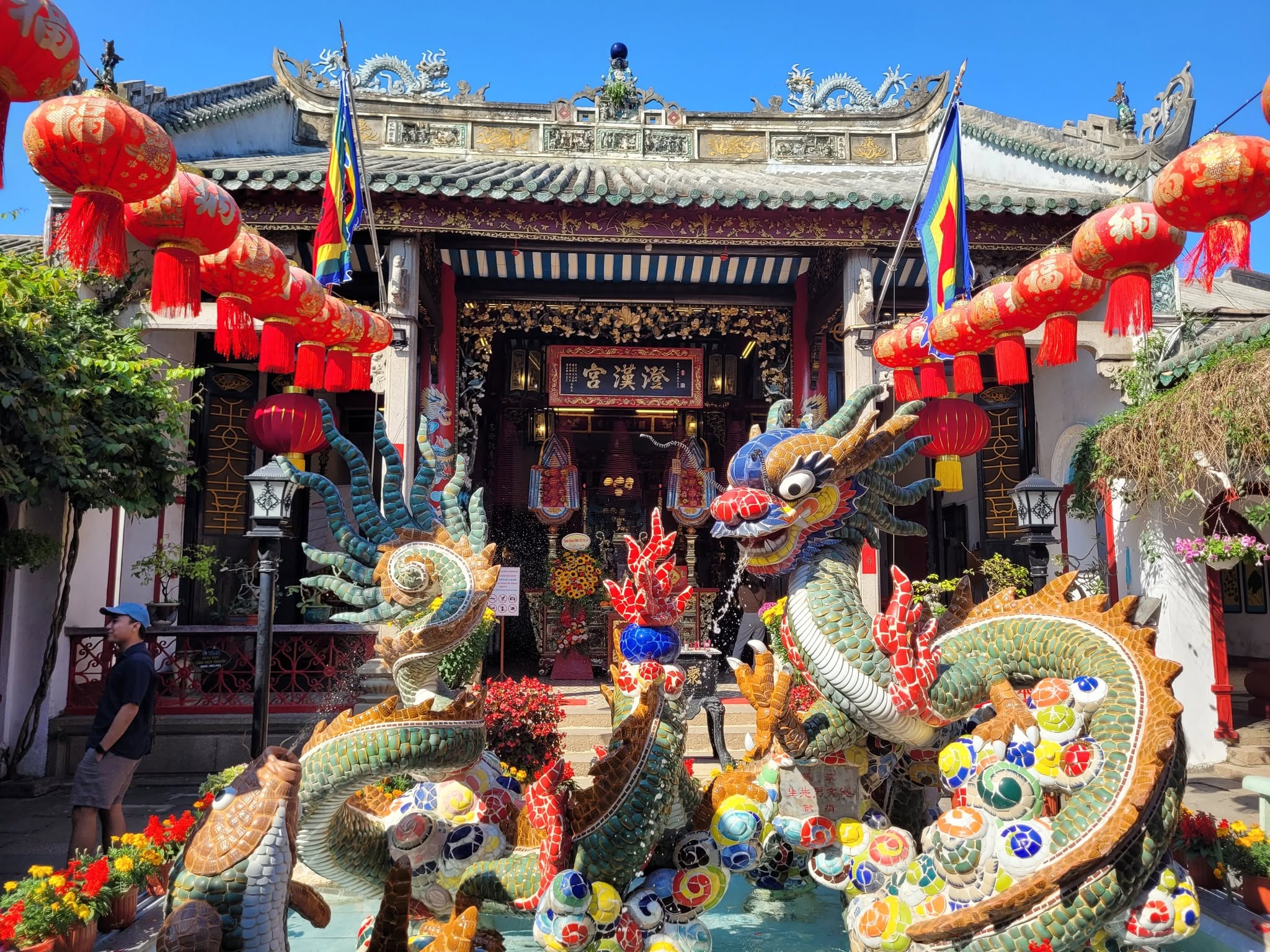
Located at 176 Tran Phu Street, near the Japanese Covered Bridge in Hoi An Ancient Town, the Cantonese Assembly Hall is one of the most distinctive architectural landmarks associated with the Chinese community in Hoi An. Also known as the Quang Trieu Assembly Hall or Chua Ong, the complex reflects the cultural, religious and social life of Cantonese immigrants who settled in Hoi An from the 18th to the 19th century.
With its monumental entrance, traditional Chinese decorative motifs, timber architecture and richly carved altars, the assembly hall is not only a place of worship but also a valuable source for understanding the history and cultural heritage of the Chinese community in Hoi An.
History of the Cantonese Assembly Hall
The Cantonese community began settling in Hoi An as Chinese merchants and immigrants arrived in the port town for trade, business and community life. The assembly hall was built to provide a place where members of the Cantonese community could meet, worship, maintain relationships and seek support in a new land.
According to historical records associated with the assembly hall, construction took place around 1885, with the participation of approximately 18 Cantonese merchants. The names of these merchants were recorded in documents relating to the community’s religious and administrative activities.
The original religious focus included worship of Thien Hau Thanh Mau, together with ancestral worship and the worship of the God of Wealth. In 1915, Confucius was added to the religious space. Over time, Quan Thanh De Quan became the central deity worshipped at the assembly hall, while the ancestral altar and the altar dedicated to the God of Wealth continued to occupy important positions.
The assembly hall has undergone several periods of repair and restoration. A major restoration took place in 1991, followed by further improvements intended to preserve the architectural complex and accommodate the religious activities of the Cantonese community.
Today, the site continues to be managed and maintained by the Cantonese community in Hoi An through a management board.
A Distinctive Chinese Architectural Layout
Covering an area of approximately 1,687 square meters, the assembly hall faces Tran Phu Street and follows a traditional Chinese architectural arrangement.
The overall complex is organized in a layout resembling the Chinese character “國”, with interconnected buildings surrounding courtyards. This arrangement creates a sequence of spaces from the entrance courtyard to the front hall, main courtyard and main sanctuary.
The front stone courtyard is approximately 20 meters long and 8 meters wide. It was traditionally enclosed by an iron fence decorated with spearhead-like motifs. A three-entrance gate is now being reconstructed, giving the front of the complex a more monumental appearance.
The gate features a curved yin-yang tiled roof, decorative roof ends and green glazed tiles. Dragons, birds and other traditional motifs decorate the roof structure, while a pair of dragons facing a pearl forms one of the most prominent decorative compositions.
The front hall is characterized by its large roof, timber columns and traditional wooden structural system. The central entrance is framed by large wooden doors, plaques and red-and-gold Chinese couplets. Decorative carvings depict scenes associated with imperial courts, rulers and traditional Chinese life.
On either side are passages marked by large Chinese characters representing blessings and prosperity, leading visitors deeper into the assembly hall.
Main Sanctuary and Religious Space
Behind the front hall is another courtyard measuring approximately 6 by 6 meters. Beyond it stands the main sanctuary, where large round columns create a strong sense of verticality and monumentality.
The principal altar is dedicated to Quan Thanh De Quan. On either side are altars dedicated to the God of Wealth and the ancestors of the Cantonese community.
The wooden altars feature intricate carvings depicting traditional court scenes and symbolic motifs. A bronze incense set occupies an important position within the sanctuary, while other religious objects and ceremonial furnishings contribute to the solemn character of the space.
The East and West buildings complete the architectural composition. Their large concrete columns, painted red to resemble timber, combine traditional visual elements with later construction techniques. Each building is connected to the main complex through covered corridors and courtyards.
The combination of courtyards, timber decoration, red-painted structural elements, tiled roofs and elaborate carvings gives the assembly hall a distinctive architectural identity within Hoi An’s historic urban landscape.
Valuable Artifacts and Decorative Works
The Cantonese Assembly Hall preserves a collection of religious, architectural and decorative objects associated with the history of the community.
The front hall contains two large wooden couplets finished in black and gold, together with four decorative plaques. The East and West buildings each preserve additional wooden couplets.
Among the most notable objects in the main sanctuary are an old bronze incense burner, a pair of Chinese glazed terracotta stools and a richly carved wooden altar. The assembly hall also houses additional incense burners, ceremonial objects and other traditional furnishings.
A bronze statue of Quan Thanh is seated on the main altar. The statue is approximately 40 centimeters high and about 35 centimeters at its widest point. Several black-and-gold plaques, a traditional drum, a bronze bell, two old lanterns and two ceremonial flags are also preserved within the complex.
These objects are more than religious furnishings. Together, they provide valuable evidence of the artistic traditions, religious practices and community life of the Cantonese population in Hoi An.
Festivals and Community Life
The Cantonese Assembly Hall remains a living religious and cultural space rather than simply a historical building.
One of its important annual ceremonies takes place on the 16th day of the first lunar month, associated with the Nguyen Tieu Festival and the worship of community ancestors. Descendants of Cantonese families from different parts of southern Vietnam may return to Hoi An for the occasion.
Another important celebration is held on the 24th day of the sixth lunar month in connection with the worship of Quan Cong.
During these occasions, the assembly hall becomes a gathering place for worship, remembrance and community interaction. Traditional rituals also help maintain connections between generations and preserve elements of Cantonese cultural heritage in Hoi An.
Historical and Cultural Significance
The Cantonese Assembly Hall is one of the important architectural and religious landmarks of Hoi An Ancient Town. Its scale is considered particularly imposing compared with several other Chinese assembly halls in the town.
The harmonious combination of wood, stone, tiled roofs, courtyards and decorative sculpture creates an architectural composition that is both monumental and deeply connected to traditional Chinese aesthetics.
Beyond its architectural value, the assembly hall functions as a living record of the Cantonese community’s presence in Hoi An. Its inscriptions, religious objects, ancestral altars, architectural details and annual ceremonies provide material for studying architecture, art, ethnography, sociology and the history of Chinese communities in central Vietnam.
The building therefore represents more than a place of worship. It reflects the way an immigrant community established its own social networks, religious practices and cultural identity while becoming part of the multicultural life of Hoi An.
Visiting the Cantonese Assembly Hall
The Cantonese Assembly Hall is located at 176 Tran Phu Street, within the historic core of Hoi An Ancient Town and close to the Japanese Covered Bridge.
Visitors can explore the entrance gate, courtyards, front hall, main sanctuary and surrounding architectural spaces while observing the carved wooden details, Chinese calligraphy, religious statues, bronze objects and traditional decorative motifs.
As the assembly hall remains an active religious site, visitors should dress respectfully, keep their voices low and avoid disturbing worshippers during ceremonies. Some interior areas may have restricted access outside regular visiting or festival periods.
The assembly hall can also be combined with a walking tour of nearby heritage landmarks, including the Japanese Covered Bridge, other Chinese assembly halls, historic merchant houses, Hoi An Market and the old streets of Tran Phu.
Quick Facts
| Information | Details |
|---|---|
| Name | Cantonese Assembly Hall |
| Other names | Quang Trieu Assembly Hall, Chua Ong |
| Location | 176 Tran Phu Street, Hoi An Ancient Town, Da Nang |
| Community | Cantonese Chinese community |
| Construction | Around 1885, according to the source |
| Architectural layout | Traditional Chinese “國” character layout |
| Main deity | Quan Thanh De Quan |
| Other worship | Ancestors and God of Wealth |
| Major restoration | 1991 |
| Main festivals | 16th day of the first lunar month; 24th day of the sixth lunar month |
| Heritage value | Architecture, religion, community history and Chinese cultural heritage |