Every autumn, when the hills around Da Lat begin to glow with the yellow of wild sunflowers, the city’s persimmon orchards enter their most beautiful season. The leaves gradually change color and fall away, leaving bare branches covered with clusters of orange-red fruit against the clear highland sky.
Da Lat crispy persimmons are therefore more than a local fruit specialty. They have become part of the imagery of autumn in the highlands, associated with old orchards, quiet roads on the outskirts of the city and the distinctive atmosphere of Da Lat toward the end of the year.
Persimmon, scientifically known as Diospyros kaki, belongs to the Ebenaceae family. Thanks to the cool climate, high elevation and fertile red basalt soil, persimmon trees have adapted well to the highlands of Lam Dong, producing several varieties with different characteristics and methods of preparation.
The transformation from soft ripe persimmons to crispy persimmons, followed by the development of air-dried persimmons, has also given this once highly perishable fruit a new place in local agriculture and tourism.
Persimmon Trees on the Da Lat Highlands
Persimmon trees are believed to have arrived in Da Lat in the early 20th century, during a period when the French introduced and experimented with various temperate fruit trees in the highlands.
Around the 1910s and 1920s, along with plums, peaches and pears, persimmon varieties from East Asia and France were introduced to Lam Dong through agricultural experimentation in Da Lat.
The high elevation, year-round cool temperatures and fertile red basalt soil provided favorable conditions for persimmon trees. From experimental plantations, the trees gradually spread into family gardens and became a familiar fruit crop in the outskirts of Da Lat.
Many old persimmon orchards can still be found around the city today. Some trees have been growing for decades and have become part of the agricultural landscape of the highlands.
From Soft Persimmons to Crispy Persimmons
For many years, Da Lat farmers primarily harvested persimmons when the fruit had fully ripened and become soft. These persimmons had tender flesh, abundant natural sweetness and a rich texture. They were commonly eaten fresh or processed into jam and dried fruit.
However, fully ripe persimmons have one major disadvantage: they are extremely delicate and difficult to transport over long distances.
Once completely ripe, the fruit quickly loses its firmness and can easily be bruised during harvesting and transportation. This once made it difficult to distribute Da Lat persimmons to distant markets.
A major turning point came with the development and refinement of methods for removing the fruit’s astringency, allowing firm persimmons to become sweet and crisp while retaining their shape.
As a result, persimmons no longer had to be left to soften completely before they could be enjoyed. Mature fruits that were still firm, with skins beginning to turn yellow-orange, could be processed into crispy persimmons, with firm flesh and a clean, sweet flavor.
This helped make persimmons easier to transport and contributed to the development of the Da Lat crispy persimmon specialty.
Traditional Persimmon Varieties
Da Lat’s persimmon orchards include several varieties, each with its own shape, texture and preferred method of consumption.
Trung persimmons, also known as Tam Hai persimmons, have elongated fruits with a slightly pointed base resembling an egg. The skin changes from green to yellow-orange and eventually deep red as the fruit ripens. The variety can be processed into crispy persimmons or allowed to ripen fully into soft, honey-like fruit.
Square persimmons, also known by local names such as Chen or Dong persimmons, are larger and slightly flattened, with a relatively square base. Their flesh is thick and firm, making them particularly suitable for processing into crispy persimmons.
Fuyu persimmons, originally from Japan, are somewhat flattened and have a naturally sweet and crisp texture. Unlike many traditional varieties, they can be eaten while still firm without requiring a separate astringency-removal process.
Another group includes Tau Lac persimmons and ripe Trung persimmons, which are generally enjoyed when soft and fully ripe. Their rich, honey-like flesh also makes them suitable for producing air-dried persimmons using the Hoshigaki-style method.
This diversity gives Da Lat persimmons a wide range of flavors and textures, from chilled crispy fruit to soft, honey-sweet persimmons and chewy air-dried fruit.
Persimmon-Growing Areas Around Da Lat
Persimmon trees are cultivated in many parts of Da Lat and neighboring areas.
Places such as Trai Mat, Xuan Tho and Xuan Truong in the Cau Dat area are home to numerous persimmon orchards, including gardens with trees that have been growing for decades.
The areas around the city, particularly Khe Sanh, Mimosa Road and Prenn Pass, also feature many orchards that combine agricultural production with visitor experiences.
Further south, D’Ran in Don Duong District is one of Lam Dong’s well-known persimmon-growing areas. Its terrain and significant difference between daytime and nighttime temperatures provide suitable conditions for persimmon cultivation.
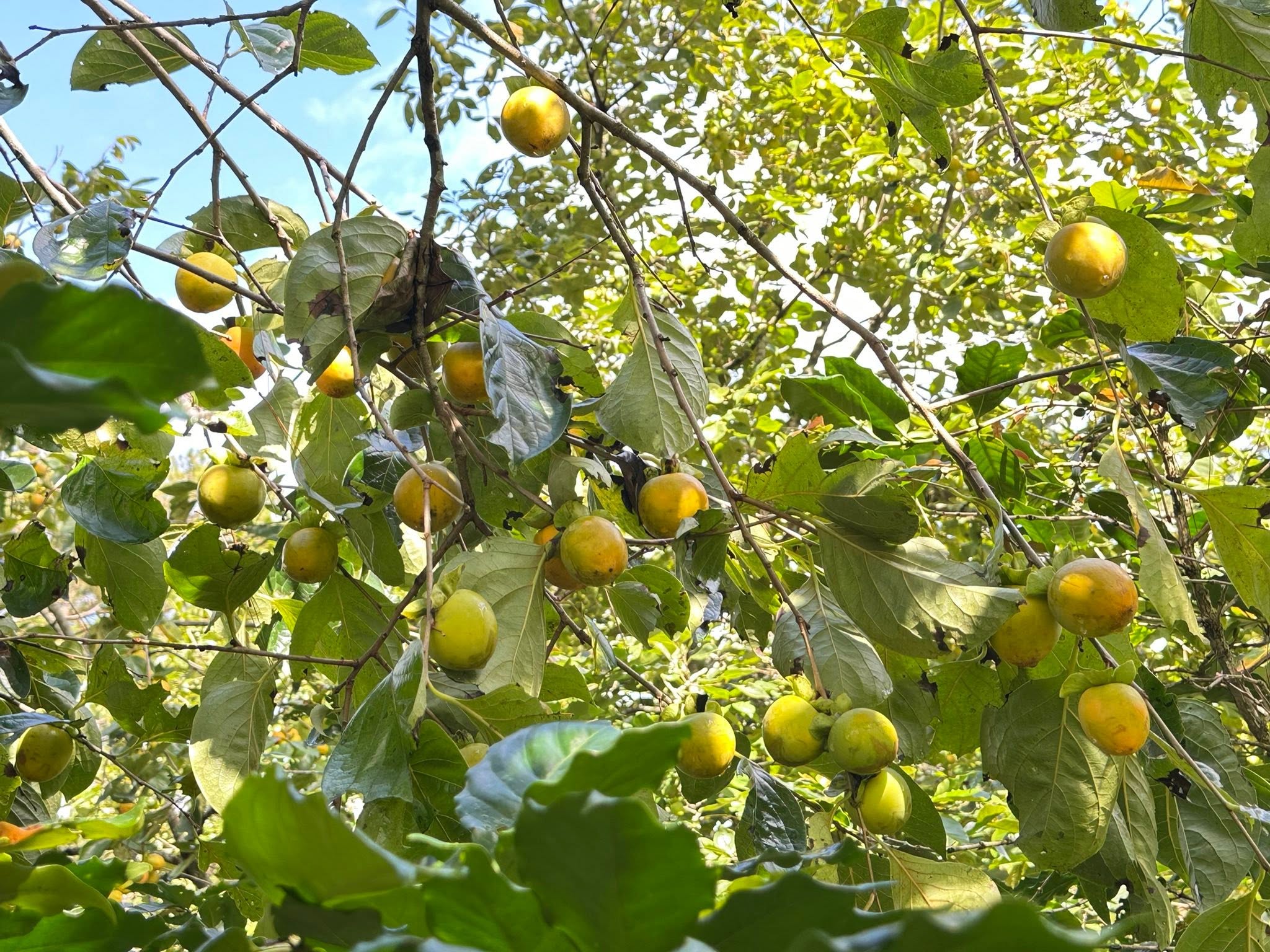
These orchards supply fruit to the market while also creating a distinctive landscape during the final months of the year. As the leaves fall, clusters of orange-red persimmons stand out dramatically against the bare branches and surrounding hills.
The Da Lat Persimmon Season
The persimmon season generally runs from around August to December, depending on the variety and weather conditions.
From August to October, many orchards enter their main harvest period for crispy persimmons. The trees still retain much of their green foliage while the fruit gradually changes color.
By November and December, the landscape changes dramatically. Much of the foliage has fallen, leaving bare branches covered with clusters of orange-red fruit.
This is also the main period for producing air-dried persimmons and one of the most popular times for visitors to explore Da Lat’s orchards.
The image of bare persimmon trees covered with bright fruit has become one of the defining scenes of Da Lat toward the end of the year.
The Traditional Process Behind Crispy Persimmons
One of the most interesting aspects of Da Lat persimmons is the process used to reduce their natural astringency and create a crisp texture.
The fruit is harvested when it has matured but remains firm. The skin has usually begun changing from green to pale yellow-orange. At this stage, the fruit is still sufficiently firm to withstand handling.
After harvesting, the fruit is gently cleaned and placed in a controlled enclosed environment for the astringency-removal process.
According to the traditional method, persimmons are placed in sealed bags or containers with limited air exchange for a period of time. After approximately five to seven days, the astringent sensation gradually decreases while the fruit retains its firmness and develops a sweeter flavor.
Once the process is complete, the persimmons can be peeled, sliced and served chilled. The flesh remains firm and crunchy, with a clean and refreshing sweetness.
This traditional technique is also an example of how local growers have adapted processing methods to increase the value and marketability of a highly perishable agricultural product.
Air-Dried Persimmons: Preserving the Season
If crispy persimmons represent one way of enjoying the fruit while it remains firm, air-dried persimmons offer another way to preserve the harvest through a much slower process.
The technique used in Da Lat follows the tradition of Hoshigaki, a Japanese method of naturally drying persimmons. Its introduction and adaptation in Da Lat opened a new, higher-value direction for local persimmon production.
Selected persimmons are peeled and hung in strings under suitable conditions. Over many days, the fruit is exposed to air and natural airflow, gradually losing moisture.
As this happens, the flesh becomes concentrated. The outer surface develops an amber-brown color, while the inside becomes soft, chewy and intensely sweet. Some finished products may also develop a natural layer of crystallized sugar on the surface.
Air-dried persimmons are therefore more than simply a processed fruit. They represent a combination of a local agricultural product and a traditional processing technique adapted to the climate and conditions of Da Lat.
Persimmons in Da Lat Cuisine
Crispy persimmons can be enjoyed in a very simple way. The fruit is peeled, sliced into bite-sized pieces and chilled before serving.
Its clean sweetness, crisp texture and firm flesh make it a popular dessert, particularly during Da Lat’s cool autumn and winter weather.
Some people also enjoy crispy persimmons with a little chili salt, creating a contrast between the fruit’s natural sweetness and the salty, spicy seasoning.
Persimmons are also processed into jams, dried fruit and packaged local specialties. Among these products, air-dried persimmons have increasingly become a premium specialty, often chosen as a gift during the holiday and Tet season.
Persimmon Orchards and Da Lat’s Tourism Experience
Today, the persimmon season has become an important part of Da Lat’s tourism calendar.
Persimmon orchards combined with cafés, agricultural experiences and visitor areas attract travelers during harvest season. Areas around Mimosa Pass, Da Chien, Trai Mat, Xuan Tho and other parts of the city’s outskirts become particularly lively as the trees begin to bear their bright clusters of fruit.
Visitors can walk among the trees, observe the harvesting process, taste fresh persimmons or learn how air-dried persimmons are made.
The final stage of the season, when most of the leaves have fallen, is especially photogenic. Orange-red fruit stands out against bare branches, with highland hills and misty skies forming the backdrop.
It is a very different side of Da Lat, far removed from the city’s famous flower seasons. This is Da Lat in autumn, shaped by orchards, falling leaves and ripening persimmons.
The Flavor of an Autumn Highland
Da Lat crispy persimmons bring together the character of a local crop, the highland climate and the landscape surrounding the city.
Persimmon trees have been part of Da Lat’s agricultural story for generations, evolving through changes in cultivation and finding new possibilities through crispy persimmons, dried fruit and air-dried Hoshigaki-style products.
Today, a crispy persimmon offers more than its clean sweetness and satisfying crunch. It evokes the quiet roads on the outskirts of Da Lat, old orchards, falling leaves and the cool air that settles over the highlands toward the end of the year.
For travelers, persimmon season is an opportunity to taste one of Da Lat’s distinctive agricultural specialties while discovering another side of the city: quiet hills, leafless trees heavy with fruit, and clusters of orange-red persimmons glowing through the misty highland air.