


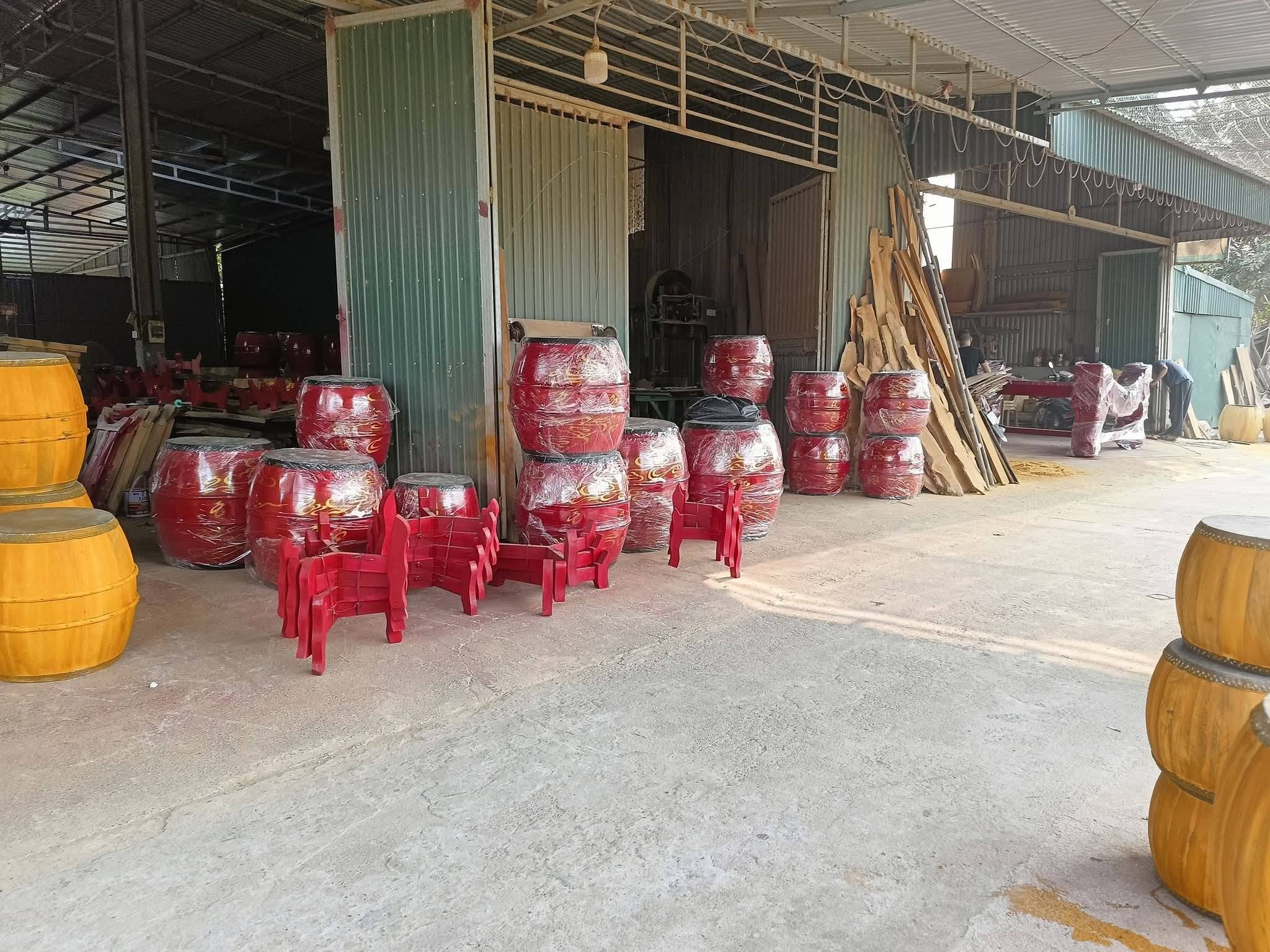
Doi Tam Drum-Making Village, located in Tien Son Ward, Ninh Binh Province, formerly part of Ha Nam Province, is one of Vietnam’s most renowned traditional drum-making communities. Nestled at the foot of Doi Mountain in the Red River Delta, the village is celebrated for its handcrafted drums, distinctive resonant sounds, durable construction, and craftsmanship passed down through generations.
According to local tradition, the village’s drum-making heritage dates back more than 1,000 years and is associated with two legendary craft founders, Nguyen Duc Nang and Nguyen Duc Ban. Local accounts relate that in 986, upon learning that Emperor Le Dai Hanh would visit the Doi Son area to conduct a royal ploughing ceremony, the two brothers crafted an enormous drum to welcome him. Its thunderous sound reportedly impressed the villagers, who honored the brothers with the title Trang Sam, meaning “Masters of Thunder.”
Over the centuries, drum making has become an integral part of the community’s cultural identity and economic life. Doi Tam artisans produce drums for communal houses, Buddhist temples, traditional festivals, schools, theatrical performances, Mid-Autumn Festival celebrations, and other cultural occasions.
The village’s craftsmanship is distinguished by its careful selection of materials and specialized production techniques. Jackfruit wood is traditionally used for the drum body, while buffalo hide is prepared and stretched across the drumheads. Every stage, from processing the hide and shaping wooden staves to assembling the body, mounting the drumheads, and tuning the sound, requires precision, patience, and practical experience.
Doi Tam has also contributed to major cultural events. Local artisans participated in producing ceremonial drums for activities associated with the 1,000th anniversary of Thang Long–Hanoi in 2010. The village is additionally known for an exceptionally large drum reportedly measuring 2.1 meters in diameter and 2.64 meters in height.
Today, Doi Tam is more than a place where musical instruments are manufactured. It is a living craft community where visitors can explore traditional production techniques, discover stories associated with Vietnamese history, and appreciate the cultural importance of drum sounds in everyday life.
History and Development of Doi Tam Drum-Making Village
Doi Tam’s drum-making tradition developed within the historical and cultural landscape of Doi Son, an area associated with agriculture, religious practices, and traditional ceremonies in northern Vietnam.
Throughout Vietnamese history, drums have served several purposes beyond music. They have been used to communicate signals, gather communities, mark ceremonial occasions, and accompany traditional performances.
The continuing demand for these instruments helped sustain specialized drum-making communities, with Doi Tam becoming one of the best-known examples.
The Legend of Craft Founders Nguyen Duc Nang and Nguyen Duc Ban
According to local tradition, Doi Tam’s drum-making heritage is associated with two brothers, Nguyen Duc Nang and Nguyen Duc Ban, who are revered as the village’s craft founders.
The story recounts that in 986, Emperor Le Dai Hanh was preparing to visit the Doi Son area to perform the royal ploughing ceremony, known in Vietnamese as Le Tich Dien.
To welcome the emperor, the two brothers reportedly crafted a large ceremonial drum.
Its powerful, far-reaching sound was compared to thunder.
Impressed by their craftsmanship, the villagers bestowed upon them the honorary title Trang Sam, reflecting the extraordinary sound of their creation.
Another version of the local folklore traces the origins of drum making back to the era of the Hung Kings, mentioning figures traditionally called Ong Truong and Ong Ca.
These accounts differ in their characters and historical periods.
Among descriptions of Doi Tam, however, the story of Nguyen Duc Nang, Nguyen Duc Ban, and the royal ploughing ceremony during the reign of Le Dai Hanh is particularly prominent.
The specific events and dates belong to local tradition and should be distinguished from historical facts independently confirmed by documentary evidence.
Nevertheless, the legends remain culturally significant because they express the community’s respect for its craft founders and inherited traditions.
More Than a Millennium of Traditional Drum Making
Based on the legendary date of 986, Doi Tam’s drum-making heritage is traditionally described as more than 1,000 years old.
Over many generations, local artisans developed specialized knowledge of wood selection, hide preparation, drum-body construction, and sound adjustment.
These skills were transmitted through practical instruction and apprenticeship.
Experienced craftspeople taught younger workers how to identify suitable materials, shape wooden components, and produce drums with the required acoustic qualities.
For many families, drum making became both a livelihood and a source of community pride.
The village gradually developed a specialized production system capable of meeting demand from different regions of Vietnam.
From small drums used in daily activities to large ceremonial instruments, Doi Tam artisans learned to produce a wide variety of sizes and designs.
Production Scale and Specialization Within the Village
Historical descriptions of Doi Tam report that, during an earlier period, the village had approximately 14 workshops producing drum bodies, 13 establishments preparing and supplying buffalo hide, and more than 10 workshops manufacturing complete drums.
Around 550 workers were reportedly involved in the craft.
These figures refer to the former Doi Son Commune administrative context and should not be treated as current statistics without updated verification.
The division of labor illustrates the specialized nature of the industry.
Some workshops focused on preparing jackfruit wood and assembling drum bodies.
Others concentrated on hide processing or the final mounting of drumheads.
Highly experienced artisans often handled the most technically demanding stages, particularly assembling the wooden body, stretching the hide, and adjusting the sound.
This production structure allowed different households to develop specialized skills while contributing to the village’s overall output.
Official Recognition and Craft Village Honors
According to local accounts, Doi Tam was officially recognized as a traditional craft village by the former Ha Nam Province in October 2004.
This recognition marked an important stage in acknowledging the village’s cultural and economic contribution.
In November 2007, the Vietnam Craft Villages Association reportedly honored Doi Tam as an Outstanding Vietnamese Craft Village.
These recognitions helped raise awareness of the village and its traditional craftsmanship.
It is important, however, to distinguish provincial traditional craft village recognition and association awards from inscription on Vietnam’s National Intangible Cultural Heritage List.
These are different forms of recognition with distinct administrative and legal foundations.
Traditional Drum-Making Techniques and the Art of Creating Resonant Sounds
Doi Tam drum making combines woodworking, animal-hide preparation, and specialized acoustic knowledge.
A completed drum must meet several requirements: a strong body, properly tensioned drumheads, tightly joined structural components, and a sound appropriate for its intended use.
According to traditional practice, the manufacturing process is divided into three principal stages: preparing the hide, constructing the drum body, and mounting the drumheads.
Each stage demands specific technical skills and directly influences the quality of the finished instrument.
Selecting and Preparing Buffalo Hide
Buffalo hide is the traditional material used for Doi Tam drumheads.
According to local craftsmanship practices, artisans often prefer carefully selected hide from female buffalo.
The material is examined for thickness, uniformity, elasticity, and surface condition.
After selection, the hide is cleaned and prepared for mounting.
Traditional descriptions mention scraping or thinning the hide to achieve a suitable thickness, followed by soaking, cleaning, and drying.
Proper treatment helps prevent deterioration and prepares the material for stretching across the drum body.
Different sections of hide may be selected depending on the drum’s size and intended function.
Large ceremonial drums generally require material with sufficient strength, thickness, and durability.
Smaller drums may use thinner prepared sections to achieve suitable responsiveness and acoustic characteristics.
The quality of the hide is one of the principal factors influencing tone, resonance, and the drum’s working life.
Constructing the Drum Body from Jackfruit Wood
The drum body, known in Vietnamese as the tang trong, forms the main wooden structure of the instrument.
In Doi Tam, jackfruit wood is traditionally favored for this purpose.
Local artisans value the wood for its workability and suitability for shaping and joining.
When properly selected, seasoned, and maintained, jackfruit wood can provide the structural stability required for drum construction.
However, its resistance to cracking or warping still depends on wood quality, moisture content, and storage conditions.
To create the drum body, artisans prepare curved wooden staves known as dam trong.
The number of staves, their thickness, curvature, and joining angles depend on the intended drum dimensions.
These pieces are carefully assembled to form the characteristic barrel-shaped body, generally wider in the middle and narrower toward the ends.
Precision is essential.
Poorly fitted staves may create gaps that weaken the structure or affect the instrument’s acoustic performance.
Traditional descriptions mention the use of Vietnamese lacquer, or son ta, and other suitable sealing materials to address small gaps and improve the tightness of the structure.
Once assembled, the body is adjusted, smoothed, and prepared for the mounting of the drumheads.
Mounting and Tensioning the Drumheads
Mounting the drumheads is one of the most important stages of the entire process.
The prepared hide is positioned across the opening of the wooden body and stretched to the required tension.
Artisans must distribute the tension evenly to prevent sagging, distortion, or uneven acoustic response.
Once the hide reaches the desired tension, it is secured to the drum body using suitable pegs or fasteners.
Traditional accounts describe the use of pegs made from mature bamboo or vau, a bamboo-like material.
This stage requires physical effort, coordination, and extensive practical experience.
If the hide is too loose, the drum may produce a weak or dull sound.
If the tension is inappropriate, the resulting tone may be unsuitable or the drumhead’s durability may be affected.
For this reason, artisans repeatedly inspect and adjust the drumhead during installation.
The Art of Sound Testing and Drum Tuning
A well-made drum must not only look attractive but also produce a sound appropriate to its purpose.
Festival drums often require powerful, resonant tones capable of carrying across open spaces.
School drums need clear and recognizable signals.
Drums used in traditional theatrical performances may require particular tonal qualities and responsiveness.
Doi Tam artisans rely on practical listening experience to assess their instruments.
They test the drum by striking its surface and listening to the resonance, clarity, strength, and balance of the sound.
Adjustments to the drumhead tension or other construction details may be made to achieve the desired result.
This process demonstrates the importance of skills passed down through generations.
The acoustic quality of a drum cannot be judged solely by its appearance.
An artisan’s trained ear develops through repeated observation, experimentation, and years of practical work.
Decorating and Finishing the Drum
After the body and drumheads are completed and the sound has been tested, the drum undergoes finishing and decoration.
Depending on its purpose, the wooden body may be painted, lacquered, or decorated with traditional motifs.
Festival drums often feature striking colors and ornamentation suited to ceremonial occasions.
Red, yellow, and other culturally significant colors may be incorporated into the design.
School drums and instruments intended for specialized use may have simpler appearances emphasizing functionality.
Final inspection includes checking the surface finish, structural joints, fasteners, and sound quality.
The combination of woodworking, hide preparation, acoustic judgment, and decorative craftsmanship gives Doi Tam drums their distinctive character.
Doi Tam Drums and Their Cultural Significance in Vietnamese Life
Drums have occupied an important place in Vietnamese cultural life for centuries.
Their sounds can be heard in communal houses, Buddhist temples, schools, traditional theatrical performances, and community festivals.
Through its ability to produce drums of different sizes and designs, Doi Tam has developed a diverse product range serving these cultural needs.
Communal House, Temple, and Festival Drums
Drums used in communal houses, temples, and festivals are closely associated with Vietnamese religious and community traditions.
During traditional festivals, drumbeats often mark the beginning of ceremonies, create a solemn atmosphere, and bring participants together.
Large festival drums are generally designed to produce strong, resonant sounds that can be heard over considerable distances.
Drums used in communal houses and Buddhist temples may have different requirements depending on the setting and purpose.
Beyond their musical functions, these instruments also contribute to the visual and ceremonial character of traditional cultural spaces.
Drums for Cheo and Traditional Performing Arts
Drums play an important role in Vietnamese traditional performing arts.
In particular, cheo, a traditional form of Vietnamese musical theater, uses percussion instruments to establish rhythm and support dramatic performances.
Drums intended for theatrical use require suitable tonal qualities, responsiveness, and rhythmic clarity.
Their construction must take into account the needs of performers.
For specialized instruments, communication between the artisan and the musician can help achieve the desired sound.
This connection between instrument making and performance traditions illustrates the wider cultural importance of Doi Tam’s craftsmanship.
School Drums and Mid-Autumn Festival Drums
The sound of a school drum is a familiar memory for generations of Vietnamese students.
In schools, drums are used to signal the beginning or end of activities, mark important moments, and accompany opening ceremonies for the academic year.
School drums generally emphasize durability, clear sound, and reliable performance.
Doi Tam also produces smaller drums for the Mid-Autumn Festival, known in Vietnamese as Tet Trung Thu.
These instruments are often compact, easy to handle, and decorated in lively colors.
They are associated with children’s celebrations and festive activities.
The variety of these products demonstrates that Doi Tam drum making serves not only solemn ceremonies but also everyday community life.
Large Ceremonial Drums and Major Cultural Events
Doi Tam is particularly known for its ability to produce exceptionally large drums.
These instruments present significant technical challenges involving material preparation, body construction, hide stretching, and acoustic control.
According to village descriptions, one notable drum measured approximately 2.1 meters in diameter and 2.64 meters in height.
It was reportedly described as the largest drum in Vietnam and displayed at the Temple of Literature complex, Van Mieu–Quoc Tu Giam, in Hanoi.
The historical record claim and the drum’s current location should be verified with the relevant managing authorities before being presented as up-to-date facts.
Regardless of its precise record status, the reported dimensions demonstrate the considerable technical demands of large-scale drum making.
Each stage requires careful planning and coordination among experienced artisans.
Producing the appropriate sound from a large drumhead is particularly challenging because of the need to control tension across a broad surface.
Contribution to the 1,000th Anniversary of Thang Long–Hanoi
One of the village’s notable contributions was its involvement in drum production for cultural activities associated with the 1,000th anniversary of Thang Long–Hanoi in 2010.
According to local accounts, Doi Tam artisans produced 285 ceremonial drums as part of a broader plan involving 1,000 drums for anniversary performances.
This contribution highlighted the village’s manufacturing capabilities and its role in major cultural events.
For local residents, seeing drums made by Doi Tam artisans used in important national celebrations was a source of considerable pride.
It also provided an opportunity to introduce the village’s traditional craftsmanship to wider audiences.
The Cultural Meaning of Doi Tam Drum Sounds
Drum sounds hold a special place in Vietnamese cultural and spiritual life.
They may announce an event, begin a ceremony, establish a musical rhythm, or create a festive atmosphere.
In communal houses, drums contribute to the solemnity of traditional rituals.
In schools, their familiar beats mark important moments in students’ daily routines.
In theatrical performances, percussion provides rhythm, emphasis, and dramatic expression.
For Doi Tam artisans, the value of a drum lies not only in the completed object but also in the knowledge required to produce the appropriate sound.
The close relationship between handcrafted instruments and cultural practices gives the village its enduring significance.
Visiting Doi Tam Drum-Making Village and Preserving Its Heritage
Situated at the foot of Doi Mountain in Tien Son Ward, Ninh Binh Province, Doi Tam Drum-Making Village is a distinctive cultural destination in Vietnam’s Red River Delta.
Visitors can explore a traditional craft with a history extending more than a millennium according to local legend, observe drum-making techniques, and learn about the village’s connections with the history of the Doi Son region.
The village also offers opportunities to understand traditional livelihoods, skills transmission, and community identity.
Exploring the Craft Village at the Foot of Doi Mountain
Doi Tam is located in an area rich in historical and cultural associations.
The presence of drum-making workshops gives the village a distinctive working atmosphere.
At households and production facilities that welcome visitors, travelers may observe wooden drum bodies being assembled, buffalo hides being prepared, and instruments at various stages of completion.
Curved jackfruit wood staves, unfinished drum bodies, and traditional tools help illustrate the manufacturing process.
Unlike handicrafts that are judged primarily by appearance, drum making requires the successful combination of structural craftsmanship and acoustic performance.
Watching artisans at work can therefore be particularly engaging for visitors interested in both culture and traditional technology.
Learning Traditional Drum-Making Techniques from Artisans
One of the most interesting aspects of visiting Doi Tam is learning about its three principal production stages: hide preparation, drum-body construction, and drumhead mounting.
Visitors may be introduced to the selection of buffalo hide, the preparation of jackfruit wood, and the process of joining curved staves.
The drumhead mounting and sound-testing stages are especially revealing because they demonstrate how practical experience influences the instrument’s tone.
Where appropriate visitor programs are available, travelers may learn about the differences between festival drums, temple drums, school drums, and instruments used in traditional performances.
Possible activities include observing artisans, examining drum construction, or trying different drum sounds under supervision.
However, not every workshop operates as a tourist attraction or provides hands-on experiences.
Visitors should contact local producers in advance to confirm visiting arrangements and workshop availability.
Discovering the Cultural Heritage of Doi Son
Beyond the drum-making village, the Doi Son area contains historical and cultural attractions associated with northern Vietnam.
One notable landmark is Long Doi Son Pagoda, a Buddhist site connected with the history and cultural heritage of the Ly Dynasty.
The wider area is also associated with the traditional royal ploughing ceremony, Le Tich Dien, and the story of Emperor Le Dai Hanh encouraging agricultural production.
These cultural associations provide important context for the legend surrounding the origins of Doi Tam drum making.
Travelers may combine a visit to the craft village with an exploration of local religious architecture, historical traditions, and cultural practices.
Such connections can help create a richer cultural itinerary through the region.
Preserving Traditional Drum-Making Skills
The future of Doi Tam depends on transmitting specialized craftsmanship to younger generations.
Selecting wood, assembling drum bodies, preparing hides, mounting drumheads, and judging acoustic quality all require practical experience.
In particular, the ability to evaluate and adjust a drum’s sound is a skill developed through repeated practice.
Documenting production techniques, preserving traditional tools, and recording the experiences of experienced artisans can support heritage conservation.
Improving working conditions is also important.
Workshops should maintain appropriate safety measures when using woodworking equipment, control dust and noise, and follow suitable procedures for material treatment.
The lawful and responsible sourcing of wood and animal hides is another consideration for sustainable production.
These measures can help protect workers, maintain product quality, and strengthen the long-term viability of the craft.
Product Innovation and Market Development
Alongside traditional drum designs, Doi Tam producers can continue developing new sizes and styles to meet changing demand.
Products for musical performances, decoration, education, and cultural activities may create additional business opportunities.
Online marketing and e-commerce can help workshops reach customers in different parts of Vietnam and potentially overseas.
For larger drums, improved packaging, transportation arrangements, and after-sales services are particularly important.
However, innovation should remain closely connected to the acoustic quality, durability, and technical standards that have established the village’s reputation.
Developing Craft Tourism Alongside Cultural Heritage
With a history traditionally described as more than 1,000 years old, Doi Tam has considerable potential as a cultural tourism destination in Ninh Binh Province.
Possible visitor programs could include workshop tours, introductions to the village’s history, demonstrations of traditional production techniques, and opportunities to experience the sounds of different drums.
Stories about the two craft founders, the royal ploughing ceremony, and important milestones in the village’s development can provide engaging cultural interpretation.
Connecting Doi Tam with other historical sites in the Doi Son area may also support more diverse travel experiences.
Successful tourism development should respect the needs of working workshops, ensure visitor safety, and preserve the everyday life of the local community.
Combining traditional craft preservation, improved product quality, and carefully organized cultural tourism can help the sounds of Doi Tam drums continue to resonate in modern Vietnamese life.
Doi Tam Drum-Making Village stands as a remarkable example of Vietnam’s traditional craftsmanship, where jackfruit wood and buffalo hide are transformed into instruments deeply connected with the country’s cultural identity. With a history extending more than 1,000 years according to local tradition, and legendary origins associated with Nguyen Duc Nang and Nguyen Duc Ban, the village has preserved specialized production techniques across generations. From communal house and festival drums to school instruments and ceremonial drums used at major cultural events, Doi Tam continues to demonstrate the value of skilled workmanship, practical knowledge, and creative adaptation. Beyond preserving an ancient craft, the village offers meaningful opportunities for cultural tourism, contributing to the distinctive heritage and appeal of Ninh Binh Province.
Quick Information
| Item | Details |
|---|---|
| Village name | Doi Tam Drum-Making Village |
| Vietnamese name | Làng nghề trống Đọi Tam |
| Alternative name | Doi Tam Drum Village |
| Current location | Tien Son Ward, Ninh Binh Province, Vietnam |
| Former administrative location | Doi Son Commune area, Ha Nam Province |
| Geographical setting | At the foot of Doi Mountain |
| Cultural region | Red River Delta, northern Vietnam |
| Craft type | Traditional handicraft village |
| Main craft | Manufacturing traditional drums |
| History according to local legend | More than 1,000 years |
| Traditional founding date | 986 |
| Legendary craft founders | Nguyen Duc Nang and Nguyen Duc Ban |
| Honorary title of the craft founders | Trang Sam, or Masters of Thunder |
| Historical figure associated with the legend | Emperor Le Dai Hanh |
| Ceremony associated with the craft’s origin | Royal Ploughing Ceremony (Le Tich Dien) |
| Main materials | Jackfruit wood and buffalo hide |
| Three traditional production stages | Hide preparation, drum-body construction, and drumhead mounting |
| Distinctive techniques | Wooden stave assembly, hide preparation, drumhead tensioning, and acoustic testing |
| Main products | Communal house drums, temple drums, festival drums, cheo drums, school drums, and Mid-Autumn Festival drums |
| Drum-body workshops in historical accounts | 14 |
| Hide preparation establishments in historical accounts | 13 |
| Complete drum workshops in historical accounts | More than 10 |
| Workers in historical accounts | Approximately 550 |
| Traditional craft village recognition | October 2004, according to local records |
| Recognizing authority | Former Ha Nam Province |
| Reported craft village honor | Outstanding Vietnamese Craft Village |
| Reported award date | November 2007 |
| Awarding organization | Vietnam Craft Villages Association |
| Notable cultural event | Activities associated with the 1,000th anniversary of Thang Long–Hanoi in 2010 |
| Reported contribution to the anniversary | 285 ceremonial drums as part of a planned 1,000-drum program |
| Dimensions of a notable large drum | Approximately 2.1 m in diameter and 2.64 m in height |
| Historically reported display location | Temple of Literature complex, Hanoi; current location requires verification |
| Cultural significance | Traditional drum-making knowledge, acoustic craftsmanship, apprenticeship, and festival culture |
| Tourism potential | Workshop visits, craft demonstrations, and cultural experiences |
| Nearby cultural attraction | Long Doi Son Pagoda |
| Visitor advice | Contact workshops in advance to confirm visiting arrangements |
| Development priorities | Craft preservation, artisan training, product quality, and cultural tourism |







