


Van Cu Pho Village, located in Nam Dong Commune, Ninh Binh Province, is one of the places most closely associated with the history and development of Vietnam’s traditional pho-making craft. For more than a century, generations of villagers have helped preserve and spread the distinctive flavors of Vietnamese beef noodle soup, from humble street-side carrying poles to family-run pho restaurants across the country.
For many Vietnamese people, pho is more than a bowl of noodles. It represents culinary knowledge, family traditions, and the cultural identity of communities that have devoted generations to preparing this iconic dish.
Van Cu is particularly famous for its traditional beef pho, featuring aromatic broth, tender rice noodles, carefully prepared beef, and a harmonious combination of spices.
Behind every bowl lies a story of craftsmanship, dedication, and the journeys of villagers who left their hometown to establish pho businesses in cities throughout Vietnam.
Among the families associated with the village’s culinary heritage, the Co family lineage is especially well known. Its name has become closely connected with traditional Nam Dinh-style beef pho and the many pho restaurants operating under the Co family name.
Today, Van Cu is not only a community that preserves traditional cooking techniques but also a destination of cultural interest, where visitors can explore the history of pho, discover how rice noodles are made, and experience a culinary tradition deeply rooted in northern Vietnam.
The History of Van Cu Pho Village and the Journey of Traditional Pho Vendors
Van Cu is situated in the agricultural lowlands of northern Vietnam, a region with longstanding traditions of rice cultivation, food preparation, and trade.
Before administrative restructuring, the village belonged to Dong Son Commune, Nam Truc District, Nam Dinh Province. Under the current administrative arrangement, Van Cu is located in Nam Dong Commune, Ninh Binh Province.
In discussions of Vietnamese culinary history, Van Cu is frequently recognized as one of the communities that played an important role in developing and popularizing traditional beef pho.
According to local accounts and stories passed down through generations, pho-making in Van Cu began to flourish in the early 20th century, during a period of significant economic and cultural change in northern Vietnam.
At that time, urban centers such as Nam Dinh, Hanoi, and Hai Phong were experiencing industrial and commercial growth, creating demand for affordable, convenient, and nourishing meals.
Several theories have been proposed regarding the origins of pho.
Some suggest that the dish emerged from a combination of Vietnamese rice noodle traditions, local beef-based dishes, and culinary influences introduced during the French colonial period.
The French beef stew pot-au-feu is sometimes mentioned in discussions about pho’s origins. However, the precise history of the dish remains debated, and its development cannot be conclusively attributed to a single recipe or village.
What is particularly well documented in Van Cu’s community memory is the tradition of pho-making and the journeys of villagers who carried their culinary skills to other regions.
During the early decades of the 20th century, many residents left the village in search of employment and business opportunities in growing urban areas.
Their equipment was often simple: a bamboo shoulder pole carrying two baskets or containers.
One side held a pot of hot broth, while the other contained rice noodles, beef, bowls, chopsticks, and serving utensils.
These mobile pho vendors served customers near railway stations, bus stops, factories, markets, and busy streets.
The sight of a vendor carrying steaming broth through city streets gradually became part of Vietnam’s urban culinary memory.
According to village traditions, members of the Co and other local family lineages were among those who introduced their pho-making skills to Hanoi, Hai Phong, and numerous other destinations.
Over time, restaurants operating under names such as Co Family Pho and Traditional Nam Dinh Beef Pho appeared in many parts of Vietnam.
These businesses carried more than recipes. They preserved knowledge of ingredient selection, broth preparation, beef handling, rice noodle production, and restaurant operations.
For many families, pho-making became both a livelihood and a lasting connection to their ancestral village.
In some households, three or four generations have continued the craft.
Children grew up surrounded by the aroma of simmering broth, the sound of knives preparing beef, and the daily routines of family kitchens.
This continuity has helped shape the distinctive identity of Van Cu’s pho-making tradition for more than a century.
Traditional Beef Pho: Ingredients, Cooking Techniques, and Distinctive Flavors
The appeal of Van Cu beef pho lies not only in its ingredients but also in the careful preparation of every component.
A traditional bowl generally consists of rice noodles, beef, aromatic broth, and accompanying herbs and seasonings.
Although these ingredients may appear simple, achieving a balanced flavor requires experience, patience, and precise cooking techniques.
The broth is widely regarded as the foundation of a good bowl of pho.
In traditional preparation, beef bones are thoroughly cleaned and simmered for several hours to extract their natural flavor.
Throughout the cooking process, the chef monitors the heat, removes impurities and foam, and adjusts the simmering temperature to maintain a clear, flavorful broth.
Common aromatic ingredients include roasted ginger, roasted shallots, cinnamon, star anise, black cardamom, and other traditional spices.
Roasted ginger and shallots provide a warm, distinctive aroma, while cinnamon, star anise, and cardamom contribute depth and complexity.
Each family may have its own approach to the cooking time, spice proportions, and seasoning methods.
Some traditional recipes also use fish sauce to enhance the broth’s savory character.
The balance between the natural sweetness of beef bones, the saltiness of seasonings, and the fragrance of spices is essential to the final flavor.
Rice noodles, known in Vietnamese as banh pho, are another defining component.
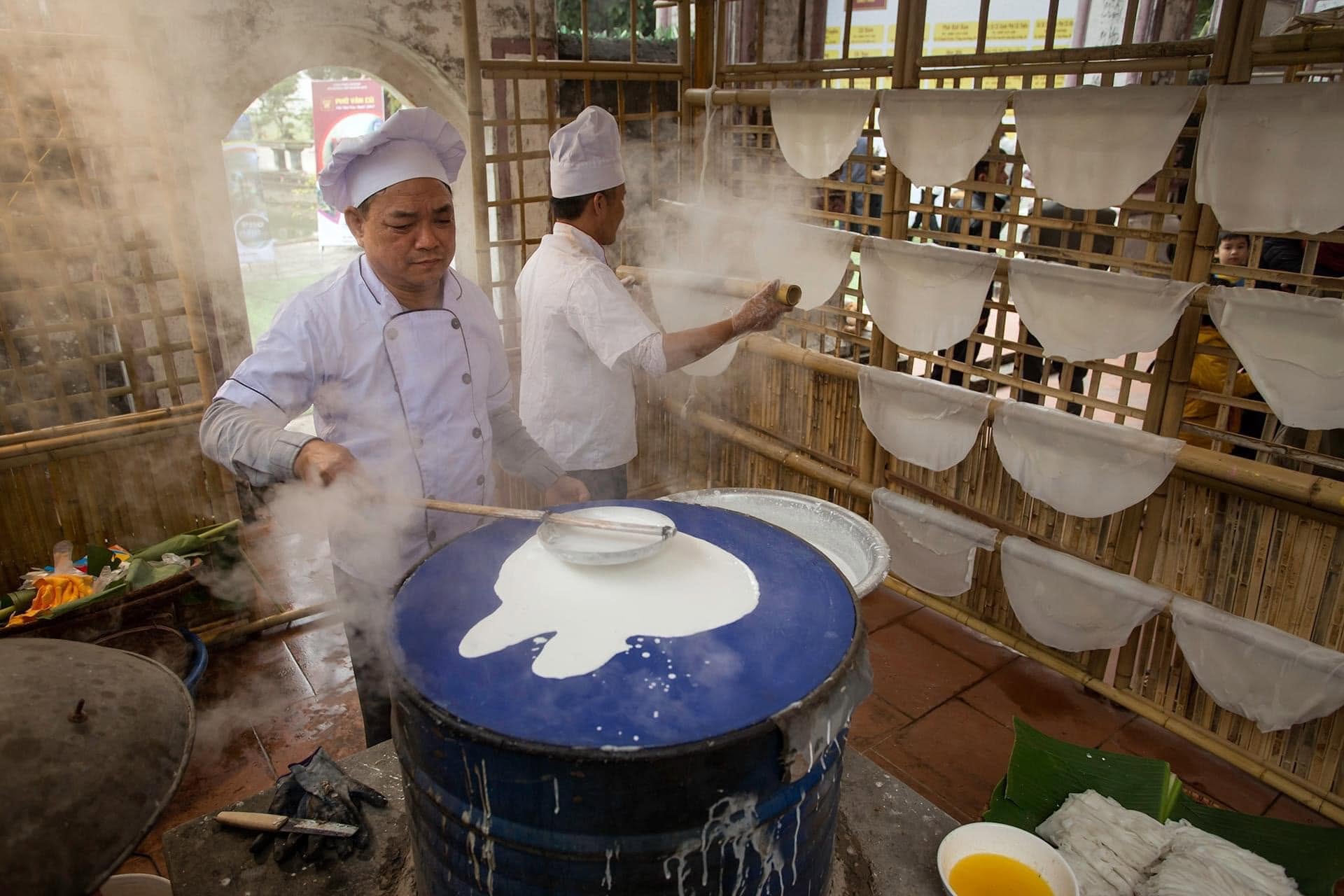
Traditionally, they are made from ordinary rice through a series of stages involving soaking, grinding, steaming, and cutting.
The rice must have suitable characteristics to produce noodles that are soft and smooth while retaining enough elasticity to hold their shape in hot broth.
After soaking, the rice is ground into a fine, liquid batter.
A thin layer of batter is spread over a heated steaming surface until it forms a delicate sheet.
Once cooked, the sheet is removed, cooled as appropriate, and cut into relatively uniform strips.
Well-made pho noodles have a naturally white appearance, a smooth surface, and a tender yet slightly chewy texture.
When served, the noodles should remain intact in the hot broth rather than becoming excessively soft or breaking apart.
Today, many producers use machinery to increase efficiency and consistency. Nevertheless, traditional hand-steaming techniques remain an important part of Van Cu’s culinary heritage.
Beef preparation also requires considerable skill.
Depending on the style of pho, chefs may use brisket, flank, beef shank, or fresh beef sliced for rare beef pho.
For cooked beef pho, the meat is boiled or simmered until it reaches the desired tenderness, then sliced thinly for serving.
For rare beef pho, thinly sliced beef is cooked or finished in hot broth. Appropriate food handling and cooking practices are essential for food safety.
Some Nam Dinh-style variations also feature lightly stir-fried or finely chopped beef, offering different textures and flavors.
To assemble a bowl, the chef places the prepared rice noodles into a serving bowl, adds beef and suitable garnishes, and pours hot broth over the ingredients.
Depending on personal preference, diners may add garlic vinegar, chili sauce, black pepper, or fresh herbs.
Compared with some other regional interpretations, Nam Dinh-style beef pho is often described as having a rich, savory character with pronounced aromatic spices.
However, the exact flavor varies between restaurants and family recipes.
These differences contribute to the diversity of Vietnamese pho and reflect the creativity of cooks who have refined their methods over generations.
Family Traditions, the Co Lineage, and the Cultural Heritage of Pho
One of the defining characteristics of Van Cu Pho Village is the tradition of passing culinary knowledge through families and lineages.
For many residents, pho-making is more than a commercial activity. It is a cultural inheritance that connects successive generations.
In households with longstanding pho businesses, children often begin by helping with simple tasks such as washing vegetables, preparing herbs, arranging bowls, and cleaning utensils.
As they grow older, they gradually learn how to select beef bones and meat, prepare broth, balance spices, make noodles, and manage the daily operation of a pho kitchen.
Important skills are frequently taught through observation and repeated practice rather than written recipes alone.
Apprentices must learn to recognize changes in ingredients, temperature, cooking time, and flavor.
Within Van Cu’s pho-making tradition, the Co family lineage holds a particularly prominent place.
Restaurants associated with the Co name can be found in various parts of Vietnam, contributing to the recognition of traditional Nam Dinh-style beef pho.
According to local accounts, artisans such as Co Huu Doi, described as a fourth-generation descendant of a pho-making family, devoted many years to preserving traditional cooking knowledge.
Stories of these artisans highlight the dedication required to maintain a culinary craft over several generations.
Beyond operating restaurants, Van Cu families also maintain connections with their ancestral village through family gatherings, lineage commemorations, and professional exchanges.
These occasions provide opportunities for pho makers from different regions to share experiences, discuss ingredients, and support one another in developing their businesses.
The cultural importance of Van Cu’s pho tradition is also reflected in events organized to promote Vietnamese cuisine.
In 2022, the program “Visiting Van Cu Pho Village” welcomed international guests, including diplomats working in Vietnam and their families.
During the event, approximately 1,000 bowls of pho were served, giving visitors an opportunity to enjoy traditional flavors while learning about the village’s culinary history.
The program helped introduce Van Cu as a destination for cultural and gastronomic experiences and demonstrated the potential of traditional food heritage to support international cultural exchange.
Another important milestone came in 2024, when “Nam Dinh Pho” was inscribed on Vietnam’s National List of Intangible Cultural Heritage, under the category of folk knowledge.
This recognition acknowledged the traditional knowledge, techniques, and cultural practices associated with pho preparation in the region.
Within the broader heritage of Nam Dinh pho, Van Cu occupies an important position because of its longstanding cooking traditions and the contributions of generations of local pho makers.
The national heritage recognition is significant not only as an honor but also as an encouragement to preserve traditional knowledge, support the transmission of skills, and promote sustainable development.
Visiting Van Cu Pho Village and Exploring Vietnam’s Culinary Heritage
Today, Van Cu has the potential to become an appealing destination for travelers interested in Vietnamese cuisine and the stories behind one of the country’s most celebrated dishes.
Unlike simply enjoying pho at a restaurant, visiting the village offers an opportunity to discover the community where generations of families have practiced and developed the craft.
Visitors can learn about the history of traditional pho vendors, the Co family lineage, and the journeys that brought Van Cu’s culinary knowledge to cities across Vietnam.
At households or workshops that welcome guests, travelers may be able to observe different stages of pho preparation, including selecting ingredients, preparing broth, steaming rice noodle sheets, and assembling a traditional bowl.
Understanding the process of simmering beef bones, balancing spices, and producing fresh noodles reveals why such a familiar dish requires considerable skill and attention.
Where suitable visitor programs are available, travelers may also have opportunities to meet experienced pho makers, participate in cooking demonstrations, or learn about traditional family recipes.
These experiences should be arranged in advance with local hosts or organizers, as access and activities may vary.
In addition to village visits, pho festivals and culinary events help promote Van Cu’s cultural identity.
Food-related celebrations held in the wider Nam Dinh region have brought together artisans, chefs, businesses, and food enthusiasts, creating opportunities to exchange knowledge and celebrate traditional Vietnamese cuisine.
Such events encourage people to appreciate pho not only as a popular meal but also as a living expression of community heritage.
Van Cu’s tourism potential could be developed through guided village walks, traditional noodle-making demonstrations, culinary workshops, and opportunities to taste freshly prepared beef pho.
These activities could be combined with visits to other cultural and historical attractions in Ninh Binh Province, offering travelers a broader understanding of the region’s heritage.
However, sustainable development should prioritize food hygiene, product quality, and respect for the daily lives of local residents.
Historical accounts of pho’s origins should also be presented carefully, distinguishing local traditions and community memories from findings supported by historical research.
Preserving Van Cu’s pho-making heritage requires continued support for younger generations learning the craft, the documentation of knowledge held by experienced artisans, and opportunities for traditional family businesses to adapt to changing markets.
As Vietnamese pho becomes increasingly recognized around the world, villages such as Van Cu play an important role in preserving the stories, skills, and cultural traditions that have helped shape the dish.
From the bamboo carrying poles of early 20th-century street vendors to family-run pho restaurants throughout Vietnam, the people of Van Cu have contributed an important chapter to the country’s culinary history. More than a century later, their traditional craft continues to connect families, preserve local identity, and celebrate the enduring heritage of Vietnamese pho.
Quick Information
| Item | Details |
|---|---|
| Craft village | Van Cu Pho Village |
| Vietnamese name | Làng nghề phở Vân Cù |
| Current location | Van Cu Village, Nam Dong Commune, Ninh Binh Province, Vietnam |
| Former administrative location | Dong Son Commune, Nam Truc District, Nam Dinh Province |
| Craft type | Traditional culinary craft village |
| Main specialties | Beef pho and traditional rice noodle production |
| Origins | Early 20th century |
| Craft history | More than 100 years |
| Notable family lineage | Co family |
| Associated culinary names | Co Family Pho, Traditional Nam Dinh Beef Pho |
| Signature dishes | Rare beef pho, cooked beef pho, stir-fried beef pho, and other beef pho variations |
| Main ingredients | Rice noodles, beef bones, beef, shallots, ginger, cinnamon, star anise, and cardamom |
| Traditional techniques | Broth simmering, spice balancing, rice noodle making, and beef preparation |
| Notable promotional event | “Visiting Van Cu Pho Village” program, 2022 |
| Related intangible heritage | Nam Dinh Pho |
| Heritage designation | National Intangible Cultural Heritage of Vietnam |
| Inscription year | 2024 |
| Cultural significance | Pho-making knowledge, family apprenticeship, traditional street food culture, and culinary heritage |
| Tourism potential | Craft village visits, noodle-making demonstrations, artisan interactions, and traditional pho tasting |
Read more: Van Cu Fresh Rice Vermicelli Making







