Address: 1 Trieu Viet Vuong Street, Xuan Huong – Da Lat Ward, Lam Dong Province, Vietnam.
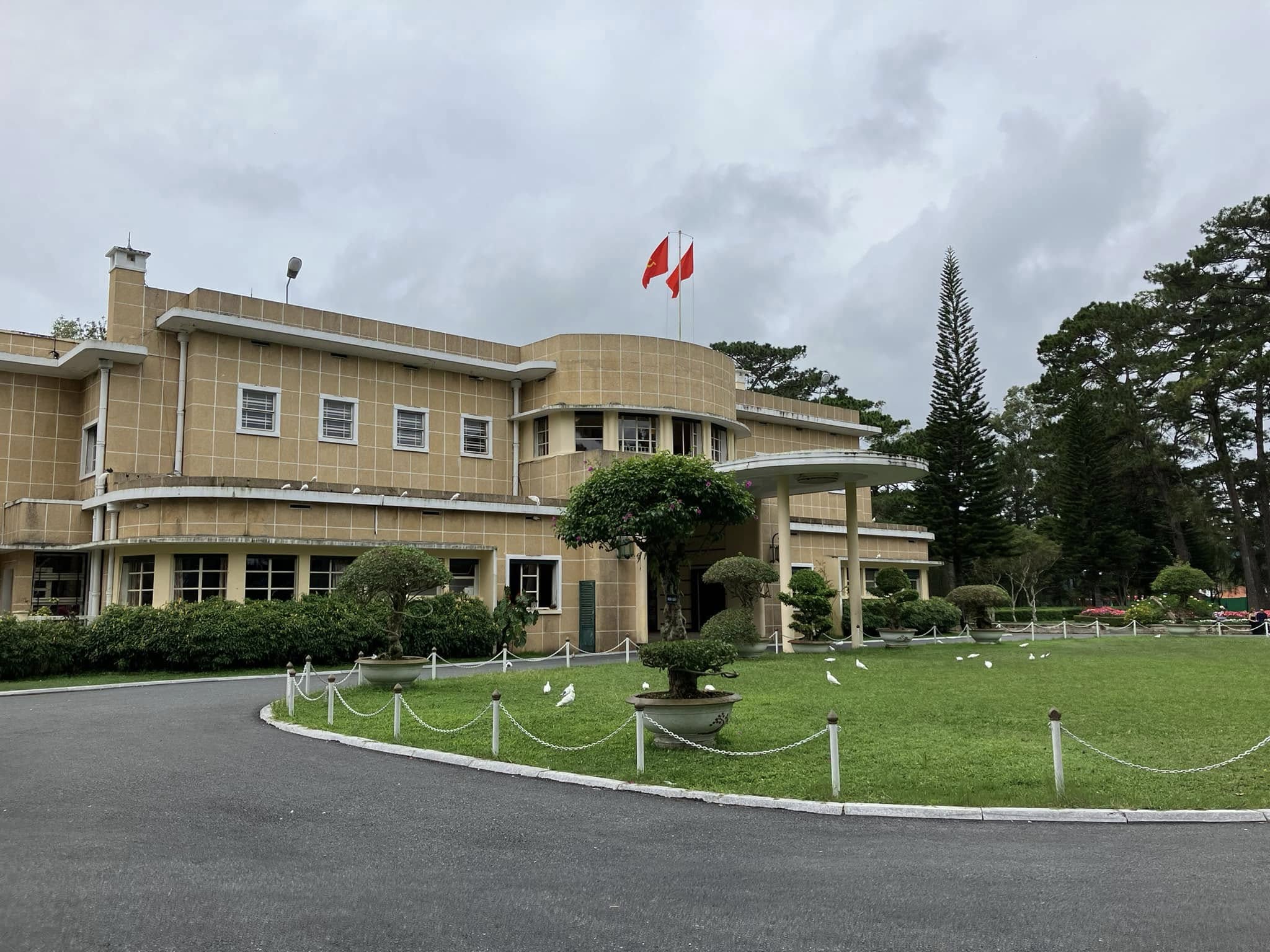
Dinh 3 Da Lat, also known as Bao Dai’s Summer Palace, is the summer residence of Emperor Bao Dai, the last emperor of the Nguyen Dynasty and the final emperor of Vietnam’s feudal monarchy. Located on An Son Hill, the palace is one of Da Lat’s most important historical and architectural landmarks.
Standing at an elevation of approximately 1,540 meters above sea level, Dinh 3 is surrounded by pine forests and lies about 2 kilometers southwest of Da Lat city center. The palace has been preserved relatively intact, allowing visitors to explore the living spaces, working areas, furnishings, and historical objects associated with Bao Dai and his family.
From a Summer Residence to the Chief of State Palace
Dinh 3 was designed and constructed between 1933 and 1938 as a summer residence for Emperor Bao Dai, Queen Nam Phuong, and their children.
The project was designed by French architect Paul Veysseyre together with Vietnamese-French architect Huynh Tan Phat, one of the first-generation graduates of the Indochina College of Fine Arts.
The palace was originally intended as a place for the royal family to live, work, and enjoy the cool climate of Da Lat. Its location on An Son Hill provided a quiet setting surrounded by pine forests, away from the bustle of the city.
In 1948, the French brought Bao Dai back to Vietnam. When the political structure known as Hoang Trieu Cuong Tho was established in 1950, Dinh 3 became associated with Bao Dai’s position as Head of State and was also known as the Chief of State Palace.
During the period from 1949 to 1954, the palace served both as a residence and as a place for administrative activities. Bao Dai worked here, received envoys, and held diplomatic and official ceremonies.
After 1954, Bao Dai spent much of his time in France, while the South Vietnamese government managed Dinh 3 as an official summer retreat.
Following 1975, the palace came under the management of Lam Dong Province and later became an important historical and cultural attraction in Da Lat.
Art Deco Architecture on An Son Hill
Dinh 3 is a two-storey building with 25 rooms, featuring a distinctive Art Deco architectural style.
The design combines asymmetrical volumes, strong vertical lines, geometric forms, and curved elements. The pale yellow exterior stands out against the surrounding green pine forest, while the large steel-framed windows bring natural light into the interior.
The building was carefully divided according to its functions.
The ground floor was primarily used for official activities, government affairs, meetings, receptions, and ceremonies.
The upper floor was mainly devoted to the private life of the royal family, including the bedrooms and personal spaces of Bao Dai, Queen Nam Phuong, and their children.
This separation between official and private areas is one of the characteristic features of Dinh 3.
The Ground Floor: Official and Ceremonial Spaces
The ground floor contains the main hall, diplomatic reception area, meeting room, Bao Dai’s office, ceremonial room, and dining room.
This was the formal and administrative area of the palace, where Bao Dai conducted official work, received important guests, and participated in meetings and ceremonies.
The palace preserves displays connected with these activities, including military insignia, diplomatic documents, historical photographs, and ceremonial objects.
The arrangement of the ground floor reflects the important dual role of Dinh 3 as both a royal residence and a place associated with the political and administrative activities of Bao Dai.
The Upper Floor: The Private Life of the Royal Family
The upper floor offers a more intimate view of the royal family.
The rooms were arranged for Bao Dai, Queen Nam Phuong, Crown Prince Bao Long, Princess Phuong Mai, Princess Phuong Lien, and Prince Bao Thang.
The preserved interiors contain furniture, photographs, personal objects, and everyday items associated with the royal household.
Bao Dai’s room and private spaces provide visitors with a different perspective on the emperor, moving beyond his official role to reveal aspects of his family life.
Historical photographs and preserved furnishings help recreate the atmosphere of the palace during the period when it was still used as a royal residence.
For visitors interested in history, this part of Dinh 3 is particularly valuable because it presents not only the political history of the final Nguyen emperor but also the daily life of his family.
Royal Artifacts and Historical Traces
Dinh 3 preserves a collection of objects associated with the Nguyen Dynasty and Bao Dai’s royal household.
Among the displays are replicas of imperial seals, a jade seal, a sword, historical photographs, and various royal objects.
The palace also features hunting trophies associated with Bao Dai, including tiger skin, ivory, and gaur horns.
These objects provide an insight into the lifestyle and interests of the royal family while reflecting the historical context of Vietnam’s final imperial period.
Together with the preserved rooms, photographs, and furnishings, the collection gives Dinh 3 the character of a historical residence rather than simply an architectural monument.
Vong Nguyet Dau and the Thuong Uyen Garden
One of the distinctive spaces at Dinh 3 is the Vong Nguyet Dau balcony, located behind Bao Dai’s bedroom.
The balcony was used as a quiet place for viewing the moon, reading, and enjoying tea. From here, visitors can look toward the surrounding hills and valleys and appreciate the peaceful landscape of An Son Hill.
The palace is also surrounded by the Thuong Uyen Garden, designed in a French-inspired style.
The garden features symmetrical flower beds, classical fountains, and a variety of flowers suited to Da Lat’s temperate climate, including buckwheat, roses, and other ornamental species.
The combination of the palace, landscaped gardens, pine-covered hills, and cool highland climate gives Dinh 3 a distinctive character among Da Lat’s historic attractions.
Visiting Dinh 3 Today
Today, Dinh 3 is preserved as a historical and cultural attraction. Visitors can explore the royal family’s former living quarters, official rooms, historical displays, photographs, artifacts, and reconstructed interiors.
Opening hours: approximately 07:00 to 17:30.
Its location makes Dinh 3 easy to include in a sightseeing itinerary around southern Da Lat. The palace is particularly suitable for travelers interested in Vietnamese history, royal heritage, architecture, photography, and the history of Da Lat.
Dinh 3 is more than a French-influenced villa hidden among the pine forests. It is a place where architecture, royal life, political history, and personal memories come together.
Walking through its preserved rooms, visitors can trace the final chapter of the Nguyen Dynasty while experiencing the peaceful landscape that once attracted Vietnam’s last emperor and his family to Da Lat.
For travelers who want to discover a side of Da Lat beyond its flowers, lakes, and romantic scenery, Dinh 3 offers a journey into the city’s royal heritage and the final chapter of Vietnam’s imperial era.