Perched on Mai Anh Hill in Da Lat, Domaine de Marie Church is one of the city’s most distinctive religious landmarks. With its deep pink walls, red-tiled roof and architecture that blends European influences with elements reminiscent of the Central Highlands, the church has a character unlike any other historic church in Da Lat.
The church is also known by several other names, including Mai Anh Church, Vinh Son Church and the Pink Church. Beyond its architectural appeal, Domaine de Marie is closely connected with the charitable work of the Daughters of Charity of Saint Vincent de Paul and the story of Suzanne Humbert, wife of Jean Decoux, the Governor-General of French Indochina.
A Church Shaped by Da Lat’s History
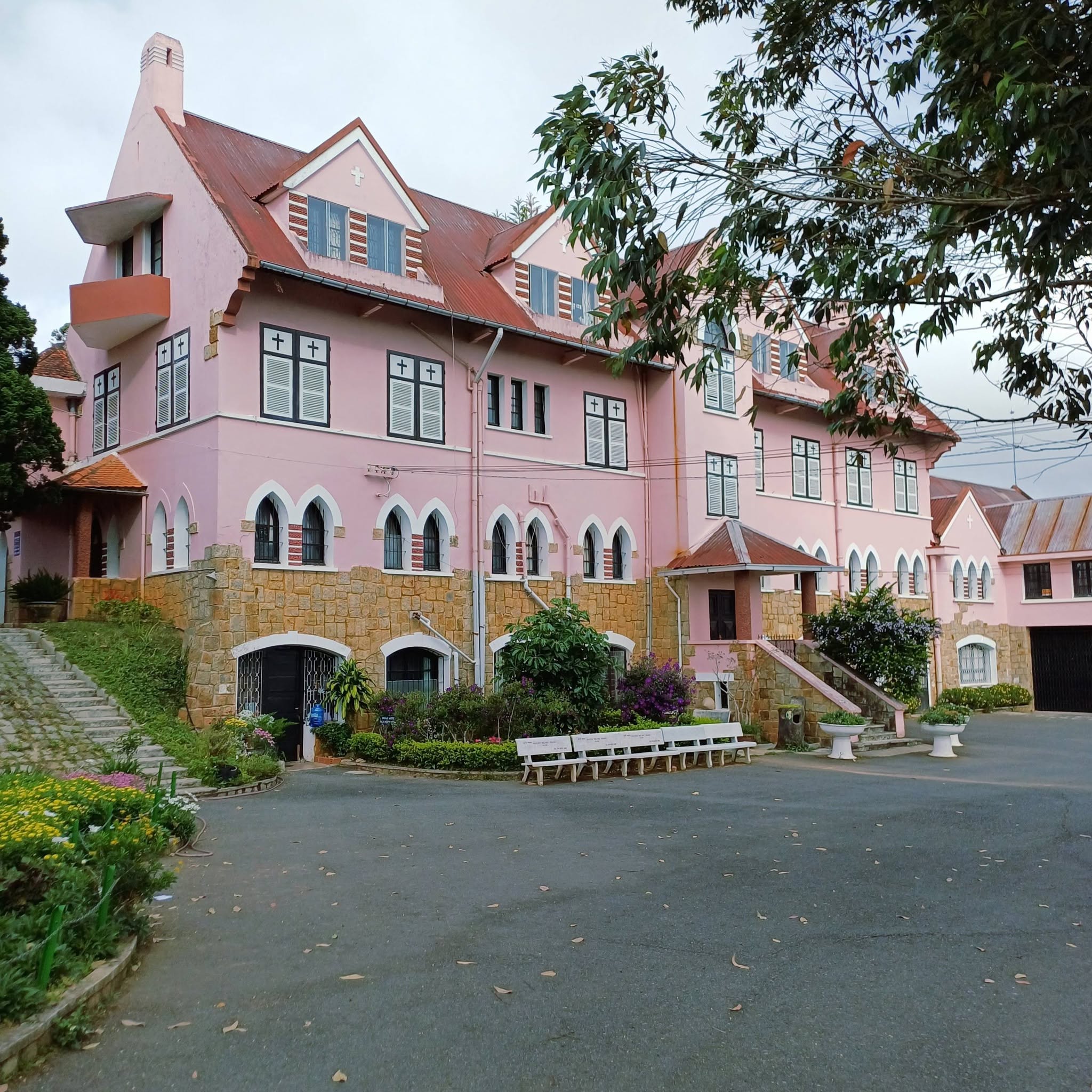
Domaine de Marie is part of a religious complex that includes the church and former convent buildings associated with the Daughters of Charity of Saint Vincent de Paul. Historical and tourism sources generally place its construction in the early 1940s, with completion during the period from 1942 to 1944.
The complex was closely associated with the charitable mission of the Vincentian sisters in Da Lat. In addition to religious activities, the sisters cared for orphans and people in difficult circumstances, while providing education and vocational training.
One of the key figures in the church’s history was Suzanne Humbert, the wife of Jean Decoux. A devout Catholic, she helped raise funds for the construction of the church and convent complex and supported the sisters’ charitable work.
In January 1944, Suzanne Humbert died following a serious road accident on Prenn Pass while traveling to Da Lat. In accordance with her wishes, she was buried in a small tomb behind the church. Her grave remains preserved within the complex and forms an important part of Domaine de Marie’s historical story.
Over the decades, the religious complex continued to be associated with charitable activities. Caring for children, supporting disadvantaged people and providing vocational training became part of its long-standing social mission.
French Architecture on Mai Anh Hill
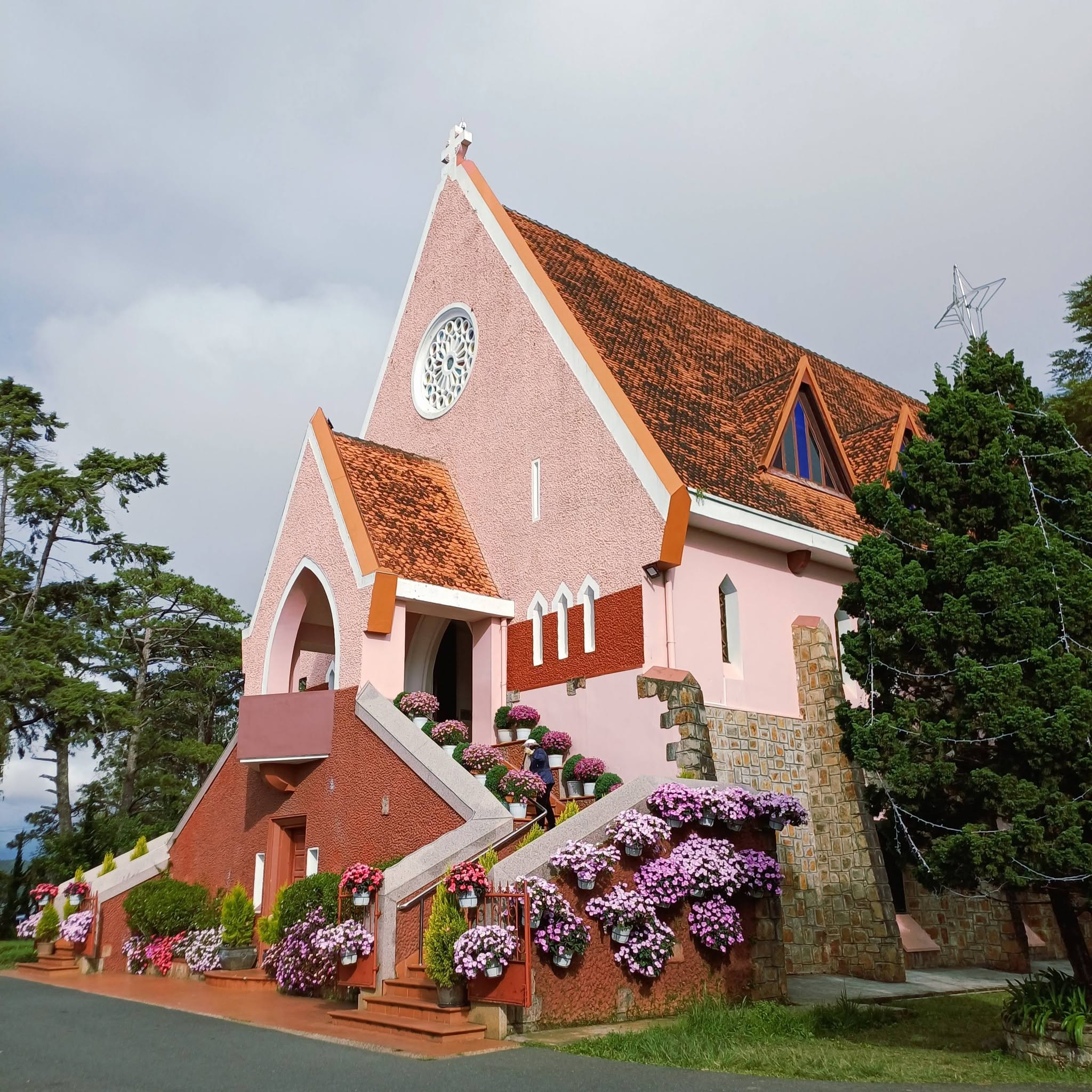
The most distinctive feature of Domaine de Marie is its combination of European church architecture and Central Highlands influences.
The main façade has a triangular form with a steeply pitched roof and arched windows. Near the upper section is a circular rose window, a characteristic feature of European church architecture.
The high, steep roof is one of the most recognizable elements of the building. Its shape evokes the roofline of a traditional Central Highlands communal house, or nhà rông, giving the church a distinctly local character despite its European architectural roots.
Unlike many Western churches, Domaine de Marie does not have a large bell tower rising above the main roof. Instead, its bell is housed in a separate structure behind the church, preserving the relatively compact silhouette of the building.
Stone and other traditional materials are used throughout the structure, while the deep pink exterior has become the church’s most recognizable visual feature. Against the green landscape of Mai Anh Hill, the warm pink walls stand out particularly beautifully in the soft light of early morning or late afternoon.
Inside, colored glass windows allow natural light to filter into the sanctuary, creating changing patterns of color and adding a quiet sense of atmosphere to the interior.
The Statue of the Virgin Mary with Vietnamese Features
One of the most notable works inside Domaine de Marie is the statue of the Virgin Mary standing on a globe.
The approximately 3-meter-tall statue weighs around one ton and was created in 1943. It was commissioned by Suzanne Humbert and designed by French architect Jonchère.
Although the statue represents a traditional Catholic image, its facial features and clothing were designed with an appearance reminiscent of a Vietnamese woman. This creates an interesting cultural meeting point within the church, where a European religious tradition is expressed through an image adapted to its Vietnamese setting.
The statue is therefore more than a religious centerpiece. It also reflects the way European Catholic architecture and imagery were interpreted and localized in Vietnam during the first half of the 20th century.
The Pink Church Among the Greenery
Domaine de Marie sits within a leafy compound filled with trees, flowers and open spaces. Its position on Mai Anh Hill provides a peaceful setting away from the busiest parts of central Da Lat.
The church is particularly striking when the light is soft. In the early morning or late afternoon, sunlight falls across the pink walls, red roof and surrounding greenery, creating one of the city’s most recognizable architectural scenes.
The setting has also made Domaine de Marie a popular destination for photography. Visitors come to admire the building, explore the grounds and enjoy the quiet atmosphere of the hill.
Despite its popularity, Domaine de Marie remains an active religious site. Visitors should dress respectfully, keep their voices low and avoid disturbing religious services or activities.
The name “Mai Anh Church” comes from Mai Anh Hill, which was historically associated with flowering mai anh dao, or Da Lat cherry blossoms. The French name Domaine de Marie is commonly understood as referring to the “Domain of Mary,” reflecting the church’s dedication to the Virgin Mary.
A Landmark of Architecture, History and Charity
The appeal of Domaine de Marie lies in more than its pink exterior and picturesque setting. Behind the building is a much broader story about Da Lat in the 20th century, the work of religious communities, charitable activities and the development of the city’s distinctive architectural heritage.
Visitors can take time to appreciate the architectural details, learn about Suzanne Humbert, visit her tomb behind the church and explore the peaceful grounds of Mai Anh Hill.
For travelers interested in Da Lat’s historic architecture, Domaine de Marie can easily be included in an itinerary alongside the city’s historic churches, villas, museums and other cultural landmarks.
It is neither a monumental cathedral nor an imposing palace. Instead, Domaine de Marie stands out through the harmony of architecture, color, landscape and history. Rising above the green slopes of Mai Anh Hill, its pink walls have become one of the enduring images of Da Lat.
Quick Facts
| Information | Details |
|---|---|
| Name | Domaine de Marie Church |
| Other names | Mai Anh Church, Vinh Son Church, Pink Church |
| French name | Domaine de Marie |
| Location | Mai Anh Hill, Ngo Quyen Street, Da Lat |
| Construction period | Approximately 1940–1944 |
| Architectural style | European architecture with Central Highlands influences |
| Highlights | Pink walls, steep roof, rose window and colored glass |
| Notable artwork | Approximately 3-meter-tall statue of the Virgin Mary |
| Historical figure | Suzanne Humbert |
| Experiences | Architecture, history, photography and exploring Mai Anh Hill |