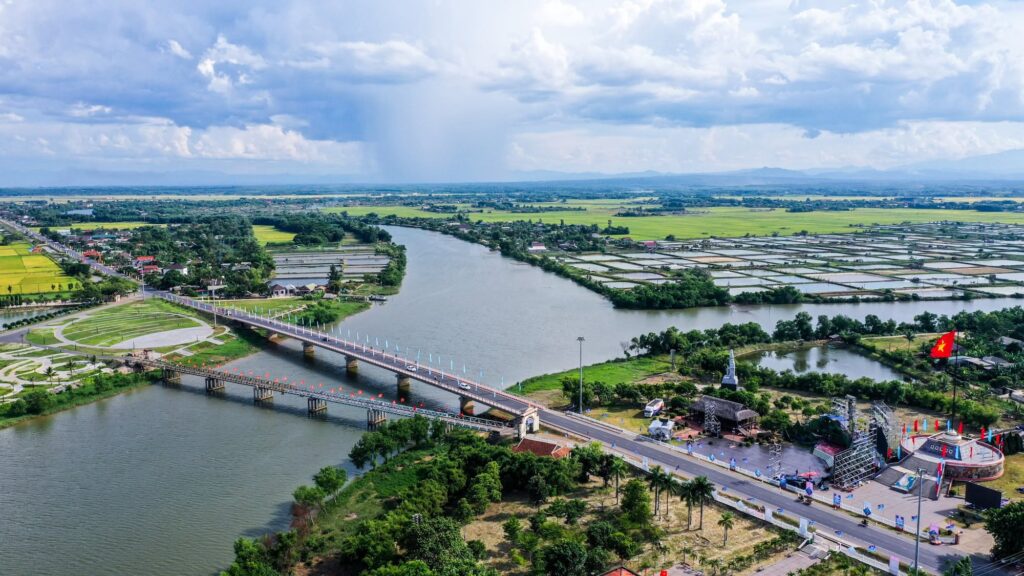
Hung Kings Temple, located on Nghia Linh Mountain in the ancient Phong Chau region, is traditionally regarded as the imperial heartland of the early Van Lang State. In the collective memory of the Vietnamese people, this is the ancestral land, or “Dat To”, a sacred place associated with the Hung Kings, the legendary origins of the Vietnamese nation and one of the country’s most important spiritual and cultural spaces.
The Hung Kings Temple historical complex is harmoniously integrated into its mountainous and forested surroundings. It includes a system of temples, a pagoda, a royal tomb and various supporting structures. The principal monuments are Ha Temple, Thien Quang Pagoda, Trung Temple, Thuong Temple, the Hung King Tomb, Gieng Temple, the Temple of Mother Au Co and the Temple of Lac Long Quan, together with the temple gate, stele house, ceremonial grounds, stone stairways and landscaped areas.
The complex is not merely an architectural and religious site. It is also an important space for the practice of the Worship of the Hung Kings, expressing the Vietnamese tradition of honoring ancestral origins and strengthening community bonds across generations.
The Temple Gate and Ha Temple
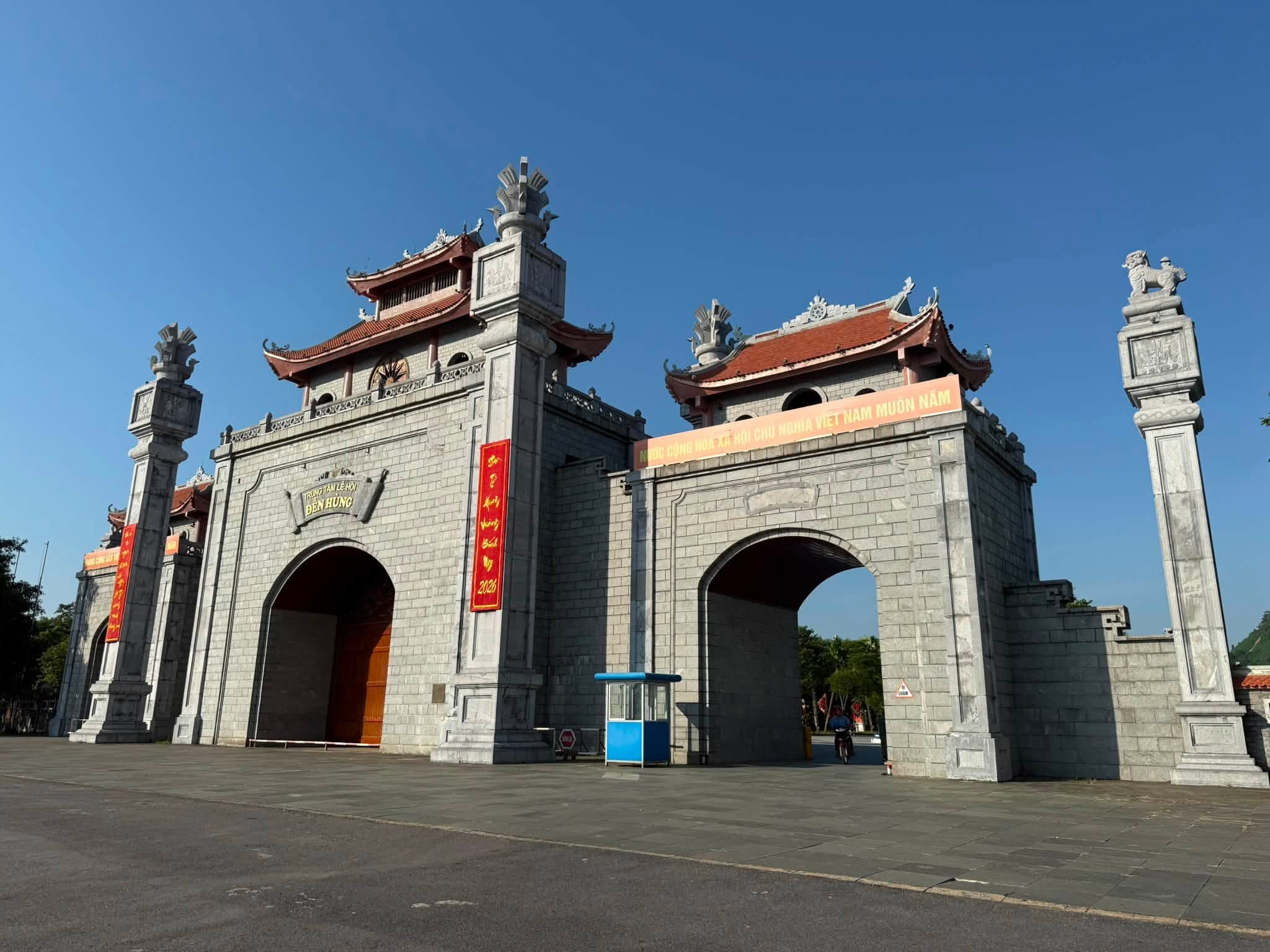
The main temple gate was built on Nghia Linh Mountain in 1917, during the reign of King Khai Dinh. It features an arched structure approximately 8.5 metres high, with two levels and eight roofs. The lower level has a large arched entrance, while the upper level contains a smaller opening. Dragons decorate the four corners of the roof, and two mythical nghe animals are sculpted in relief above the gate.
The front of the gate features reliefs of two armored warriors, one holding a spear and the other a battle axe. Tiger-mask motifs decorate their chests, creating a solemn and imposing entrance to the sacred complex.
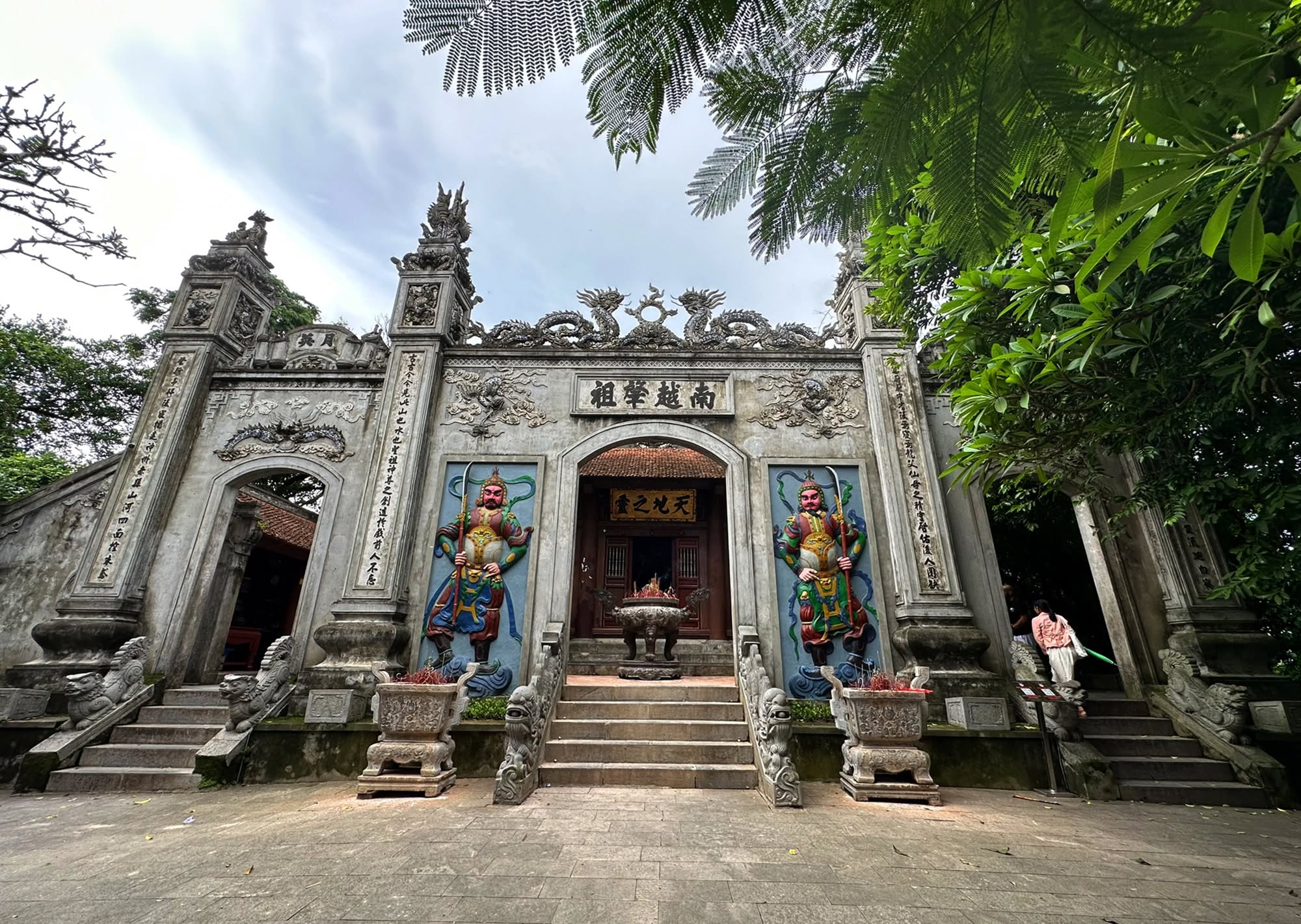
Ha Temple was rebuilt on the foundations of an earlier structure around the seventeenth or eighteenth century. It follows a traditional two-section layout, consisting of a front worship hall and a rear sanctuary, each with three bays. The architecture is relatively simple, with roofs covered in traditional curved tiles sometimes known locally as “pig-nose tiles”. Reliefs of elephants and horses appear on both gable ends.
At the foot of Ha Temple stands the Stele House, built in 1917 in a hexagonal form with six roofs and six round brick columns. Inside is a stone stele bearing the famous words spoken by President Ho Chi Minh during his visit to Hung Kings Temple on September 19, 1954:
“The Hung Kings made great contributions to founding the country.
We, their descendants, must protect it together.”
These words have become widely quoted as a powerful reminder of Vietnam’s enduring tradition of nation-building and national defense.
Thien Quang Pagoda and Trung Temple
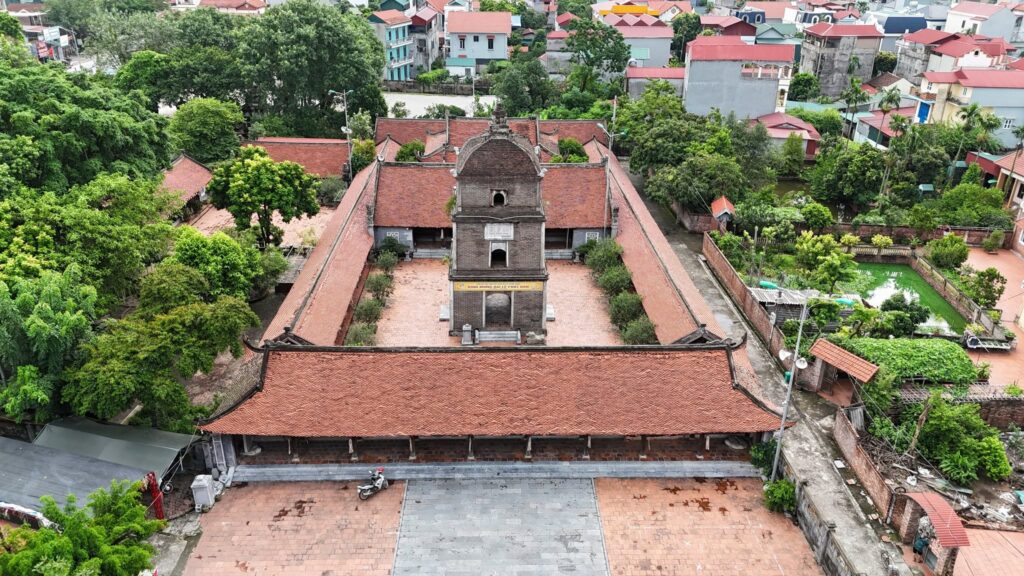
Thien Quang Pagoda forms part of the Hung Kings Temple complex. It follows the traditional “inner Cong, outer Quoc” layout, comprising the Front Hall, Incense-Burning Hall, Three Jewels Hall, surrounding corridors and Ancestor House. The buildings use traditional construction techniques, with wooden columns, beams, rafters and tiled roofs. The ridge of the Front Hall is decorated with the image of two dragons facing the moon.
The pagoda follows the Mahayana Buddhist tradition. In front of the pagoda stand two cylindrical monk stupas, each with four levels and a lotus-shaped finial. Stone inscriptions inside the stupas record the names of monks who practiced and passed away at the pagoda.
The pagoda also has a bell tower believed to date from the seventeenth century. It consists of three bays and two roof levels, with a timber frame using layered beams and bracket supports. Although the bell does not bear a clear casting date, an inscription on it preserves the historical name of the surrounding area.
In front of Thien Quang Pagoda stands a cycad tree estimated by scientists to be approximately 800 years old. It is considered one of the oldest trees in the Hung Kings Temple complex. The tree is more than five metres tall, with a trunk diameter of about 35 centimetres and a natural inclination of roughly 30 degrees. A support column has been installed to protect it. Its three main branches spread in different directions and are popularly associated with the three regions of Vietnam, North, Central and South, sharing one ancestral origin.
Trung Temple, also known as Hung Vuong To Mieu, is located on Nghia Linh Mountain. It has a simple one-section layout with three bays and faces south. The building is approximately 7.2 metres long and 3.7 metres wide, with an eave height of around 1.8 metres. It is closely associated with the worship and commemoration of the Hung Kings within the sacred complex.
Visitors reach Trung Temple after climbing more than 150 stone steps from Ha Temple. In the temple courtyard is a rustic eight-seat stone table. According to local tradition, this was where the Hung Kings and their generals, known as the Lac Hau and Lac Tuong, gathered to discuss affairs of state.
Thuong Temple and the Hung King Tomb
Thuong Temple occupies one of the highest positions on Nghia Linh Mountain. Its architectural complex is arranged on several levels and includes a ceremonial gate, bell and drum houses, a front ritual hall, a main worship hall and a rear sanctuary. To the left of the temple stands a square oath stone pillar, approximately 1.3 metres high and 0.3 metres wide. Its base was restored and reinforced in 1968.
Thuong Temple is associated with numerous legends concerning the era of the Hung Kings and is one of the most important destinations on the pilgrimage route to the ancestral land.
To the east of Thuong Temple lies the Hung King Tomb, traditionally believed to be the resting place of the sixth Hung King. Its location is described according to the geomantic principle of “the head resting against the mountain and the feet facing the water”, with the tomb oriented toward the southeast.
The tomb has a square form and two layers of roofs, whose corners are decorated with dragons. The top is shaped like a precious pearl, recalling the legend of “nine dragons competing for a pearl”. The roof imitates ancient tubular tiles. Three sides feature arched openings and the structure is surrounded by stone walls. Inside is a rectangular tomb and a stele bearing the inscription “Bieu Chinh”, while the outer walls are inscribed with the words “Hung Vuong Lang”, meaning the Hung King Tomb.
From Trung Temple, visitors climb more than 100 additional stone steps to reach Thuong Temple. This was traditionally regarded as the place where the Hung Kings conducted rituals honoring Heaven, Earth, the Mountain Spirit and the Rice Spirit. The temple’s formal name is Kinh Thien Linh Dien, meaning the sanctuary dedicated to Heaven. It is also the principal location for the most important ceremonies held during the annual Hung Kings Commemoration Day.
Gieng Temple
Gieng Temple, formally known as Ngoc Tinh, is located on Nghia Linh Mountain and is believed to have been built around the eighteenth century. Facing southeast, it follows the traditional “Cong” layout and consists of a front worship hall, rear sanctuary, connecting section, two offering houses and a pavilion linking the front and rear structures.
According to legend, Tien Dung and Ngoc Hoa, the daughters of the eighteenth Hung King, often came here to look at their reflections in the well. The well consequently became an important element in the legends associated with Hung Kings Temple.
The entrance gate to Gieng Temple was built during the Nguyen Dynasty in a two-story, eight-roof design. Above the gate is the horizontal inscription “Trung Son Tieu That”, which may be translated as “A Small Shrine in the Mountain”.
The Temple of Mother Au Co, the Temple of Lac Long Quan and the Heritage Values of Hung Kings Temple
In addition to the historic temples on Nghia Linh Mountain, the complex includes several memorial structures built to expand and enrich the space dedicated to the origins of the Vietnamese people.
The Temple of Mother Au Co was begun on Oc Son Peak, commonly known as Van Mountain, in 2001 and inaugurated in December 2004. The complex includes the main temple, eastern and western side halls, a stele house, ornamental pillars, a three-entrance gate, a reception house and landscaped courtyards.
The main temple follows traditional Vietnamese architecture. Its columns, beams and roof framework are made of ironwood, while the roof is covered with traditional curved tiles. The building follows a “Dinh” layout and covers approximately 137 square metres. Inside is a statue of Mother Au Co, accompanied by figures representing the Lac Lords and Lac Generals. The approach to the temple consists of 553 stone steps, creating a pilgrimage route closely connected with the surrounding mountain landscape.
The Temple of Lac Long Quan was begun in 2007 on Sim Hill, within a site covering approximately 13.79 hectares, and was inaugurated in 2009. The complex includes a ceremonial gate, ornamental pillars, a stele house, the main temple and two side halls. The main temple consists of the front ritual hall, main worship hall and rear sanctuary.
The statue of Lac Long Quan inside the temple is cast in bronze, while its pedestal and incense burner are carved from solid stone. The elaborate decorative details were carefully crafted. Together, the Temple of Lac Long Quan and the Temple of Mother Au Co complete the memorial landscape associated with the national origin legends of Lac Long Quan and Au Co, the Vietnamese identity of being descendants of the Dragon and the Fairy, and the era of the Hung Kings.
The significance of Hung Kings Temple lies not only in its individual architectural structures but also in the close relationship between the monuments, the natural landscape and the cultural life of the community. Nghia Linh Mountain, the temples, pagoda, tomb, pilgrimage paths and green spaces form an integrated landscape with both architectural importance and profound spiritual meaning.
Every year, the Hung Kings Commemoration Day and Hung Kings Festival attract large numbers of visitors from across Vietnam who come to offer incense and pay tribute to the Hung Kings. These activities express the Vietnamese principle of remembering one’s origins and honoring the ancestors whom the community regards as the founders of the nation.
The Worship of the Hung Kings has grown beyond the boundaries of Phu Tho to become a shared cultural symbol of the Vietnamese people. On December 6, 2012, UNESCO officially inscribed the Worship of the Hung Kings in Phu Tho on the Representative List of the Intangible Cultural Heritage of Humanity.
Hung Kings Temple is therefore both an important historical, architectural and archaeological monument and a living space of religious practice deeply rooted in community life. From the ancient structures on Nghia Linh Mountain to the memorial temples dedicated to Lac Long Quan and Au Co, the entire complex forms a cultural landscape oriented toward ancestral origins, where generations of Vietnamese people find a connection with the traditions of nation-building and national defense.
Because of its outstanding historical, cultural and scientific significance, the Hung Kings Temple Historical Monument was recognized by the Prime Minister as a Special National Monument under Decision No. 1272/QD-TTg dated August 12, 2009. It remains one of the most significant heritage sites in Vietnam and a powerful symbol of the nation’s enduring reverence for its roots and communal identity.