Address: 120 Tu Phuoc Street, Xuan Truong – Da Lat Ward, Lam Dong Province, Vietnam, in the Trai Mat area, approximately 8 km from central Da Lat.
Opening hours: Approximately 7:00 AM – 5:00 PM daily.
Buddhist tradition: Northern Buddhism (Mahayana).
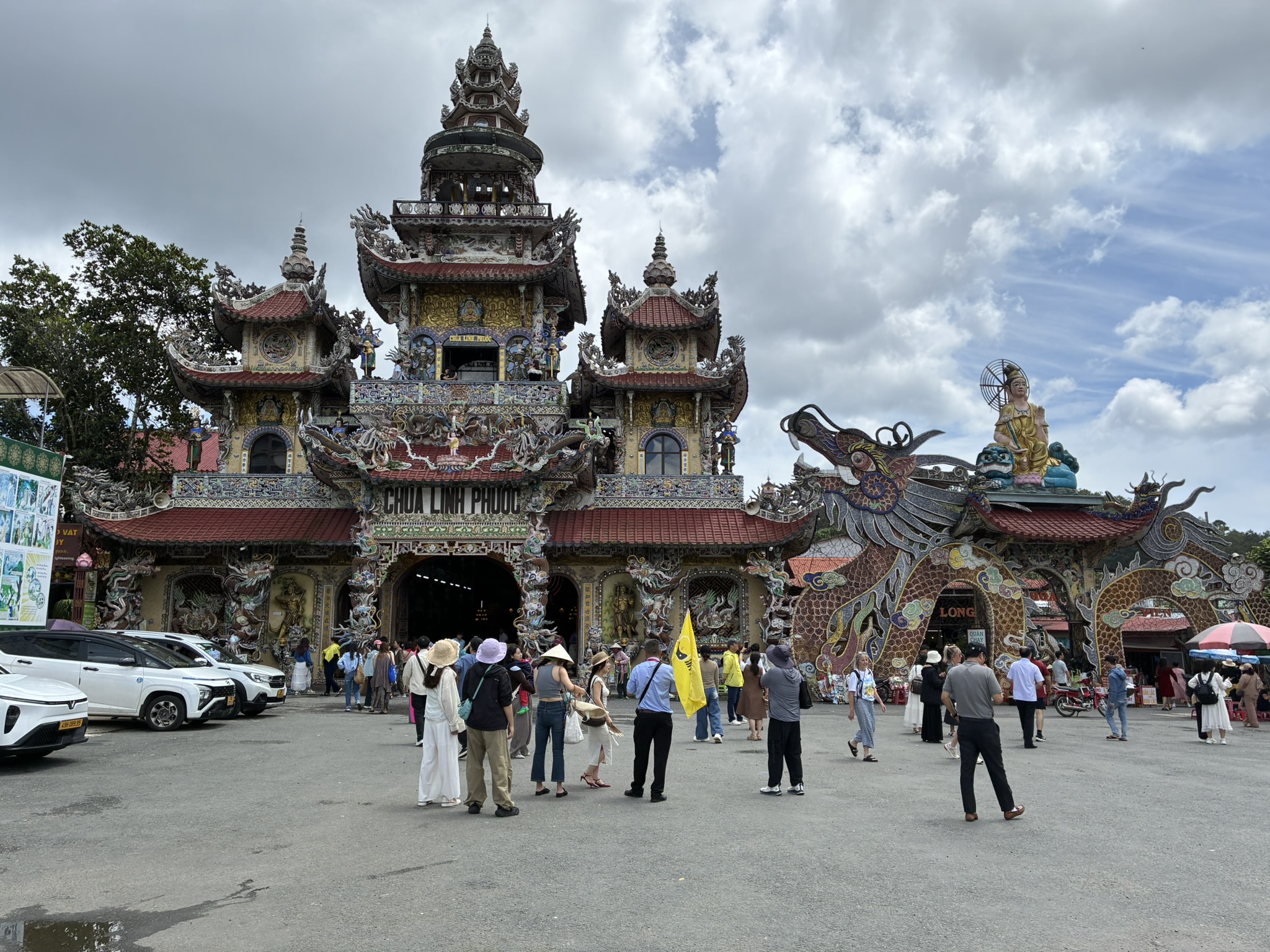
Set amid the green landscape of Trai Mat, around 8 km from central Da Lat, Linh Phuoc Pagoda is one of the city’s best-known spiritual and architectural attractions. The pagoda is also widely known as the “Ve Chai Pagoda”, a name associated with its extensive use of ceramic fragments, porcelain pieces and glass in architectural decoration.
Unlike the simple, understated appearance of many Buddhist temples, Linh Phuoc immediately stands out for its elaborate decorative style. Thousands of small pieces of ceramic, porcelain, glass and recycled bottles have been carefully assembled into dragons, floral patterns, reliefs and Buddhist imagery, creating a colorful yet solemn architectural complex.
The pagoda was built in the late 1940s and completed in the early 1950s. Originally established by monks and Buddhist followers from Thua Thien – Hue, it gradually expanded over the decades. A major turning point came in 1990, when Venerable Thich Tam Vi initiated a large-scale renovation and added numerous new structures, giving the pagoda much of the appearance visitors see today.
From a Small Pagoda to a Famous Da Lat Landmark
According to the pagoda’s records, the original complex was constructed around 1949 – 1952. During its early years, Linh Phuoc was relatively little known. Over time, it was administered by several abbots, including Most Venerable Thich Minh The (1951 – 1954), Most Venerable Thich An Hoa (1954 – 1956), Venerable Thich Quang Phat (1956 – 1959), Most Venerable Thich Minh Duc (1959 – 1985), and Venerable Thich Tam Vi, who has served as abbot since 1985.
A major transformation began in 1990, when Venerable Thich Tam Vi organized a comprehensive renovation and added many new structures. The complex gradually developed into a large architectural ensemble featuring the main hall, towers, worship halls, landscaped gardens and numerous structures decorated with ceramic and porcelain mosaics.
From this period onward, Linh Phuoc became increasingly well known and developed into one of Da Lat’s most visited attractions. During major Buddhist festivals such as Buddha’s Birthday and Vu Lan, large numbers of Buddhists and visitors come to the pagoda to worship, make offerings and explore the complex.
The Mosaic Art Behind the “Ve Chai Pagoda”
The most distinctive feature of Linh Phuoc is its extensive use of ceramic and porcelain mosaic art.
From the main hall and towers to walls, roofs, columns, railings and garden structures, numerous surfaces are decorated with pieces of ceramic, porcelain, glass and recycled bottles. Materials that might otherwise be discarded have been carefully assembled into intricate decorative patterns, giving each structure its own visual character.
The image of the dragon appears throughout the architecture. Dragons can be found on columns, roofs, walls and many decorative details, becoming a recurring visual motif throughout the complex.
This technique gives the pagoda an appearance unlike most other Buddhist temples in Vietnam. When sunlight falls across the mosaic surfaces, the colorful fragments reflect light in different directions, making the architectural details appear to shift and sparkle.
The Main Hall and Buddhist Reliefs
The main hall is one of the central structures of Linh Phuoc Pagoda and measures approximately 33 meters in length. Inside, a solemn statue of Shakyamuni Buddha sits in meditation on a lotus throne.
On either side are reliefs depicting Manjushri Bodhisattva and Samantabhadra Bodhisattva. Along the two rows of columns are dragons assembled from ceramic fragments, while above them are numerous reliefs depicting the life of Shakyamuni Buddha and stories associated with Buddhist scriptures, including the Lotus Sutra and Amitabha Sutra.
The mosaic decoration does more than simply embellish the building. The walls and columns become a visual narrative, with Buddhist figures and stories expressed through color, form and thousands of carefully arranged fragments.
In front of the main hall stands the Da Bao Tower, approximately 27 meters high according to the pagoda’s descriptive materials. Bell and drum towers stand on either side. Inside the tower are reliefs depicting manifestations of Guanyin Bodhisattva, together with relief sculptures of Arhats.
At the Great Compassion Hall, visitors can pay their respects to a statue of Guanyin with a Thousand Arms and a Thousand Eyes.
Long Hoa Garden and the 49-Meter Dragon
One of the most striking areas of Linh Phuoc Pagoda is Long Hoa Garden, or the Dragon Flower Garden.
The centerpiece is a large dragon sculpture approximately 49 meters long and about 1.3 meters wide. Its scales are made from around 12,000 beer bottles, carefully arranged along the body of the dragon.
The dragon’s head rises more than 7 meters above the ground and forms a canopy over a statue of Maitreya Buddha placed within an artificial rock garden.
The use of discarded bottles to create such a large-scale architectural sculpture makes the dragon one of the most recognizable features of Linh Phuoc. From a distance, the dragon appears to wind through the garden; up close, visitors can see the thousands of individual pieces used to create its layered scales.
The surrounding area includes a pond, artificial rock formations, an orchid garden and ornamental plants, creating a green space between the colorful mosaic structures.
The Linh Tower and Great Bell
Another major landmark within the complex is the Linh Tower, a seven-story tower rising more than 37 meters according to the pagoda’s descriptive materials. The tower is decorated with numerous ceramic mosaics and dragon motifs and serves as a place for Buddhist statues and related artifacts.
Associated with the tower is the Great Bell, cast in 1999 under the direction of Venerable Thich Tam Vi. The bell-casting ceremony was held on August 29, 1999, corresponding to the 19th day of the seventh lunar month in the Year of the Cat, while the completion ceremony took place on November 22, 1999, corresponding to the 15th day of the tenth lunar month.
The Great Bell stands approximately 4.3 meters high, measures more than 2.3 meters in diameter and weighs around 8.5 tons. Its surface is decorated with Buddhist figures and motifs, including Buddhas, Thousand-Armed Guanyin, Cundi Bodhisattva, Zen patriarchs from India and China, and numerous ornamental patterns.
The bell also depicts several famous Buddhist and Vietnamese temples, including One Pillar Pagoda in Hanoi, Thien Mu Pagoda in Hue, Linh Phuoc Pagoda in Da Lat and the Mahabodhi Temple complex at Bodh Gaya in India.
Four circular panels represent the four seasons, Spring, Summer, Autumn and Winter, each accompanied by dragon motifs. According to the pagoda’s description, the bell is sounded in connection with the corresponding seasonal panel.
Guanyin and Other Remarkable Works
The Linh Phuoc complex also contains several spaces dedicated to Buddhist worship and contemplation.
One of the most notable is the Guanyin area, featuring a statue of Guanyin approximately 17 to 18 meters high. According to the pagoda’s descriptive materials, the statue was created using hundreds of thousands of immortal flowers, a type of flower strongly associated with Da Lat.
The work was produced with the participation of numerous Buddhist followers and skilled artisans. The flowers were carefully arranged in layers to form the entire figure of the Bodhisattva.
Nearby is a space housing 324 statues of Guanyin, forming an extensive ensemble of Buddhist figures.
The pagoda also preserves numerous valuable objects and works of craftsmanship, including a large sao-wood platform, a sao-wood peacock sculpture, a set of furniture made from sao-tree roots and carved with the twelve zodiac animals, an intricately carved statue of Bodhidharma, and large wooden printing blocks engraved with Chinese characters.
These objects add another layer of cultural and artistic value to Linh Phuoc, complementing the better-known mosaic architecture.
Records Associated with Linh Phuoc Pagoda
Over the course of its development, Linh Phuoc Pagoda has been associated with a number of Vietnamese national records involving structures and artifacts within the complex.
These include records associated with the Linh Tower, Great Bell, Guanyin statue made from immortal flowers, large sao-wood platform, furniture made from sao-tree roots carved with the twelve zodiac animals, King Peacock statue made from sao wood, and large Buddhist woodblocks.
Such records have contributed to the pagoda’s popularity among visitors. Yet the defining character of Linh Phuoc remains its large-scale ceramic and porcelain mosaic art. Each structure has its own decorative treatment, while the entire complex is connected by recurring colors, materials and Buddhist imagery.
Linh Phuoc Pagoda in a Da Lat Journey
Today, Linh Phuoc Pagoda offers a combination of spiritual experience, architecture, traditional craftsmanship and sightseeing. Visitors can come to worship and find a quiet space, while also taking time to examine the elaborate mosaic details throughout the complex.
The pagoda is located in Trai Mat, making it a natural addition to an itinerary exploring the eastern side of Da Lat. Along the way, the urban landscape gradually gives way to hills, flower gardens, greenhouses and the characteristic scenery of the city’s outskirts.
Visitors are encouraged to dress appropriately and maintain a respectful atmosphere in worship areas. Photography and sightseeing are generally possible within the complex, but visitors should remain mindful that this is an active religious site.
During major Buddhist festivals such as Buddha’s Birthday and Vu Lan, the pagoda can become particularly crowded. Those looking for a quieter experience and more time to appreciate the architecture may prefer visiting on regular days.
From its beginnings as a Buddhist temple established by followers from central Vietnam, Linh Phuoc has undergone decades of development to become one of Da Lat’s most distinctive Buddhist landmarks. Ceramic fragments, porcelain pieces, glass and recycled bottles that might otherwise have been discarded have been transformed into dragons, floral patterns, reliefs and large-scale architectural works.
That transformation is at the heart of Linh Phuoc Pagoda’s appeal. Visitors come not only for a spiritual experience in the Central Highlands, but also to discover a remarkable place where Buddhist architecture, mosaic craftsmanship and human creativity come together to create a visual identity that is uniquely Da Lat.
Destination Information
Name: Linh Phuoc Pagoda
Other names: Ve Chai Pagoda, Linh Phuoc Tu
Chinese name: 靈福寺
Address: 120 Tu Phuoc Street, Xuan Truong – Da Lat Ward, Lam Dong Province, Vietnam
Area: Trai Mat, approximately 8 km from central Da Lat
Buddhist tradition: Northern Buddhism (Mahayana)
Opening hours: Approximately 7:00 AM – 5:00 PM daily
Parking: Parking facilities are available near the pagoda
Highlights: Ceramic and porcelain mosaic architecture, Main Hall, Long Hoa Garden, Linh Tower, Great Bell, Guanyin statues and numerous distinctive works of Buddhist art.