
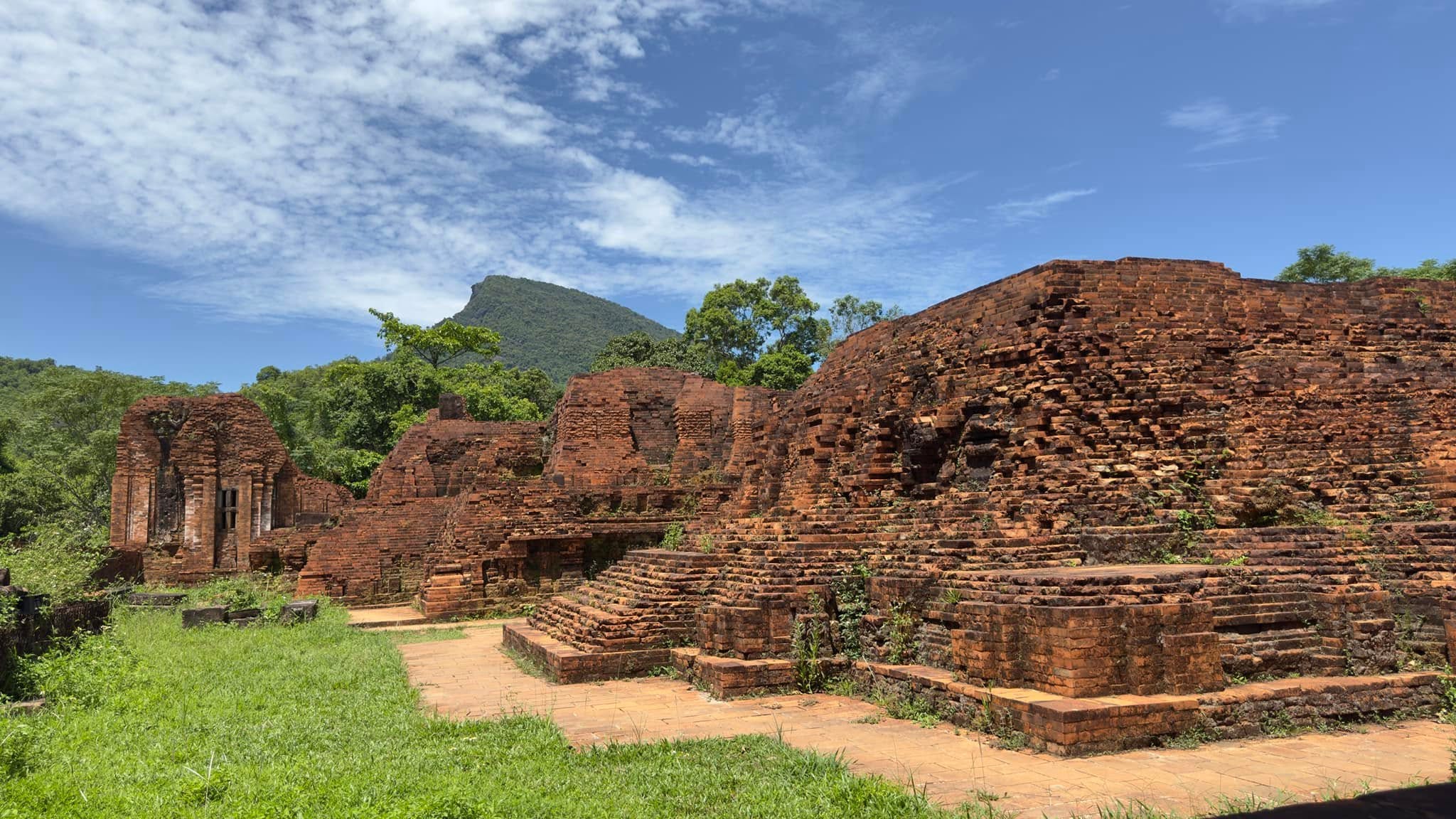
My Son Sanctuary is an ancient complex of Cham temples and towers located in an enclosed valley approximately 2 kilometers in diameter, in My Son Hamlet, Thu Bon Commune, Da Nang City, Vietnam. The protected heritage site covers 324,600 m² in Conservation Zone I and 11,255,400 m² in Conservation Zone II.
My Son was brought to the attention of French researchers in 1885. By the early 20th century, international scholars had begun conducting archaeological surveys and studying the temple architecture and inscriptions found at the site. In 1904, some of the earliest academic studies of My Son’s architecture and inscriptions were published in the journal of the École française d’Extrême-Orient (EFEO), the French School of Asian Studies.
Most researchers believe that many of the major temples at My Son were constructed to worship Shiva, one of the principal deities of Hinduism. Other interpretations suggest that the site’s early religious traditions may have originated from the worship of a local deity in northern Champa, before Srisana-Bhadresvara became the principal deity of My Son and gained religious significance throughout the Champa Kingdom.
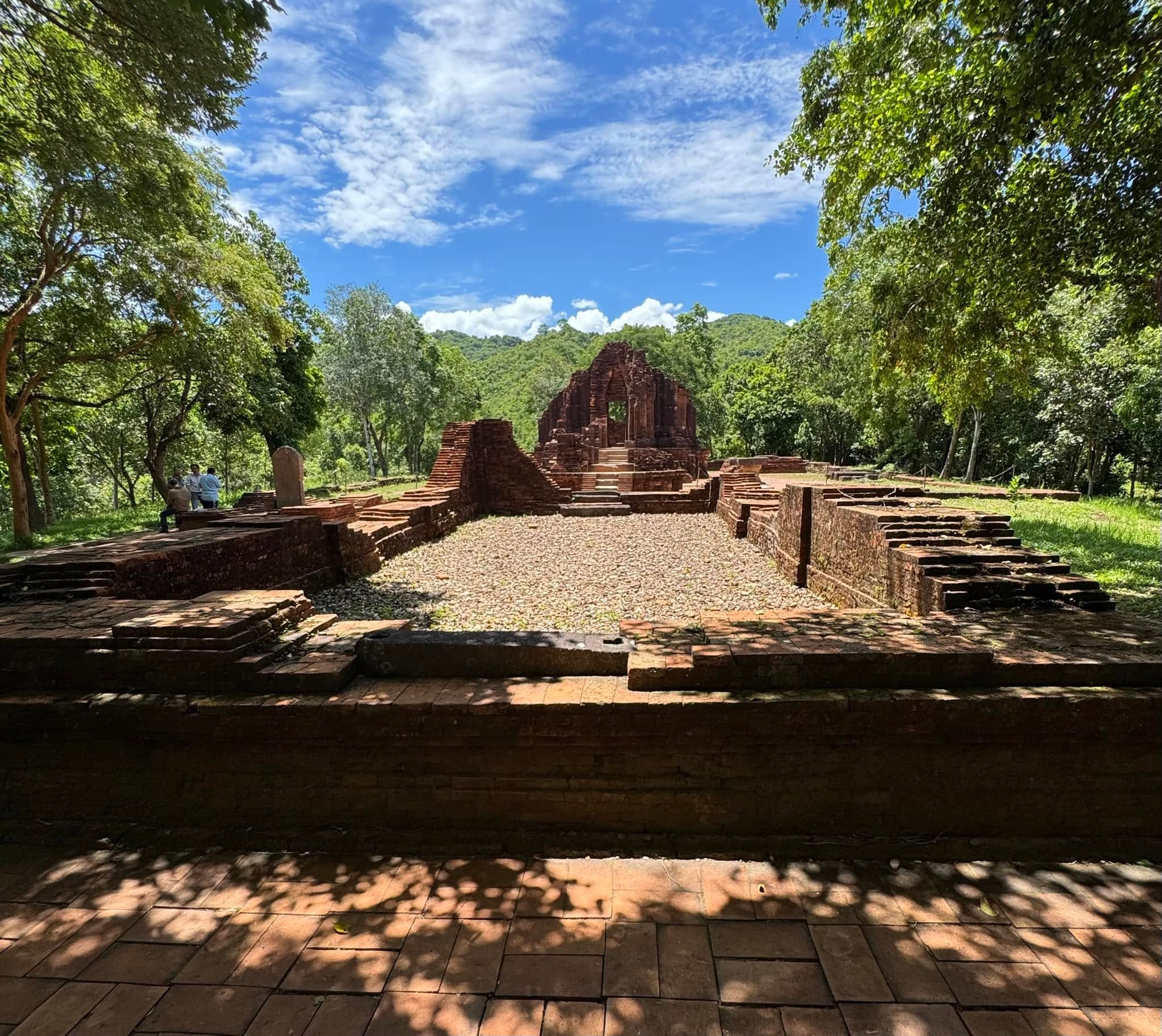
Historical and Artistic Significance
The My Son complex contains the remains of more than 70 temples and towers, constructed over several centuries, particularly between the 7th and 13th centuries.
These structures generally consist of three main sections: the base, body, and roof. Their primary construction material is brick, complemented by decorative sandstone elements. The sophisticated bricklaying, construction techniques, and intricate carvings demonstrate the remarkable architectural skills of the ancient Cham civilization.
Decorative motifs on stone pillars, sculptures, and sandstone reliefs depict Hindu deities, mythical creatures, dancers, religious ceremonies, and scenes from Hindu mythology.
The art of My Son reflects a combination of indigenous traditions and external cultural and religious influences, creating distinctive architectural and sculptural styles within Cham artistic heritage.
Based on the geographical distribution of the monuments, French archaeologist H. Parmentier classified the temples into groups identified by Latin letters, including Groups A and A’, B, C, D, E, F, G, and H, as well as the isolated towers K, L, M, and N.
Researcher P. Stern identified several major artistic styles in the architecture of My Son:
- Early My Son E1 Style (7th–8th centuries): Represented by Towers E1 and F1.
- Hoa Lai Style (late 8th–early 9th centuries): Including Towers A2, C7, and F3.
- Dong Duong Style (mid-9th–early 10th centuries): Including Towers A10, A11, A13, and B4.
- My Son A1 Style (10th century): Represented by numerous temples in Groups A, B, C, D, and E.
- Transitional My Son A1–Binh Dinh Style (11th–12th centuries): Including Towers E4 and F2.
- Binh Dinh Style (13th–14th centuries): Including Tower B1, Tower K, and structures in Groups G and H.
Architectural Layout of a Cham Temple Complex
Like many other Cham religious monuments, the temples at My Son were generally arranged in groups following a relatively consistent religious and architectural layout.
- Kalan: The principal sanctuary, usually located at the center of the complex, with its entrance commonly facing east. It housed the principal deity, often Shiva, and symbolized Mount Meru, the sacred mountain regarded as the dwelling place of the gods.
- Gopura: The entrance tower positioned in front of the main sanctuary, typically featuring two connecting entrances oriented east and west.
- Mandapa: An elongated hall connected to the entrance tower, used to welcome pilgrims and receive religious offerings.
- Kosagraha: A structure situated beside the main sanctuary, usually containing one or two rooms and an entrance facing north. It was used to store ceremonial objects and offerings.
- Subsidiary Towers: Smaller shrines surrounding the main sanctuary, dedicated to guardian deities, celestial gods, and other Hindu figures such as Skanda and Ganesha.
Major Temple Groups at My Son Sanctuary
Group A and Group A’
Group A consists of 13 towers, numbered A1 to A13, located in the southeastern part of the My Son valley.
Group A’ includes four smaller towers south of Group A. Most of these structures have entrances facing west, toward the central area of the sanctuary.
Group B
Group B comprises 14 towers.
Among them, Tower B5 is one of the relatively well-preserved structures. It has an elongated rectangular floor plan along the east–west axis, with its entrance facing north.
The tower features decorative carvings of curling foliage, figures with hands joined in prayer, and two elephants intertwining their trunks beneath a tree.
Group C
Group C consists of seven towers located north of Group B.
In 1904, French archaeologists discovered a collection of gold ceremonial ornaments at Tower C7, including a crown, belt, and chest ornament associated with a deity statue approximately half the size of a human figure.
Group D
Group D contains six towers situated east of Groups B and C.
Towers D1 and D2 differ from the traditional Cham temple design. Both feature rectangular floor plans with entrances at opposite ends, facing east and west.
Group E
Group E consists of nine towers located north of Groups A and G. This area is particularly important for its architectural and sculptural heritage.
Temple E1
Temple E1 has a square floor plan with an entrance facing west. Its four corners feature intricately carved stone pillars.
A sandstone relief above the doorway depicts the “Birth of Brahma.”
Inside the temple is a large sandstone altar decorated with scenes of silk dancing, musicians playing instruments, flute performances, and the daily activities of Brahmin priests.
Tower E2
Tower E2 served as the entrance tower to Temple E1.
Tower E3
Tower E3 was used for preparing religious offerings and ceremonial objects.
Tower E4
Tower E4 is a subsidiary tower located north of Temple E1.
Towers E5 and E6
These two subsidiary towers are located south of Temple E1.
In 1903, a standing four-armed statue of Ganesha was discovered at Tower E5. Dating from approximately the late 7th to early 8th century, it is considered a rare example of Hindu religious sculpture.
Tower E7
Tower E7 served as the ceremonial storage building for Group E.
It features a distinctive boat-shaped curved roof, an elongated east–west layout, and a north-facing entrance.
Towers E8 and E9
These towers are located in the northeastern corner of the group. Today, only portions of their foundations remain.
Group F
Group F consists of three towers located north of Group E:
- F1: The principal sanctuary.
- F2: The entrance tower.
- F3: A subsidiary tower.
Group G
Group G comprises five towers built on a low hill between Groups A and E.
The most recognizable surviving structure is Temple G1, whose main entrance faces west.
Its architectural features include pointed-arch doorways, sandstone reliefs depicting the goddess Lakshmi, Kala faces, and lion sculptures positioned at the corners of the tower.
Group H
Group H consists of four towers situated on a low hill northwest of Groups B, C, and D.
A large relief depicting the Hindu god Shiva was discovered in this area.
Isolated Towers K, L, M, and N
Towers K, L, M, and N are located separately from the main temple groups, at some distance from the central sanctuary.
Most of these structures have suffered extensive damage, leaving only partial architectural remains.
My Son Sanctuary: A UNESCO World Heritage Site
My Son Sanctuary is one of the most important religious architectural complexes of the ancient Champa Kingdom.
The monuments reflect centuries of cultural exchange between Southeast Asia and India, while preserving outstanding historical, archaeological, architectural, sculptural, and religious values.
In 1999, UNESCO inscribed My Son Sanctuary on the World Heritage List, recognizing its exceptional cultural significance and its role in the development of Cham civilization.
On August 12, 2009, the Prime Minister of Vietnam issued Decision No. 1272/QD-TTg, designating My Son Temple Complex, formerly located in Duy Xuyen District, Quang Nam Province, as a Special National Monument.
Today, My Son Sanctuary remains an important destination for visitors interested in Vietnamese history, Cham culture, Hindu religious traditions, and ancient Southeast Asian architecture.
Exploring the temple complex offers an opportunity to discover the remarkable achievements of the Champa civilization and appreciate one of Vietnam’s most significant archaeological heritage sites.