


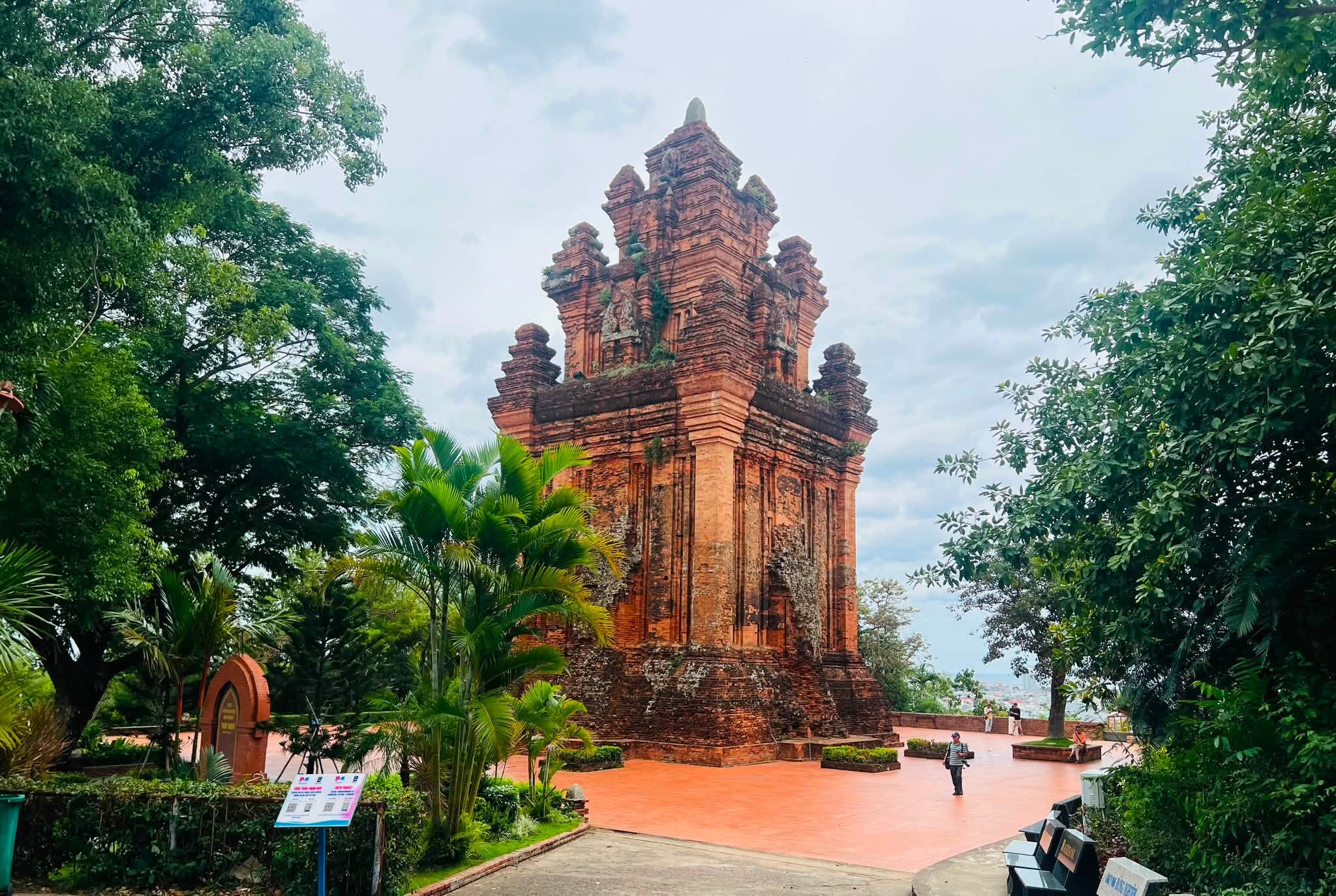
Nhan Tower stands on Nhan Mountain in Tuy Hoa Ward, Dak Lak Province, under the current administrative system. Nhan Mountain rises approximately 60–64 meters above sea level and has a circumference of about 1.5 kilometers at its base. To the south, the mountain borders Bach Dang Street and Song Chua, a tributary of the Da Rang River, while residential areas surround the other sides. The site is about 1.5 kilometers from Da Dien Estuary, where the Da Rang River flows into the sea.
Set within the river and mountain landscape of Tuy Hoa, Nhan Tower is one of the relatively well-preserved Cham architectural monuments in central Vietnam and an important cultural symbol of Phu Yen. Beyond its architectural and sculptural value, the tower reflects the region’s historical development and the cultural interactions that shaped this part of central Vietnam.
History and Religious Traditions
Nhan Tower was built around the late 11th or early 12th century, during a transitional period between the My Son A1 and Binh Dinh architectural styles. Some commonly cited sources date the tower more broadly to the 12th century, when Cham culture flourished along the central coast.
According to local tradition, the goddess Thien Y A Na once descended to earth and taught people how to cultivate crops, weave cloth, spin thread and organize their communities. After returning to the celestial realm, the Cham people built a tower to honor and worship the goddess who was believed to have helped establish and protect their society. The name Nhan Tower is traditionally associated with the large number of swallows that once lived and nested on the mountain.
In Cham religious tradition, Thien Y A Na is identified with or closely associated with the goddess Poh Inư Naga, also known as Poh Nagar. In the ancient Cham language, “Poh” means deity, “Inư” means mother and “Naga” refers to the land or realm. The name is therefore commonly understood as “Mother of the Land.” She was believed to govern the land, forests, mountains, rivers and sea, bringing prosperity, peace and happiness to the people.
Unlike many Cham towers traditionally associated with the linga-yoni cult of Shiva, Nhan Tower is considered one of the relatively few monuments connected with the worship of the goddess Poh Inư Naga. At the top of the tower remains a four-sided pyramidal stone believed to represent a linga within the Hindu religious system, reflecting the interplay between Indian religious traditions and indigenous beliefs.
In 1988, Nhan Tower was recognized by the Ministry of Culture and Information as a national architectural and artistic relic. The monument underwent restoration and conservation between 1997 and 1999. In 2017, the Prime Minister recognized Nhan Tower as a Special National Relic of architectural and artistic value under Decision No. 2082/QD-TTg dated December 25, 2017.
Architecture and Cham Art
Nhan Tower consists of three principal sections: the base, the main body and the roof. The entire structure is approximately 24 meters high. Its form gradually narrows toward the top, creating a balanced and solid yet elegant silhouette.
The square base measures approximately 12.2 by 12.2 meters and consists of multiple stepped projections that slightly flare outward to provide stability. The stepped platform supports the tall tower rising above it.
The main body also has a square plan, measuring approximately 9 by 9 meters. The base and body together are about 12.4 meters high. Each side of the tower features a system of wall pilasters, with five pilasters on each facade, including the two corner pilasters. Recessed vertical bands between the pilasters create depth across the walls and reduce the visual monotony of the large brick surfaces.
The upper and lower sections of the pilasters widen outward but remain largely undecorated. Near the roof, the body expands into horizontal bands running around all four sides, creating a smooth transition between the square body and the progressively smaller roof structure.
The main entrance faces east. The original doorway collapsed and only its foundation and a projecting section approximately three meters long remain. The current entrance is about 2.4 meters high, with stepped brickwork above forming an arched opening.
The roof consists of three tiers, each upper tier forming a smaller version of the one below. Each side of every roof tier contains elaborately decorated false doors. Early 20th-century records describe images of mythical aquatic creatures tearing apart snakes at these openings, although most of these details have not survived. Only several truncated four-sided stone pillars remain beside some of the false doors.
The four corners of the roof tiers originally featured multi-level pyramidal ornaments resembling miniature towers. During restoration work, researchers discovered 11 stone finials of different sizes, possibly parts that had fallen from the original roof. The uppermost roof tier gradually narrows and ends in a four-sided pointed stone finial approximately 1.4 meters high. Eight lotus petals are carved around its base.
The interior of the tower has a square plan measuring approximately 4.6 by 4.6 meters. The inner walls are stepped inward as they rise, gradually narrowing until they meet at the final brick, creating a space resembling a bell or pointed vault. This construction gives the interior considerable vertical depth and produces a distinctive spatial effect when viewed from below.
The tower is built of large bricks measuring approximately 40 centimeters long, 20 centimeters wide and 8 centimeters thick. The bricks are tightly stacked to form walls approximately 2–2.5 meters thick. The absence of visible mortar joints is one of the most remarkable features of Cham brick architecture.
Researchers believe that ancient Cham builders may have used natural binding materials combined with a grinding and polishing technique that allowed the brick surfaces to fit together with exceptional precision.
The square courtyard around Nhan Tower measures approximately 38 meters on each side and is paved with brown tiles measuring 40 by 40 centimeters. Behind the tower stands a monument information stele erected in 2011, designed in the form of a traditional ear-shaped decorative element and carved from red granite.
In addition to its architectural value, Nhan Tower preserves important traces of Cham sculpture. Particularly notable is the pedestal located inside the tower, attributed to the Thap Mam artistic style and dated to around the 12th century. A Nandin bull sculpture was also discovered in the monument area, although only its head and neck remain, along with numerous stone finials and architectural fragments associated with the tower roof.
Festival and Heritage Value
The annual Via Ba Festival, also known as the Nhan Tower Festival, is held at the monument in connection with the worship of Thien Y A Na and the Cham goddess Poh Inư Naga. The festival usually takes place from the 20th to the 23rd day of the third lunar month. Its main rituals honor the Mother of the Land and express wishes for favorable weather, abundant harvests, peace and prosperity.
The festival attracts residents of Phu Yen and neighboring central provinces, as well as Cham communities from Ninh Thuan and Binh Thuan. Participants traditionally offer flowers, agricultural products and other ceremonial offerings. The event provides a space for cultural interaction between Cham and Vietnamese communities and demonstrates the continuing presence of indigenous religious traditions in contemporary life.
Nhan Tower also hosts cultural and artistic activities, including the Nguyen Tieu Poetry Festival. During traditional festivals, Lunar New Year, the first and full days of the lunar month, and other important occasions, local residents often visit the tower to burn incense and pray for peace and good fortune.
Nhan Tower is an important historical monument reflecting the development of the Tuy Hoa plain. Its architectural and artistic characteristics indicate connections with the historical center of Vijaya, corresponding broadly to present-day Binh Dinh. At the same time, the tower and the local legends surrounding Nhan Tower and Co Co Tower also reflect the historical process of Vietnamese settlement and development in Phu Yen from the 16th century onward, as well as the cultural interaction and peaceful coexistence between Vietnamese and Cham communities.
With its outstanding historical, architectural, artistic and religious values, Nhan Tower is one of the most significant surviving Cham monuments in central Vietnam. It enriches the country’s cultural heritage while remaining closely connected with the landscape of Nhan Mountain, the Da Rang River and Tuy Hoa.


