The Tây Sơn Tam Kiệt Historical Relic Site is a heritage complex of exceptional historical, cultural and scientific significance. It is closely associated with the lives and legacy of the three Tây Sơn brothers, Nguyễn Nhạc, Nguyễn Huệ and Nguyễn Lữ, who led the Tây Sơn uprising and established the Tây Sơn dynasty in the late 18th century. Among them, Quang Trung – Nguyễn Huệ is particularly remembered as one of Vietnam’s prominent national heroes.
The original heritage area includes the Tây Sơn Tam Kiệt Temple, Trường Trầu Wharf, Quang Trung Museum and other cultural structures. Together, these sites preserve memories of the Tây Sơn brothers’ homeland and the historical development of the Tây Sơn movement.
Tây Sơn Temple
After the fall of the Tây Sơn dynasty, Kiên Mỹ, the homeland of the three Tây Sơn brothers, experienced destruction and displacement. However, out of gratitude to the heroes of their homeland, local residents built a large communal house on the former site of the home of Hồ Phi Phúc and his wife. Known as Kiên Mỹ Communal House, it was used secretly to worship the “Three Tây Sơn Lords.”
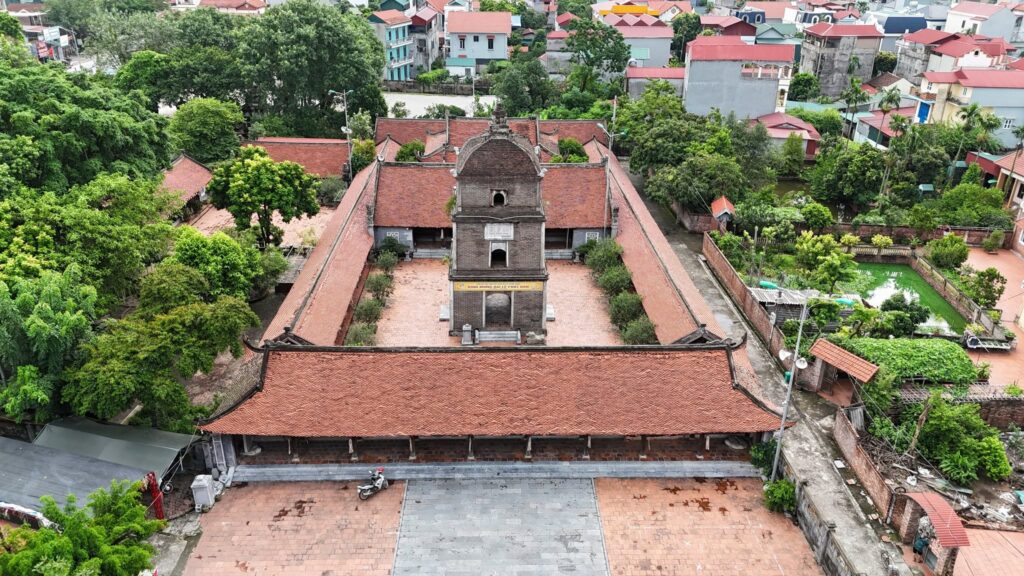
The present Tây Sơn Temple was rebuilt on the foundations of Kiên Mỹ Communal House. In front of the temple is a large entrance gate with brick pillars. Chinese-character couplets are displayed on the two main gate pillars, while a relief plaque bearing the three characters “Tây Sơn Điện” is placed above the entrance.
Inside the gate is a stele house recording the merits of Emperor Quang Trung – Nguyễn Huệ in Vietnamese. Behind the stele house is the front hall, which connects to the main sanctuary.
The temple currently contains 10 wooden altars, elaborately carved with motifs such as two dragons facing the moon, vines and bunches of grapes, reflecting traditional artistic styles of Central Vietnam. The altar in the front hall is known as the Communal Altar, where figures associated with the Tây Sơn dynasty are worshipped collectively.
The rear sanctuary contains three main altars. The central altar is dedicated to Emperor Quang Trung – Nguyễn Huệ; the altar on the right honors Emperor Thái Đức – Nguyễn Nhạc; and the altar on the left honors Đông Định Vương – Nguyễn Lữ.
Behind these altars is a large wooden horizontal plaque decorated with dragons and traditional patterns, finished with red lacquer and gilding. In front of the three altars are two wooden racks displaying the eight traditional weapons, including long swords, serpent spears, yin-yang rings, long maces, long spears, long halberds, long axes and tridents.
The eastern and western sides of the sanctuary contain altars dedicated to civil officials and military commanders of the Tây Sơn period. The eastern row has three altars dedicated to Ngô Thì Nhậm, Trần Văn Kỷ and Ngô Văn Sở. The western row has three altars dedicated to Trần Quang Diệu, Bùi Thị Xuân and Võ Văn Dũng.
The eastern and western walls feature large wooden plaques finished in red lacquer and gold, decorated with traditional motifs and symbolic imagery. A writing brush placed within a scroll represents civil officials, while the hổ phù, or tiger-mask motif, represents military commanders. The two end rooms are used for ceremonial drums and gongs.
The Ancient Well and the 300-Year-Old Tamarind Tree
The relic site also preserves an ancient well constructed with laterite stones. The well has a diameter of approximately 0.9 meters, with walls about 0.8 meters high.
In 1998, a hexagonal pavilion was built over the well. Each side measures approximately 3.45 meters. The roof is made of concrete covered with fish-scale tiles, while the well itself is protected by a stylized hexagonal wooden frame resembling bamboo joints.
Another distinctive feature of the site is an approximately 300-year-old tamarind tree. Its trunk has a circumference of about 3.9 meters, while its canopy extends approximately 30 meters, providing shade across a large part of the garden.
Beyond its age and landscape value, the tamarind tree has special cultural and historical significance. It is closely associated with memories of the Tây Sơn homeland and has become a symbol of the enduring historical memory of the Tây Sơn movement.
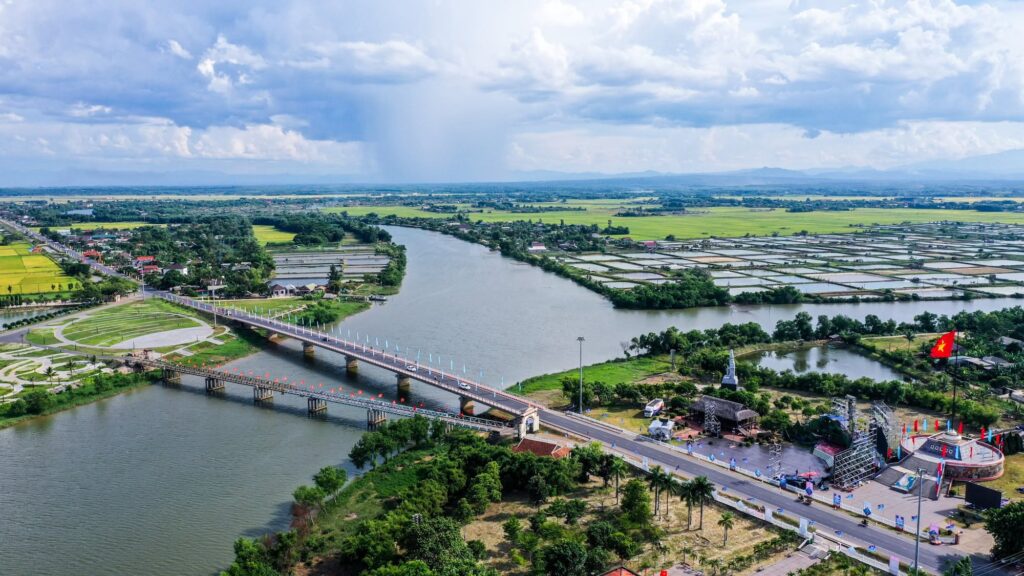
Trường Trầu Wharf on the Côn River
In 2007, Bình Định Province decided to expand the Tây Sơn Temple heritage area southward toward the northern bank of the Côn River, incorporating the historical site of Trường Trầu Wharf. The expanded area covers nearly 6 hectares, identified as Zones C and D.
The Trường Trầu area was improved with stone-paved paths, while the riverbank was reinforced with stone to reduce erosion. Each year, Zones C and D are also used for recreational activities, festivals and events honoring the historical heritage of the site.
Trường Trầu Wharf was once a major trading wharf for betel leaves and areca nuts along the Côn River. It was located in Trầu Hamlet, Kiên Mỹ Village, approximately 200 meters from the Tây Sơn Tam Kiệt Temple.
Betel leaves and areca nuts were important products in both Tây Sơn Thượng Đạo and Tây Sơn Hạ Đạo, particularly the forest-grown betel leaves cultivated by highland communities in the Central Highlands.
Trường Trầu Wharf became a transit point connecting trade between the mountains and the lowlands. Besides betel leaves and areca nuts, many other essential goods were exchanged here.
The family of Hồ Phi Phúc, while living in his wife’s native village of Phú Lạc, engaged not only in agriculture but also in trade between the highlands and lowlands. Through these activities, the family became wealthy. His sons later continued and expanded their father’s trading activities.
Trường Trầu Wharf and the Early Tây Sơn Movement
Trade and communication at Trường Trầu Wharf played an important role in the environment in which the Tây Sơn uprising developed, particularly in relation to Nguyễn Nhạc.
Nguyễn Nhạc frequently traveled through the Tây Sơn Thượng Đạo region and maintained close relations with ethnic communities in the Central Highlands. He also participated in trading activities with markets, wharves and small commercial centers in the lowlands.
These activities enabled him to broaden his understanding of different communities and social groups. They also helped establish relationships that later supported the mobilization and organization of forces for the uprising.
After preparations in Tây Sơn Thượng Đạo, Tây Sơn forces under Nguyễn Nhạc launched a large-scale advance toward Tây Sơn Hạ Đạo and Quy Nhơn, establishing an important foundation for the subsequent development of the movement.
Within this process, Trường Trầu Wharf served as an important point of exchange and communication, where information and correspondence could be transmitted during the early preparations for the uprising.
According to local tradition, Nguyễn Nhạc once built a house beside the old Trường Trầu Wharf to store betel leaves and provide accommodation for merchants trading in betel products. As a result, residents of Kiên Mỹ and surrounding areas came to know Nguyễn Nhạc by the name “Anh Hai Trầu,” meaning “Second Brother Trầu.”
After the Tây Sơn dynasty ended, residents of Kiên Mỹ built a shrine on the former site of the house to worship the three Tây Sơn brothers. It was called Vĩnh Thọ Shrine, also known as Cây Gòn Shrine, after a large kapok tree that once stood there.
Later, the French colonial authorities used the site as a food storage facility before it was destroyed. In 1963, three mendicant monks from southern Vietnam and local residents built a small thatched-roof temple on the old shrine site. In 1967, the structure was rebuilt in brick and became known as Ngọc Bình Hermitage.
Today, Trường Trầu Wharf has been filled with sediment and survives mainly as a sandy area along the river. The busy boats and bustling atmosphere of the old trading port have disappeared, but the memory of the old tamarind tree and Trầu Wharf remains an important part of the historical story of Tây Sơn.
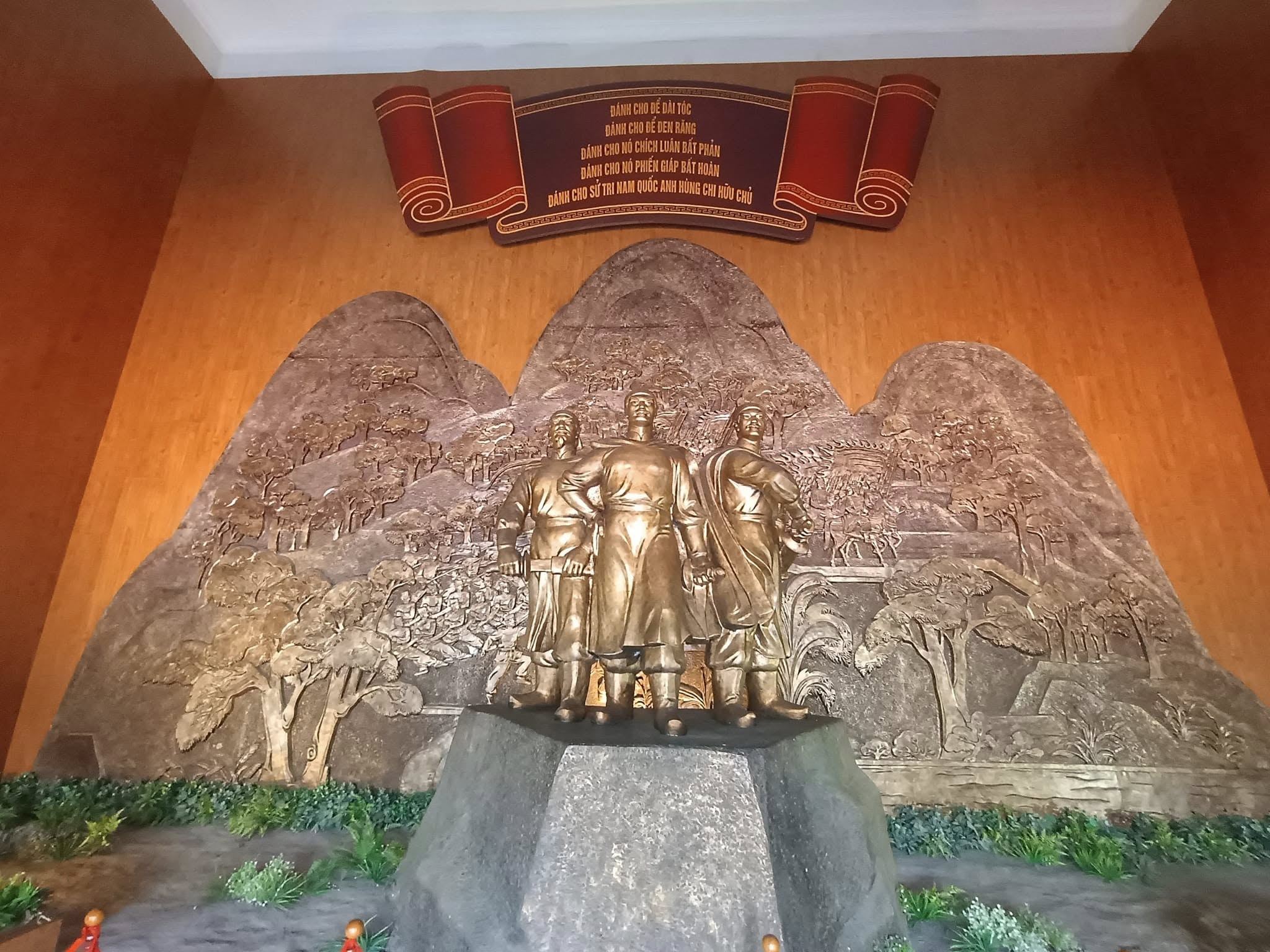
Quang Trung Museum
Quang Trung Museum was built in 1977 and inaugurated in 1979. It preserves and displays 11,605 documents and artifacts related to the Tây Sơn movement.
In front of the museum stands an imposing bronze monument of Emperor Quang Trung, creating a prominent focal point within the memorial complex.
The museum provides visitors with an opportunity to learn about the Tây Sơn uprising, the Tây Sơn dynasty and the historical figures associated with the region through documentary materials and artifacts.
Tây Sơn Music and Martial Arts Performance House
The Tây Sơn Music and Martial Arts Performance House covers approximately 268 square meters. It is a venue where performers present traditional programs including Tây Sơn battle drums, traditional Tây Sơn martial arts and folk cultural performances representing several Central Highlands ethnic communities that participated in the early Tây Sơn movement.
These performances contribute to recreating the cultural atmosphere associated with Tây Sơn and provide visitors with a more direct experience of the region’s heritage.
Central Highlands Cultural Rong House
The Central Highlands Cultural Rong House covers approximately 118 square meters. It displays documents and artifacts introducing the cultures of Central Highlands ethnic communities, including communities that participated in or maintained relationships with the Tây Sơn movement during its early period of mobilization.
The building helps illustrate the connections between the Tây Sơn homeland and highland communities while expanding the interpretation of the heritage site beyond military history to include cultural exchange and community traditions.
Commemorative Ceremonies and the Living Heritage of Tây Sơn
Various ceremonies commemorating and honoring the three Tây Sơn brothers and other historical figures are held annually at the site.
Important commemorative occasions include the Tây Sơn Tam Kiệt joint death anniversary on the 15th day of the eleventh lunar month, the anniversary of the Đống Đa Battle on the 5th day of the first lunar month, and the death anniversary of Emperor Quang Trung on the 29th day of the seventh lunar month.
During these occasions, Quang Trung Museum and the ceremonial committee of the temple organize traditional commemorative rituals. These events attract large numbers of residents and visitors who come to pay their respects and commemorate the contributions of earlier generations.
The ceremonies demonstrate that the heritage of Tây Sơn is preserved not only through buildings, artifacts and historical documents, but also through community practices and traditional rituals passed down through generations.
A Special National Historical Relic
Because of its exceptional historical, cultural and scientific values, the Tây Sơn Tam Kiệt Temple Historical Relic Site was recognized as a Special National Relic under Decision No. 2408/QĐ-TTg dated December 31, 2014, issued by the Prime Minister.
The recognition reflects the importance of the site within Vietnam’s national heritage system and provides a foundation for continued conservation, research and promotion of its historical and cultural values.
Today, the Tây Sơn Tam Kiệt Temple, Trường Trầu Wharf, Quang Trung Museum and associated cultural structures form an integrated heritage space. Together, they offer visitors an opportunity to explore the homeland of the three Tây Sơn brothers, learn about the Tây Sơn movement of the late 18th century and experience the historical and cultural traditions that continue to be preserved in the region.
Quick Information
| Item | Information |
|---|---|
| Name | Tây Sơn Tam Kiệt Historical Relic Site |
| Related name | Tây Sơn Tam Kiệt Temple Historical Relic Site |
| Type | Historical and cultural relic |
| Location | Tây Sơn, Gia Lai Province, Vietnam |
| Historical figures | Nguyễn Nhạc, Nguyễn Huệ and Nguyễn Lữ |
| Notable figure | Emperor Quang Trung – Nguyễn Huệ |
| Main components | Tây Sơn Tam Kiệt Temple, Trường Trầu Wharf and Quang Trung Museum |
| Trường Trầu Wharf | Along the Côn River, approximately 200 m from the Tây Sơn Tam Kiệt Temple |
| Expanded area in 2007 | Nearly 6 hectares |
| Quang Trung Museum | Built in 1977 and inaugurated in 1979 |
| Museum collection | 11,605 documents and artifacts |
| Tây Sơn Music and Martial Arts Performance House | Approximately 268 m² |
| Central Highlands Cultural Rong House | Approximately 118 m² |
| Ancient well | Approximately 0.9 m in diameter, with a wall about 0.8 m high |
| Ancient tamarind tree | Approximately 300 years old, trunk circumference about 3.9 m, canopy about 30 m wide |
| Recognition | Special National Relic |
| Recognition decision | Decision No. 2408/QĐ-TTg, December 31, 2014 |
Location: Tây Sơn Tam Kiệt Historical Relic Site, Tây Sơn, Gia Lai Province, Vietnam.