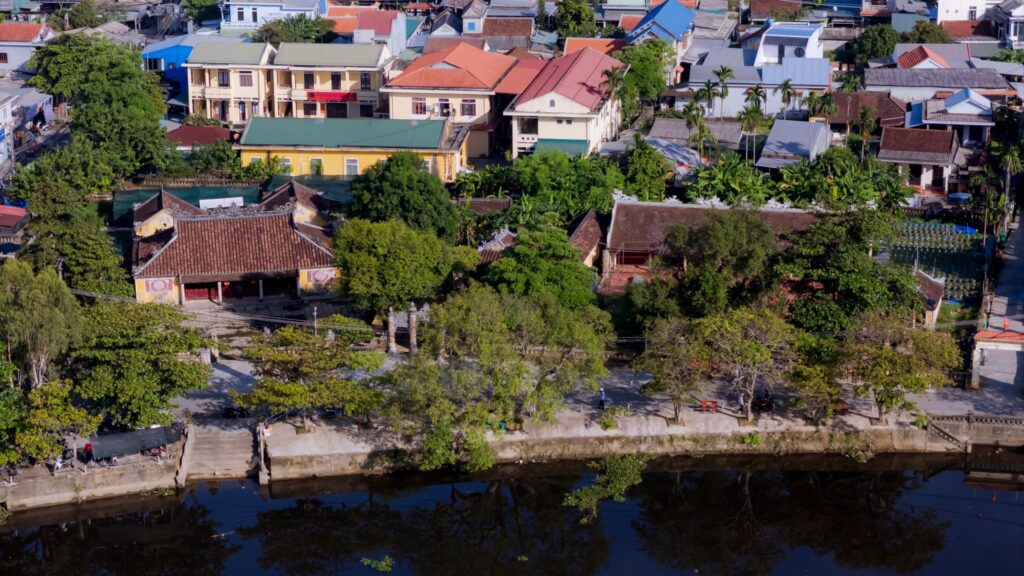
The Ancestral Temple of the Swiftlet Nesting Industry is located at Bãi Hương on Tân Hiệp Island Commune, within the Cù Lao Chàm archipelago. This traditional religious structure is closely associated with the history and development of swiftlet nest harvesting in the waters around Hội An. The temple honors the pioneers who established and passed down the trade, while also reflecting the spiritual traditions of a community whose livelihoods have long been connected to the sea and surrounding islands.
From Hội An’s passenger boat terminal, visitors can travel by motorboat along the river toward Cửa Đại, then continue southeast for approximately 15 km to Bãi Làng Wharf. From Bãi Làng, the temple can be reached by boat by traveling southwest for about 2 km, or by road over a distance of approximately 4 km.
Cù Lao Chàm and the Swiftlet Nesting Industry
Cù Lao Chàm is a mountainous island community comprising seven islands of different sizes: Hòn Khô, Hòn Lá, Hòn Dài, Hòn Mồ, Hòn Lao, Hòn Tai and Hòn Ông. Together, they form an arc across the sea. The archipelago features eight sandy beaches with distinctive natural scenery: Bãi Bấc, Bãi Ruộng, Bãi Ông, Bãi Xếp, Bãi Chồng, Bãi Bìm, Bãi Hương and Bãi Nần. Most residents live in the Bãi Làng and Bãi Hương settlements.
The area’s steep cliffs and secluded sea caves provide suitable nesting habitats for swiftlets. Well-known nesting caves are found on rocky islands such as Hòn Khô, Hòn Tai and Hòn Lao. The swiftlet species identified in the site’s historical records as Collocalia fuciphaga germaini is a small bird roughly the size of a sparrow. It has dark brown plumage, long pointed wings, a short forked tail, a short broad beak and short legs with claws.
Swiftlets typically inhabit exposed sea caves where they are subject to strong winds, waves and saltwater. During the nesting season, they secrete a substance from their salivary glands to construct nests that adhere to the rock walls. Newly formed nests are pale pinkish-white, soft and pliable. They gradually harden when exposed to the air and become opaque white.
According to historical accounts cited in local materials, the Chinese were familiar with the value of edible bird’s nests before the 13th century. Some communities in Southeast Asia, including the Cham people, also harvested this valuable natural product from coastal island caves. When the Vietnamese expanded into the region from the 15th century onward, they continued to draw on the Cham people’s knowledge of swiftlet nest harvesting. Residents of Thanh Châu Village played an important role in developing the trade.
From Thanh Châu Village to the Thanh Châu Team
According to local legend, a resident of Thanh Châu Village named Trần Tiến discovered swiftlet nests in Tò Vò Cave on Hòn Lao. Initially, harvesting was carried out informally by members of the Thanh Châu community. As the Nguyễn lords expanded their territories southward, swiftlet nest harvesting spread to other areas, including Quy Nhơn, Phú Yên, Bình Khang and Diên Khánh.
The Nguyễn lords established the Thanh Châu Team, assigning residents of Thanh Châu to organize swiftlet nest harvesting and pay annual taxes to the state. In the early 19th century, under the Nguyễn dynasty, the team was organized along military lines, with positions including regional supervisors, team leaders and household heads responsible for managing the trade.
These positions were primarily held by residents of Thanh Châu, who oversaw swiftlet nest harvesting across the three provinces of Quảng Nam, Quảng Bình and Khánh Hòa.
From the reign of Emperor Gia Long onward, Hồ Văn Hòa and successive generations of his descendants took responsibility for overseeing the industry. Historical objects preserved at the temple, including inscribed boards, parallel panels and a stone stele, record Hồ Văn Hòa’s role in organizing the trade and establishing a place of worship for its pioneers. For this reason, he is traditionally honored by the swiftlet-harvesting community as the founding ancestor of the industry.
From the early 20th century until 1974, the state administered the industry and awarded harvesting rights through tenders to trading houses and private companies. Swiftlet harvesters from Thanh Châu subsequently worked as laborers for these operators. After 1975, the state assumed control over swiftlet nest harvesting and distribution, and the Hội An Swiftlet Nest Team developed from the traditional Thanh Châu swiftlet-harvesting community.
The Legend of the Swiftlet Maiden
Alongside the history of the industry, Hội An preserves a folk legend about the “Swiftlet Maiden,” a story traditionally associated with the origins of swiftlet nest harvesting.
The story tells of a coastal couple who had lived together for 17 years before having a daughter. As time passed, the girl continued to retain the face of a young child. When she reached 16 years, one month and four days of age, flocks of seabirds suddenly became agitated and fled the coastal waters.
An elderly clan leader recognized the signs of an impending disaster and advised the villagers to seek refuge in the mountains. However, a tsunami soon swept through the fishing village.
The girl’s parents were miraculously carried to safety in the mountains. Yet, on the barren slopes, they had no food. When they became exhausted, their daughter searched for something to eat and found a wild yam. She broke it into small pieces to feed her parents and even used her own saliva to help them recover. By the time her parents regained consciousness, the girl had grown weak and died in their arms.
The couple buried their daughter at the foot of the mountain. Three days later, a bird with glossy black feathers appeared above her grave. In the following springs, the bird returned with others. By the third spring, flocks of these birds gathered around the couple’s home.
Fishermen later noticed that the birds had begun nesting in caves on a small island that had emerged where the girl had once lain. The villagers collected the nests for food and gradually learned to appreciate their value. They called the birds swiftlets and honored the maiden as the ancestral founder of the swiftlet nesting industry.
Passed down through generations, this legend reflects how the community explained the origins of its traditional livelihood and expressed gratitude toward a figure regarded as its symbolic founder. The detail that the maiden was exactly 16 years, one month and four days old is also linked in local tradition to the swiftlets’ nesting cycles, which generally occur around the first and fourth lunar months.
Swiftlet Nest Harvesting and the Dangers of the Sea
Swiftlet nest harvesting is an economically valuable occupation that has traditionally involved considerable danger. Workers must prepare boats, containers and a range of specialized equipment, including bamboo poles, hooks, nets, ropes, carrying bags, drinking water and food supplies.
Under traditional harvesting methods, boats enter a cave through its opening and follow the water inward until they reach the rock walls. The boats are then secured to large rocks. Bamboo poles approximately 10 to 15 meters long are placed in prepared supports on the boats and leaned against the cliffs. These poles form makeshift ladders that allow workers to climb toward the nests.
Harvesters carry a bamboo pole fitted with a thin metal hook used to lift the nests. A small woven basket beneath the hook catches each nest. Ropes approximately 100 meters long provide additional support for climbing the steep rock faces. The work requires specialized skills, experience and close coordination among team members.
Today, motorboats, flashlights and modern equipment have replaced some traditional tools. Nevertheless, reaching swiftlet caves high on steep cliffs in the open sea remains an exceptionally hazardous task.
These challenges help explain the establishment of the Ancestral Temple at Bãi Hương. The temple honors the founding ancestors of the trade, earlier generations of local residents and deities associated with waterways. It is also a place where the community prays for safety, favorable weather and successful harvesting seasons.
The Ancestral Temple and the Annual Commemoration Ceremony
Based on historical records, architectural features, decorative motifs and comparisons with religious structures from the same period, the temple is believed to have been built in the early 19th century. It is dedicated to the ancestral founders of the swiftlet nesting industry and the local tutelary deity, Thành Hoàng bổn xứ.
Every year, on the 10th day of the third lunar month, local residents hold a ceremony to honor the industry’s founding ancestors. The event expresses gratitude to earlier generations and marks the community’s preparations for the first swiftlet nest harvesting season of the year, which generally begins in April.
In 2006, as part of preparations for the Quảng Nam National Tourism Year, Hội An town authorities, Tân Hiệp Commune officials and clans historically involved in swiftlet nest harvesting organized a ceremony at the temple on January 6 and 7, 2006.
The ceremony began with a preparatory ritual in the evening, attended by representatives of the Tân Hiệp authorities, the swiftlet-harvesting team and the Hồ clan. The following day, a ceremonial procession by boats traveled around the islands. The procession visited religious sites to pay homage, continued to Hòn Tai, where swiftlet caves are located, and then returned to the ancestral temple to bring the incense burner into the main sanctuary and conduct the principal rites.
The worship ceremonies include offerings to wandering spirits and rituals honoring the founding ancestors. Traditional chanting, ceremonial music, prayers and offerings are performed in a solemn atmosphere. The ancestral ceremony includes offerings of swiftlet nests and incense.
Alongside the religious observances, community activities such as basket-boat rocking, boat racing and sack races create a lively atmosphere that reflects the distinctive cultural traditions of the island’s maritime communities.
Architecture of the Ancestral Temple
The temple stands on a sandy mound approximately 150 meters from the shoreline at Bãi Hương. Its main façade faces west to northwest toward the mainland and the sea approaches. The entire complex is enclosed by a surrounding wall.
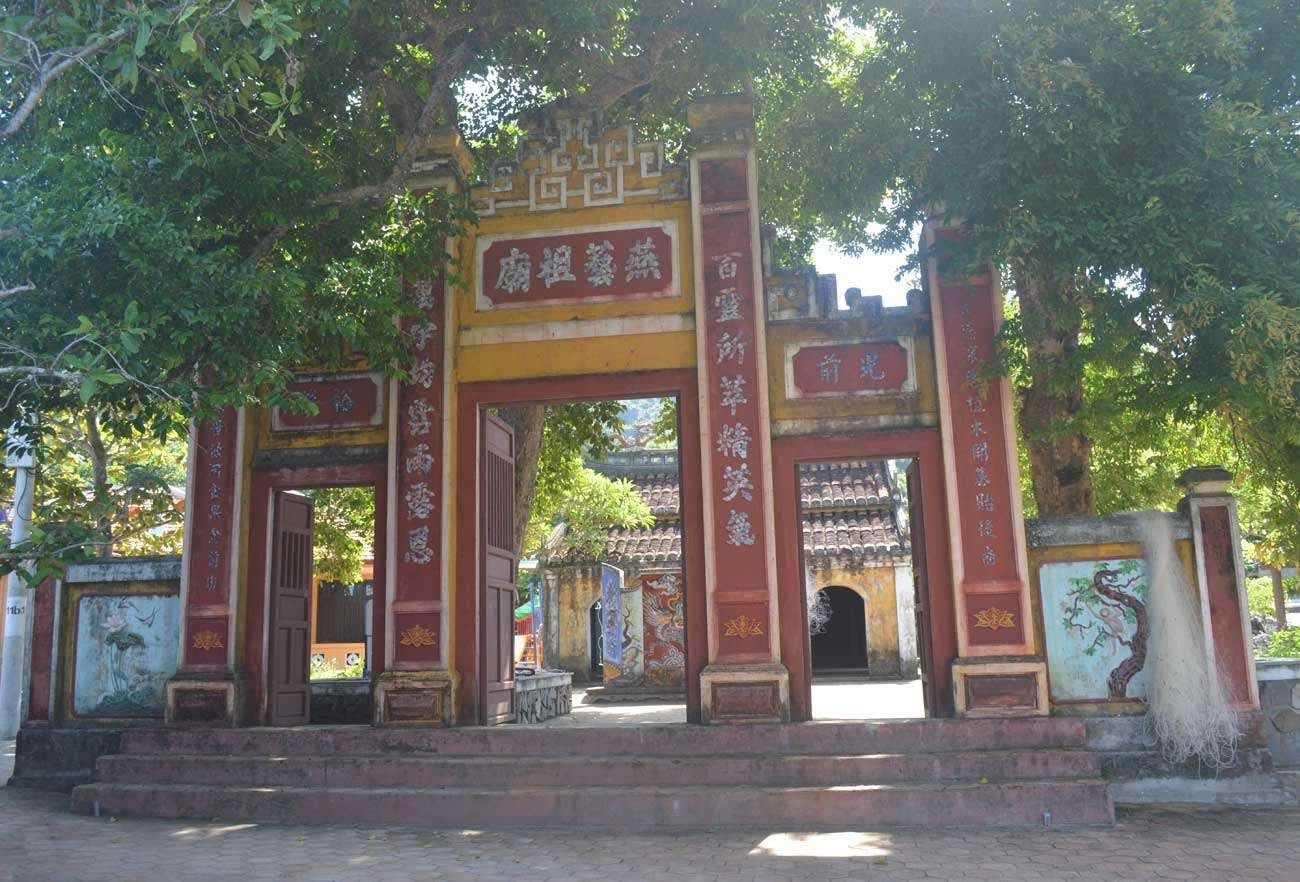
The three-entrance ceremonial gate is a prominent architectural feature. Its central pillar is approximately 5.02 meters high, while the two side pillars reach 4.1 meters. The main entrance measures 2.6 meters high and 1.7 meters wide; the two side entrances are approximately 2 meters high and 0.95 meters wide.
Four Chinese characters, “Yến Nghệ Tổ Miếu,” meaning the Ancestral Temple of the Swiftlet Nesting Industry, are prominently displayed above the main entrance. A pair of parallel inscriptions appears on either side:
“Bách linh sở tụy tinh anh khí – Vạn vũ quân chiêm vũ lộ ân.”
The gate is painted red with white and yellow edging and decorated with traditional auspicious geometric motifs.
Beyond the gate lies a courtyard approximately seven meters wide, paved with Bát Tràng bricks. At its center stands a scroll-shaped ornamental screen, about 1.6 meters high and 2.6 meters wide. The front depicts a tiger, while the reverse features a landscape scene with mountains and water, combined with traditional decorative patterns.
The main building consists of two interconnected sections with a combined floor area of approximately 69.3 square meters. The roof is covered with traditional yin-yang tiles. The front section features a timber roof structure incorporating layered beams, supporting posts and curved brackets. The wooden components are decorated with carved floral motifs, including stylized gourd-shaped elements.
The rear section houses the principal worship space and is separated from the front section by wooden doors with an upper lattice and solid lower panels. It contains the main altar, side altars and a simpler timber roof structure. Its traditional column-and-beam arrangement creates a spacious and airy interior.
Several horizontal lacquered and gilded plaques decorate the lower beams. Three notable inscriptions are “Trướng Hải Vô Trần,” “Hải Bất Dương Ba” and “Tích Ngã Vô Cương.” The altars, incense tables and ancestral tablets are arranged with great care. Many feature openwork carving, relief decoration, red lacquer and gold leaf, as well as traditional sets of auspicious objects.
The roof incorporates 29 rows of yin-yang tiles. Its ridge is decorated with two dragons contesting a pearl, with a blue glass sphere resting on a base of swirling clouds. Two dragons, each approximately 1.92 meters long, form a striking focal point. Decorative panels, curved gable ends and porcelain details add elegance to the overall architectural composition.
Notable Historical Artifacts
The temple preserves numerous artifacts of historical and artistic significance, including:
- Three horizontal inscribed plaques: one dating from the reign of Emperor Thiệu Trị, another from the reign of Emperor Tự Đức, and a third believed to date from the early 20th century.
- Six intricately carved and gilded wooden shrines.
- Fourteen wooden ancestral tablets decorated with floral borders and dragon motifs, honoring deities, early settlers and later generations associated with the local community and swiftlet harvesting.
- One stone stele dating to the eighth year of Emperor Tự Đức’s reign.
The ancestral tablets reflect the diversity of religious beliefs practiced at the temple. The figures honored include Đại Càn, the local tutelary deity, the Council of Deities, the Five Elements, General Phục Ba, Hà Bá, successive generations of craft ancestors, Chúa Ngọc, the pioneers who opened and cultivated the land, and deities associated with waterways and traditional occupations.
Cultural and Heritage Significance
The Ancestral Temple of the Swiftlet Nesting Industry is a religious structure associated with a distinctive occupation that has shaped the economic and cultural life of island communities. It documents the development, organization and transmission of swiftlet nest harvesting in Hội An and Cù Lao Chàm, while reflecting the integration of ancestral craft worship with the broader folk beliefs of coastal residents.
Architecturally, the temple is modest in scale but rich in detail. Its ceremonial gate, ornamental screen, timber buildings, roof structures, horizontal plaques, ancestral tablets, shrines and roof decorations demonstrate the craftsmanship of traditional Vietnamese religious architecture. Its woodcarving, lacquerwork, gilding, Chinese inscriptions and stone stele also provide valuable historical evidence.
Set within the Cù Lao Chàm archipelago, the temple enriches Hội An’s cultural attractions, where island landscapes, community life and historical heritage coexist within a distinctive maritime setting.
Conservation
The temple underwent state-funded restoration in 1997. Today, it remains under the direct management of Tân Hiệp Commune People’s Committee, with a caretaker responsible for its regular upkeep.
Beyond preserving the history of swiftlet nest harvesting, the temple continues to serve as a gathering place where local residents honor earlier generations, maintain traditional ceremonies and pass down stories associated with the history of their livelihoods.
Quick Information
| Item | Details |
|---|---|
| Name | Ancestral Temple of the Swiftlet Nesting Industry on Cù Lao Chàm |
| Type | Historical site; architectural and artistic heritage |
| Location | Bãi Hương, Cù Lao Chàm, Tân Hiệp Island Commune |
| Cultural context | Swiftlet nest harvesting in Cù Lao Chàm and Hội An |
| Estimated construction period | Early 19th century |
| Worshipped figures | Founding ancestors of the swiftlet nesting industry, local tutelary deity, earlier generations of settlers and associated deities |
| Annual ancestral ceremony | 10th day of the third lunar month |
| Restoration | 1997 |
| Architectural highlights | Three-entrance gate, ornamental screen, two interconnected halls, yin-yang tiled roof and paired dragons contesting a pearl |
| Notable artifacts | Three inscribed plaques, six shrines, fourteen wooden ancestral tablets and one stone stele |
| Heritage value | History of the swiftlet nesting industry, ancestral worship, traditional architecture and decorative arts |