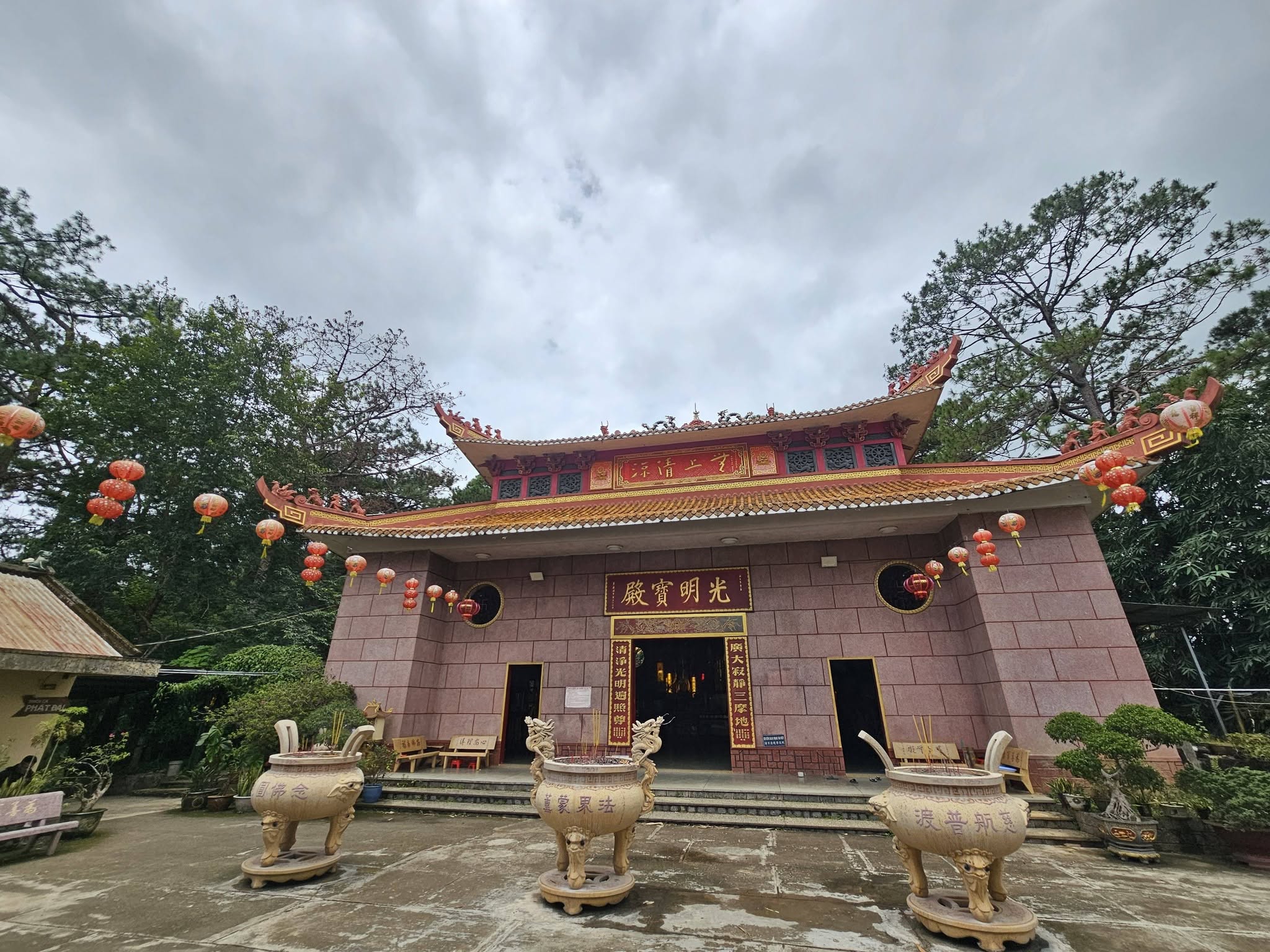
Set among the pine-covered hills of eastern Da Lat, Thien Vuong Co Sat Pagoda is one of the city’s most distinctive Buddhist landmarks. Locally known as Chua Tau or the Chinese Pagoda, the temple reflects the cultural heritage of the Teochew Chinese community in Da Lat.
The pagoda is also known as Chua Phat Tram, or the Pagoda of Agarwood Buddhas, a name inspired by its remarkable collection of large wooden Buddhist statues.
Located on Dragon Hill at 385 Khe Sanh Street, the pagoda combines Chinese Buddhist architecture, a peaceful pine-forest setting and a long history dating back to the middle of the 20th century. It is also known for its curious rotating table, an unusual attraction that has intrigued visitors for decades.
A Pagoda Built by Da Lat’s Chinese Community
Thien Vuong Co Sat was established in 1958, closely associated with the Teochew Chinese Buddhist community living in Da Lat.
Venerable Tho Da and local Buddhist followers built a modest temple on Dragon Hill. The original complex consisted of simple wooden buildings with corrugated metal roofs, serving as a place for Buddhist worship, chanting and community gatherings.
After several decades, the original structures deteriorated. In 1989, the pagoda underwent a major reconstruction supported by Buddhist followers in Vietnam and overseas Chinese communities. The renovation gave the complex much of its present appearance, incorporating architectural elements inspired by Buddhist temples in southern China.
The pagoda follows the Huayan Buddhist tradition, part of the Mahayana tradition. Its religious heritage, architecture and arrangement of Buddhist images therefore differ from many of the Vietnamese Buddhist temples commonly seen elsewhere in Da Lat.
The official name, Thien Vuong Co Sat, refers to the Four Heavenly Kings, guardian figures in Mahayana Buddhist tradition. The popular name Chua Tau, meaning Chinese Pagoda, reflects the temple’s origins within the local Chinese community. Meanwhile, the name Chua Phat Tram comes from the famous agarwood Buddha statues housed inside the temple.
Rare Agarwood Buddha Statues
The temple is arranged along the slope of Dragon Hill, with its buildings set among pine trees.
In the front section, visitors encounter Buddhist images associated with Maitreya Buddha and the Four Heavenly Kings, creating a solemn entrance to the temple complex.
The most remarkable collection is found in the main worship hall, where visitors can see the Western Pure Land Trinity, consisting of Amitabha Buddha at the center, flanked by Avalokitesvara Bodhisattva and Mahasthamaprapta Bodhisattva.
The three large statues were brought to Da Lat from Hong Kong in 1958. They were carved from large pieces of agarwood, a rare and highly valued fragrant wood. Their impressive size, warm brown tones and detailed carving make them among the most memorable objects in the temple.
The statues are closely associated with the name Chua Phat Tram. Inside the hall, the natural color and subtle fragrance of the wood create an atmosphere quite different from that of many conventional Buddhist temples.
Behind the main worship area, steps lead further up the hill through the pine trees. At the higher part of the complex stands a large outdoor statue of Shakyamuni Buddha, forming another prominent landmark of the pagoda.
From the upper grounds, visitors can enjoy views across the surrounding hills and valleys, with the pine forest adding to the peaceful character of the site.
The Curious Rotating Table
Alongside its religious and architectural heritage, Thien Vuong Co Sat is also famous for its rotating table, one of the most unusual experiences associated with Da Lat’s temples.
The wooden table has a circular surface mounted on a mechanism that allows it to rotate. Visitors place their hands lightly on the surface and concentrate on the direction in which they want the table to move. The table may then begin turning, sometimes gradually increasing its speed.
For many years, the phenomenon generated considerable curiosity and speculation. Rather than requiring a supernatural explanation, however, the movement can be understood through the ideomotor effect.
This psychological phenomenon occurs when a person’s expectations or focused thoughts produce very small, unconscious muscle movements. When the hands rest lightly on a low-friction rotating surface, these subtle forces can be enough to make the table move without the participant consciously realizing that they are contributing to the motion.
Whether approached as a curious experiment or simply as part of the temple’s popular history, the rotating table remains one of the experiences that makes Chua Tau particularly memorable.
A Chinese Buddhist Landmark in Da Lat’s Pine Forests
One of the most appealing aspects of Thien Vuong Co Sat is its peaceful setting.
The temple sits on Dragon Hill among pine trees, away from the busiest parts of central Da Lat. Its buildings follow the natural slope of the hill, creating a walking route that combines religious architecture with mountain scenery.
As visitors move upward, they encounter worship halls, Buddhist statues, landscaped areas and the large outdoor statue of Shakyamuni Buddha. The steps, courtyards and pine trees also create a number of attractive viewpoints.
Visitors interested in architecture can look for Chinese-inspired elements in the roofs, colors, decorative details and arrangement of the worship halls. Those interested in history can explore the story of the Teochew community and its contribution to the cultural landscape of Da Lat during the mid-20th century.
Visiting Thien Vuong Co Sat Pagoda
The pagoda is approximately 5 km from central Da Lat, making it easy to include in an itinerary around the eastern side of the city.
Allowing around an hour or more gives visitors enough time to explore the worship halls, admire the agarwood statues, walk through the pine-covered grounds and experience the rotating table if it is available.
As an active religious site, visitors should dress modestly, keep their voices low and respect ongoing ceremonies and worship. Photography inside the worship halls should follow the temple’s instructions.
Thien Vuong Co Sat may not be the largest temple in Da Lat, but it brings together several distinctive elements: the history of the Teochew Chinese community, Huayan Buddhist traditions, Chinese-inspired architecture, rare agarwood statues and the curious story of the rotating table.
Among Da Lat’s pine-covered hills, Chua Tau offers a different perspective on the city’s cultural heritage, where religion, migration, architecture and local folklore come together in one peaceful destination.
Quick Facts
| Information | Details |
|---|---|
| Name | Thien Vuong Co Sat Pagoda |
| Other names | Chua Tau, Chua Phat Tram |
| Address | 385 Khe Sanh Street, Da Lat |
| Location | Dragon Hill |
| Buddhist tradition | Huayan Buddhism, Mahayana tradition |
| Founded | 1958 |
| Major reconstruction | 1989 |
| Highlights | Agarwood Buddha statues, Four Heavenly Kings, Shakyamuni Buddha and the rotating table |
| Setting | Pine-covered hill with Chinese Buddhist architectural influences |
| Experiences | Temple visit, Buddhist art, architecture, history and the rotating-table experience |