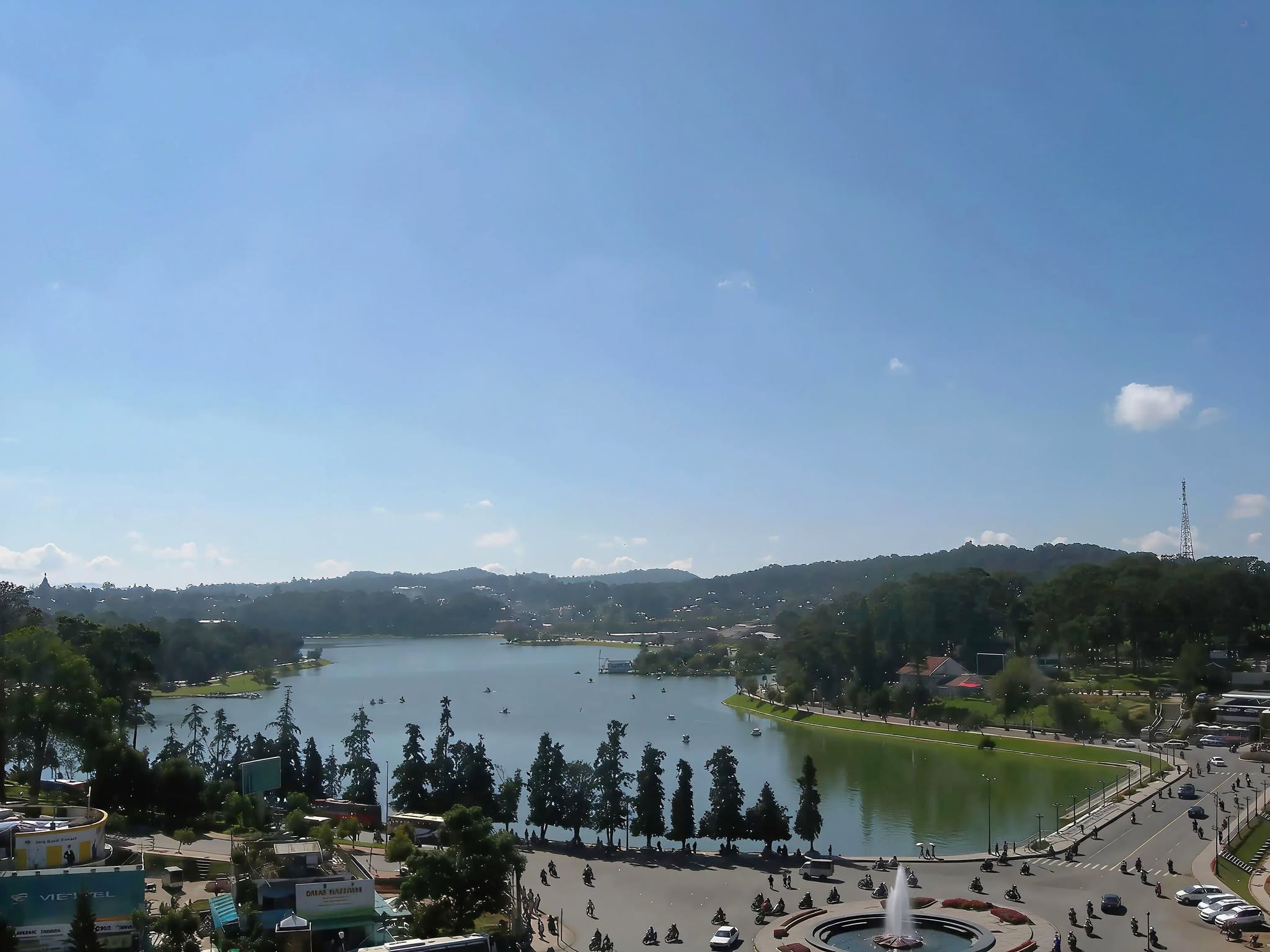
Located in the heart of Da Lat, Xuan Huong Lake is one of the city’s most recognizable landmarks and a familiar symbol of the Central Highlands. The lake is not only a scenic landscape but also an important part of Da Lat’s urban identity, with its history closely connected to the formation and development of the city.
With its crescent-shaped shoreline, surrounding pine trees, flower gardens, roads and historic buildings, Xuan Huong Lake creates a distinctive landscape where nature and the city’s architectural heritage meet.
From a Natural Wetland to Grand Lac
Before the lake was formed, the area was a natural swampy valley crossed by the Cam Ly Stream, where the indigenous Lach people lived.
In 1919, French Resident Cunhac proposed creating a lake in this area. Public works engineer Labbé was responsible for building a dam across the Cam Ly Stream, creating the first lake.
In 1923, a second dam was constructed farther downstream, at the location of today’s Ong Dao Bridge. The two water bodies were subsequently connected, creating a much larger lake. During the French colonial period, the lake was known as Grand Lac, meaning “Great Lake.”
The formation of Grand Lac played an important role in the development of Da Lat’s urban landscape. The lake gradually became a central element around which roads, villas, parks and other important spaces were organized.
From Grand Lac to Xuan Huong Lake
In 1953, Nguyễn Vỹ, Chairman of the Da Lat Town Council, renamed Grand Lac Xuan Huong Lake.
The name was chosen in honor of the famous Vietnamese poet Ho Xuan Huong, while also evoking the meaning of the fragrance of spring. Since then, Xuan Huong Lake has become deeply associated with the image and identity of Da Lat.
Today, the lake covers approximately 25 to 32 hectares, depending on the season and dredging conditions. Its perimeter is nearly 5 kilometers, while the lake stretches for more than 2 kilometers in length.
The lake has a characteristic crescent shape. Its average depth is around 1.5 meters, while some lower areas, outlets and canals can reach depths of approximately 3 to 6 meters.
At an elevation of about 1,478 meters above sea level, the lake forms the visual center of Da Lat. The French urban planning tradition used the lake as a major focal point for roads, villas, parks and the surrounding Doi Cu Hill, helping shape the spatial character of the city.
In 1988, Xuan Huong Lake was recognized as the first National Scenic Site of Lam Dong Province.
Ong Dao Bridge and the Story of the Lake’s Southern Dam
At the southern end of Xuan Huong Lake stands Ong Dao Bridge, connecting the lake area with the central market area.
The name is associated with Pham Khac Hoe, who served as a Quản đạo, or local administrative official, during the reign of Emperor Bao Dai. The dam and bridge were reinforced during his tenure, and the structure subsequently became known as Ong Dao Bridge.
The lake also has a remarkable history of surviving severe weather.
In 1932, a major storm destroyed both of the French earth dams. Large volumes of water rushed downstream toward Cam Ly Waterfall.
Reconstruction was later assigned to engineer Tran Dang Khoa, who would become the first Minister of Water Resources of the Democratic Republic of Vietnam. He designed a stone dam combined with a spillway bridge. The work was completed in 1935, forming the foundation of the present-day Ong Dao Bridge.
The bridge and dam therefore represent more than an infrastructure structure. They are part of the historical story of how Da Lat’s central lake was created, damaged and rebuilt over time.
Thuy Ta and Thanh Thuy by the Lake
Among the most recognizable buildings beside Xuan Huong Lake are Thuy Ta and Thanh Thuy, both associated with the long-standing café culture of Da Lat.
During the French period, Thuy Ta was known as La Grenouillère, a French name meaning “frog pond.” Some accounts suggest that the original structure may have included a diving platform.
The name Thuy Ta, sometimes interpreted in connection with the idea of a structure standing over the water, became associated with the distinctive white building that extends toward the lake. With its broad railings and unusual form, the building has often been described as resembling a yacht floating on the water.
Today, Thuy Ta continues to operate as a small café and bar and remains one of the familiar visual symbols of Xuan Huong Lake. Its setting is relatively quiet and private.
Across the lake, Thanh Thuy offers a larger and busier café and dining space. The two locations provide different ways to enjoy the lake: Thuy Ta is often associated with a quieter atmosphere, while Thanh Thuy offers a livelier setting with a wider range of choices.
Both have long been popular places for enjoying coffee and taking in views across Xuan Huong Lake.
A Lake That Changes with the Seasons
One of the charms of Xuan Huong Lake is that its appearance changes throughout the year.
In January and February, mai anh dao, the pink cherry blossom-like flowers closely associated with Da Lat, bloom along Tran Quoc Toan Street near Doi Cu Hill and Lam Vien Square. The blossoms add a soft pink accent to the landscape surrounding the lake.
During March and April, purple flamboyant trees become another seasonal highlight. Several mature trees along the lakeside burst into purple flowers, creating a distinctly Da Lat atmosphere.
During the dry and sunny season, the lake may appear green or reflect a silvery gray sky, depending on the light and weather conditions.
From around August to October, during the rainy season, water flowing from the upper Cam Ly system can carry reddish-brown sediment derived from the basaltic soil upstream. Before the sediment settles, the lake may temporarily take on a reddish or orange-brown tone, creating another seasonal expression of the landscape.
These changes mean that Xuan Huong Lake is never quite the same from one visit to the next. Light, weather, flowers and water conditions continually reshape the scenery.
Xuan Huong Lake in Literature and Music
For generations, Xuan Huong Lake has inspired poets, musicians and artists who have been drawn to the mist, cold air and quiet waters of Da Lat.
The lake and the highland city appear in the poetry of Han Mac Tu, including his poem Da Lat Trang Mo, which evokes the dreamlike atmosphere of the city.
Other poets, including Bich Khe and Quach Tan, also wrote about Da Lat’s misty landscapes and tranquil lakes, contributing to the romantic literary image associated with the city.
Music has played an equally important role. Songs associated with composers such as Trinh Cong Son and Pham Duy have helped shape the poetic image of Da Lat in Vietnamese popular culture.
Through literature, music, photography and painting, Xuan Huong Lake has become more than a body of water in the center of the city. It has become part of the emotional landscape of Da Lat.
Xuan Huong Lake, the Green Heart of Da Lat
Today, Xuan Huong Lake remains one of the most important landscapes in Da Lat. Its crescent-shaped waters, surrounding greenery, seasonal flowers, historic structures and nearby urban landmarks form a landscape that is closely intertwined with the city’s identity.
For visitors, the lake offers a simple way to experience Da Lat: walking along the waterfront, enjoying a coffee at Thuy Ta or Thanh Thuy, watching the seasonal flowers, or simply taking in the changing colors of the water and surrounding hills.
For Travelin, Xuan Huong Lake represents the green heart of Da Lat, where the city’s natural landscape, history, architecture, literature and music come together in one of the most recognizable places in Vietnam’s Central Highlands.