The Cái Chanh Revolutionary Base, located in Cây Cui Hamlet, Ninh Thạnh Lợi Commune, Cà Mau Province, is one of the important sites associated with the revolutionary activities of Southern Vietnam during the two resistance wars against French colonialism and American imperialism. The site is closely linked to the activities of the Southern Regional Party Committee, the Central Office for South Vietnam, the Southern Resistance Administrative Committee, and the Bạc Liêu Provincial Party Committee. It also reflects the vital role of local residents in sheltering, supporting, and protecting revolutionary cadres.
The base was situated in an area characterized by dense vegetation and a complex network of rivers and waterways. These natural conditions were favorable for establishing revolutionary headquarters, maintaining communications, and ensuring the safety of revolutionary agencies. This terrain helped Cái Chanh become an important location within the revolutionary base network of the southwestern region of Vietnam.
Cái Chanh During the Resistance War Against the French
In October 1949, the leadership agencies of the Southern Regional Party Committee were relocated from the Đồng Tháp Mười region to Cái Chanh. From that time, the base became one of the operational locations of the Southern Regional Party Committee and, after 1952, the Central Office for South Vietnam. A number of important policies and directives guiding the revolutionary movement in Southern Vietnam were developed and implemented from these bases.
During the period of operation at Cái Chanh, several senior Party and State leaders were present, including Lê Duẩn, Lê Đức Thọ, Phạm Hùng, Ung Văn Khiêm, and Võ Văn Kiệt. The presence and activities of revolutionary agencies at the site also enabled the revolutionary movement in Bạc Liêu to receive direct guidance from higher-level organizations.
During the resistance war against French colonial rule, Cái Chanh, together with the Đồng Tháp Mười and U Minh bases and other locations across the southwestern region, formed an important network of revolutionary operational areas. Revolutionary agencies and cadres were sheltered, fed, and protected by local residents. The support of the people became a decisive factor that enabled revolutionary leadership agencies to maintain their activities under extremely difficult wartime conditions.
The Bạc Liêu Provincial Party Committee Base During the Resistance War Against the United States
During the resistance war against the United States, the Cái Chanh area continued to serve as a revolutionary base. From 1973 to 1975, it was an operational location of the Bạc Liêu Provincial Party Committee.
On 20 November 1973, at Cái Chanh Base, Vũ Đình Liệu, Secretary of the Regional Party Committee of Region 9, chaired a conference announcing the decision to re-establish Bạc Liêu Province for the first time. The conference appointed an 11-member Provincial Party Committee Executive Committee, with Nguyễn Văn Đáng, a member of the Regional Party Committee, serving as Secretary of the Provincial Party Committee. This event marked an important step in consolidating the leadership organization of the Bạc Liêu Provincial Party Committee during the final stage of the resistance war.
On 13 January 1975, the Bạc Liêu Provincial Party Committee held a meeting at Cái Chanh Base and adopted its determination to liberate Bạc Liêu Province. At the same time, the committee decided to move its base to Lái Viết Hamlet, Ninh Quới Commune, Hồng Dân District, in order to facilitate the direction of military activities and prepare for the liberation of Bạc Liêu Town.
By 30 April 1975, the Saigon administration in Bạc Liêu had announced its unconditional surrender, and Bạc Liêu Province was liberated. From the time it was selected as the provincial base in November 1973 until its relocation to Lái Viết in January 1975, Cái Chanh Base fulfilled its role as a place that sheltered, concealed, and protected the provincial leadership agency while it directed the revolutionary movement.
Main Structures within the Historical Site
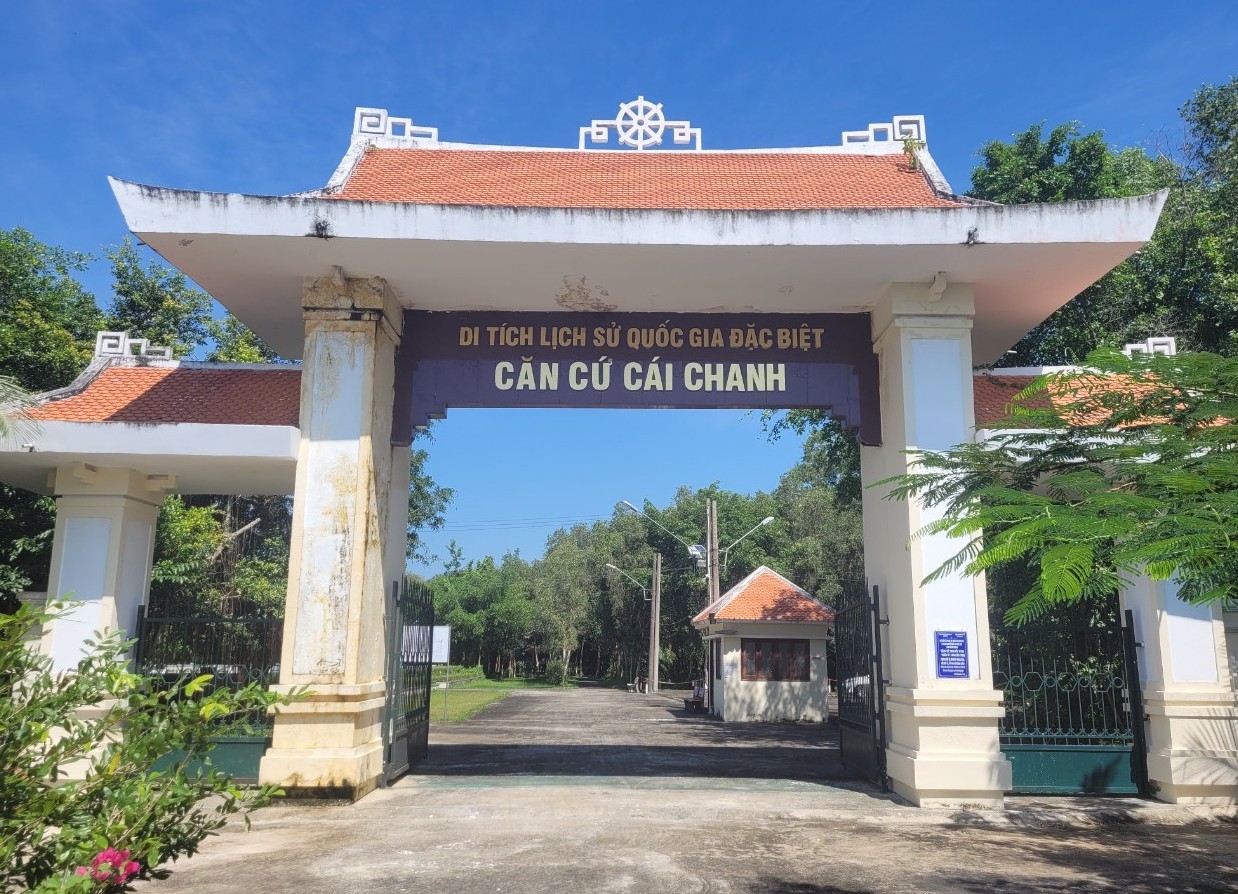
Cái Chanh Base has been reconstructed with various facilities designed to recreate the working and living environment of revolutionary agencies during different historical periods. The main structures include the entrance gate, exhibition house, commemorative stele house, residence and workplace of Lê Duẩn, assembly hall, residence and workplace of the Provincial Party Committee Secretary, kitchen of the Provincial Party Committee office, clerical and medical station, cryptographic office, radio communication station, defensive platoon house, office of the Provincial Party Committee Chief of Staff, base construction unit, waiting house, as well as a system of trenches and bunkers used for operations and defense.
The reconstruction of these facilities not only helps preserve the historical traces of the base but also recreates the living conditions, working environment, and organizational methods of revolutionary cadres during wartime.
To preserve and promote the site’s values, Bạc Liêu Province has undertaken various restoration, embellishment, and reconstruction projects at Cái Chanh Base. After the site was recognized as a national historical relic in 2011, relevant authorities continued to develop plans for its conservation, improvement, and promotion.
Recognizing its outstanding historical significance, the Cái Chanh Revolutionary Base was designated a Special National Historical Site by the Prime Minister under Decision No. 2280/QĐ-TTg dated 31 December 2020.
The site is an important part of the system of revolutionary historical relics in Southern Vietnam. It preserves memories of the activities of revolutionary leadership agencies and highlights the sacrifices, contributions, shelter, and protection provided by local people during the two major resistance wars.