Address: 17 Tran Phu Street, Xuan Huong – Da Lat Ward, Lam Dong Province, Vietnam.
Among the architectural landmarks that have become closely associated with Da Lat, Da Lat Cathedral, commonly known as the Rooster Church, is one of the city’s most recognizable. It is the cathedral of Da Lat and one of the city’s oldest and most distinctive architectural works. Its popular name comes from the large rooster sculpture mounted on top of the bell tower, an image that has become part of Da Lat’s urban landscape.
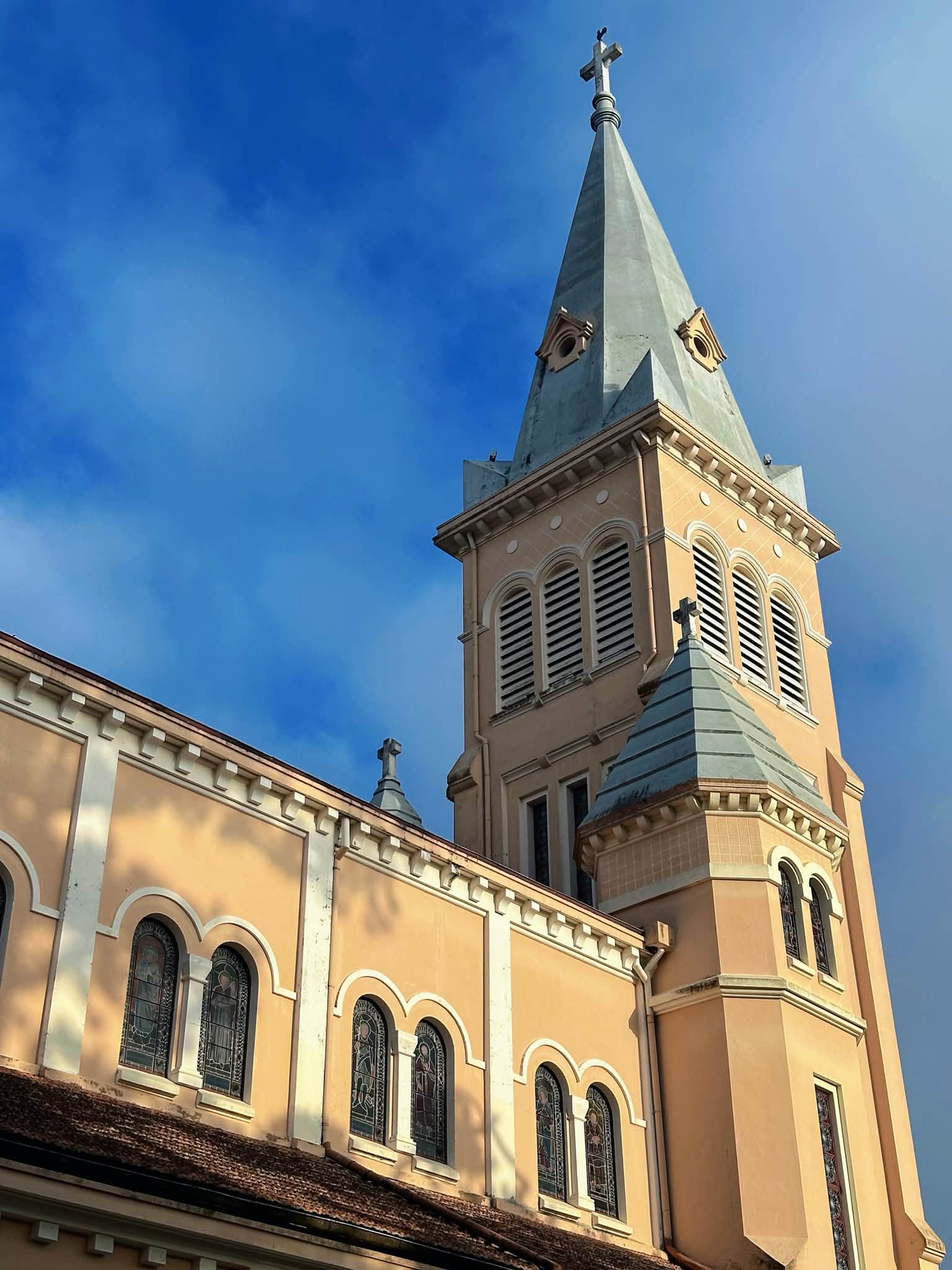
The cathedral was built between 1931 and early 1942. It measures 65 meters in length and 14 meters in width, while its bell tower rises 47 meters above the ground. Standing prominently in the central area, the tower can be seen from many parts of the city.
Beyond its architectural significance, Da Lat Cathedral preserves stories about the development of the Catholic community in Da Lat, the remarkable efforts required to finance and construct the building, and a cultural legacy that has continued through generations.
From the First Stone to the Cathedral Today
On the morning of July 19, 1931, Bishop Colomban Dreyer, Apostolic Delegate to Indochina and Thailand, presided over the Mass marking the laying of the foundation stone for the third church, the building that stands today.
Construction took approximately 11 years and relied on the efforts of Father Nicolas, together with contributions from parishioners and benefactors. According to historical accounts, Father Nicolas personally appealed to families and donors, collecting whatever contributions could be spared in order to gradually bring the ambitious project to completion.
The construction was carried out in three stages.
The first stage lasted eight months, from July 19, 1931 to March 17, 1932. It included the sanctuary, apse, two transepts and the front section of the church. A solemn inauguration was held on March 27, 1932, Easter Sunday. Because the parish still had construction debts to pay, Father Nicolas had temporary wooden partitions installed so that religious services could continue in the completed section while fundraising continued. The debt from the first stage was eventually paid off in 1938, allowing preparations for further construction to resume.
The second stage focused on the main body of the church and the foundations of the bell tower. The third stage concentrated primarily on the construction of the tower itself.
These final two stages were carried out continuously over approximately 15 months, beginning on October 7, 1940, and reaching completion on January 14, 1942.
On January 15, 1942, four bells from the previous church were transferred to the new bell tower. With this, the cathedral reached essentially its present architectural form and became one of Da Lat’s most prominent landmarks.
Roman Architecture with Gothic Influences
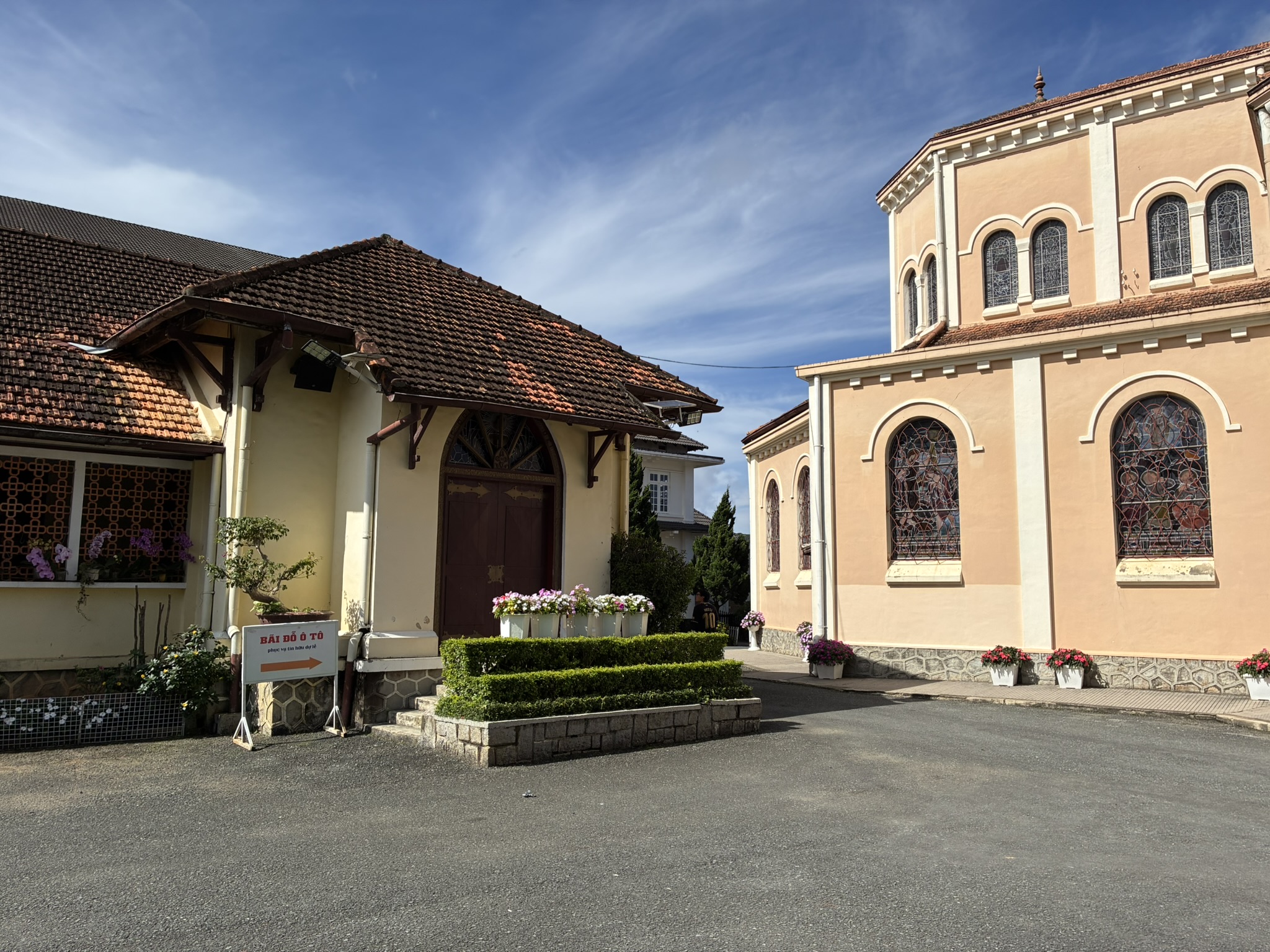
Built in the first half of the 20th century, Da Lat Cathedral reflects a period when construction techniques and materials were undergoing significant development. Its architectural foundation is Romanesque, but the design incorporates a number of Gothic elements, giving the building a distinctive character.
Romanesque features can be seen in the semicircular arches, the cross-shaped floor plan, the central nave rising above the two symmetrical side aisles, and the carefully balanced arrangement of the building’s major volumes. Together, these elements give the cathedral a strong, solemn and harmonious appearance.
Yet unlike the heavier, more restrained exterior commonly associated with Romanesque architecture, Da Lat Cathedral incorporates numerous windows, stained glass and delicate decorative motifs. These Gothic influences soften the overall structure and give it a more elegant appearance.
The combination of Romanesque foundations, refined Gothic details and restrained use of reinforced concrete resulted in a building that is both substantial and graceful. This architectural blend is one of the features that makes Da Lat Cathedral particularly distinctive.
Another remarkable element is the stained-glass system. The cathedral has 70 window openings, including 38 fitted with stained-glass panels, or vitrail, produced by the workshop of French artist Louis Balmet in Grenoble and donated by benefactors.
During the day, natural light passing through the colored glass fills the interior with changing shades. Combined with the arches and columns, the light creates an atmosphere that is quiet, solemn and almost dreamlike, offering a very different experience from the imposing exterior of the building.
Along the interior walls are 14 relief panels depicting the Passion of Christ. Each panel measures approximately 1 meter by 0.8 meters and was created in relief by Xuan Thi, a Vietnamese sculptor from Hanoi.
At the rear of the church stands a statue of Saint Nicholas, the patron saint, facing toward the sanctuary. There was once also a colored statue of Saint Nicholas near the Tabernacle. Following the liturgical reforms of the Second Vatican Council, it was replaced by a statue of Christ on the Cross.
The Four Bells of the Tower
The 47-meter bell tower is the most prominent part of Da Lat Cathedral. Four bells are installed at a height of approximately 25 meters and were transferred from the second church in January 1942.
The largest bell produces the note C, weighs approximately 415 kilograms, measures 0.75 meters in diameter and is 1 meter high. The second weighs 185 kilograms and produces the note E.
The third bell produces the note F, weighs 117 kilograms and had been blessed by Bishop Quinton on February 17, 1924, when it was still installed in the second church. The fourth produces the note G, weighs approximately 120 kilograms and was blessed by Bishop Grangeon on July 8, 1923.
The four bells are not simply part of the cathedral’s soundscape. They also represent a physical link between the present building and the earlier churches of the Catholic community in Da Lat.
A Remarkable Acoustic Space
One of the less visible but particularly interesting characteristics of Da Lat Cathedral is the resonance of its interior space.
The cathedral has a carefully balanced structure, with rows of columns dividing the interior into three sections. The central nave is the highest, helping focus and amplify sound within the main space. The side aisles contain windows that allow air circulation, helping warm air rise toward the central section and escape through the bell-tower area.
The harmonious proportions between the three sections, the height of the roof, the columns and the symmetrical structure contribute to the cathedral’s distinctive acoustics. According to parish accounts, Father and musician Paul Nguyen Van Hoa, who served as assistant parish priest in Da Lat from 1963 to 1968 and later became Bishop of Nha Trang, often mentioned the remarkable resonance of the church.
For a building designed in the early 20th century, this is an intriguing detail that shows how the architecture of Da Lat Cathedral was concerned not only with appearance but also with sound and ventilation.
A Sacred Relic Beneath the Altar
At the sanctuary, beneath the altar, a silver reliquary preserves a portion of the relics of nine Vietnamese Martyrs.
Within the spiritual life of the parish, these saints, together with Saint Bishop Nicholas, are regarded as spiritual protectors accompanying the church and parish families through the difficulties and changes of time.
This detail gives Da Lat Cathedral significance beyond its architectural and historical value. It is also a place where the faith, memories and spiritual traditions of the local Catholic community have been preserved.
A Cathedral Built Through Collective Support
Behind the imposing appearance of Da Lat Cathedral lies a long story of fundraising and community support.
According to parish records, the construction company SIDEC (Société Indochinoise d’Etudes et de Constructions) initially estimated the construction cost at 200,000 piastres in September 1930. By May 1931, the estimate had been reduced to 182,000 piastres.
Beginning on February 1, 1929, Father Nicolas appealed to parishioners and benefactors for financial support. The parish also published the Bulletin Paroissial de Dalat, whose first issue appeared in March 1930 and recorded the names of those supporting the construction of the new church.
The first stage was estimated to cost around 67,000 piastres. When construction began, the parish was able to pay SIDEC only 30,000 piastres and continued making payments until the debt was finally cleared in September 1938.
When the final two stages resumed on October 7, 1940, the parish had collected only about 17,000 piastres, while the estimated cost of the remaining work was approximately 133,000 piastres.
According to the March 1942 issue of the Da Lat Parish Bulletin, the total construction cost was recorded as 200,000 piastres. Donations collected since 1929 had reached approximately 100,000 piastres, leaving the parish with a debt of roughly the same amount.
By November 1943, the remaining debt was recorded as 85,897 piastres and 16 cents. Historical accounts of the parish indicate that the remaining debt was eventually settled with financial assistance involving the Paris Foreign Missions Society (MEP), through the support of Bishop Jean Cassaigne and Father Fernand Parrel.
The story of the cathedral’s construction is therefore also a story of persistence. It reflects the contributions of parishioners, benefactors and individuals who supported the project over many years, often when the financial resources available were far from sufficient.
Why Is It Called the Rooster Church?
The most recognizable feature of the cathedral stands at the top of the bell tower: a metal rooster mounted on the cross.
According to explanatory materials, the rooster is positioned about 27 meters above ground level. It is approximately 0.66 meters long and 0.58 meters high, made from a lightweight metal alloy with a hollow interior. It is mounted on a bearing mechanism that allows it to rotate with the wind.
The rooster has several layers of meaning. On one hand, the Gallic rooster (Coq Gaulois) is a familiar symbol associated with France. In Christian tradition, the crowing of the rooster is also associated with the biblical story of Saint Peter denying Christ three times before the rooster crowed, giving the rooster a connection with awakening and repentance.
Because the rooster sits high above the city and turns according to the wind, local residents once jokingly referred to it as a kind of “weather station.” In reality, the rotating mechanism primarily allows the sculpture to respond to wind direction and reduces the risk of damage from strong gusts.
Over time, the rooster became such a distinctive visual marker that the popular name Rooster Church became almost as familiar as the cathedral’s official name.
Da Lat Cathedral at Christmas
During the Christmas season, the area around Da Lat Cathedral becomes particularly lively as large numbers of parishioners and visitors come to attend services, explore the site and experience the festive atmosphere.
Christmas decorations, lights, bells and the historic architecture create a distinctive setting in the heart of Da Lat. The cathedral attracts not only Catholics but also visitors interested in architecture, culture and the atmosphere of Christmas in the highland city.
Da Lat is also home to several other churches with their own distinctive architectural identities, including Domaine de Marie Church and Cam Ly Church. Together, these buildings contribute to the diverse religious and architectural character of Da Lat.
Da Lat Cathedral and “Sad Christmas Hymn”
Another interesting story associated with Da Lat Cathedral concerns the city’s musical heritage.
According to the source material, composer Nguyen Vu used Da Lat Cathedral as the setting and inspiration for his song “Bai Thanh Ca Buon” (“Sad Christmas Hymn”) in 1944.
The song later became a familiar Christmas piece for generations of Vietnamese listeners. As a result, the image of Da Lat Cathedral has extended beyond architecture and religious life into the city’s musical and cultural memory.
Today, the cathedral tower remains visible from many streets around central Da Lat, standing above the surrounding cityscape. After more than eight decades, the building continues to witness the transformation of Da Lat while retaining its distinctive place in the city’s identity.
With its Romanesque foundations, Gothic influences, stained-glass windows, historic bells, iconic rooster sculpture and stories surrounding its construction, Da Lat Cathedral is more than a place of worship. It is a lasting part of the architectural, cultural and historical memory of Da Lat.
Destination Information
Name: Da Lat Cathedral (Rooster Church)
Address: 17 Tran Phu Street, Xuan Huong – Da Lat Ward, Lam Dong Province, Vietnam
Construction began: July 19, 1931
Completed: January 14, 1942
Length: 65 meters
Width: 14 meters
Bell tower height: 47 meters
Architectural style: Romanesque with Gothic influences
Signature feature: Rooster sculpture atop the bell tower
Stained glass: 70 window openings, including 38 stained-glass panels (vitrail)