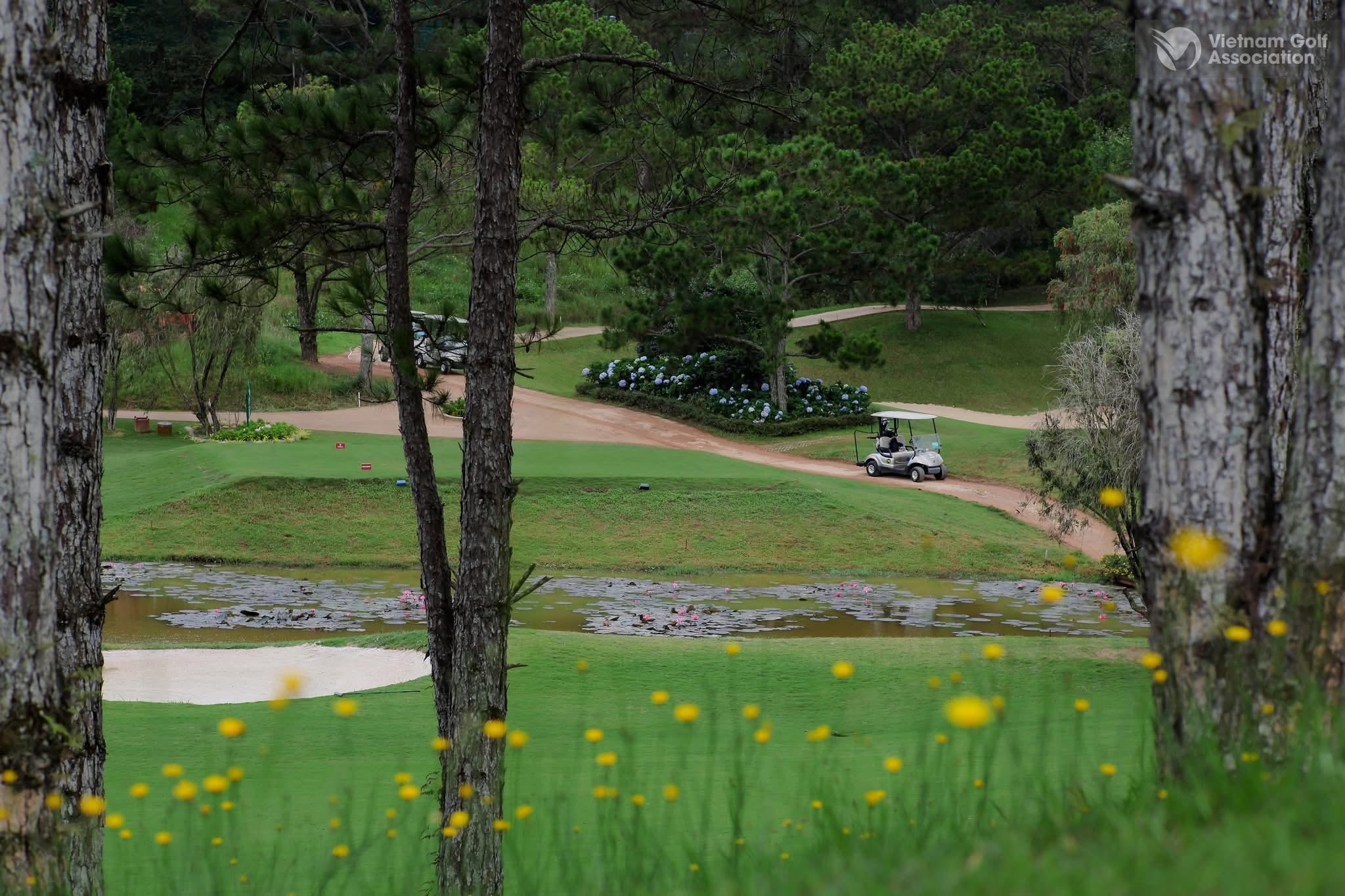
Located beside Xuan Huong Lake, Doi Cu Hill is one of the distinctive green spaces in central Da Lat. Its gently rolling grass-covered hills and pine trees form a rare open landscape within the highland city, while its history is closely associated with the development of Da Lat’s golf course.
Doi Cu Hill has sometimes been described as part of the rhythm and character of Da Lat. Across Xuan Huong Lake, its gentle green slopes, dotted with pine trees, create a peaceful landscape that contrasts with the increasingly urban character of the city.
Two poetic lines:
The hill leans gently, Doi Cu,
While Xuan Huong drifts quietly…
evoke two familiar images of the highland city: Doi Cu Hill and Xuan Huong Lake. Standing side by side, they form one of Da Lat’s most recognizable landscapes.
Doi Cu Hill, a Green Space in the Heart of Da Lat
Doi Cu Hill covers approximately 62.4 hectares and lies directly beside Xuan Huong Lake. It is bordered by Dinh Tien Hoang, Tran Nhan Tong and Tran Quoc Toan streets.
- West: Dinh Tien Hoang Street
- South: overlooking Xuan Huong Lake
- North: Tran Nhan Tong Street
- Southeast: Tran Quoc Toan Street
It is one of the relatively few areas in central Da Lat where broad stretches of grassland and pine forest remain, with less concrete development than many other parts of the city.
From several locations around Xuan Huong Lake, visitors can look across to the green slopes of Doi Cu Hill. Its soft, rolling terrain is one of the features that gives this landscape its distinctive character.
From Urban Planning to an Early Golf Course
The history of Doi Cu Hill is closely connected with the development and planning of Da Lat.
In 1920, the French designed the area as a golf course. By 1922, the golf course was reportedly built and inaugurated under Emperor Bao Dai and became known as one of the earliest golf courses in Southeast Asia.
In 1930, the course was renovated into a nine-hole course following European standards.
Over the following decades, Doi Cu Hill went through various changes in use as the city itself developed. In 1991, Hoan Cau Company took over the site and undertook further renovation.
In 1993, the golf course officially resumed operations as an 18-hole course, becoming one of Da Lat’s notable recreational and leisure destinations.
In August 1991, the Da Lat Golf Club project received investment approval from Lam Dong Province for Da Lat Resort Joint Venture Company. In June 2022, the investment policy was adjusted for the tenth time. Following the adjustment, the project was named Da Lat Resort, with Hoang Gia DL Joint Stock Company as the investor.
The project is also known as Doi Cu Golf Course, covering approximately 62.4 hectares. The entire project area had been handed over to the investor from an earlier stage, with the land classified for commercial and service use.
Doi Cu Hill in Da Lat’s Urban Landscape
As early as 1942, in the master planning of Da Lat, architect Lagisquet designated Doi Cu Hill as an “inviolable” area, intended to preserve open views across the city.
This approach helped shape Da Lat’s characteristic urban landscape, where broad open spaces remain between developed areas. Doi Cu Hill therefore became more than a sporting venue. It also formed an important visual element when viewed from Xuan Huong Lake and the surrounding central streets.
Later, a Scottish architect designed the area as a nine-hole golf course with a fully equipped clubhouse, which became known as a notable golf destination in Southeast Asia.
Through subsequent stages of development, Doi Cu Golf Course was upgraded to 18 holes, further strengthening its association with leisure and recreation in Da Lat.
Romantic Stories and Memories of Doi Cu
Beyond golf, Doi Cu Hill has also lived on in stories and memories of an earlier Da Lat.
According to one local account, when the area was still largely undeveloped, its hills became popular meeting places for young couples. Three hills were given romantic names: Meeting, Rendezvous and Love, connected by the Cam Le stream.
Nearby places were also remembered through poetic names such as Ngo Nam Cho Doi, meaning “Five-Way Waiting Junction,” and Duong Tinh Tu, or “Lovers’ Road.”
Although these stories carry the character of local folklore and urban memory, they have contributed to a different image of Doi Cu Hill. It is not simply a golf course, but also a landscape that became part of the emotional life of Da Lat.
Doi Cu has appeared in poetry, music and painting, inspiring artists and writers who have devoted their work to the highland city.
Why Is It Called “Doi Cu”?
The origin of the name Doi Cu is not clearly established, and several explanations have been passed down.
One interpretation suggests that, when viewed from a distance, the gently rounded hills resemble the backs of giant sheep, giving rise to the name Doi Cu.
Another explanation connects the name with golf, traditionally referred to in Vietnamese as “danh cu,” and suggests that the name developed from the area’s association with the sport.
There is no single explanation universally accepted in the source material, but these different interpretations add another layer of local memory and character to the landscape.
Doi Cu Hill in the Da Lat Experience
Today, Doi Cu occupies a distinctive position in the center of Da Lat. On one side is Xuan Huong Lake, while roads and urban buildings surround the area on the others. Between them, broad grassy slopes and pine trees preserve a rare sense of openness within the city.
For visitors, Doi Cu is first and foremost a recognizable landscape when exploring the area around Xuan Huong Lake. From viewpoints around the lake, especially under favorable light, the green hills provide one of the characteristic backdrops of Da Lat.
It is also a place where visitors can experience several defining elements of the highland city within a relatively compact area: pine forests, rolling hills, open grassland, water and urban life.
From its history as a golf course and its role in Da Lat’s urban planning to the romantic stories associated with its hills, Doi Cu has become an enduring part of the city’s landscape and collective memory.
Doi Cu Hill and Xuan Huong Lake, one formed by gentle green slopes and the other by calm waters, together create one of the most recognizable images of Da Lat.