Silver engraving is a traditional craft that holds an important place in the cultural life of the Hmong people in Sa Pa. Beyond its use in jewelry, silver has traditionally been regarded as a protective material associated with health, happiness, and spiritual well-being.
In traditional Hmong beliefs, silver bracelets are considered places where spiritual strength can gather and where protective spirits may reside. Through ritual practices performed by spiritual practitioners, these bracelets can become objects believed to protect people’s health and ward off harmful spirits.
Silver jewelry also carries important family and social meaning. Parents may give silver ornaments to their daughters as part of their dowry when they marry. For this reason, silver engraving has been maintained across generations, producing objects that serve both everyday needs and important cultural and spiritual functions.
Traditional Tools for Silver Crafting
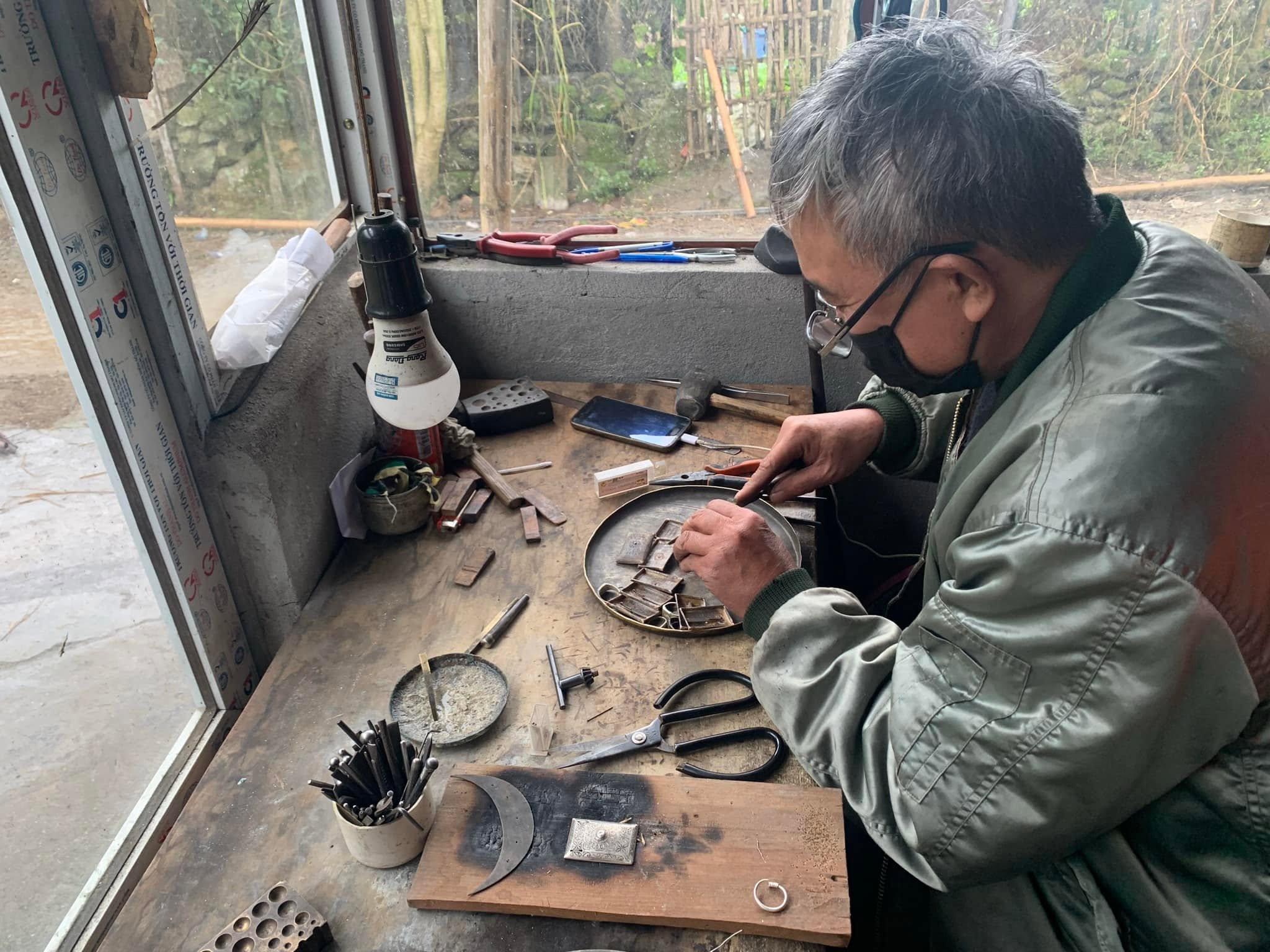
Working with silver requires patience, precision, dexterity, and a strong sense of aesthetics. Creating a finished piece of Hmong silver jewelry involves a series of carefully connected stages, from melting and casting the metal to shaping, engraving, repairing, and polishing.
The traditional toolkit includes a bellows called pux, a furnace known as áng, a silver-melting pot called lò cox, and casting molds known as đangz giôz.
Hammers, known as traurx, include several types such as the buffalo-horn hammer cừ traurx nhux cú, the hand-grip hammer traurx, a medium-sized hammer, and a small hammer. Each is used according to the requirements of a particular stage of shaping.
Iron tongs, known as kè, come in three main forms. The long type is used to stir charcoal, lift the silver-melting pot, or adjust its position inside the furnace. A shorter type is mainly used to handle pieces during quenching and while working with hot silver. The smallest tongs are used to hold silver during final shaping on the anvil.
All three types generally have long, slightly curved jaws and wooden handles.
The thái anvil provides the heavy supporting surface required during shaping. Artisans also use a set of engraving chisels made from iron nails, each designed for a different type of decorative pattern.
Ná tram is used for tiny motifs, tủ ma for dotted patterns, khó chủ for long lines, and chầy nấy nix for semicircular motifs. Another tool, sừ phăng, is used to create square-shaped patterns.
Together, these simple tools form a specialized traditional toolkit that reflects generations of Hmong knowledge in working with precious metals.
Traditional Silver and the Selection of Materials
In the past, the primary silver used by Hmong artisans often came from old Indochinese silver coins, commonly known as hoa xòe. Families in the Hmong community and other highland communities traditionally preserved these coins from one generation to the next.
Such old silver is now rare and has considerable economic value. When a family needed silver but had no stored supply, it could purchase the metal or exchange livestock with another family in the community.
Selecting the right material is an important part of the craft. Artisans must be able to distinguish between different qualities of silver. Silver containing excessive impurities may break apart during processing and fail to achieve the desired whiteness and purity, reducing both its quality and value.
The artisan therefore needs knowledge not only of engraving techniques but also of the characteristics of silver, including how it behaves under heat and during shaping.
The Traditional Silver-Making Process
Hmong silver engraving requires patience, diligence, and creativity because a finished piece must pass through numerous intricate stages.
The traditional process includes preparing and heating the furnace, known as cháu lán tôx, heating the silver or nhà dàng, casting it in a mold or giố nhiax, shaping the silver on the anvil or chaux paux, engraving decorative motifs or plòng xux, and finally repairing and polishing the finished piece.
The silver is first heated until it reaches the appropriate state before being poured into a mold to form a basic blank. The artisan then uses hammers and an anvil to stretch, press, bend, and shape the metal.
This stage requires considerable experience. The force of each hammer blow must be carefully controlled so that the silver takes the intended shape without becoming damaged or distorted. Temperature is equally important because the metal must remain sufficiently workable during shaping.
Once the basic form has been completed, the artisan begins engraving the decorative patterns. Small chisels are selected according to the desired motif, producing lines, dots, semicircles, squares, and other details across the surface.
The final stages involve correcting imperfections, refining the details, and polishing the piece to achieve the desired brightness and finish.
Traditional Hmong Silver Jewelry
Hmong silver engraving produces a diverse range of jewelry, combining decorative beauty with spiritual and cultural meanings.
Necklaces are known as pâux cu đăng, while bracelets are called pâux tês. Bracelets come in two principal forms: flat bands and round-section bracelets. Their surfaces may be engraved with realistic representations of flowers, leaves, butterflies, and other motifs.
Particularly significant are protective bracelets known as pâux sux, traditionally made for children and adults who are ill. These protective bracelets come in three forms: ankle bracelets, necklaces, and wrist bracelets.
A pâux sux bracelet usually has a hook clasp at the opening. According to traditional belief, after the bracelet is placed on the wearer, a spiritual practitioner closes the clasp as a symbolic act of keeping the person’s vía, or vital spirit, from leaving the body and preventing harmful spirits from entering.
Earrings, known as vòng che pláx, and decorative hair ornaments are traditional jewelry items associated particularly with women.
Finger rings, called khay, are made in two forms, with either round or flat cross-sections. According to traditional community beliefs, a round-section ring could indicate a person’s marital status, including those who were unmarried or widowed and considering remarriage.
Ritual Practices Associated with the Craft
Silver engraving is closely connected with Hmong spiritual beliefs. Traditionally, the Hmong believe that all things possess a spirit and that the household hearth is governed by a hearth deity.
For this reason, artisans may perform certain ritual offerings during the practice of their craft. These rituals form part of the spiritual traditions that developed alongside the continuation of silver engraving.
Such ceremonies are associated with wishes for a smooth and safe working process, protection from accidents, and the successful completion of silver products without burning or damaging them.
The silver workshop is therefore more than a place of production. It is also a cultural space connected with traditional concepts of spirits, health, protection, and well-being.
Cultural and Artistic Values
Hmong silver engraving in Sa Pa demonstrates a sophisticated combination of traditional metalworking techniques and decorative artistry. From selecting the raw material and controlling heat to shaping silver on the anvil and engraving fine patterns, every stage requires precision and accumulated experience.
Silver objects serve practical and ceremonial purposes at the same time. Protective bracelets are associated with traditional beliefs concerning health, silver jewelry may form part of a daughter’s dowry, and engraved motifs express the community’s aesthetic traditions and cultural identity.
The value of the craft therefore extends beyond the silver itself. It encompasses a body of technical knowledge, spiritual beliefs, family customs, and aesthetic principles embedded in the production and use of each object.
Today, silver ornaments continue to hold an important place in the cultural life of the Hmong people in Sa Pa. They also represent one of the distinctive traditional crafts of Vietnam’s northern highlands.
A National Intangible Cultural Heritage
Hmong silver engraving in Sa Pa is a traditional craft in which metalworking, decorative art, spiritual beliefs, and community customs are closely intertwined.
Across generations, Hmong artisans have preserved traditional methods of working silver with hand tools while passing down knowledge of materials, heating, shaping, and engraving to younger generations.
For its historical, cultural, and scientific values, the traditional craft of Hmong silver engraving in Sa Pa was included in the National Intangible Cultural Heritage List by the Minister of Culture, Sports and Tourism in 2013, under the category of Traditional Craftsmanship.
Basic Information
| Information | Details |
|---|---|
| Heritage | Hmong Silver Engraving in Sa Pa |
| Community | Hmong people |
| Location | Sa Pa, Lao Cai Province |
| Heritage category | Traditional Craftsmanship |
| Main material | Silver |
| Key techniques | Melting, casting, shaping, engraving, and polishing |
| Typical products | Necklaces, bracelets, protective bracelets, earrings, hair ornaments, and rings |
| Cultural values | Metalworking skills, decorative art, spiritual beliefs, and traditional customs |
| Recognition | National Intangible Cultural Heritage, 2013 |