


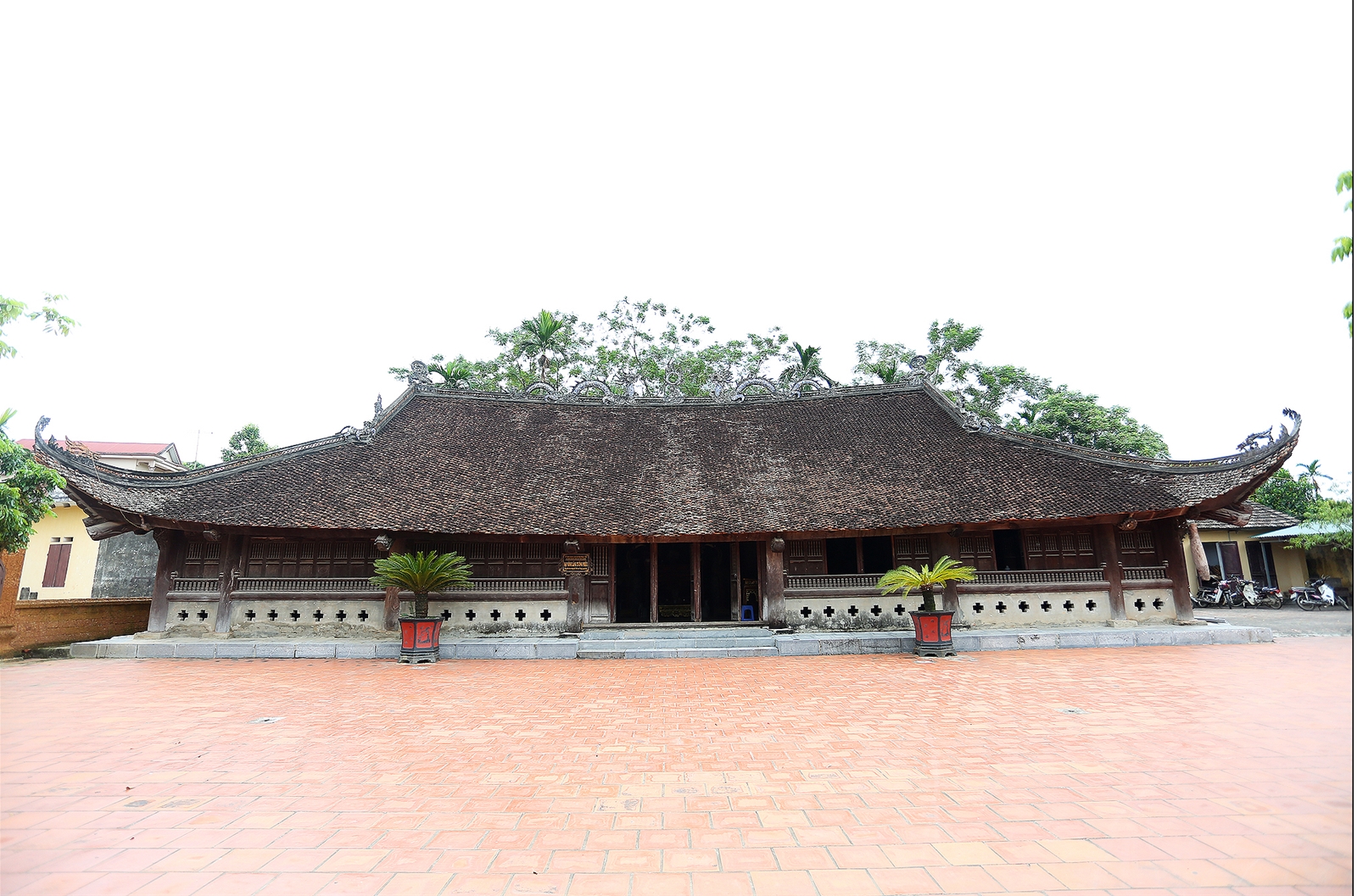
Tuong Phieu Communal House, also known as Dinh Ca, stands in the heart of Tuong Phieu Village, now part of Phuc Tho Commune, Hanoi. This large historic structure preserves distinctive values in architecture, wood carving, religious traditions and community cultural life in the former Doai region.
The communal house is dedicated to the three Great Kings of the highest divine rank associated with Tan Vien Son Thanh: Tan Vien Son Quoc Chua, Cao Son Dai Vuong and Quy Minh Dai Vuong. It also worships Quan Son Thanh Hoang Dai Vuong as an associated deity.
In Vietnamese folk beliefs, Tan Vien Son Thanh is a mountain deity believed to have helped local people control floods, manage water, protect communities and defend the country. He is traditionally honored as one of the Four Immortals of Vietnamese folk belief.
History and Worship of Tan Vien Son Thanh
The worship of Tan Vien Son Thanh holds a particularly important place in the spiritual life of communities around Ba Vi Mountain and the former Doai region. Numerous historic sites around Ba Vi are associated with the worship of Saint Tan, including Thuong Temple, Trung Temple, Va Temple, Ha Temple and Da Den Temple.
Within this network of monuments, Saint Tan is commonly worshipped together with Cao Son and Quy Minh, forming the three deities known as the Three Saints of Tan Vien.
At Tuong Phieu Communal House, six royal decrees and surviving ancestral tablets indicate that the principal deities are worshipped according to a three-position arrangement: the central position, the left position and the right position.
The three principal deities are Tan Vien Son Quoc Chua, a deity of the highest rank, whose personal name is said to have been Tuan, occupying the central position; Cao Son Dai Vuong, whose personal name is Sung, on the left; and Quy Minh Dai Vuong, whose personal name is Hien, on the right. Quan Son Thanh Hoang Dai Vuong is worshipped at a separate altar on the right side of the Great Hall.
According to legend, Tan Vien Son Thanh was originally named Nguyen Tuan. His mother reportedly encountered a golden dragon while fetching water from a well and subsequently became pregnant, giving birth to him after 14 months. Nguyen Tuan lost his father at an early age. From the age of 12, he regularly crossed the Da River to Tan Vien Mountain to gather firewood and help his mother.
After receiving a magical staff with the power to bring life and death from the divine general Bach Tuyet, he used its powers to revive the son of the Dragon King. In gratitude, the Dragon King gave him a magical book of wishes. From then on, Nguyen Tuan traveled widely, helping people and protecting communities from natural disasters and harmful forces.
Toward the end of the Hung Kings period, when Thuc Phan repeatedly sent troops southward, Nguyen Tuan and his two younger brothers, Cao Son and Quy Minh, joined the resistance and helped the Hung King defend the country. After the Hung King offered him the throne, Nguyen Tuan reportedly refused it and allowed Thuc Phan to succeed instead, according to folk tradition. This story is associated with the beginning of the Au Lac period.
Tan Vien Son Thanh therefore became associated with controlling floods, combating natural disasters, protecting communities and supporting the nation. The people of Tuong Phieu subsequently established the communal house to worship him together with Cao Son, Quy Minh and Quan Son Thanh Hoang Dai Vuong.
Quan Son Thanh Hoang is traditionally believed to have been a general who assisted Ngo Quyen in defeating the Southern Han forces. His worship alongside the Three Saints of Tan Vien reflects the development of the local religious tradition through different historical periods.
Tuong Phieu Communal House faces southwest, toward Ba Vi Mountain, which is closely associated with the system of temples dedicated to Tan Vien Son Thanh. The orientation establishes a symbolic religious connection between the village communal house and Tan Vien Mountain, while also reflecting local concepts of sacred space.
According to inscriptions and historical studies, the communal house dates from around the beginning of the 17th century. The Ngo Son Tu Bi stele records a restoration in 1645, during the year At Dau. Over time, the communal house underwent numerous restoration campaigns and accumulated architectural features from periods ranging from the 17th to the 20th centuries.
Nevertheless, the 17th-century structural components and carved panels remain among the most significant historical layers of the monument.
Architecture and Wood-Carving Art
Tuong Phieu Communal House has a “Nhat” shaped layout, consisting of the Ceremonial Gate, courtyard, Great Hall, left covered gallery and several auxiliary structures. Because the complex has no separate Rear Sanctuary, the overall plan has retained its “Nhat” configuration through successive restoration periods.
The Great Hall is a substantial wooden structure consisting of three main bays and two double side bays. It is constructed primarily from ironwood. The structural frame includes four principal roof trusses supported by six rows of columns. The roof trusses follow the traditional “jiachiang and seated bracket” construction style.
The main columns are particularly large, with circumferences of approximately 1.5 to 1.6 meters. The central bay houses the worship chamber of the Three Great Kings of the highest divine rank associated with Tan Vien Son Thanh. The chamber is elaborately carved with a pair of dragons facing a moon and wooden screens decorated with relief carvings of coiling dragons.
Viewed from the courtyard, the Great Hall resembles a large traditional raised-floor house, with gently curved roofs and elegantly upturned corners. The roof ridge features a pair of dragons facing the sun. The two ends of the ridge are decorated with ridge ornaments, while the connecting roof edges feature paired crocodile-like creatures and mythical guardian lions.
Some of these decorative creatures were made from fired ceramic and display characteristics of the Later Le period.
The most outstanding value of Tuong Phieu Communal House lies in its rich and finely executed system of wood carvings. Architectural components such as veranda brackets, projecting supports, decorative panels, projecting beam ends and ceremonial screens are decorated with numerous motifs depicting sacred animals, plants, clouds and scenes from everyday life.
The veranda beams feature motifs including waves, clouds, horses, tortoises carrying the Luoshu diagram, kylins and dragons. The main techniques include deep relief and raised carving. The lines are decisive yet fluid, demonstrating the sophisticated woodworking skills of the craftsmen.
The eight projecting supports along the exterior veranda of the Great Hall are primarily decorated with dragons displaying artistic characteristics of the 18th century. Some dragons are depicted grasping hair or stroking their whiskers, while others feature blade-like motifs crossing their bodies. The dragons generally have four claws and hold pearls in their mouths.
Several carved panels also depict Sun Wukong holding his staff, reflecting decorative layers added during later restoration campaigns.
The decorative panels in the Great Hall feature a variety of subjects, including mother and young dragons, phoenixes, deer, kylins and other sacred creatures. Projecting beam ends are transformed into stylized dragon heads with flared mouths, bulging eyes and bat-like ears, while hair and whiskers are rendered as flowing blade-like lines.
The treatment of curved forms and fine details gives the carvings a vivid sense of movement.
The dragon imagery at Tuong Phieu Communal House is particularly representative of 17th-century sculpture in the former Doai region. The dragons have forward-facing heads, large eyes, spread ears and thick lips, creating a powerful yet approachable appearance characteristic of folk art.
The blade-like scales and extensions along their bodies are relatively large but do not appear rigid because of the delicate incised lines running through them. This artistic approach combines distinctive 17th-century characteristics with traces of the artistic influence of the Mac period.
Alongside sacred animals, the communal house preserves carvings depicting the lives and beliefs of contemporary communities. One notable subject is the story known as “Father and Son Ba Vang Carrying Offerings to the Communal House,” together with numerous images of phoenixes, guardian lions and other mythical creatures.
These carvings serve not merely as decoration but also as valuable visual evidence of the cultural life, religious beliefs and folk art of Vietnamese communities in the past.
The ceremonial screen, or Y Mon, inside the Great Hall is also elaborately decorated. It creates an important visual focal point while softening the strong geometric lines of the columns, beams and other wooden structural components.
The combination of raised carving, openwork carving and deep relief creates a layered decorative system with considerable visual depth.
Artifacts, Festivals and Cultural Value
Tuong Phieu Communal House preserves a rich collection of historical artifacts and antiques in various materials. The collection includes 44 artifacts and antiquities, notably six Nguyen Dynasty royal decrees, three ceremonial palanquins displaying artistic characteristics of the 17th and 18th centuries, three sets of royal thrones and ancestral tablets dating from around the first half of the 18th century, and ancient ceramic incense burners from Tho Ha displaying artistic characteristics of approximately the 18th to 19th centuries.
The monument also preserves ceremonial garments, bronze candle stands and numerous other objects used in religious practices.
The surviving architectural structures and artifacts demonstrate the long process through which a community religious institution was established, restored and developed. In particular, the 17th-century architectural components and carved panels help clarify the artistic character of communal houses in the former Doai region during this period.
Beyond its role as a place of worship, Tuong Phieu Communal House has long served as a center of community cultural life. Every year, villagers hold a festival during the first lunar month to commemorate the deities worshipped at the communal house and pray for peace and favorable harvests.
The Tuong Phieu Communal House Festival usually lasts for three days, from the 14th to the 16th day of the first lunar month. One of its most important ceremonies is the procession of the Saint, carried out under the glow of ceremonial torches, creating an atmosphere that is both solemn and visually distinctive.
The festival also provides an opportunity for community members to meet, participate in cultural activities, maintain traditional customs and strengthen local social bonds.
In 1993, Tuong Phieu Communal House was recognized by the State as a national monument. In recognition of its outstanding historical, architectural, artistic, religious and community-cultural values, the Prime Minister classified Tuong Phieu Communal House as a Special National Monument under Decision No. 1820/QD-TTg dated December 24, 2018.
This recognition confirms the exceptional importance of Tuong Phieu Communal House within Vietnam’s architectural and artistic heritage. After nearly four centuries, the communal house continues to preserve numerous architectural components, wooden structures, carved panels and valuable artifacts, while remaining an active religious and cultural space for the Tuong Phieu community.
Tuong Phieu Communal House is therefore not only a place of worship dedicated to the Three Saints of Tan Vien and Quan Son Thanh Hoang but also a living record of communal-house architecture and art in the former Doai region.
The heritage preserved here reflects the creative abilities of Vietnamese craftsmen, the spiritual life of agricultural communities and the enduring vitality of local culture across generations.


