


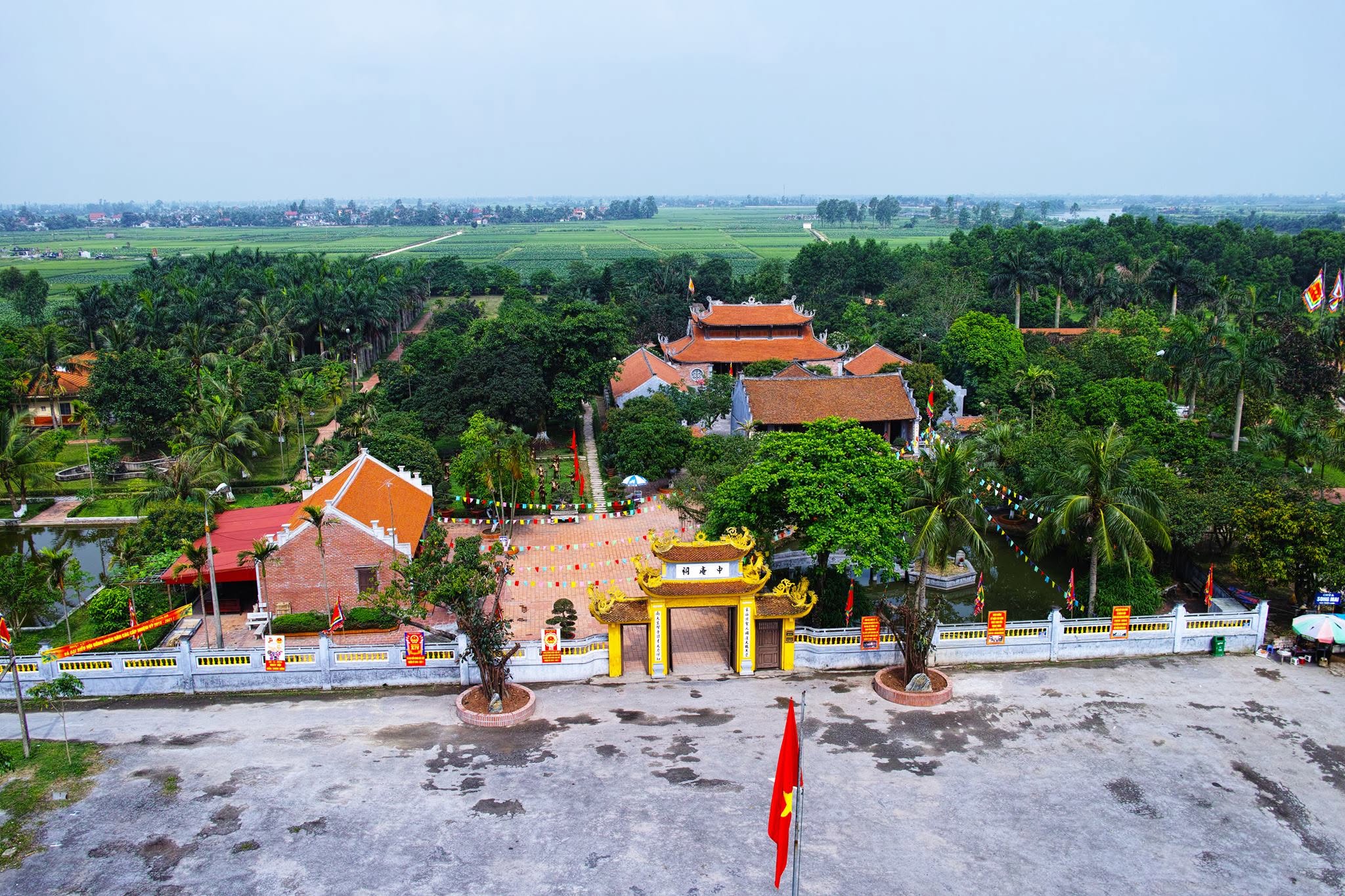
Nguyen Binh Khiem Temple, also known as Quan Trang Temple or the Temple of Trang Trinh Nguyen Binh Khiem, is located in Village 5, Nguyen Binh Khiem Commune, Hai Phong City. The site is closely associated with the life, career and legacy of Nguyen Binh Khiem, the top laureate of the Mac dynasty, as well as a prominent Vietnamese thinker, educator, poet and cultural figure of the 16th century.
The temple is not only a memorial site dedicated to one of the most influential intellectuals in Vietnamese history, but also an important space for local cultural and religious activities. The heritage complex occupies the former Trung Am village landscape, where numerous places connected with Nguyen Binh Khiem’s family, teaching career and literary activities have been preserved.
Nguyen Binh Khiem and the Formation of the Heritage Site
Nguyen Binh Khiem, whose birth name was Van Dat, courtesy name Hanh Phu and literary name Bach Van Cu Si, was born in 1491 in Trung Am Village, Vinh Lai District, Hai Duong Province, in what is now Ly Hoc Commune, Vinh Bao District, Hai Phong. In the 1535 examination held under King Mac Dang Doanh, he ranked first among the doctoral laureates and received the title of Trang Nguyen, the highest academic distinction of the imperial examination system.
After passing the examination, Nguyen Binh Khiem held a number of important positions at the royal court, including Dong Cac Hieu Thu, Huu Thi Lang and Dong Cac Dai Hoc Si, before becoming Minister of the Ministry of Personnel and later Thai Bao. He was also granted the title Trinh Quoc Cong.
In 1542, after submitting a petition requesting the execution of 18 powerful officials accused of abusing their influence, but receiving no approval, Nguyen Binh Khiem resigned from office and returned to his hometown. He established Trung Tan Pavilion and built Bach Van Hermitage as a place to live, teach, study, write poetry and receive visitors. From then on, he was known as Bach Van Cu Si.
Although he no longer directly participated in government affairs, Nguyen Binh Khiem continued to command considerable respect from the Mac court, which frequently sought his advice on important matters of state. Bach Van Hermitage also became a place where many talented scholars studied, including Phung Khac Khoan, Luong Huu Khanh and Giap Hai.
His influence extended beyond politics and education to philosophy, ethics and social thought. He was respected by contemporary and later scholars, while his students honored him with the title Tuyet Giang Phu Tu.
Nguyen Binh Khiem died on the 28th day of the 11th lunar month in the year At Dau, corresponding to 17 January 1586, at the age of 95. He left a substantial literary legacy of more than 1,000 poems, including approximately 620 poems written in Classical Chinese and 153 poems in Nom script that are widely known today. His major works include Bach Van Am Thi Tap and Bach Van Quoc Ngu Thi Tap. His poetry reflects his attachment to his homeland and country, his philosophy of life, his concern for society and his criticism of corruption and abuse of power.
According to historical sources, the temple was built after his death and completed toward the end of 1586. However, the inscription known as the “Tu Vu Bi Ky”, erected in 1736 during the second year of the Vinh Huu reign, records that the people of Trung Am Village and Thuong Am Canton contributed money and labor to restore and embellish the temple in 1735. The temple was renovated again in 1928, when its architecture followed a “Dinh” shaped layout characteristic of Nguyen dynasty art.
In 1991, on the occasion of the 500th anniversary of Nguyen Binh Khiem’s birth, the heritage site underwent restoration, reconstruction and expansion. New elements including a monument, square and semicircular lake were added, creating much of the landscape seen today.
The temple faces east, with a lake in front. To the north are the dyke and Tuyet Giang River, while the eastern side opens toward the sea. Villages lie to the south, while green rice fields and tobacco fields extend to the west. The entire heritage complex covers approximately 91,500.7 square metres, including Zone I of 3,137.5 square metres and Zone II of 88,327.2 square metres.
Major features include the Nguyen Binh Khiem Temple, the Temple of his parents, Bach Van Hermitage, Trung Tan Pavilion, Kinh Thien Pen Tower, the tomb of Nguyen Van Dinh, the monument square and the statue of Nguyen Binh Khiem.
Architecture and Major Structures
The approach to the temple passes through an outer and inner ceremonial gate. The outer gate is carved from stone. The tops of the two central pillars are shaped like gardenia fruits, while the two side pillars are decorated with pairs of guardian lions facing inward. Lantern-shaped sections on the pillars contain carvings of the four sacred creatures in various forms, while the pillar bodies feature Chinese parallel inscriptions.
The inner gate has a two-tiered, eight-roof design, with curved corners decorated with dragons and phoenixes. Chinese inscriptions and horizontal plaques are displayed on the gate. The exterior bears the words “Trung Am Tu”, while the interior bears “Trinh Quoc Cong”, referring to the temple and the title bestowed on Nguyen Binh Khiem.
In front of the temple are the Thai At and Thai Nham ponds. A small island in the middle of the water is connected to the shore by a five-span bridge made of green stone. The bridge is decorated with flowing water motifs, creating a harmonious relationship between the architecture and surrounding landscape. A stone stele on the island records the reconstruction of the temple.
The main temple follows a “Dinh” shaped layout, consisting of a three-bay Front Ceremonial Hall with two side sections and a two-bay Inner Sanctuary. The Front Hall has four roof frames and 22 ironwood columns. Its main roof frame uses a traditional stacked-beam structure. The wooden components feature relief carvings of curling leaves, lotus petals, dragons, clouds, waves, carp, lotus flowers and stylized dragon motifs.
The four projecting beam ends are decorated with openwork and relief carvings of dragon heads, reflecting the artistic style of the early 20th-century Nguyen dynasty. The decorative wooden panels between the roof frames are densely carved, demonstrating sophisticated traditional craftsmanship.
The Inner Sanctuary has enclosed gable walls and a roof structure combining decorative panels with stacked beams. Decorative motifs include paired dragons facing the sun, plum blossoms, lotus branches, turtles, dragon horses and other traditional patterns. The innermost chamber contains the altar and statue of Nguyen Binh Khiem.
The Temple of Nguyen Binh Khiem’s parents was begun in 2010. Its main layout follows a “Cong” shape and consists of a Front Ceremonial Hall, connecting passage, Inner Sanctuary, two auxiliary halls and northern and southern gates. The buildings follow traditional architectural forms, using stacked-beam and column structures, decorative wooden panels and traditional curved roof tiles. Floral vines, curling leaves and lotus motifs decorate the wooden components.
Bach Van Hermitage was established after Nguyen Binh Khiem resigned from government service and returned home. It served as his residence, school and a place where envoys and officials from the Mac, Trinh and Nguyen dynasties came to seek his advice on military and political affairs. After deteriorating over a long period, the hermitage was reconstructed in 2004 with a “Nhat” shaped layout. The three-bay building is supported by four roof frames and 24 columns. Decorative elements include lotus-shaped column bases, curling leaves, stylized dragons and relief carvings on beams and eaves.
Trung Tan Pavilion was built by Nguyen Binh Khiem after leaving government service to teach in his hometown. It was originally located beside the Han Ferry and was associated with his teaching activities and interactions with local people and visitors. Records by Vu Phuong De in 1742 and Nguyen Thiep in 1777 indicate that the pavilion had deteriorated and disappeared sometime between the two accounts. It was reconstructed in 2001 as a three-bay building within a site covering approximately 905.5 square metres.
Kinh Thien Pen Tower covers approximately 845.5 square metres. According to local tradition, the tower was built by Nguyen Binh Khiem’s students more than 400 years ago to honor their teacher’s talent and virtue, symbolically comparing him to a pen reaching toward heaven. The original structure eventually collapsed, and it was rebuilt during the Nguyen dynasty in a two-tiered, eight-roof design. The tower contains Chinese parallel inscriptions and an incense burner.
The tomb of Nguyen Van Dinh, Nguyen Binh Khiem’s father, lies behind the main heritage complex. Nguyen Van Dinh was known by the literary name Cu Xuyen Tien Sinh and was granted the title Thai Bao Nghiem Quan Cong by the Mac court. He was an educator and had studied at the royal academy. After his death, he was buried in his native Trung Am.
The monument square and statue of Nguyen Binh Khiem form the largest open space within the heritage complex and serve as a venue for festivals, cultural activities and educational events. The statue is carved from granite and measures 5.7 metres high and weighs approximately 8.5 tonnes. It depicts Nguyen Binh Khiem seated with a writing brush in his right hand and a book in his left, dressed as a Confucian scholar.
Two large relief panels beside the statue depict episodes from Nguyen Binh Khiem’s life and career as well as important periods in the history of the local area, from the French colonial period to the present.
Artifacts, Festivals and Heritage Values
The Nguyen Binh Khiem Temple preserves numerous historical artifacts dating from the 17th century to the early 20th century, including ritual texts, ceremonial objects, palanquins, ancestral tablets, parallel inscriptions, horizontal plaques and traditional worship objects.
Among the most notable artifacts is the “Tu Vu Bi Ky” stone stele erected in 1736. Although many characters have become difficult to read, the stele remains an important source of information about the restoration and history of the temple. Other objects include an 18th-century yellow-brown glazed ceramic incense burner and a rectangular green stone engraved with three Chinese characters meaning “Everlasting Spring Bridge”. According to local tradition, the inscription was written by Nguyen Binh Khiem himself when he encouraged local residents to build a bridge for the benefit of the community.
The annual temple festival is held from the 27th to the 29th day of the 11th lunar month, coinciding with the anniversary of Nguyen Binh Khiem’s death. Traditional ceremonies include ritual bathing, the procession of ceremonial texts and offerings, together with cultural performances and folk activities such as wrestling, Chinese chess, lion and unicorn dances, boat racing, clay firecracker games, traditional swings and water and land puppetry.
The festival provides an opportunity for local communities to commemorate Nguyen Binh Khiem’s talent, contributions and moral character while expressing the traditional Vietnamese values of respect for teachers and remembrance of one’s roots.
At the beginning of each new academic year, Hai Phong City also holds ceremonies at the heritage site to honor outstanding students. These activities connect the historical heritage of Nguyen Binh Khiem with contemporary education and encourage younger generations to follow his example through learning, personal development and service to their community.
Nguyen Binh Khiem Temple brings together important historical, cultural, educational, architectural and artistic values. The site preserves the memory of a distinguished scholar, top imperial laureate, educator and poet while reflecting the long tradition of learning in the Vinh Bao region.
Bach Van Hermitage, Trung Tan Pavilion, Kinh Thien Pen Tower, the temples dedicated to his parents, the lakes, monument square and statue together form a memorial landscape combining the traditional village environment with historic architecture and cultural memory.
For its outstanding historical and cultural significance, the Nguyen Binh Khiem Temple Historical Site, formerly in Vinh Bao District, Hai Phong City, was recognized as a Special National Monument under Prime Minister’s Decision No. 2367/QD-TTg dated 23 December 2015.


