Binh Dinh Bai Choi Art is a distinctive form of Vietnamese folk performing art that brings together traditional games, music, poetry, acting, and improvisation. Emerging from springtime community gatherings, Bai Choi has developed into a vibrant cultural practice where people meet, play, enjoy performances, and pass cultural knowledge from one generation to the next.
Binh Dinh is one of the regions with a long and rich tradition of Bai Choi. Alongside the familiar Bai Choi festival, with its card-drawing and poetic calling tradition, the province has preserved older forms of Bai Choi performance, including storytelling Bai Choi, Bai Choi scenes, and solo Bai Choi performances. Its interaction with Hat Boi, the traditional Vietnamese classical theatre of Binh Dinh, has also contributed to the distinctive character of local Bai Choi.
Binh Dinh Bai Choi Art was included in Vietnam’s National Intangible Cultural Heritage List in 2014. In 2017, The Art of Bai Choi in Central Vietnam was inscribed by UNESCO on the Representative List of the Intangible Cultural Heritage of Humanity.
- Heritage name: Binh Dinh Bai Choi Art
- Category: Folk performing art
- Location: Binh Dinh
- Cultural space: Central Vietnam
- Key characteristics: Bai Choi festivals, Bai Choi calling, music, poetry, performance, and improvisation
- Major forms: Bai Choi festivals, storytelling Bai Choi, Bai Choi scenes, and solo Bai Choi
- National recognition: National Intangible Cultural Heritage, 2014
- Decision: No. 2684/QD-BVHTTDL, dated August 25, 2014
- UNESCO inscription: The Art of Bai Choi in Central Vietnam
- UNESCO inscription year: 2017
Origins and Development
The origins of Bai Choi are commonly associated with watchtowers built on agricultural fields in Central Vietnam. In their early form, these simple structures were used to observe and protect crops while allowing people positioned in different locations to communicate with one another.
From this setting, forms of communication through singing, riddles, and verbal exchanges gradually developed into a folk game. Over time, Bai Choi spread from upland areas to lowland villages, rural communities, and coastal regions throughout Central Vietnam.
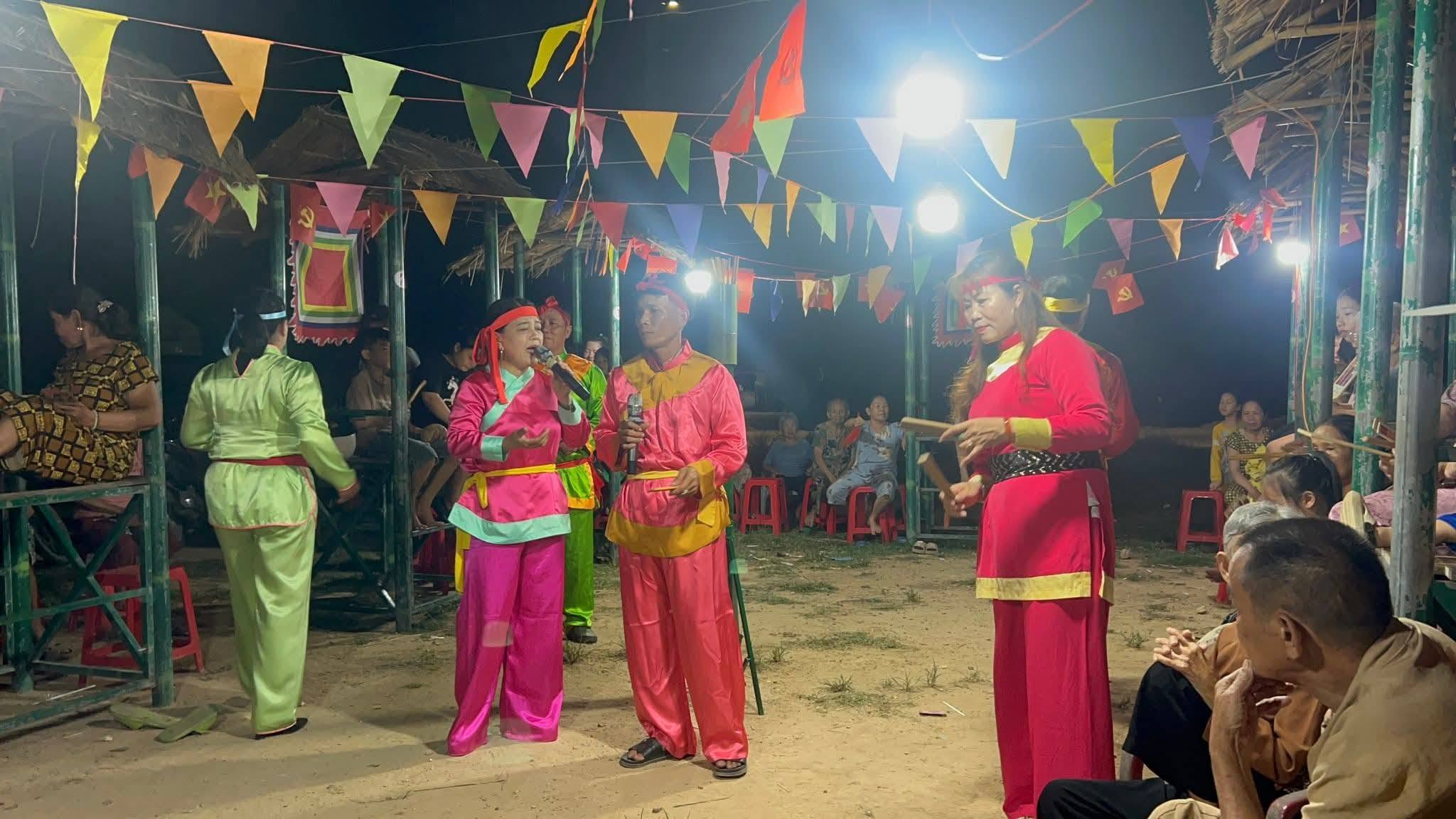
During Tet and the spring season, Bai Choi festivals became a familiar form of community life. Bamboo and thatched huts were erected in communal courtyards, village grounds, or open spaces where people could gather and participate.
In Binh Dinh, Bai Choi developed particularly strongly and gradually acquired more sophisticated theatrical forms. What began as a community game evolved into a performing art capable of telling stories, creating characters, and expressing a wide range of emotions.
Bai Choi Festivals and the Art of Calling
A traditional Bai Choi festival is usually held in a communal courtyard, village grounds, or another spacious and level area. Bamboo and thatched huts are arranged in a U-shaped formation. Depending on the locality, there may be nine or eleven huts.
The hut positioned at the center of the base of the U is known as the Chòi Cái, where the Hiệu sits and conducts the game.
Players receive cards according to traditional rules and sit inside their huts, waiting for the Hiệu to call out the corresponding cards. Rather than simply announcing the name of each card, the Hiệu uses songs, folk verses, proverbs, riddles, or improvised lines to provide clues.
Players listen carefully and identify whether the called card is among those they hold. The game continues until a player completes the required combination of cards.
Bai Choi is not primarily about gambling or competition for material gain. It is a communal form of entertainment, social interaction, and artistic enjoyment. Often, the most engaging part is not the prize itself, but the way the Hiệu transforms a simple card into a song, a story, or a humorous exchange.
The Hiệu therefore occupies a special position within the Bai Choi tradition. A skilled Hiệu must have a strong singing voice, know numerous melodies, folk songs, proverbs, and poetic forms, and possess the ability to improvise quickly while maintaining the atmosphere of the gathering.
Music is another essential element. Instruments such as the đàn nhị fiddle, song loan percussion, horn, and drum are commonly used to establish rhythm and accompany the calling. The combination of drums, strings, horns, and the Hiệu’s voice creates the distinctive soundscape of a Central Vietnamese Bai Choi festival.
The Traditional Bai Choi of Binh Dinh
One of the distinctive features of Binh Dinh Bai Choi is that it extends beyond the card-drawing festival and the calling of cards. Over the course of its development, older forms of Bai Choi performance emerged, notably storytelling Bai Choi, Bai Choi scenes, and solo Bai Choi.
These forms demonstrate how a folk game could develop into a performing art with narratives, characters, and diverse performance techniques. They also reflect the interaction between Bai Choi and Hat Boi, which has a long-standing theatrical tradition in Binh Dinh.
Storytelling Bai Choi
Storytelling Bai Choi is a form in which performers use sung verse and rhythmic narration to tell a story. The repertoire may draw on Vietnamese folk tales such as Thoai Khanh – Chau Tuan and Lam Sanh – Xuan Nuong, as well as stories and episodes from the Hat Boi tradition.
In this form, the Hiệu is no longer simply the person who calls out cards, but becomes a storyteller. The narrative unfolds through singing, narration, dialogue, and physical performance.
Through this combination, Bai Choi can convey stories of love, family, morality, human relationships, and social conduct.
Bai Choi Scenes
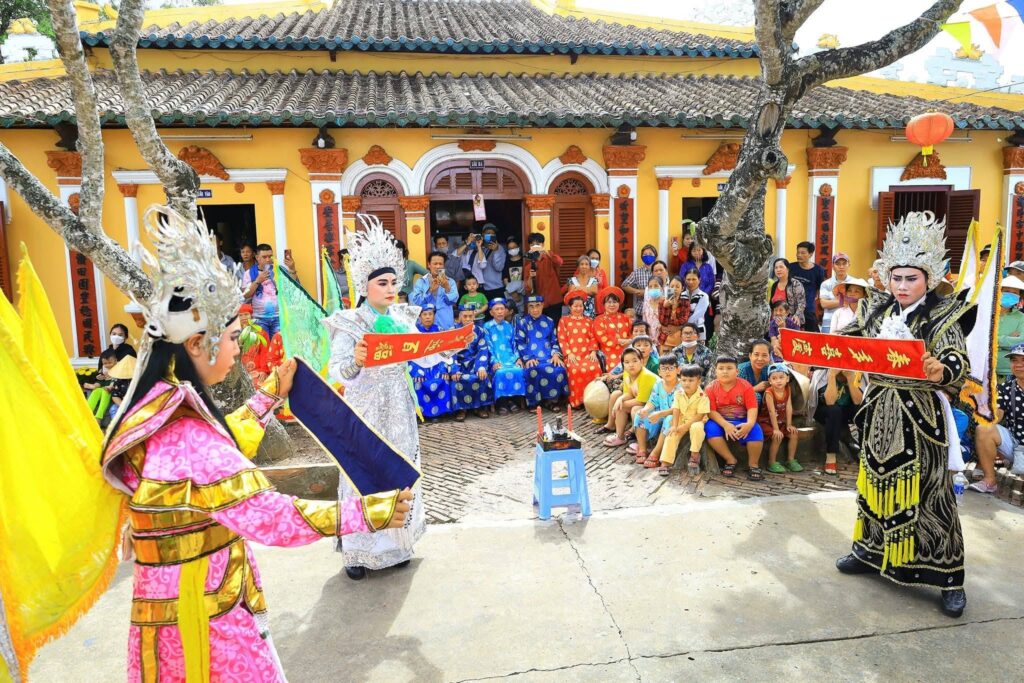
In Bai Choi scenes, performers take on specific characters and present a particular dramatic episode. They may use costumes, makeup, gestures, movement, and singing to portray different personalities.
This form shows a clear influence from Binh Dinh Hat Boi. At the same time, Bai Choi scenes retain the folk character of the tradition and its direct interaction with the audience.
The combination of folk performance and theatrical techniques creates a form that remains close to the community while possessing a strong dramatic and performative quality.
Solo Bai Choi
Solo Bai Choi is a distinctive form of traditional Bai Choi in Binh Dinh. A single performer may take on several roles within the same performance, continuously changing voice, facial expression, gestures, and attitude to portray different characters.
This form requires strong acting ability, excellent memory, and quick improvisational skills. Solo Bai Choi therefore demonstrates the creativity and artistic mastery of traditional folk performers.
Cultural and Artistic Values
Binh Dinh Bai Choi brings together numerous elements of local culture, including music, poetry, language, acting, visual expression, customs, and community life.
One of its most important cultural values is its ability to preserve and reactivate the heritage of Vietnamese folk literature. Folk songs, proverbs, verses, riddles, and traditional stories are flexibly incorporated by performers into individual games and performances.
Its themes are closely connected to everyday life. They may explore romantic love, family affection, village relationships, love of homeland and country, or observations about human nature and social life.
Humorous verses often create laughter, but beneath the humor there are frequently lessons about morality, human relationships, and appropriate conduct.
Improvisation is particularly important because it allows Bai Choi to change according to the circumstances of each performance. A folk verse can become a calling line, a card can provide the starting point for a story, and members of the audience can directly participate in the atmosphere of the performance.
Bai Choi is therefore not simply an art form to be watched and enjoyed. It is also a cultural environment in which communities collectively create, perform, and preserve their shared cultural memory.
Artisans, Community, and Safeguarding
Artisans play a central role in maintaining the Bai Choi tradition. Skills such as poetic calling, singing, improvisation, acting, and performing traditional melodies are generally transmitted through direct practice.
Many artisans begin learning Bai Choi at a young age from their parents or older generations. Through continued performance, they gradually acquire the knowledge and skills needed to pass the tradition on to others.
In Binh Dinh, some artisans continue to preserve techniques associated with traditional Bai Choi, including storytelling Bai Choi, Bai Choi scenes, and solo Bai Choi. These forms represent valuable cultural knowledge that requires documentation and transmission to prevent its gradual disappearance.
The community is equally important. A Bai Choi festival truly comes to life only when players, audiences, and performers participate together.
Safeguarding Bai Choi therefore involves more than preserving melodies and performance techniques. It also requires maintaining spaces for practice, community activities, and transmission between generations.
Bai Choi in Contemporary Life
Today, Bai Choi continues to be practiced in Binh Dinh and throughout many parts of Central Vietnam. Clubs, performances, festivals, cultural exchanges, and teaching activities provide opportunities for artisans to continue practicing and transmitting the heritage.
Bai Choi also appears in cultural programs, festivals, and community activities. For visitors, attending a Bai Choi performance offers more than entertainment. It provides an opportunity to encounter the cultural life and traditions of Central Vietnamese communities.
The experience is particularly interactive. Visitors can sit inside a hut, listen to the drums, wait for the Hiệu to begin calling, and try to identify the card being described. Rather than remaining outside as passive observers, audiences can become part of the performance space itself.
Bringing Bai Choi into contemporary cultural life also creates opportunities for younger generations to approach and experience the heritage in a more accessible way.
National and UNESCO Recognition
On August 25, 2014, Binh Dinh Bai Choi Art was included in Vietnam’s National Intangible Cultural Heritage List by the Ministry of Culture, Sports and Tourism under Decision No. 2684/QD-BVHTTDL.
On December 7, 2017, The Art of Bai Choi in Central Vietnam was inscribed by UNESCO on the Representative List of the Intangible Cultural Heritage of Humanity.
The UNESCO heritage encompasses Bai Choi practices found across several Central Vietnamese localities, with Binh Dinh recognized as one of the regions with a long-standing and distinctive Bai Choi tradition.
These recognitions highlight the cultural significance of Bai Choi while also emphasizing the role of communities and artisans in safeguarding, transmitting, and sustaining the heritage.
Binh Dinh Bai Choi as a Living Heritage
Binh Dinh Bai Choi emerged from community life and continues to survive through community participation. From simple bamboo huts, the sound of drums and the calling voice of the Hiệu have created a distinctive artistic space where games, music, literature, and performance come together.
Its defining quality lies in creativity and interaction. A folk verse can become a calling line, a card can open the way to a story, an artisan can transform into several characters, and an audience member can become part of the performance.
This ability has allowed Bai Choi to move beyond the boundaries of a traditional folk game and become a performing art of considerable cultural value and a living heritage of Central Vietnam.
Binh Dinh Bai Choi is therefore not merely a memory of spring festivals from the past. It continues to be practiced, taught, performed, and developed as part of contemporary cultural life.
Frequently Asked Questions
What is Binh Dinh Bai Choi?
Binh Dinh Bai Choi is a traditional Vietnamese folk performing art that combines games, music, poetry, acting, and improvisation, with a long history of development in Central Vietnam.
Is Bai Choi a form of gambling?
Traditional Bai Choi is primarily a folk game for entertainment and community interaction, rather than an activity centered on gambling or competition for material gain.
Who is the Hiệu in Bai Choi?
The Hiệu is the artisan who conducts the Bai Choi game. The Hiệu draws cards and uses songs, folk verses, proverbs, or improvised lines to give clues to the players.
What are the main forms of traditional Bai Choi in Binh Dinh?
The major forms include storytelling Bai Choi, Bai Choi scenes, and solo Bai Choi.
When was Binh Dinh Bai Choi recognized as heritage?
Binh Dinh Bai Choi Art was included in Vietnam’s National Intangible Cultural Heritage List in 2014. In 2017, The Art of Bai Choi in Central Vietnam was inscribed by UNESCO on the Representative List of the Intangible Cultural Heritage of Humanity.
Is Binh Dinh Bai Choi related to Hat Boi?
Yes. Traditional Bai Choi in Binh Dinh has interacted with the local Hat Boi tradition, particularly in forms such as storytelling Bai Choi, Bai Choi scenes, and solo Bai Choi.
When are Bai Choi festivals traditionally held?
Traditional Bai Choi festivals are closely associated with Tet and the spring season. Today, Bai Choi is also performed throughout the year at festivals, cultural programs, and community events.