


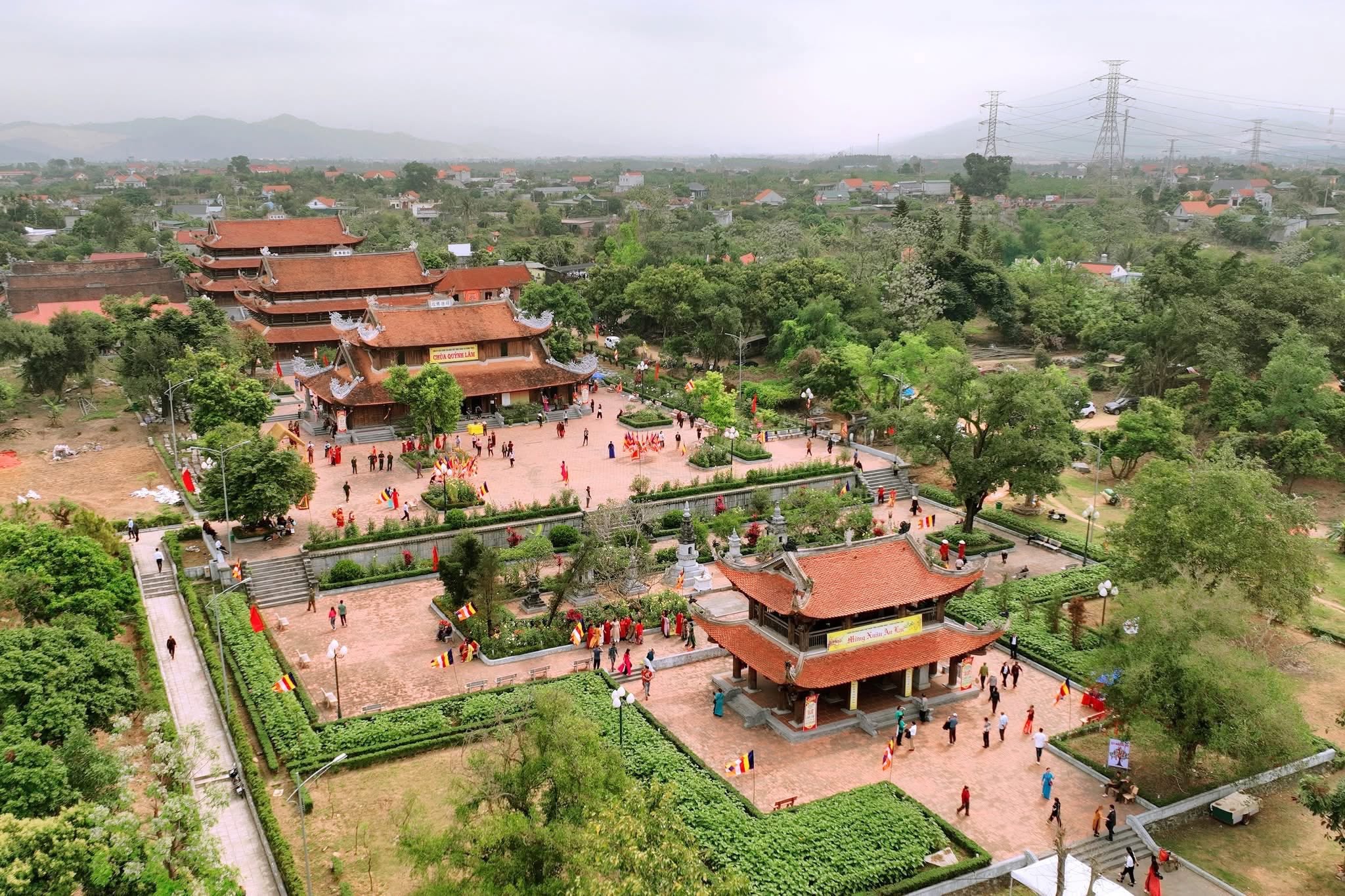
The Tran Dynasty Historical Complex in Dong Trieu, also known as the Historical and Cultural Complex of Tran Dynasty Temples and Royal Tombs, is a group of monuments associated with the Tran Dynasty and the formation and development of the Truc Lam Zen Buddhist tradition. The complex is located in An Sinh Ward, Quang Ninh Province.
It is one of the most important historical, cultural, and religious spaces associated with the Tran Dynasty. The area contains royal tombs, temples, shrines, pagodas, hermitages, and archaeological remains that reflect a significant period in the history of Dai Viet.
A Land Closely Associated with the Tran Dynasty
The Tran Dynasty, which ruled from 1225 to 1400, holds a special place in Vietnamese history, particularly for its role in nation-building and the defense of Dai Viet. Dong Trieu is especially significant because it is regarded as one of the early settlements of the Tran family.
According to historical records and Tran family genealogies, the Dong Trieu area was one of the places where members of the Tran family lived from an early period. Later, King Tran Thai Tong granted the area to his elder brother, Tran Lieu, as a hereditary estate. As a result, Dong Trieu maintained a close connection with the Tran royal family and received considerable attention from the royal court throughout different periods.
The complex gradually took shape from the late 13th century, particularly after 1299, when Emperor Emeritus Tran Nhan Tong went to Yen Tu to practice Buddhism and established the Truc Lam Zen tradition. Along with the development of Truc Lam Buddhism, numerous religious structures were built in Dong Trieu.
By the late 14th century, several Tran royal tombs had either been constructed or relocated to Dong Trieu. In addition to the tombs, the court built temples and shrines dedicated to earlier kings, together with religious facilities used for worship, meditation, and Buddhist teachings.
Dong Trieu consequently became a distinctive historical space of the Tran Dynasty and one of the important Buddhist centers of Dai Viet during the Tran period.
Royal Tombs and Religious Monuments
One of the most outstanding features of the complex is its system of Tran royal tombs. Although many structures now survive only as ruins, architectural traces and archaeological excavations have provided valuable information about the layout, scale, construction techniques, and artistic characteristics of Tran-period royal tombs.
Tu Phuc Tomb is situated on a low hill formerly known as An Bai Mountain in the Trai Loc area of An Sinh. It is associated with King Tran Thai Tong and King Tran Thanh Tong. Historical records describe the tomb as a spacious complex surrounded by mountains, with worship halls and burial areas enclosed by walls. Today, mainly architectural foundations and ruins remain. Archaeological test excavations in 2009 uncovered traces of several structures, helping clarify the former scale of the tomb complex.
Thai Tomb is located on Tran Quy Hill in An Sinh and is associated with King Tran Anh Tong and Empress Dowager Thuan Thanh Bao Tu. The tomb was built on a low hill, and archaeological excavations identified a three-level layout. Most of the original structures have since disappeared.
Muc Tomb, associated with King Tran Minh Tong, lies at the foot of Khe Gach Hill in An Sinh. Ancient records indicate that the tomb once consisted of three architectural platforms. Due to the passage of time and historical changes, the complex was almost completely destroyed, with only a few traces remaining below the Trai Loc Reservoir.
Ngai Son Tomb, the burial site of King Tran Hien Tong, is located in the Ao Beo area of Trai Loc 2 Hamlet, An Sinh. Historical documents describe a rectangular layout with a square burial mound at the center and an entrance facing south. Stone statues of animals and court officials were once arranged symmetrically along the entrance path. Archaeological remains include bricks, roof tiles, and decorative architectural materials. Particularly notable are bricks inscribed with the words “Vinh Ninh Truong”, together with roof-tile fragments decorated with lotus petals and scrolling chrysanthemum patterns.
Phu Son Tomb, associated with King Tran Du Tong, was built on a raised area surrounded by lower-lying land and waterways. The site now survives mainly as ruins. Archaeological excavations in 2012 revealed traces of several architectural sections, including the main burial sanctuary, corridors, and enclosing walls, helping researchers reconstruct the former appearance of the tomb.
Nguyen Tomb, associated with King Tran Nghe Tong, is located in the Khe Nghe area of Bai Dai Hamlet, An Sinh. Facing south, the tomb was built on a raised strip of land surrounded by mountains on three sides. Ancient records provide relatively detailed descriptions of its enclosing walls and burial location. Archaeological work has identified important areas such as the main sanctuary, ceremonial space, and burial pit.
Hy Tomb, also known as Dong Hy Tomb, is located on Ngoc Thanh Mountain in Dam Thuy Hamlet, Thuy An. It is associated with King Tran Due Tong and King Tran Thuan Tong. Historical records describe a relatively large complex with enclosing walls, shrines, and architectural foundations. The original structures have disappeared, leaving only archaeological traces.
The complex also includes a number of temples, pagodas, hermitages, and religious sites closely connected with the Tran Dynasty and Truc Lam Buddhism.
An Sinh Temple stands on a hill in Trai Loc Hamlet and is one of the principal sites within the complex. According to historical records, it was originally built during the Tran Dynasty to worship Tran kings. Over the centuries, the temple was rebuilt, repaired, and modified several times.
The present temple covers more than 1,000 square meters and follows a “Cong”-shaped layout, consisting of a front hall, middle hall, and rear sanctuary. It is dedicated to the Tran kings as well as several historical figures and local deities. The grounds preserve numerous valuable objects and architectural materials, including stone steles, bricks, roof tiles, tower fragments, and terracotta decorations dating from approximately the 14th to the 18th centuries.
Thai Temple is located on Dinh Hill in Trai Loc Hamlet. Its predecessor was Tien Mieu, an ancestral shrine built by Tran Lieu, Prince of An Sinh, around the first half of the 13th century to worship the ancestors of the Tran family and Tran Thua.
The site later became a royal ancestral temple associated with the worship of Tran kings. During the Nguyen Dynasty, the structure was damaged, and local residents rebuilt it as Doc Trai Communal House. Archaeological surveys and excavations have revealed two architectural layers dating from the Tran and Nguyen periods, demonstrating the long history of the site.
Ngoa Van Hermitage and Pagoda is located on Bao Dai Mountain at an elevation of approximately 600 meters above sea level, in the former Binh Khe area. It is especially associated with Emperor Emeritus Tran Nhan Tong, the first patriarch of the Truc Lam Zen tradition. Ngoa Van was where he practiced Buddhism and passed away, and it later became a religious center for many eminent monks during the Tran and Le Trung Hung periods.
Archaeological excavations have uncovered traces of numerous structures and artifacts dating from the Tran and Le Trung Hung periods, particularly in the Thong Dan, Da Chong, Three-Tiered Steps, and Ngoa Van hermitage and pagoda areas.
Ho Thien Pagoda, also known as Tru Phong Pagoda, was founded during the Tran Dynasty on the southern side of the Phat Son mountain range in the former Binh Khe area. Local traditions and historical accounts state that Emperor Emeritus Tran Nhan Tong and Phap Loa once delivered Buddhist teachings here. Today, the site mainly consists of foundations and architectural ruins.
Quynh Lam Pagoda is located on Tien Du Mountain in Trang An. Originally established during the Ly Dynasty, the pagoda was greatly expanded under the Tran Dynasty. Phap Loa, the second patriarch of the Truc Lam Zen tradition, enlarged the pagoda and transformed it into a major Buddhist center of the period. It continued to be repaired and expanded during the Le and Nguyen dynasties.
Archaeological excavations have revealed overlapping architectural layers from the Ly, Tran, Le, and Nguyen periods. Important remains include a stone stele decorated with dragons, a dragon pedestal displaying Ly-period artistic characteristics, and a system of ancient stone stupas.
Trung Tiet Pagoda, also known as Tuyet Pagoda, stands on a low hill in Nghia Hung Hamlet, An Sinh. In addition to Buddhist worship, the pagoda honors two loyal officials of King Tran Anh Tong: Confucian scholar Dang Tao and palace servant Le Chung. The present complex has been restored and includes a three-entrance gate, main pagoda, Patriarch’s House, Mother Goddess shrine, and several auxiliary structures.
Ngoc Thanh Pagoda and Taoist Shrine is located on the eastern slope of the Dam Thuy mountain range, near Hy Tomb in Dam Thuy Hamlet, Thuy An. Historical records indicate that the pagoda and shrine were built in the late 14th century in connection with the Dong Hy royal tomb. The original structures have long since disappeared. In 1990, local residents rebuilt a pagoda on the old foundations and established a shrine dedicated to Saint Tran. The site continues to play a role in local religious life.
Moc Cao Hermitage lies on the left bank of the Phu Am Tra stream in Trai Loc Hamlet, approximately 1.5 kilometers northwest of Thai Tomb. It was once the residence of Empress Dowager Thuan Thanh Bao Tu, who lived there while worshipping and caring for the tomb of King Tran Anh Tong. The original structure no longer survives, leaving only foundation remains.
Historical, Archaeological, and Cultural Significance
The importance of the Tran Dynasty Historical Complex in Dong Trieu lies in the way its different layers of heritage are closely interconnected. The royal tombs reflect the imperial landscape and funerary traditions of the Tran Dynasty. The temples and shrines represent ancestral worship and royal rituals, while Ngoa Van, Ho Thien, Quynh Lam, and other religious sites illustrate the development of Truc Lam Buddhism.
The complex also preserves a wide range of artifacts and architectural materials, including stone steles, column bases, decorated bricks and roof tiles, ceramics, stone stupas, and statues of mythical animals. Archaeological discoveries at the tombs, temples, and pagodas have enriched knowledge of architecture, sculpture, religious practices, and cultural life across different historical periods.
In addition to its tangible heritage, Dong Trieu continues to maintain traditional community activities associated with the history of the region. Notable examples include the An Sinh Temple Festival, the Quynh Lam Pagoda Festival, and religious practices at Ngoc Thanh Pagoda and Taoist Shrine.
Special National Relic
Because of its outstanding historical, cultural, architectural, archaeological, and religious values, the Tran Dynasty Historical Complex in Dong Trieu was recognized by the Prime Minister as a Special National Relic under Decision No. 2383/QD-TTg dated December 9, 2013.
According to the official classification dossier, the protected area covers 22,063,054.5 square meters, including royal tombs, temples, shrines, pagodas, hermitages, and other religious structures associated with the Tran Dynasty and the Truc Lam Zen tradition.
Today, the Tran Dynasty Historical Complex in Dong Trieu offers an important setting for exploring the Tran Dynasty, the history of the royal family, the development of Truc Lam Buddhism, and the many cultural layers that have formed in Dong Trieu over the centuries. Every tomb, pagoda, temple, and surviving foundation contributes another chapter to the story of one of the most important periods in Vietnamese history.


