


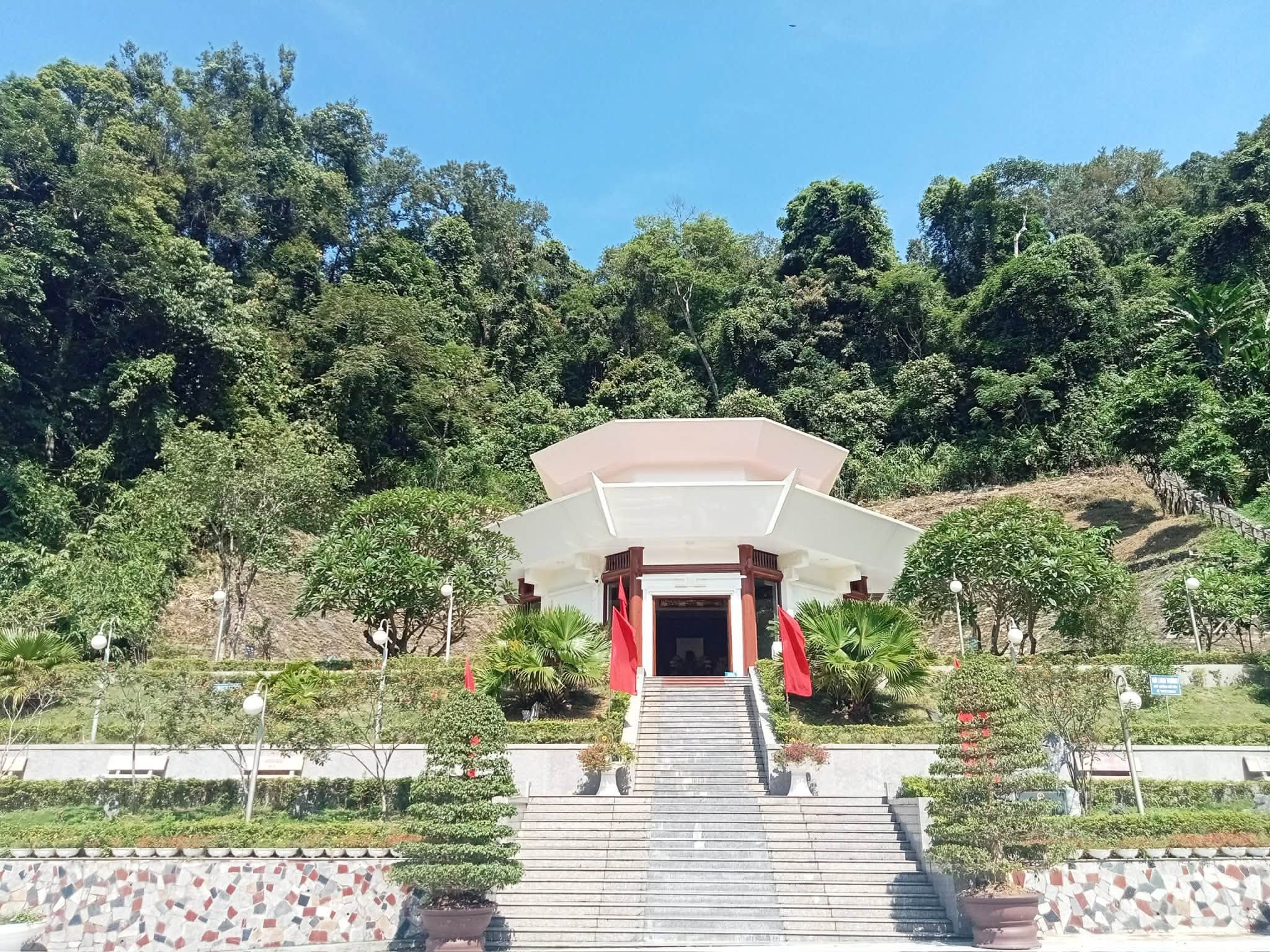
The Tran Hung Dao Forest Historical Site is closely associated with the establishment of the Vietnam Propaganda Liberation Army on December 22, 1944, the forerunner of the Vietnam People’s Army today. It is one of the most important sites in Vietnam’s revolutionary and military history, marking the early formation of the country’s revolutionary armed forces.
The site is located across Tam Kim and Hoa Tham communes, Nguyen Binh District, Cao Bang Province. The complex includes Tran Hung Dao Forest, Tham Khau Cave, Phai Khat Fort, Va Pha, and Na Ngan Fort.
The Birthplace of the Vietnam Propaganda Liberation Army
On December 22, 1944, in a forested area around Den Sinh Mountain, General Vo Nguyen Giap, acting on behalf of President Ho Chi Minh, announced the directive establishing the Vietnam Propaganda Liberation Army.
The unit consisted of 34 soldiers organized into three platoons under the command of Vo Nguyen Giap. It was the first main armed force of the Vietnamese revolution, established under extremely difficult conditions with a dual mission: to fight the enemy while spreading revolutionary ideas, mobilizing local people, and developing the revolutionary movement.
Following the establishment ceremony, the soldiers took an oath beneath the red flag with a yellow star. The ten solemn pledges made at that ceremony later became part of the traditional heritage of the Vietnam People’s Army.
Only three days after its formation, the unit won its first battle by attacking Phai Khat Fort on December 25, 1944. The following day, December 26, it continued its campaign by attacking Na Ngan Fort and achieving another victory. These two opening battles were of great significance, demonstrating the combat capabilities of the revolutionary armed forces during their earliest days.
Tran Hung Dao Forest is a primary forest covering approximately 201.7 hectares. Its rugged mountainous terrain was well suited for establishing bases, organizing secret activities, and conducting guerrilla warfare.
The location was once described as having a strategic position where “one could advance to attack and retreat to defend.” Its natural terrain allowed the revolutionary forces to observe the surrounding area, move discreetly, and preserve their strength when necessary.
The central site of the army’s establishment is a relatively flat area in the middle of the forest, where the formation ceremony took place on December 22, 1944. In 1994, a two-story, eight-roof memorial stele house was built here. The four-sided stele records the directive establishing the Vietnam Propaganda Liberation Army, the ten oaths taken during the ceremony, and the names of the unit’s original 34 soldiers.
Approximately 30 meters from the central stele house are the former resting hut and kitchen area of the unit. These structures have been reconstructed to recreate the simple living conditions of the soldiers during the early period. The resting hut follows the traditional style of houses in the northern lowlands, with a kitchen located nearby.
About 50 meters downhill from the hut and kitchen is a spring once used by the soldiers for daily water. The stream continues to flow, and the area also contains ancient dracontomelon trees associated with the unit’s activities.
Slam Cao Peak, located on Den Sinh Mountain, was used by Vo Nguyen Giap and the unit’s command staff as an observation point. From the summit, they could monitor important directions, including Phai Khat Fort, Phai Khat Village, Tham Khau Mountain, and Na Ngan Fort. The elevated position provided a strategic advantage for observing enemy movements and understanding the surrounding terrain. A flagpole and memorial stele now mark the site.
Tham Khau Cave and the Early Military Campaigns
Tham Khau Cave is located halfway up a mountain northwest of Phai Khat Village in Tam Kim Commune. The cave is approximately 3 meters deep and 12 meters long. It is dry and spacious enough to shelter around 40 people.
Between 1941 and 1944, the cave was used as a communication point and as a place supporting the delivery of food to revolutionary cadres working in the area. On December 24, 1944, the Vietnam Propaganda Liberation Army gathered here to prepare for the attack on Phai Khat Fort.
A large, relatively flat rock beside the cave was used to draw maps and prepare the attack plans for Phai Khat and Na Ngan forts.
Phai Khat Fort is located near Provincial Road 202, in the middle of Phai Khat Village, Tam Kim Commune. It was the site of the first battle fought by the Vietnam Propaganda Liberation Army on December 25, 1944, just three days after the unit was established.
The fort originally belonged to the house of Nong Van Lac, built in 1940 and covering approximately 210 square meters. The building consisted of four rooms, brick walls, and a sàn nghiến wooden floor made from ironwood. Because of its strategic location along local routes, French forces converted the house into a military post.
During the battle on December 25, 1944, the Vietnam Propaganda Liberation Army quickly took control of the fort. This victory became the opening battle in the combat tradition of Vietnam’s revolutionary armed forces.
Today, Phai Khat Fort has been restored and serves as an additional exhibition space within the historical site. Photographs, artifacts, and documents displayed here recreate the establishment of the unit, its earliest activities, and the support provided by local residents to revolutionary cadres and soldiers.
Na Ngan Fort, located in Hoa Tham Commune, marks the second battle of the Vietnam Propaganda Liberation Army, which took place on December 26, 1944.
The fort was originally the house of Nong Van Pao, also known as Pho Ly Pao, situated on a hill in Na Ngan Hamlet. It was a traditional stilt house with three rooms and two side compartments, covered with tiles and surrounded by several layers of fences.
After the revolutionary unit captured the fort, the original house was later moved to another location and no longer survives at the site. A memorial stele now stands here to commemorate the victory of the Vietnam Propaganda Liberation Army.
Together, the battles of Phai Khat and Na Ngan created the first two victories of the newly established unit. They strengthened public confidence and laid an important foundation for the development of Vietnam’s revolutionary armed forces.
Va Pha is located in a broad and relatively flat valley at the foot of Slam Khau Hill in Tam Kim Commune. The secluded terrain, distance from residential areas, and favorable geographical position made it suitable for secret activities and military training.
In February 1944, the Cao Bang Viet Minh General Headquarters organized a training course here for cadres from across the province. The course was led by Vo Nguyen Giap and Le Thiet Hung.
The training focused on military affairs and the development of revolutionary forces. It was an important preparatory step in terms of personnel and organization, contributing to the establishment of the Vietnam Propaganda Liberation Army later that year.
Today, Va Pha still preserves traces of the former training camp, covering an area of approximately 150 square meters.
Historical and Cultural Significance
The Tran Hung Dao Forest Historical Site is associated not only with a single event but also with the broader process of preparing the organization, personnel, and forces for the birth of Vietnam’s revolutionary army.
From Va Pha, where cadre training was conducted, to Tham Khau Cave, Tran Hung Dao Forest, Phai Khat Fort, and Na Ngan Fort, the sites form a connected historical chain that helps reconstruct the early activities of the Vietnam Propaganda Liberation Army.
The establishment of the unit on December 22, 1944, became a major milestone in the history of the Vietnamese military. December 22 was later designated as the founding anniversary of the Vietnam People’s Army and Vietnam’s All-People National Defense Day.
In addition to its revolutionary and military significance, the site is surrounded by the characteristic mountain landscape of Cao Bang, with relatively pristine forests, rugged terrain, and a mild climate. This makes it suitable for combining historical study with exploration of the natural and cultural landscape of northern Vietnam.
Because of its outstanding revolutionary, military, cultural, and scenic values, the Tran Hung Dao Forest Historical Site was recognized by the Prime Minister as a Special National Relic under Decision No. 2383/QD-TTg dated December 9, 2013.
Today, the site is an important destination for those wishing to learn about Vietnam’s revolutionary history in Cao Bang. Visitors can explore the story of the original 34 soldiers and follow the locations associated with the preparation, establishment, and first victories of the Vietnam Propaganda Liberation Army.
Through its forests, caves, forts, memorials, and reconstructed facilities, the Tran Hung Dao Forest Historical Site preserves the story of a crucial period in Vietnamese history, from the formation of a small unit of only 34 soldiers to the eventual development of the Vietnam People’s Army.


