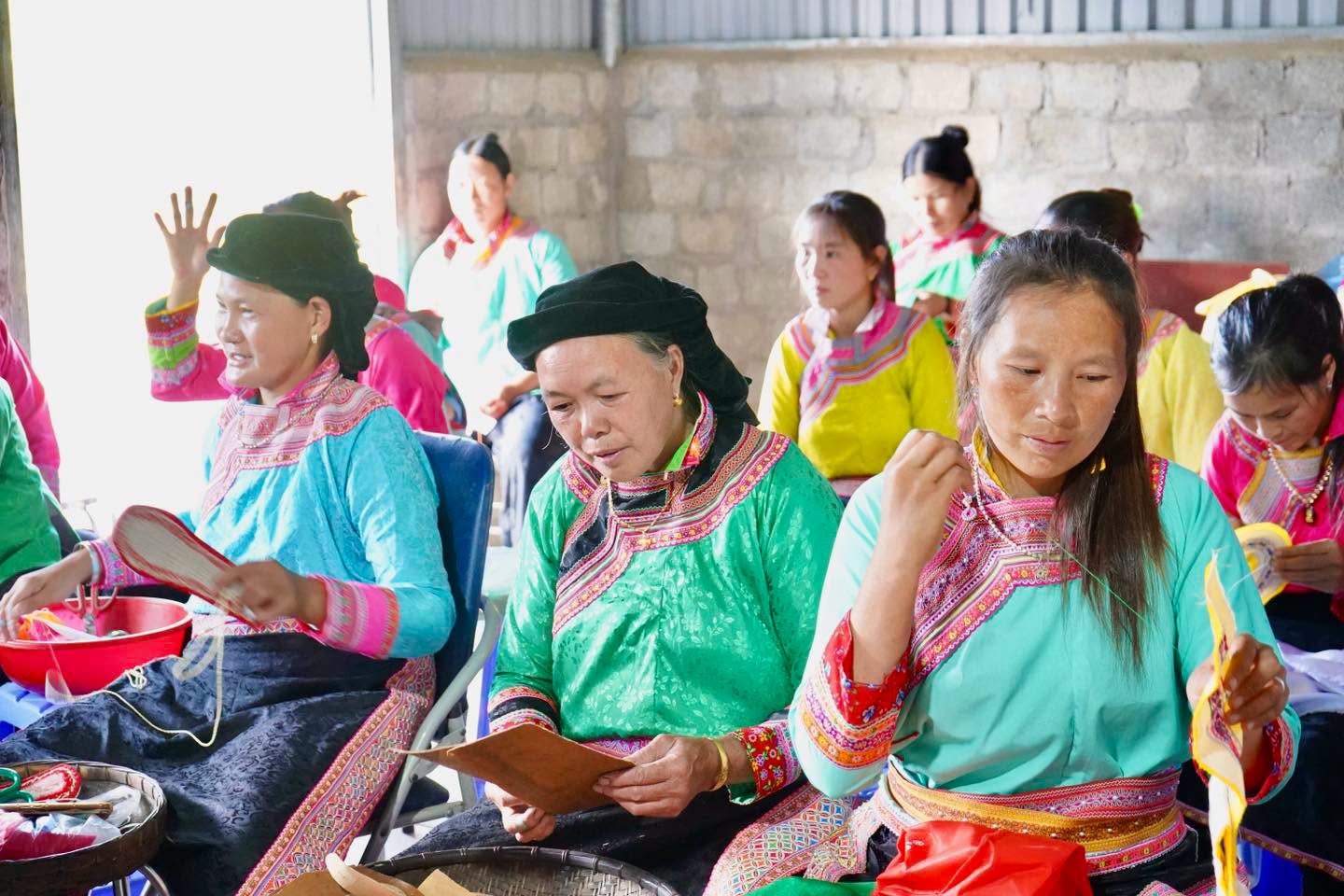
The Hoa people, who call themselves the Xạ Phang, are an ethnic minority community living in Na Sang Commune, Điện Biên Province. They traditionally live in villages organized around clans in areas including Mường Chà, Nậm Pồ, Mường Nhé, and Tủa Chùa. The community has preserved many elements of its traditional cultural heritage, including clothing and elaborately embroidered shoes that demonstrate the artistic skills and technical expertise of Xạ Phang women.
The traditional shoe is called liển hài in the Xạ Phang language. These shoes are handmade and embroidered by women for members of their families, both for everyday use and for keeping for future needs. The Xạ Phang also make specialized shoes sold to the Hmong for use in funeral practices.
There are several types of Xạ Phang shoes, including men’s shoes, women’s shoes, shoes for older people, and shoes specially made for brides and grooms. Shoes for older people and grooms are traditionally black, with rounded and closed toes. Men’s and women’s shoes for younger and middle-aged wearers feature a greater variety of colors and decorative patterns. Women’s shoes have closed toes, while men’s shoes are partly open at the front and along the sides.
A Craft Passed Down Through Families
The knowledge of making embroidered shoes is traditionally passed down within families. From an early age, Xạ Phang girls learn sewing, embroidery, and the making of personal clothing and household items from their grandmothers, mothers, and older sisters. The skills are acquired through observation, practice, and participation in everyday family life.
Making a pair of embroidered shoes involves several stages, from preparing materials and selecting an appropriate design to cutting and stitching the soles, creating decorative patterns, embroidering the uppers, and finally joining the upper, straps, and sole.
The main materials include fabric, bamboo sheath, sewing thread, embroidery thread, adhesive, and dó paper. Traditional tools include scissors, a small knife, sewing needles, embroidery needles, and a piece of dried beeswax.
The fabric used for the sole and upper needs to be thick, strong, and durable. Handwoven fabric made by the Thai community is traditionally used. Sewing thread can be made from the bark of a forest tree known locally as Mà. The bark is stripped from the tree, crushed and softened, boiled, and dried. The thin fibers are then separated, joined, and twisted into thread. Before sewing, Xạ Phang artisans rub the thread with dried beeswax so that it becomes smoother, stronger, less likely to break, and more resistant to water.
The adhesive used for the soles is traditionally made from the tuber of a forest plant known as Mùa Rỉ. The tubers are cleaned, peeled, crushed, mixed with water, and filtered before being cooked into a thick paste.
Embroidery threads come in a variety of colors, including red, pink, blue, and yellow. These brightly colored threads are generally purchased at local markets or from small traders.
From Bamboo Sheath to a Durable Sole
The sole is one of the components that most clearly demonstrates the technical skill involved in Xạ Phang shoe making. Artisans select mature, dry bamboo sheaths, dry and flatten them, then cut them according to the shape of the foot.
A sole is generally assembled from about five layers of bamboo sheath. Each layer is wrapped with a layer of thick, durable fabric to provide strength, rigidity, and thickness. The bamboo layers are bonded together using the adhesive traditionally made by the Xạ Phang.
The layers are then firmly stitched together with thread treated with dried beeswax. This strengthens the stitching and helps reduce water absorption. The underside of the sole is lined with white fabric, while the inner surface is covered with fabric in a color chosen by the artisan. These layers are securely stitched to the sole, creating a durable structure designed for long-term use.
The combination of bamboo sheath, fabric, natural adhesive, and waxed thread reflects the community’s detailed knowledge of local materials and their practical properties. Familiar natural materials are transformed into a functional product with distinctive aesthetic qualities.
Shaping the Upper and Distinguishing Men’s and Women’s Shoes
The upper is cut from white fabric and covered on the outside with a colored layer that serves as the background for embroidered patterns. Its shape varies according to the type of shoe.
For women’s shoes, the upper is made from an arc-shaped piece of fabric attached around the sole, enclosing the foot. The two ends meet at the heel and are stitched together. At this joining point, the artisan adds an embroidered fabric piece that both conceals the seam and reinforces the connection while providing an additional decorative element.
Women’s shoes often feature a large central flower as the main visual focus, surrounded by smaller motifs. Their closed-toe, compact, and graceful form gives them a modest and refined appearance.
Men’s shoes are partly open at the front and on the sides, while the heel and rear section remain connected. This design creates a stronger and more active appearance suitable for everyday movement. The decorative patterns are generally distributed across the upper rather than concentrated in one central motif.
Two principal decorative areas can often be distinguished on men’s shoes: the pattern surrounding the heel and the pattern extending from the instep toward the sides and toes.
A fabric fastening button is also placed on the instep, allowing the wearer to put on and remove the shoes more easily.
Embroidered Patterns and Xạ Phang Aesthetics
The most distinctive feature of Xạ Phang shoes is their colorful embroidered decoration. Both men’s and women’s shoes share many of the same decorative motifs, including stylized flowers and leaves, climbing plants, and geometric patterns such as interlocking diamonds, zigzags, waves, and serrated forms.
Six-petal and four-petal flowers are commonly embroidered together, surrounded by stylized leaves and climbing plants. Geometric motifs are generally placed along the borders, forming a frame around the principal floral patterns.
Strong colors such as red, pink, blue, and yellow are combined to create vivid decorative areas. According to the cultural knowledge associated with the craft, these colors and patterns express the Xạ Phang aesthetic, including a sense of vitality, confidence, optimism, and aspirations for happiness and good fortune.
For major floral and plant motifs, artisans traditionally use dó paper and small scissors to cut pattern templates. The paper templates are then placed on the selected fabric and used as a guide for embroidery. Threads in different colors are combined according to the artisan’s design.
Template cutting is mainly used for major floral and leaf motifs, while geometric patterns can be embroidered directly onto the fabric. Experienced artisans may work without templates because the patterns have become deeply embedded in their memory through years of learning and practice.
This ability to remember, adapt, and combine motifs gives individual pairs of shoes their own character. Each pair therefore represents not only a functional object but also the accumulated knowledge and creativity of its maker.
Final Assembly and Cultural Value
Once the upper has been completed, the artisan joins it to the sole. Strong, thick thread is used for the final stitching. The stitches are carefully concealed so that they do not appear rough or prominent on the outside, ensuring both durability and aesthetic quality.
Xạ Phang embroidered shoes combine technical knowledge, color coordination, pattern design, and meticulous handwork. Every motif, stitch, and thread reflects the care and skill of the women who make them. From familiar natural materials, artisans create shoes with distinctive forms, colors, and patterns that also carry personal feelings, hopes, and aspirations.
The craft is practiced and transmitted within families and the wider community. Its transmission preserves not only technical knowledge but also values associated with diligence, patience, perseverance, and careful work. Learning and practicing the craft from one generation to the next helps educate younger generations, strengthen community bonds, and maintain the cultural heritage of the Xạ Phang people.
The craft also has economic value. Xạ Phang embroidered shoes have been developed as an OCOP product in Tả Sìn Thàng Commune, Tủa Chùa District, contributing to the value of the product and the livelihoods of the local community. The development of the craft also creates opportunities for stronger production and distribution links, quality control, and value chains associated with Xạ Phang cultural heritage.
With its outstanding values in traditional craftsmanship, decorative art, indigenous knowledge, and intergenerational transmission, Xạ Phang Hoa Embroidered Shoe Making was included in Vietnam’s National Intangible Cultural Heritage List by the Minister of Culture, Sports and Tourism under Decision No. 829/QD-BVHTTDL dated March 9, 2021.
Basic Information
| Item | Information |
|---|---|
| Heritage | Xạ Phang Hoa Embroidered Shoe Making |
| Traditional name of the shoes | Liển hài |
| Community | Xạ Phang Hoa people |
| Main area | Na Sang Commune, Điện Biên Province; Xạ Phang communities in Mường Chà, Nậm Pồ, Mường Nhé, and Tủa Chùa |
| Products | Men’s shoes, women’s shoes, shoes for older people, bridal and groom’s shoes |
| Main materials | Fabric, bamboo sheath, sewing thread, embroidery thread, dó paper, natural adhesive, beeswax |
| Key techniques | Bamboo-sheath sole making, stitching, shaping, and embroidery |
| Values | Cultural, artistic, indigenous knowledge, and community economic values |
| Heritage status | National Intangible Cultural Heritage |
| Recognition | Decision No. 829/QD-BVHTTDL, March 9, 2021 |