


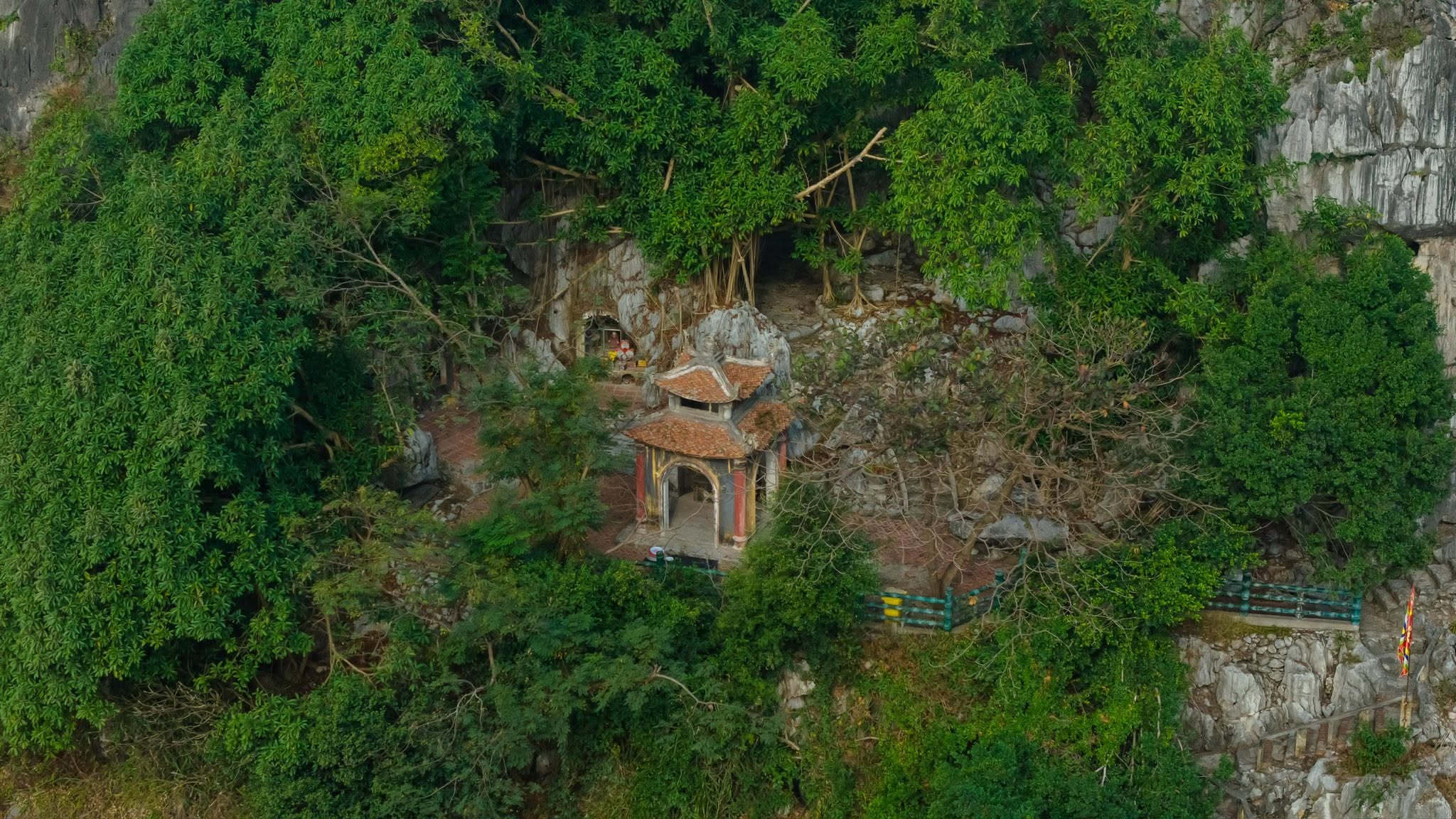
Kinh Chu Cave, also known as Duong Nham Cave, is a famous historical and scenic site in Duong Nham, Pham Su Manh Ward, Hai Phong City. The site is associated with limestone mountains, caves, religious monuments and a remarkable collection of cliff inscriptions, known as ma nhai, which hold significant historical, cultural, artistic and archaeological value.
The An Phu area includes An Phu Temple, also known as Den Cao, and Tuong Van Pagoda, also known as Cao Pagoda, in An Sinh Commune. The Kinh Chu area comprises Kinh Chu Cave in the Duong Nham limestone range, formerly known by names such as Bo Da, Quan Chau, Thach Mon and Duong Nham. The Nham Duong area includes Nham Duong Pagoda, officially known as Thanh Quang Pagoda, in Duy Tan Commune, together with surrounding caves and archaeological sites.
Recognized for its outstanding historical, cultural, scenic and archaeological values, the An Phu Kinh Chu Nham Duong complex was designated a Special National Relic by the Prime Minister under Decision No. 2499/QD-TTg dated December 22, 2016.
An Phu Relic Area
An Phu Temple, also known as Den Cao, stands on the highest point of the An Phu mountain range. According to historical records and local traditions, the temple was built during the Tran Dynasty, around the 13th century, to worship An Sinh Vuong Tran Lieu, the father of Hung Dao Dai Vuong Tran Quoc Tuan.
From a small original shrine, the temple was gradually expanded and restored over successive periods. During the Nham Dan year, Truong Thi Diem from Ha Trang Village, now part of Thang Long Commune, contributed funds to build the Middle Hall. The couple Ba Phi from Phi Xa Hamlet later sponsored the construction of the Ceremonial Hall. During the Hoang Dinh era, around 1600–1619, the royal court provided public funds and assigned the monk Nam Nhac to oversee restoration work.
In the 16th year of the Gia Long reign, corresponding to 1817, Nguyen Van Tai, who held the position of Huu Quan Le Uy and served as an imperial commissioner in Kinh Mon Prefecture, ordered the construction of two additional side galleries. In the 15th year of the Thanh Thai reign, in 1903, the temple underwent another major restoration. Details of this work were recorded on the stele known as Trung Tu An Phu Son Bi Ky, which also lists contributors who provided labor and financial support.
Within the An Phu temple grounds stands Tuong Van Pagoda, also known as Cao Pagoda. The pagoda follows the Mahayana Buddhist tradition and is also associated with Tran Nhan Tong, the Buddha Emperor and founder of the Truc Lam Yen Tu Zen tradition. It has undergone several restorations, including repairs during the Hoang Dinh period and the reconstruction of its three-bay Mother Goddess Hall in 1928.
An Phu also played an important role during the country’s wars of resistance. During the resistance against French colonial forces, the rugged mountain terrain served as a base for local militia and guerrilla forces. Several military operations were organized from this area.
During the Vietnam War, the site continued to serve as a base for military communications, an observation point for monitoring enemy aircraft, and a location for receiving and transmitting information related to national policies and military operations.
In 1985, local authorities and residents began restoring the relic complex. In 2007, An Phu Temple and Tuong Van Pagoda underwent extensive restoration, gradually becoming an important center for religious practice, cultural activities and traditional education.
Another landmark in the An Phu area is the monument to Hung Dao Dai Vuong Tran Quoc Tuan. Located about 50 meters below the temple and approximately 300 meters in front of it, the nearly 13-meter-high stone monument depicts Tran Quoc Tuan with one hand resting on the hilt of his sword and the other holding a scroll, his gaze directed toward the northeastern frontier.
Construction of the monument began in 1993 under Hai Duong Province, with General Vo Nguyen Giap laying the foundation stone. The monument area also features a 45-meter-long and 2.5-meter-high terracotta relief made up of 265 sections, depicting the resistance of the Dai Viet army and people against the Mongol-Yuan forces. The work was created with the participation of ceramic artisans from Cay Village in Binh Giang District.
Kinh Chu Cave
Kinh Chu Cave lies within the Duong Nham limestone range in Pham Menh Commune. It is one of the famous scenic sites of northeastern Vietnam and was historically regarded as one of the six most beautiful caves in the country.
The Duong Nham range is characterized by steep limestone formations, with many peaks rising in sharp, spear-like shapes. From the foot of the mountain, visitors climb a system of stone steps to reach the cave entrance. Facing south, the entrance is approximately 18.6 meters wide, 7.9 meters high and around 7 meters deep, leading into three main chambers.
The cave contains numerous natural recesses and stalactites, many of which have been incorporated into religious spaces over the centuries. Historical inscriptions indicate that Duong Nham Pagoda already existed during the Ly Dynasty. The stele Trung Tu Duong Nham Tu Bi Ky, written by Vu Can in 1532, records that Emperor Ly Than Tong visited the site, while Emperor Le Thanh Tong also came to admire the landscape and left poems here.
Throughout history, Kinh Chu Cave attracted emperors, officials, scholars and literary figures. Their impressions of the surrounding landscape were carved directly into the limestone walls, forming an exceptional collection of ma nhai inscriptions.
Today, 47 inscription units remain inside the cave, dating from the 14th century to the early 20th century. Together, they reflect the development of calligraphy, sculpture and literature across different historical periods.
Among the authors represented are Pham Su Manh of the Tran Dynasty, Emperor Le Thanh Tong, Vu Can of the Mac and Le periods, and Truong Quoc Dung of the Nguyen Dynasty, along with many other scholars and officials. One notable inscription reads Van Thach Thu That, meaning “Van Thach Library,” referring to a place associated with Pham Su Manh’s reading and poetry activities.
The inscriptions span several centuries. Those from the Mac period include works dated 1529, 1532, 1581 and 1587. Seventeenth-century inscriptions date from 1622, 1653, 1664 and 1676, while those from the 18th century include 1710 and 1733. The 19th century is represented by inscriptions from 1809, 1829, 1831 and 1862. Additional texts in Han Chinese, Nom and modern Vietnamese script were added in the early 20th century.
Beyond literary expression, these inscriptions provide valuable information about the restoration of the pagoda, the creation of statues, the donation and purchase of farmland, land offerings and the maintenance of religious activities at the site.
Inside the cave are numerous altars and religious statues arranged within natural chambers and recesses. The central altar is dedicated to the Buddha and includes statues of Amitabha Buddha, the Jade Emperor, Nam Tao, Bac Dau, the infant Shakyamuni Buddha and the Nine Dragons. Other areas are dedicated to Emperor Ly Than Tong, Empress Ly Chieu Hoang, the Sage Saint, the Lady Goddess, the Village Guardian, Duc Ong and Huyen Quang, the Third Patriarch of the Truc Lam tradition.
During the revolutionary period, Kinh Chu Cave and Duong Nham Pagoda served as places of refuge for revolutionary cadres working in the area. Monks and local residents helped shelter and provide food for them. In 1950, French forces occupied the area, destroying many valuable artifacts and building bunkers on the mountain summit. During the Vietnam War, the cave was also used for military purposes. In 1967, American bombing destroyed many of the architectural structures in front of the cave entrance.
Beyond Kinh Chu Cave, the Duong Nham area contains several other caves and scenic sites, including Vang Cave, Luon Cave, Tien Su Cave and Ngu Nuoc Cave, as well as shrines, hermitages and religious sites along the mountain slopes. From higher elevations, visitors can view the surrounding villages, farmland and waterways.
The most distinctive value of Kinh Chu Cave lies in the combination of limestone landscapes, natural caves, Buddhist worship spaces and its extensive collection of cliff inscriptions. Together, these elements have earned the site a reputation as an open-air “museum of inscriptions,” reflecting the history, culture, art and intellectual life of many periods.
Nham Duong Pagoda and Archaeological Sites
Nham Duong Pagoda, formally known as Thanh Quang Pagoda, is an ancient Buddhist temple believed to have been founded during the Tran Dynasty. It was expanded and restored several times under the Le and Nguyen dynasties and once served as an influential Buddhist center in the region.
In the 17th century, the pagoda became the religious base of Master Thuy Nguyet, Dharma name Thong Giac Dao Nam Thien Su, regarded as the first patriarch of the Tao Dong Zen tradition in Vietnam. The pagoda is closely associated with the transmission, development and revival of Buddhism during this period.
Historical inscriptions preserved at the pagoda document numerous restoration projects. In 1856, the three-bay Upper Sanctuary was repaired. In the 12th year of the Tu Duc reign, in 1859, nine stone Buddha statues were recast. In the 27th year of Tu Duc, in 1874, local residents donated a bronze bell and one mau of farmland to the pagoda. The latest restoration recorded in the old inscriptions took place in the 13th year of the Bao Dai reign, in 1938.
In 1952, the pagoda was severely damaged by French colonial forces. After 1954, local residents rebuilt a simple structure using bamboo and thatch to maintain Buddhist worship. After 1975, monks and followers rebuilt the pagoda in brick and tile. In 1996, the temple was restored on its original foundations with financial contributions from local residents and Buddhist followers from across the country. The Patriarchs’ House was begun in 2006 and completed in 2011.
Nham Duong Pagoda still preserves two valuable stone stupas from the Le period. The five-story stupa behind the main pagoda, made of green stone, contains relics associated with Thong Giac Thuy Nguyet, the first patriarch of the Vietnamese Tao Dong Zen tradition. The second stupa, three stories high, stands halfway up Nghe Mountain in front of the pagoda and is associated with the second patriarch, Tong Dien Chan Dung. These stupas are important surviving evidence of the development of the Tao Dong Zen tradition in Vietnam.
In addition to its religious significance, Nham Duong is located within an important archaeological landscape containing caves with evidence of prehistoric human occupation.
At Thanh Hoa Cave behind the pagoda, archaeological surveys and excavations conducted in 2000 and 2001 uncovered fossil remains of numerous animals, including elephants, rhinoceroses, tigers, leopards, wild boars, porcupines and monkeys. Particularly significant was the discovery of Pongo teeth, belonging to an ancient orangutan species.
The findings indicate that some cultural deposits inside the cave reach approximately four meters in thickness, with fossils dating from roughly 30,000 to 50,000 years ago. In addition to animal fossils, researchers discovered traces of ancient human remains covered by stalactite deposits.
The discovery of Pongo fossil teeth at Nham Duong is important for understanding prehistoric settlement and adaptation in areas near the coast. Before this discovery, Pongo fossils in Vietnam had mainly been recorded in mountainous areas of northern and north-central Vietnam.
At Hang Toi, archaeologists also discovered bronze artifacts, including a shouldered bronze axe, a bronze vessel and a bronze spearhead associated with the Dong Son cultural tradition. The Nham Duong mountain area has also yielded numerous stone tools, stone axes, pebble tools, drilling cores, grinding stones and other artifacts belonging to different periods of the Stone Age.
Approximately 1,796 artifacts were collected from Thanh Hoa Cave and Hang Toi, most of them animal fossils dating back tens of thousands of years. These discoveries establish Nham Duong as an important archaeological site that provides evidence of long-term human occupation in the Kinh Mon area.
Outstanding Values of the An Phu Kinh Chu Nham Duong Complex
The An Phu Kinh Chu Nham Duong complex is an exceptional heritage landscape where historical, cultural, religious, scenic and archaeological values come together. The complex developed within the long-established cultural landscape of the Red River Delta and occupies an important position along historical routes connecting Thang Long, northeastern Vietnam, the Red River Delta and the East Sea.
The site is associated with numerous historical figures, emperors, scholars, writers and eminent monks, including An Sinh Vuong Tran Lieu, Tran Quoc Tuan, Emperor Le Thanh Tong, Pham Su Manh, Vu Can, Truong Quoc Dung, Master Thuy Nguyet and Tong Dien.
The complex also preserves traces of different periods of national defense, from the resistance against the Mongol-Yuan forces during the Tran Dynasty and the resistance against the Ming during the Le period to the two major wars against French colonialism and American forces in the 20th century.
Religious heritage is another defining feature of the complex. Tuong Van Pagoda in An Phu is associated with Tran Nhan Tong and the Truc Lam Yen Tu Zen tradition. Duong Nham Pagoda in the Kinh Chu area represents an ancient Buddhist space closely connected with the extensive system of cliff inscriptions. Nham Duong Pagoda became an important center of the Tao Dong Zen tradition in Vietnam.
Together with Con Son Kiep Bac, Yen Tu and the Tran Dynasty relics in Quang Ninh, the An Phu Kinh Chu Nham Duong complex contributes to a distinctive Buddhist cultural landscape in northeastern Vietnam.
The complex also possesses significant scenic value. Limestone mountains, caves, stalactites, streams, vegetation and natural ecosystems create a diverse landscape. Particularly important are the caves around Nham Duong, where sedimentary layers, animal fossils, stone artifacts, bronze objects and traces of prehistoric humans provide evidence for both natural history and the long-term settlement of the region.
The designation of An Phu Kinh Chu Nham Duong as a Special National Relic provides an important foundation for conserving its historical monuments, religious architecture, cave systems, cliff inscriptions and archaeological sites. It also creates opportunities for the sustainable promotion of cultural and spiritual tourism and for connecting the complex with other major heritage destinations across northeastern Vietnam.
With its diverse relics, dramatic limestone landscapes and valuable archaeological evidence, the An Phu Kinh Chu Nham Duong complex represents an important part of the heritage of Hai Duong. It reflects the intersection of national history, Buddhist culture, traditional art and the long history of human settlement in the Kinh Mon region.


