


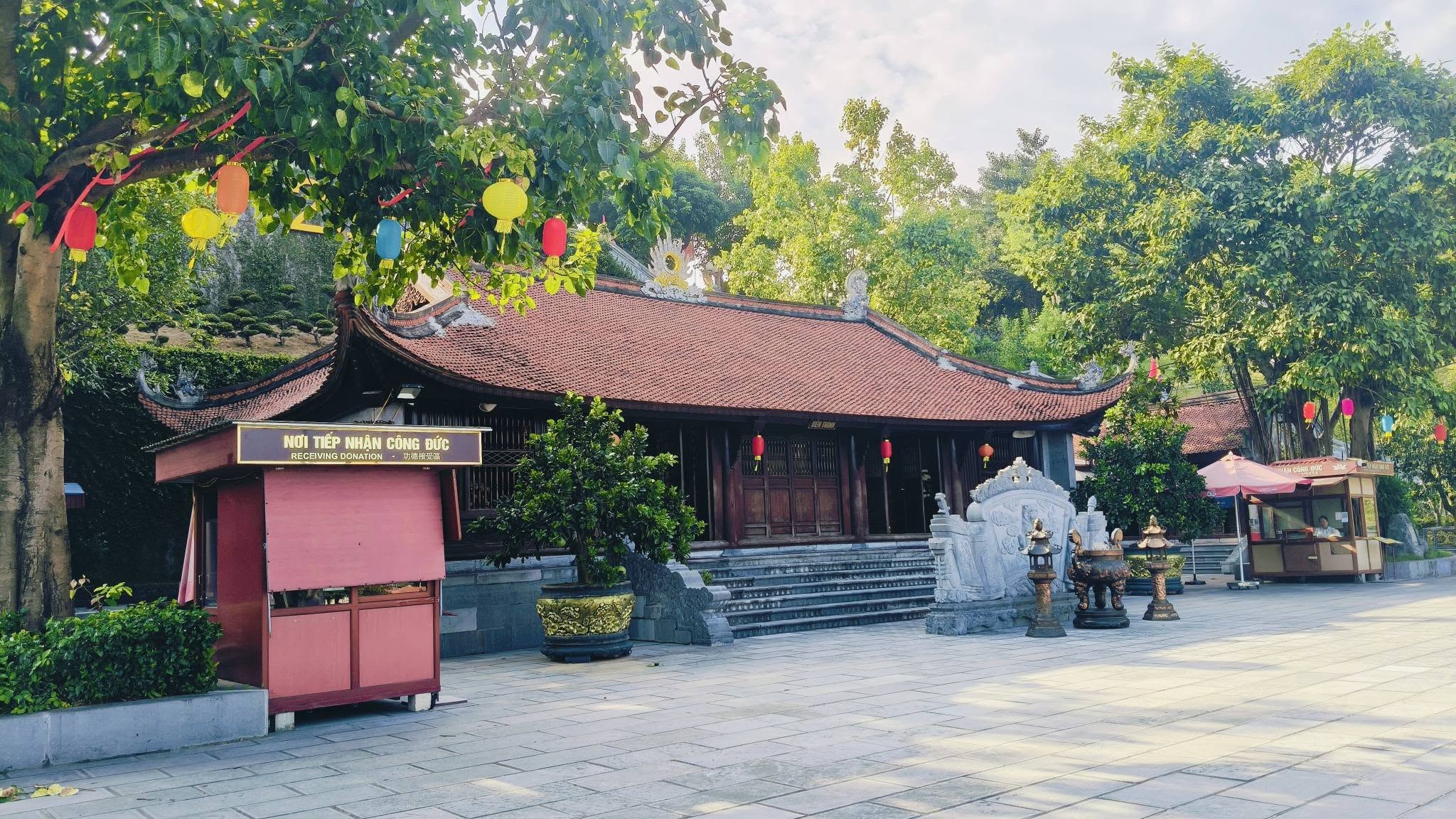
Cua Ong Temple, also known as Dong Hai Linh Tu or Duc Ong Temple, stands on a hill nearly 100 meters above sea level, overlooking Bai Tu Long Bay in Cua Ong Ward, Cam Pha City, Quang Ninh Province. It is one of the region’s notable historical and cultural monuments associated with the Tran Dynasty and is dedicated to Hung Nhuong Dai Vuong Tran Quoc Tang, a general credited with defending the northeastern coast and protecting the country during the resistance wars against the Mongol-Yuan forces in the 13th century.
The setting of Cua Ong Temple combines mountains, forests and the sea, creating a landscape that is expansive and imposing while remaining solemn and sacred. From the temple grounds, visitors can look across Bai Tu Long Bay, while the mountain range behind the temple stretches through Cam Pha and Mong Duong. Two smaller hills on either side form a landscape configuration traditionally compared to the Azure Dragon and White Tiger.
History and Worship System
According to surviving historical records, Cua Ong Temple originated as a small thatched shrine built from bamboo and leaves to worship Tran Quoc Tang. Over time, the site was gradually expanded into a larger complex consisting of Ha Temple, Trung Temple, Thuong Temple, a Buddhist pagoda and several auxiliary structures.
Between 1907 and 1916, the temple underwent a major restoration. In 1916, Thuong Temple, Trung Temple, Ha Temple and the pagoda were constructed, establishing the basic architectural layout of the monument complex. In 1946, Ha Temple and Thuong Temple were further repaired and restored. In 2014, the master plan for the Cua Ong Temple historical site was approved, covering approximately 18.125 hectares. Trung Temple was constructed from 2016 and completed in 2017.
From the foot of the mountain upward, the monument complex is arranged into three main areas: Ha Temple, Trung Temple and Thuong Temple.
The Ha Temple area includes Mau Temple and Trung Thien Long Mau Temple. Mau Temple worships the Three Holy Mothers, including Mau Thuong Thien, Mau Thuong Ngan and Mau Thoai Phu, together with the Jade Emperor, Nam Tao, Bac Dau, the Four Ladies of the Court, the Five Venerable Lords and several deities in Vietnamese folk belief such as Ong Hoang Muoi, Ong Hoang Bo and Ong Hoang Bay.
Trung Thien Long Mau Temple worships Trung Thien Long Mau and also enshrines Ba Co, Cau Be Cua Suot and Co Be Cua Suot. In local belief, these figures serve as attendants, protectors and guardians of the Cua Suot land and sea as well as the temple itself. Ha Temple still preserves an imperial decree honoring Trung Thien Long Mau as a sacred deity for Cam Pha Commune, Hoanh Bo District, Quang Yen Province. The decree is dated the 18th day of the third lunar month in the second year of the Khai Dinh reign, corresponding to 1917. A stone stele at Ha Temple was erected in 1948, the year Mau Ty.
Trung Temple stands on the Cam Son mountain range and faces the sea. It worships Kham Sai Dong Dao Tiet Che Hoang Can, a figure traditionally believed to have helped repel northern invaders and defend the eastern coastal region. The temple also worships mountain and water deities, reflecting the beliefs of communities living around the estuary and those whose livelihoods depended on travel and work at sea. Offerings and prayers were traditionally made for divine protection and safety.
The Thuong Temple area includes Thuong Temple, Quan Chau Temple, Quan Chanh Temple, the pagoda and the tomb of Tran Quoc Tang. Thuong Temple is dedicated to Hung Nhuong Dai Vuong Tran Quoc Tang, the principal deity of the site. It also worships Hung Dao Dai Vuong Tran Quoc Tuan, members of his family and numerous generals and military figures of the Tran Dynasty.
Hung Nhuong Dai Vuong Tran Quoc Tang (1252–1313) was the third son of Hung Dao Dai Vuong Tran Quoc Tuan. He was a prominent military commander who contributed to the resistance against the Mongol-Yuan forces and helped defend the northeastern coastal region. When appointed to guard Cua Suot Port, he played an important role in protecting the territory, securing the coastal route and preventing enemy incursions. For this reason, local people respectfully called him Duc Ong.
According to local legend, during one of Tran Quoc Tang’s patrols in the Cua Suot sea area, he encountered a violent storm. Amid the enormous waves, a large rock emerged from the sea, and he sat upon it. When the storm subsided, local people could no longer see him. Only his hat remained on the rock. According to folk belief, he was transformed into a deity on the 16th day of the eighth lunar month in 1311. The people carried his hat back and established a shrine in his honor. This story became one of the legends associated with Duc Ong at Cua Suot. He was later granted the title of Thuong Dang Phuc Than, or Supreme Blessed Deity, by the imperial court and became the principal deity worshipped at Cua Ong Temple.
Thuong Temple still preserves numerous imperial decrees, legends, divine records, stone steles, wooden plaques, horizontal boards and parallel couplets associated with Tran Quoc Tang. These historical materials help establish the central position of Hung Nhuong Dai Vuong within the worship system of the monument.
In addition to Tran Quoc Tang, Thuong Temple also worships Hung Dao Dai Vuong Tran Quoc Tuan and numerous historical figures of the Tran Dynasty, including Pham Ngu Lao, Da Tuong, Yet Kieu, Nguyen Khoai, Do Hanh, Tran Binh Trong, Tran Thi Kien, Tran Quang Trieu, Tran Quoc Toan, Tran Khanh Du, Do Khac Chung, Truong Han Sieu and Le Phu Tran, together with other generals, members of the royal family and individuals who made important contributions to the Tran Dynasty.
Quan Chanh Temple is dedicated to Quan Chanh, Quan Tuan Tranh and Quan Giam Sat. Quan Chau Temple worships Quan Tri Chau, a deity traditionally believed to govern the area of Cam Pha Chau.
The tomb of Tran Quoc Tang within the monument complex has strong symbolic significance, expressing the local people’s reverence for the general who came to be honored as Duc Ong. According to a divine record documented in 1938, the tomb serves as a memorial site rather than definitive archaeological evidence establishing the exact location of Tran Quoc Tang’s burial.
The pagoda within the Cua Ong Temple complex worships the Buddha, the Jade Emperor, Nam Tao, Bac Dau, Quan Am Tong Tu, Tue Trung Thuong Si, Duc Chua Ong, Duc Thanh Hien and other figures commonly worshipped in Vietnamese Buddhist tradition.
Approximately 2 kilometers from Cua Ong Temple is Cap Tien Temple, also known as Co Be Cua Suot Temple, which was established during the Nguyen Dynasty. The temple is associated with the worship of a young noblewoman traditionally believed to have been a daughter of Tran Quoc Tang, together with Quan Chanh and several other historical deities. Later, the temple also incorporated worship of the Buddha, the Jade Emperor, Nam Tao, Bac Dau and Tien Thien Thanh Mau. Backed by the mountains and facing the sea, the temple occupies a tranquil and sacred setting.
Historical, Architectural and Festival Values
Cua Ong Temple is significant not only for its historical and religious value but also for its distinctive artistic heritage. The structures were built using traditional materials such as stone, Bat Trang bricks, fired clay roof tiles and mortar mixed with molasses. Decorative elements feature the Four Sacred Animals, including the dragon, kylin, tortoise and phoenix, together with motifs characteristic of traditional Vietnamese art.
The monument complex is particularly notable for its valuable system of worship statues. Many were created during the 19th century, including approximately 34 large and small statues carved with considerable craftsmanship. They portray various figures seated on thrones, within shrines or on dragon-shaped palanquins. These statues provide important material for the study of Vietnamese sculpture and the worship of historical and human deities in Vietnamese folk belief.
At a high point within the monument complex stands a statue of Hung Nhuong Vuong Tran Quoc Tang. The monument is approximately 10 meters high and weighs around 40 tons, serving as a prominent landmark within the overall landscape of Cua Ong Temple.
Ancient trees, ornamental plants and flowers are arranged among the architectural structures, creating a green, quiet and solemn environment. The entire planned monument area covers approximately 18 hectares, providing sufficient space for visitors to explore the worship areas, landscape and associated structures within a day.
Cua Ong Temple also preserves numerous divine legends, sacred records and imperial decrees concerning the deities worshipped at the site. These materials are valuable sources for studying the history, religious beliefs and culture of northeastern Vietnam, particularly the legacy of the Tran Dynasty and the development of communities in Cam Pha.
One of the most important cultural activities at the site is the Cua Ong Temple Festival. The festival was recognized as a National Intangible Cultural Heritage in 2016 and is held annually with a variety of traditional rituals and cultural activities. Key ceremonies include incense offerings and a procession carrying the spirit tablet of Hung Nhuong Vuong Tran Quoc Tang from Cua Ong Temple to Vuon Nhan Shrine, followed by a return procession to the temple. The procession recreates the traditional patrol journeys of Duc Ong and recalls his contribution to protecting the northeastern coastal region.
The festival also features cultural and sporting activities and traditional folk games, including dragon dances, lion dances, five-fruit tray competitions, folk chess, blindfolded pot smashing, tug-of-war and stick pushing. The festival serves the spiritual needs of the local community while helping preserve traditional customs, rituals and folk games.
Despite the passage of time and numerous historical changes, Cua Ong Temple has retained many elements of its historic architecture, together with ancient statues, stone steles, imperial decrees and documents associated with the monument. Restoration and conservation work has been carried out to protect its tangible heritage, landscape and historical and cultural values.
With its outstanding historical, cultural, architectural, artistic and religious values, the Cua Ong Temple Historical Site was recognized by the Prime Minister as a Special National Monument under Decision No. 2082/QD-TTg dated December 25, 2017.
Today, Cua Ong Temple remains an important cultural and religious destination in Quang Ninh. Set between the mountains and Bai Tu Long Bay, the monument combines a system of worship buildings, ancient statues, traditional festivals and historical documents, forming a site of exceptional significance within the network of Tran Dynasty-related heritage sites in northeastern Vietnam.


