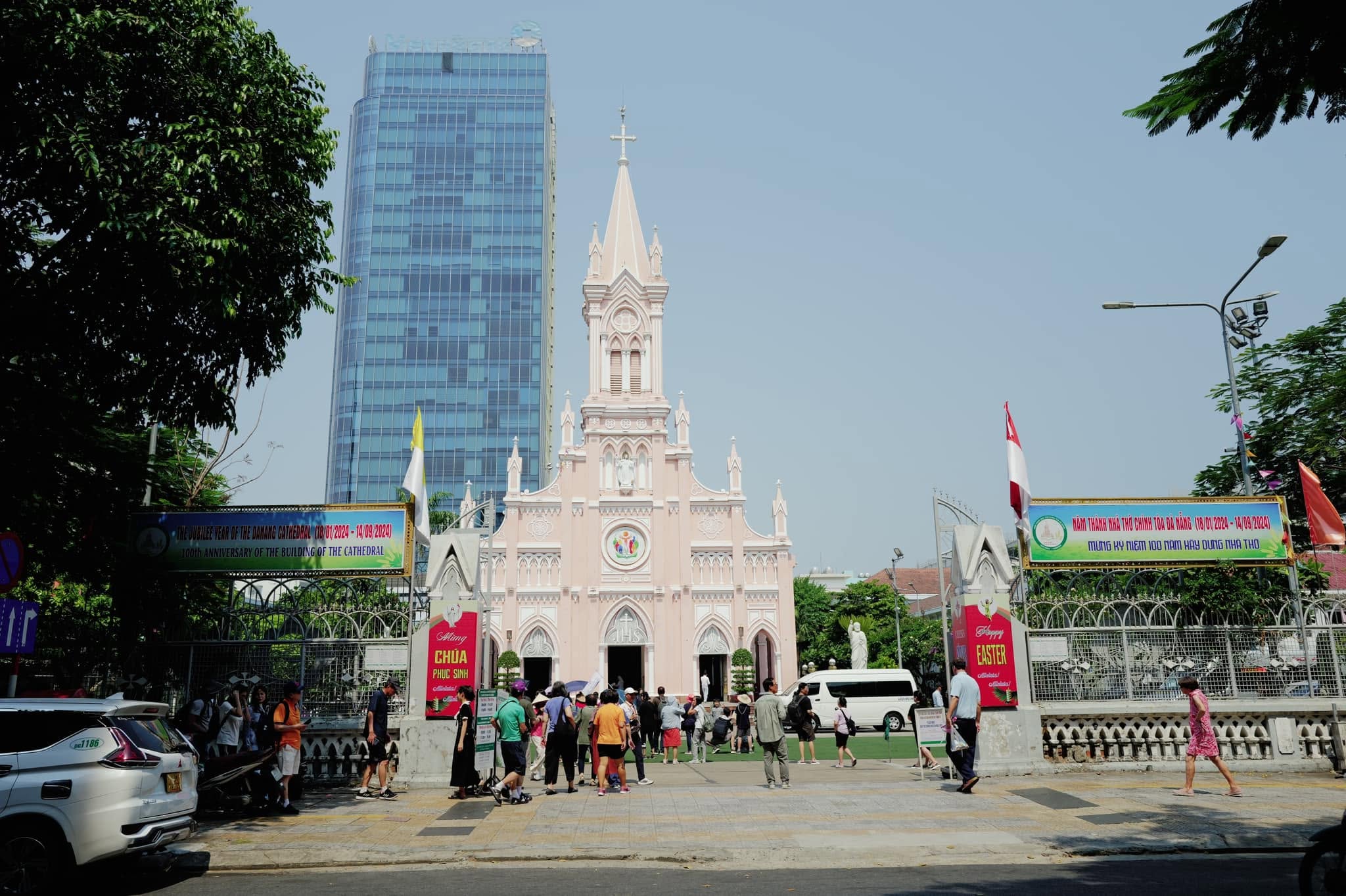
Located at 156 Tran Phu Street, Da Nang Cathedral is one of the city’s oldest and most distinctive Catholic architectural landmarks. Built during the French colonial period, the cathedral is characterized by its Gothic architecture, soaring vertical lines, pink exterior and prominent bell tower rising above the surrounding streets.
The cathedral was once known as Tourane Cathedral during the French colonial period and is popularly called the Chicken Church, a name derived from the rooster statue mounted on top of its bell tower.
Address: 156 Tran Phu Street, Hai Chau 1 Ward, Hai Chau District, Da Nang, Vietnam.
Admission: Free.
From Tourane Cathedral to Da Nang Cathedral
Construction began in February 1923 on an empty plot along Rue du Musée, now Tran Phu Street. The project was led by French priest Louis Vallet, who was responsible for the overall design and construction.
The cathedral was completed and inaugurated on March 10, 1924. Rising nearly 70 meters, it became the most prominent Catholic church built in Da Nang during the French colonial period.
In its early years, the church was known as Tourane Cathedral, reflecting the name used for Da Nang under French rule.
In 1963, the Diocese of Da Nang was officially established, and the church became the Cathedral of the Diocese of Da Nang, taking on an important role in the Catholic life of the city.
Nearly a century later, the cathedral remains one of the most recognizable historic architectural landmarks in central Da Nang.
Gothic Architecture and Its Distinctive Pink Facade
The most striking feature of Da Nang Cathedral is its Gothic architectural style, characterized by strong vertical lines that draw the eye upward.
The facade features pointed arches, slender supporting columns and decorative details influenced by Western Catholic church architecture.
The entire exterior is painted in a distinctive pastel pink, creating a striking contrast with the surrounding urban landscape. Combined with the Gothic forms, the pink facade has made the cathedral one of the most recognizable buildings in central Da Nang.
Inside, the cathedral has a spacious and solemn interior. Paintings, statues and religious images depicting stories from the Bible are arranged according to the artistic traditions of Western Catholic churches. Stained-glass windows allow natural light to filter into the interior, creating an atmosphere filled with soft, colorful light.
Behind the cathedral stands a Grotto of Our Lady, modeled after the Grotto of Lourdes in France. Completed in 1940, the grotto is surrounded by greenery and provides a quiet space for prayer and reflection.
Why Is It Called the Chicken Church?
The popular name Chicken Church comes from the statue of a rooster made of lightweight alloy mounted on the lightning rod at the top of the bell tower, approximately 70 meters above the ground.
According to the parish’s explanation, the rooster is not a symbol of France. Instead, it is associated with the biblical story of Saint Peter, representing repentance, spiritual awakening and steadfast faith.
The hollow rooster statue can rotate with the wind. In earlier times, this feature also allowed it to function as a simple indicator of wind direction.
The rooster has consequently become an unmistakable visual symbol of the cathedral, giving rise to the familiar local name Chicken Church, used alongside its official name, Da Nang Cathedral.
An Architectural Landmark in Central Da Nang
Da Nang Cathedral is significant not only to the Catholic community but also as an important architectural feature of the city’s historic center.
Tran Phu Street is surrounded by a number of historic and cultural landmarks. Within this urban setting, the cathedral stands out with its tall bell tower, pink facade and distinctive Gothic details.
Visitors can easily combine a visit to the cathedral with other attractions in central Da Nang, particularly cultural and historic sites around the Han River.
Da Nang is also home to several other Catholic and Christian churches with their own architectural character, including Phu Thuong Church, Hoa Ninh Church and Tung Son Church, as well as Protestant churches elsewhere in the city.
Among them, Phu Thuong Church is one of the city’s older religious buildings. Located along the route from Hoa Khanh Junction toward Ba Na in the Hoa Son area, its parish was established in 1876, and the church was completed in 1887, forming part of a distinctive Catholic architectural complex with a quiet, historic atmosphere.
Visiting Da Nang Cathedral
Located in the heart of the city, the cathedral is convenient to include in a walking or sightseeing itinerary through central Da Nang. Visitors can admire the Gothic facade, bell tower, architectural details, interior space and the grotto of Our Lady behind the church.
Visitor hours:
- Monday to Saturday: 08:00-11:30 and 13:30-16:30.
- Sunday: The cathedral prioritizes liturgical activities, so sightseeing and unrestricted photography may be limited.
Mass schedule for reference:
- Monday to Saturday: 05:00 and 17:15.
- Sunday: 05:30, 08:00, 10:00, 15:00, 16:30 and 18:00.
- The 10:00 Sunday Mass is celebrated in English, making it convenient for international visitors and English-speaking Catholics.
Visitor Etiquette
Da Nang Cathedral remains an active place of worship. Visitors should:
- Dress respectfully and modestly, particularly when entering the cathedral.
- Keep voices low and maintain cleanliness.
- Avoid photography or filming that may disturb religious services.
- Minimize movement inside the cathedral during Mass.
- Respect worshippers and follow regulations established by the parish.
A Historic Architectural Landmark in Da Nang
Nearly a century after its inauguration, Da Nang Cathedral continues to occupy a distinctive place in the city’s urban landscape.
While bridges, beaches and contemporary buildings tell the story of modern Da Nang, the cathedral on Tran Phu Street preserves part of the city’s memory of the French colonial era, Catholic heritage and European architecture in Central Vietnam.
Its pastel-pink walls, Gothic arches, soaring bell tower and rooster weather vane have together created an architectural identity that is instantly recognizable.
For travelers interested in architecture, history and urban culture, Da Nang Cathedral offers a meaningful stop in the heart of the city.