


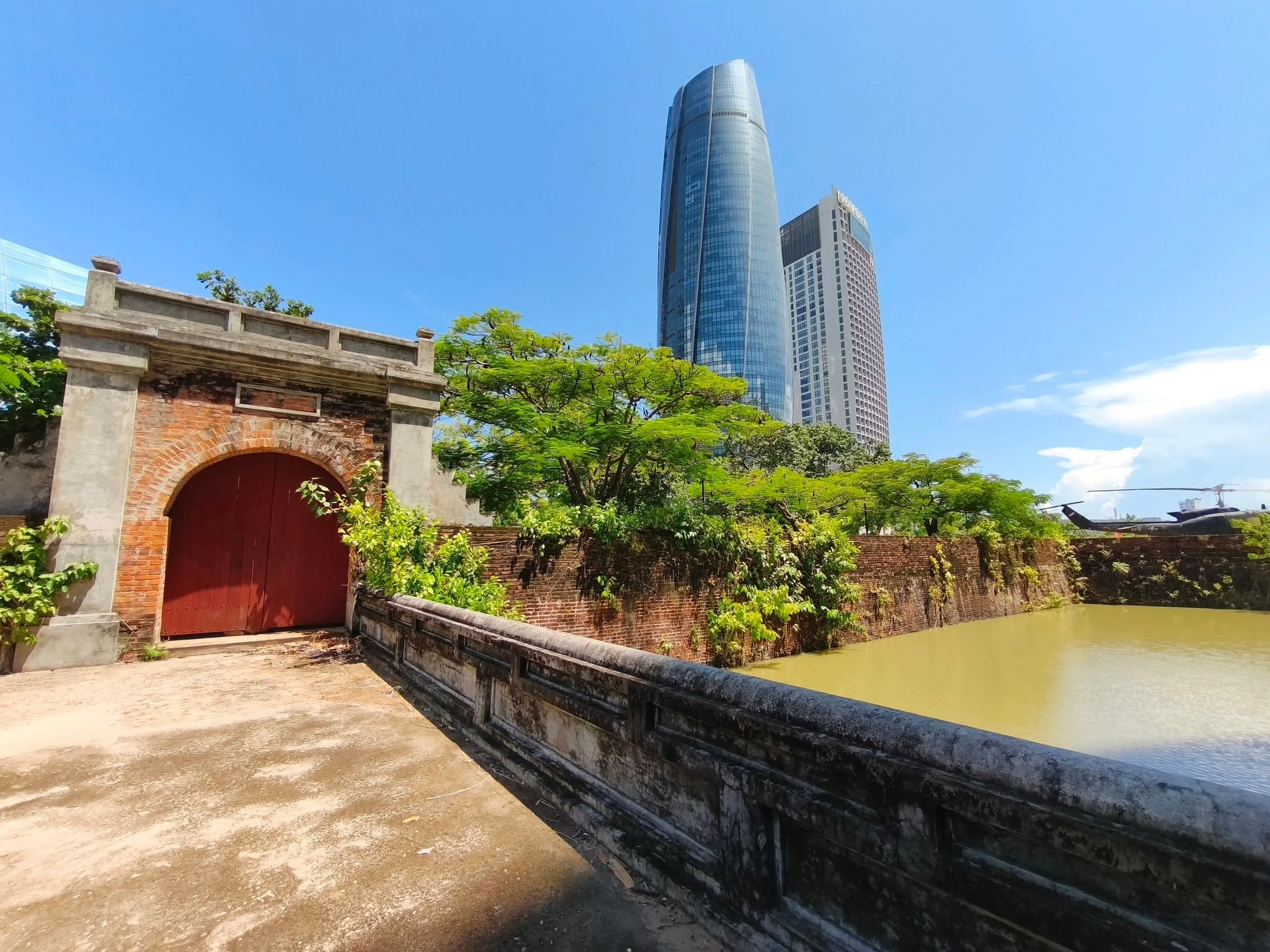
Dien Hai Citadel, also known as Dien Hai Fort or the Western Fortress, is located in central Da Nang City, on the left bank of the Han River, in Hai Chau Ward, Da Nang City. It was one of the most important military structures built by the Nguyen Dynasty in Da Nang and is closely associated with the resistance of the Vietnamese military and people against the Franco-Spanish forces from 1858 to 1860.
From the 16th century onward, Da Nang attracted the attention of Western merchants because of its favorable maritime location. By the 19th century, it had become one of the major seaports in central Vietnam and an important maritime gateway to the imperial capital of Hue. Recognizing the strategic importance of Da Nang, the Nguyen Dynasty gradually developed a defensive system around the seaport, on Son Tra Peninsula and along both banks of the Han River. Within this system, Dien Hai Citadel and An Hai Citadel played particularly important roles.
Construction of Dien Hai Citadel
Soon after ascending the throne in 1802, Emperor Gia Long focused on strengthening the defensive system in Da Nang. In the spring of the 12th year of the Gia Long reign, corresponding to 1813, the emperor ordered the construction of Dien Hai Fort and An Hai Fort on opposite sides of the entrance to Da Nang Bay. Dien Hai Fort was initially built close to the sea to monitor vessels entering and leaving the harbor and to protect this strategically important area.
In 1813, Emperor Gia Long personally traveled to Da Nang to inspect the defensive arrangements at Dien Hai Fort. He also ordered the dredging of the Han River and organized naval forces to protect the seaport. Nguyen Van Thanh was assigned to oversee the construction of the fort.
Because the original structure stood close to the sea, it was heavily affected by waves and coastal erosion and gradually deteriorated. In 1823, Emperor Minh Mang ordered the fort to be rebuilt farther inland, on higher ground in the Trem area of Thach Thang Village, the site of the present-day Dien Hai Citadel. The new structure was built more solidly with brick, while the terrain was reassessed to improve its defensive capabilities.
In 1835, during the reign of Emperor Minh Mang, Dien Hai Fort was officially renamed Dien Hai Citadel. In 1847, under Emperor Thieu Tri, the citadel was further expanded and reinforced on a larger scale. It had a perimeter of approximately 556 meters, walls more than 5 meters high, a moat approximately 3 meters deep and two entrances. The citadel followed the Vauban style of military fortification, with a square layout and four projecting corners.
Inside the citadel were an imperial residence, a flag tower, quarters and working areas for soldiers, food storage facilities, gunpowder magazines, weapons depots and structures used for the manufacture, repair and storage of firearms and ammunition. Numerous artillery emplacements were positioned throughout the fortress, making Dien Hai Citadel one of the most important defensive strongholds in Da Nang.
Together with An Hai Citadel on the opposite bank of the Han River, Dien Hai Citadel formed a defensive system controlling the entrance to Da Nang. The strategic positions of the two citadels enabled the Nguyen Dynasty to monitor and prevent vessels from advancing into the Han River and the surrounding coastal area.
Dien Hai Citadel in the Resistance Against the Franco-Spanish Forces
On August 31, 1858, Franco-Spanish forces commanded by Vice Admiral Rigault de Genouilly entered the Han River estuary, beginning the attack on Da Nang. Their objective was to quickly capture Da Nang and use it as a base from which to advance toward Hue.
From the first days of the campaign, Dien Hai Citadel became one of the key targets of the invading forces. On the morning of September 1, 1858, after sending an ultimatum demanding the surrender of the Nguyen forces but receiving no response, French and Spanish troops began shelling defensive positions around Da Nang Bay, including Dien Hai Citadel and An Hai Citadel.
An Hai Citadel and several other defensive positions were successively occupied by the enemy, while Dien Hai Citadel was damaged but remained under the control of the Nguyen forces.
On the morning of September 2, 1858, the Franco-Spanish forces continued their assault on Dien Hai Citadel using warships and gunboats. Their heavy artillery fire breached one corner of the citadel and caused the gunpowder magazine to explode. After fierce resistance, the Nguyen forces were forced to withdraw. French troops entered the citadel, destroyed several structures and seized a large number of cannons.
Following the initial battles, the Nguyen court continued organizing forces to resist the offensive. When Marshal Nguyen Tri Phuong was appointed commander of the Da Nang front, the defensive system was gradually strengthened. Fortifications, defensive lines and military positions were constructed, linking the area around Dien Hai Citadel with other defensive locations throughout Da Nang.
Thanks to the organized defensive system and the determined resistance of local soldiers and civilians, the Franco-Spanish forces failed to achieve their objective of capturing Da Nang quickly. The invading troops faced harsh climatic conditions, disease, shortages and persistent resistance from Vietnamese forces and local communities.
On February 2, 1859, Rigault de Genouilly moved most of his forces to southern Vietnam to launch an attack on Gia Dinh, while part of the French force remained in Da Nang. Nguyen forces continued strengthening their defensive lines, with Dien Hai Citadel maintaining an important strategic position.
On April 20, 1859, French forces launched another attack on Dien Hai Citadel from the left bank of the Han River. Faced with the enemy’s superior firepower, the Nguyen forces withdrew and the French occupied the citadel, positioning artillery there as a base for subsequent military operations.
However, the campaign in Da Nang lasted much longer than the invading forces had anticipated. From 1858 to 1860, Vietnamese forces and local communities continued their determined resistance, preventing the Franco-Spanish forces from expanding their occupied territory. After suffering heavy losses from combat and disease, the French forces withdrew from Da Nang on March 23, 1860.
The fighting in Da Nang from 1858 to 1860 thwarted the French plan for a rapid victory in central Vietnam. Dien Hai Citadel became one of the most prominent symbols of the defense of Da Nang during the early stages of Vietnam’s resistance against French colonial forces.
Dien Hai Citadel After 1975
After national reunification, Dien Hai Citadel was used for a period of time for industrial production. In 1976, the Quang Nam-Da Nang Pharmaceutical Enterprise was established and based within the Dien Hai Citadel area. During the following years, several production facilities were added, altering part of the landscape and affecting the integrity of the historical site.
In 2004, Da Nang approved a master plan for the restoration and preservation of Dien Hai Citadel and the improvement of its surrounding landscape. The Central Pharmaceutical Enterprise No. 5 was subsequently relocated, creating conditions for the city to gradually restore the historic space of the monument.
Dien Hai Citadel was then extensively restored, including the reconstruction of sections of the walls, projecting corners, gates and moat system. During the restoration process, several cannons were discovered within the monument grounds. These artifacts provided additional evidence concerning the weapons system and defensive activities of Dien Hai Citadel throughout its history.
The Da Nang Museum was built within the Dien Hai Citadel area and officially opened in 2010. It became a venue for displaying numerous documents and artifacts related to the history of Da Nang. Several cannons discovered during the restoration of Dien Hai Citadel are also displayed here.
Conservation work has continued with the aim of restoring the historical appearance of the citadel. Sections of the eastern, northern and southern walls and several projecting corners have been reconstructed. The clearance of residential areas to the west has also been proposed to gradually restore the historic setting and create conditions for the full reconstruction of the monument’s original structure.
Historical and Cultural Value of Dien Hai Citadel
Dien Hai Citadel is a representative military structure of the Nguyen Dynasty in Da Nang. It reflects the process through which the imperial court developed and strengthened its coastal defense system in response to the growing activities of Western powers in Southeast Asia during the 19th century.
Architecturally, Dien Hai Citadel is one of the remaining Vietnamese military fortifications preserving elements of the Vauban system. Its square layout, four projecting corners, defensive walls, moat and gates form a relatively complete military defense structure.
Historically, Dien Hai Citadel is directly associated with the resistance against the Franco-Spanish forces in Da Nang from 1858 to 1860. It bears witness to some of the earliest battles fought by Vietnamese forces and local communities against the French colonial invasion in the mid-19th century. The site is also closely connected with the role of Marshal Nguyen Tri Phuong in organizing the defense of Da Nang.
Today, Dien Hai Citadel is an important historical monument in Da Nang’s heritage system. The citadel itself, together with surviving artifacts, historical documents and commemorative structures, provides residents and visitors with an opportunity to learn about the development of Da Nang’s defensive system and the resistance of the Vietnamese people during the early years of the struggle against French colonial forces.
With its outstanding historical and military architectural values, Dien Hai Citadel was recognized by the Prime Minister as a Special National Monument under Decision No. 2082/QD-TTg dated December 25, 2017.


