


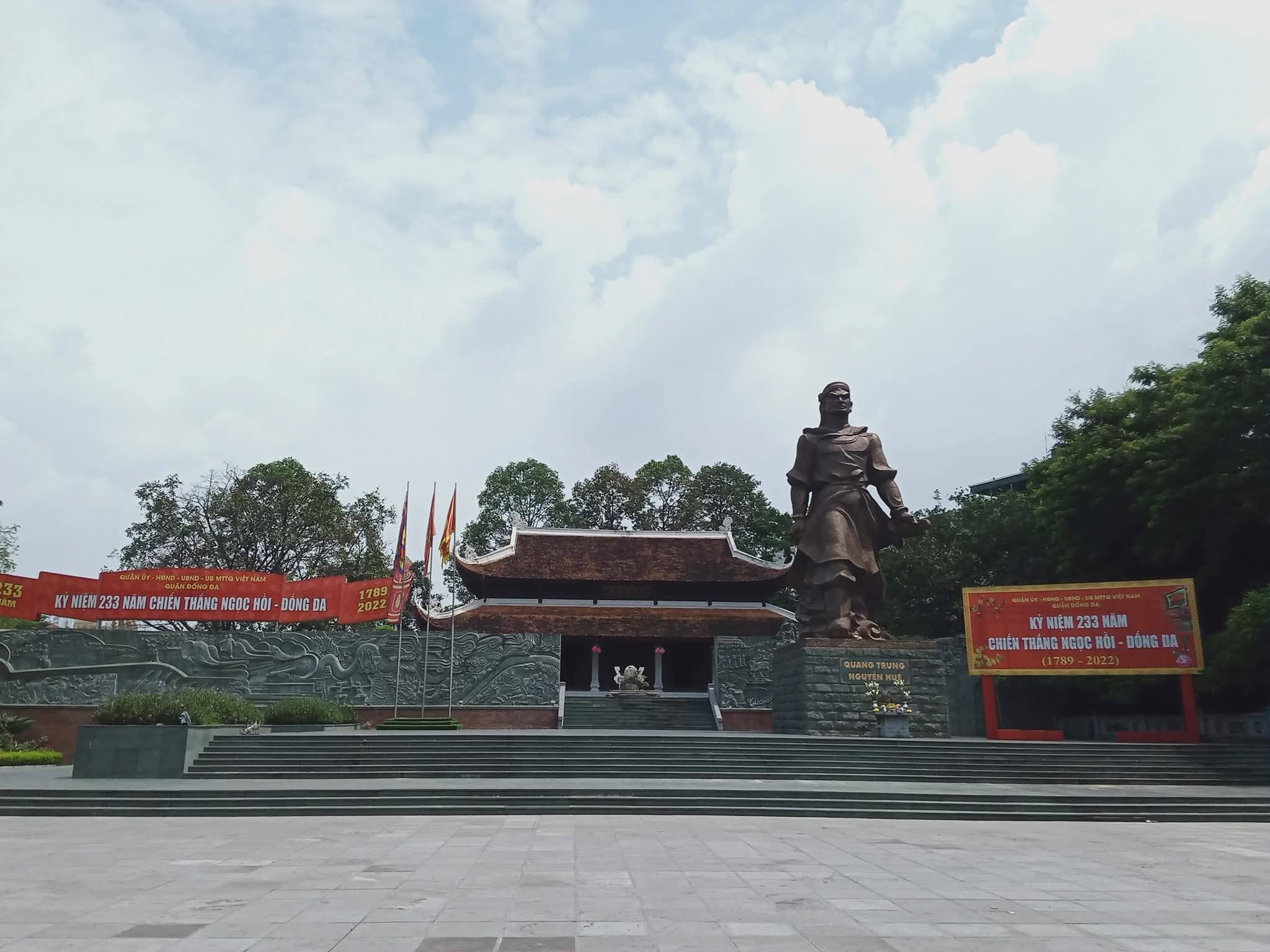
Dong Da Mound, also known as Dong Da Cultural Park, is located on Tay Son Street in Dong Da Ward, Hanoi. It is one of the historical sites associated with the Dong Da Victory in the spring of 1789, when the Tay Son army under the command of Emperor Quang Trung Nguyen Hue defeated the Qing forces and liberated the imperial capital of Thang Long.
According to historical records and recollections preserved by elders in Thinh Quang Village, the area now known as Dong Da Mound was once located near the outer area of Thang Long Citadel, within the territory of Khuong Thuong Village, Quang Duc District, Thuan Thien Prefecture. The name Dong Da originally referred to an area characterized by numerous earthen mounds, many of which were covered with banyan trees. Over time, the name became associated with the entire surrounding area.
Dong Da Mound and the Ky Dau Victory of 1789
At the end of 1788, Qing forces invaded Dai Viet, occupied Thang Long and established military bases at several locations around the imperial capital. In response, Nguyen Hue ascended the throne in Phu Xuan, adopted the reign title Quang Trung, and then marched north.
In the spring of the Year of the Rooster, Ky Dau, in 1789, the Tay Son army launched a rapid and bold offensive. Among the decisive battles of the campaign, Ngoc Hoi and Dong Da were two important battlefields. In the Dong Da area, the Tay Son forces attacked Khuong Thuong Fort and defeated the Qing troops stationed there. The Qing general Sam Nghi Dong was defeated and took his own life.
The Dong Da Victory was part of the campaign to liberate Thang Long and contributed to the collapse of the Qing defensive system. Following a series of successive battles from Ngoc Hoi and Khuong Thuong to Thang Long, the Tay Son army entered the imperial capital, bringing the Qing invasion of Dai Viet to an end.
The Ky Dau Victory in the spring of 1789 demonstrated the outstanding military strategy of Quang Trung Nguyen Hue, particularly in the organization of forces, rapid troop movements, selection of the right moment for attack, and coordination among different fronts. It is also regarded as one of the major victories in Vietnam’s history of resistance against foreign invasions.
Emperor Quang Trung Nguyen Hue (1753–1792) was one of the most prominent figures of the Tay Son movement. During approximately two decades of military activity, he personally commanded numerous major campaigns, including victories over Siamese forces in the south and Qing forces in the north. After ascending the throne, he continued to implement policies in politics, economics, education, culture and military affairs with the aim of strengthening the country.
Formation and Transformation of Dong Da Mound
The former Dong Da area contained numerous earthen mounds, some of which were associated with the battlefield of 1789. For a long period, many of these mounds remained relatively intact and became places remembered by local people through legends, place names and religious structures.
According to a map of Hanoi compiled in the 26th year of the Tu Duc reign (1873), the Dong Da area still contained six mounds at that time. However, during the Nguyen Dynasty and the French colonial period, many of these mounds were not protected and were gradually leveled or altered as urban development expanded.
Today, the former system of mounds has not survived intact. Some locations are still preserved in historical records and local memory, including Trung Liet Mound, also known as the 13th mound, which was added in 1851, and Dong Thieng Mound in the Thai Ha hamlet area. Dau Lau Mound, located behind Boc Pagoda near Dong Quang Pagoda, was also once associated with the battlefield area but was demolished long ago.
In 2010, on the occasion of the grand celebration marking the 1,000th anniversary of Thang Long – Hanoi, Dong Da Mound was restored, renovated and expanded with additional structures across an area of more than 22,120.8 square meters. The present-day complex includes the entrance gate, Dong Da Mound, the ceremonial gate, a monument to Emperor Quang Trung, the temple dedicated to Emperor Quang Trung and several auxiliary structures.
These structures contribute to recreating a commemorative space for the Dong Da Victory and honoring the contributions of Emperor Quang Trung and the Tay Son army.
Historical Sites Associated with the Dong Da Victory
Dong Da Mound forms part of a broader historical landscape associated with the Ngoc Hoi – Dong Da campaign. Numerous sites in the surrounding area continue to preserve traces, legends and memories of the 1789 campaign.
Boc Pagoda, whose formal name is Thien Phuc Pagoda, is located near the former Khuong Thuong battlefield. According to local historical sources, the pagoda was burned during the fighting in 1789 and rebuilt in 1792. In front of the pagoda is Tam Tuong Lake, which is associated with a legend concerning the elephant corps of the Tay Son army after the Battle of Khuong Thuong. Behind the pagoda is an area known as Loa Son, associated with the event in which Sam Nghi Dong took his own life after his defeat. The pagoda also contains Thanh Mieu, a shrine dedicated to Sam Nghi Dong and Qing soldiers who died in the battle.
Kim Son Pagoda is located in an area that was once used for burying those who died during the Dong Da campaign. It is also associated with rituals held to pray for the souls of those who perished in the fighting during the spring of Ky Dau.
Nam Dong Pagoda, formally known as Can An Pagoda, stands opposite the Dong Da Mound complex. The pagoda has a long history and preserves stone steles dating from 1621 and 1697, as well as a bell cast in 1812. These artifacts indicate that the place name Dong Da existed before the victory of 1789. After the war, the pagoda became one of the religious sites associated with commemorating those who died in the conflict.
Together, these historical sites and related locations form a historical landscape connected with the Dong Da Victory and the campaign to liberate Thang Long in the spring of Ky Dau. The value of Dong Da Mound therefore lies not only in its surviving traces of a battlefield but also in its role in preserving the historical memory of one of the nation’s notable victories in the late 18th century.
With its outstanding historical and military significance, the Dong Da Mound Historical Site was recognized by the Prime Minister as a Special National Monument under Decision No. 1820/QD-TTg dated December 24, 2018.


