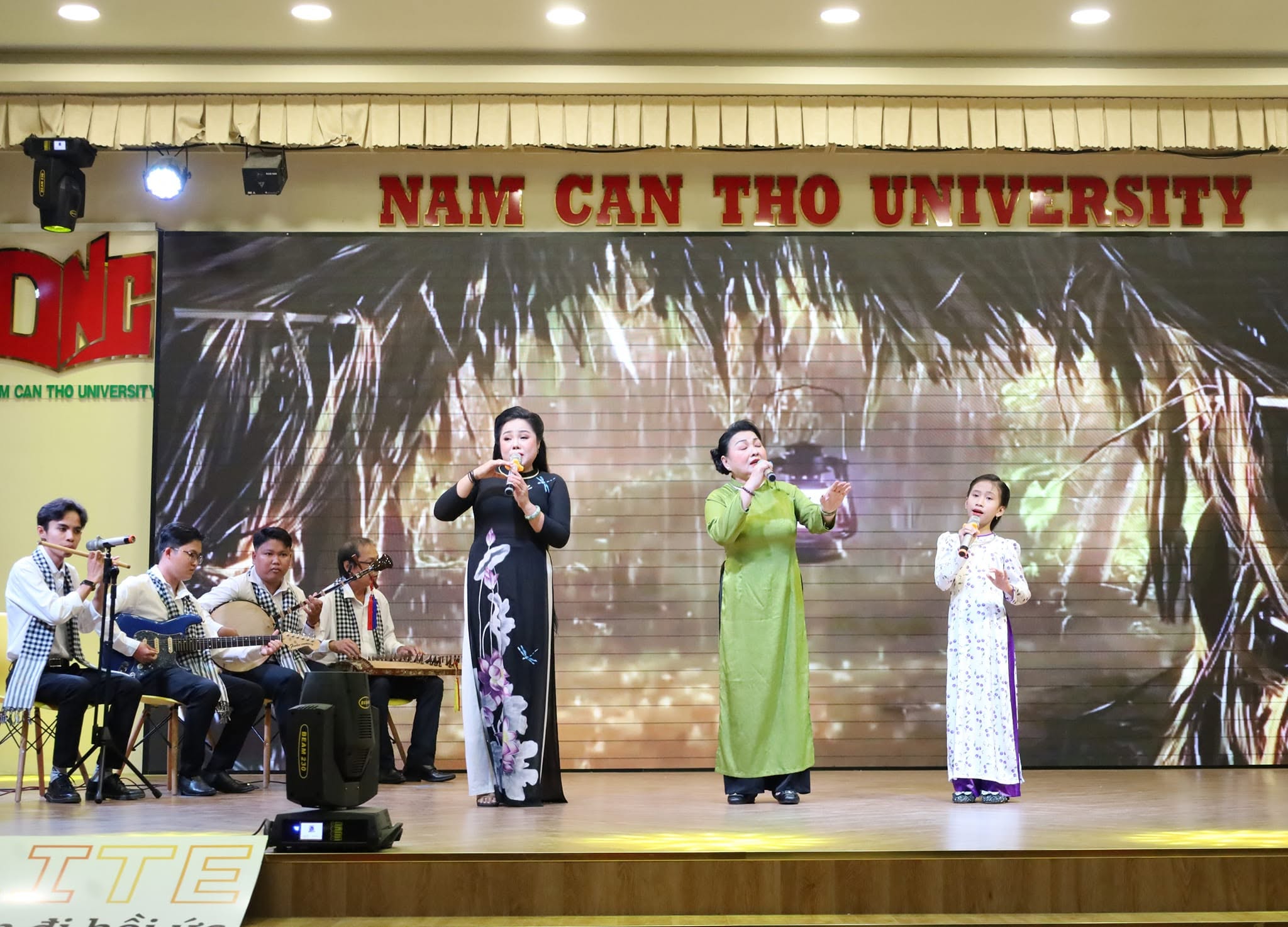
Hò Cần Thơ is a distinctive form of Vietnamese folk performance from the riverine region of Tây Đô, developed through the labor, agriculture, trade, and community life of the people of Cần Thơ. Through simple yet expressive verses, local people have conveyed their love for their homeland, romantic feelings, social values, and everyday thoughts.
Recognizing its cultural significance, Hò Cần Thơ was included in Vietnam’s National Intangible Cultural Heritage List under Decision No. 446/QĐ-BVHTTDL dated January 29, 2019, in the category of Folk Performing Arts.
Hò Cần Thơ shares characteristics with the broader tradition of southern Vietnamese hò, while developing its own distinctive vocal style, including long phrasing, sustained tones, breath control, and improvisation. The melodies once echoed across rice fields, fruit gardens, trading boats, rivers, and canals throughout the Hậu Giang region.
Musician Lư Nhất Vũ once described it as:
“The voice of Hò Cần Thơ resonates endlessly, soaring and stretching across the landscape, a long-standing specialty that could only have emerged in the poetic riverine environment and vast fields of Hậu Giang.”
Hò Cần Thơ and the Riverine Life of Southern Vietnam
Southern Vietnamese hò developed through the adaptation and creative transformation of singing traditions brought by Vietnamese settlers as they moved southward and opened new lands. From around the 17th century, during migration from the central regions known historically as Ngũ Quảng toward the South, folk songs and hò became part of the settlers’ cultural heritage.
After settling in the new environment, communities adapted their lyrics, melodies, and singing techniques to rice fields, waterways, orchards, and village life. Over time, distinctive local forms emerged in different areas, including hò Mỹ Tho, hò Cái Bè, hò Ngã Bảy, hò Đồng Tháp, hò Bến Tre, and Hò Cần Thơ.
There is currently no precise historical record identifying the exact date when Hò Cần Thơ first appeared. Researchers, however, generally believe that it has a history of more than a century and is closely connected with the development of communities in the Cần Thơ area.
Writer Sơn Nam was among those who paid particular attention to southern hò and the folk culture of Hậu Giang. In works such as Tìm hiểu đất Hậu Giang, Văn minh miệt vườn, and Nói về miền Nam, he described how waterways, trade, and the orchard economy created favorable conditions for antiphonal singing and improvised exchanges.
He also mentioned the traditional hò teachers, respected singers who were skilled at improvisation, knew large numbers of folk verses, and understood how to “bẻ câu hát”, literally reshaping or adapting an existing verse to suit a new situation.
Sơn Nam gave the following example:
“Chiếu bông mà trải góc đền
Muốn vô làm bé biết bền hay không?”
The verse could be adapted to a waterway setting as:
“Nước xuôi chạy gió buồm mềm
Muốn vô làm bé biết bền hay không?”
This practice illustrates the creative nature of hò. Familiar folk verses were not simply repeated word for word. Singers could reshape them according to the landscape, occupation, circumstances, and people around them.
In his collection Hương rừng Cà Mau, Sơn Nam’s story “Con Bảy đưa đò” also evokes the singing traditions of the Mekong Delta. The character Bảy, a boatwoman from Ba Láng in Cái Răng, is known for her singing and antiphonal exchanges. She explains “Hò Bánh bò”, a form of hò believed to have developed from the calls of vendors selling bánh bò, a traditional Vietnamese steamed rice cake, along the waterways.
The original vendor’s call:
“Ai bánh bò không…”
could become:
“Bánh bò hông, bánh bò hơ…ơ…”
The wide rivers and scattered houses of the region required a voice that could travel a long distance. As the character explains, the singer needed a high and sustained voice so that people along the river could hear.
This connection between everyday calls, work, and musical expression illustrates how naturally hò grew out of the riverine environment of Cần Thơ.
The Main Forms of Hò Cần Thơ
According to musician Lư Nhất Vũ and other researchers, Hò Cần Thơ has three representative forms: hò huê tình, hò cấy, and hò mái dài. Each is associated with different settings, performance techniques, and emotional expressions.
Hò Huê Tình
Hò huê tình is lyrical and often associated with courtship and romantic exchange. It may be performed solo or as an antiphonal dialogue between men and women. The verses are generally easy to remember, while skilled singers can freely add, remove, or improvise words according to the situation.
A recorded example from Nguyễn Thị Phiến of Thạnh An, Thốt Nốt, begins:
“Hò ơ ớ… Ngó lên nhà thức ngủ bớ nhà.
Giựt cái nống chống cái cửa thổi bếp lửa đốt cái đèn quơ nồi dọn dẹp à…Hò ơ ớ ơ… mà chị em mình tới đây…”
Another example says:
“Hò ớ… Tôi con của thầy Ba Đại, ở tại Thới Lai
Tôi đi tới đây chẳng dám khoe tài
Làm thinh cũng ngặt ừ… hò ớ…
Làm thinh cũng ngặt mà chị nài tôi
phải dưng…”
Hò huê tình often carries a gentle, slightly wistful quality. It is neither excessively cheerful nor deeply sorrowful, leaving room for subtle expressions of affection, communication, and improvisation.
Hò Cấy
Hò cấy is closely associated with rice planting. Farmers could sing while working in the fields, using hò as a way to communicate, entertain one another, and compete through verses and vocal skill.
A performance might begin with greetings and introductions before developing into playful exchanges, courtship, teasing, or challenges of improvisation. It would often end with a farewell or a promise to meet again during the next planting season.
One example is:
“Hò ơ… Em ơi anh cầm chài ơ…
Anh vãi năm bảy con cá lòng tong
Thương em nát gan nát ruột lại nát tấm… ờ… lòng… ơ…Hò ơ ơ… thấy em ở bạc… ơ…
mà trong lòng… ơ… anh hết… ơ… thương…”
The flexible rhythm of hò cấy follows the rhythm of agricultural work. Singers need to respond quickly, match rhymes, and improvise verses in response to their partners.
Hò Mái Dài
Hò mái dài, also known as hò mái trường, is particularly associated with the waterways. It is characterized by long, continuous phrases and extended narratives. The singer needs strong breath control and the ability to sustain and divide long vocal passages naturally.
An example recorded from Đỗ Văn Chu of Tân Lộc Tây, Thốt Nốt, is:
“Ơ ớ ơ… đi vô gặp em bán trầu, đi ra gặp em bán mắm
mà thấy em đằm thắm trong dạ anh thương.Em ơi đi về thưa lại với song đường… ơ…
đưa ông mai dong đến nói… ì i…
hò ơ ơ ơ… đến nói mà cho… ơ… tường… ơ…
dạ anh… ì i…”
Another example, recorded from Trần Thị Ba of Trung Nhứt, Thốt Nốt, says:
“Hò hờ ê… cây vông đồng không trồng mà nó mọc
Còn rễ cây vông đồng nằm dọc nằm ngang
Trái dưa gang sọc dài sọc vắn
Còn ngọn rau đắng trong trắng ngoài xanhAnh có thương em thì đừng dỗ mà đừng… ơ… dành… ơ…
Chờ nơi phụ mẫu định… ơ… ì i i…
phụ mẫu định mà… ơ…
Phụ mẫu…. ơ ờ… ơ… đành… ơ…
em sẽ ưng…. ơ ì i i…”
The extended vocal line is one of the defining features of Hò Cần Thơ. On broad waterways, the singer needs to project the voice across considerable distances. Breath control, sustained tones, and long vocal phrases therefore become essential parts of the performance.
Performance Spaces and Courtship Songs
Hò Cần Thơ was never confined to a formal stage. It emerged from everyday life and could be performed in rice fields, orchards, family gatherings, community hò sessions, competitions, on boats, or along rivers and canals.
People could sing while rowing boats, traveling to markets, transporting goods, fishing, farming, or resting after work. For laborers, hò helped ease fatigue, create a lively atmosphere, and strengthen bonds among people working together.
On the waterways, hò could also serve as a distinctive form of communication. A verse might function as a greeting, an invitation, a playful remark, or a subtle expression of romantic interest.
For example:
“Hò ơ tôi bước xuống 3 cầu,
cầu trơn cầu trợt, tôi bước xuống tàu
tàu lắc tàu nghiêng mở miệng kêu người nghĩa nọ
ở Phong Điền ra đây cho tôi thấy mặt
mà kẻo tình tôi nhớ lại với thương.”
Such verses combine improvisation with the subtle and playful communication traditionally associated with the people of the Mekong Delta.
Another verse expresses longing:
“Hò ơ dế kêu dưới giạ đống rơm,
tôi xa mình thời một bữa mà tôi bưng chén cơm tôi khóc ròng.
Khoát màn loan chạy tuốt vô phòng,
tôi nghe mình có chỗ vậy tôi yên lòng tôi trở ra.”
Other verses reflect everyday life on the river:
“Chèo ghe đi bán cá dồ
Nước chảy ồ ồ chẳng thấy ai mua.”
Or:
“Bớ chiếc ghe sau chèo mau anh đợi
Kẻo giông khói đèn, bờ bụi tối tăm.”
These verses show that Hò Cần Thơ is more than a musical form. It is also a way of communicating, expressing emotions, and creating connections within the community.
Artistic Value and Continuing Legacy
Hò Cần Thơ is closely connected with Vietnamese ca dao, or folk poetry. Singers may use an existing verse exactly as it is, modify part of it, or improvise an entirely new line based on the circumstances.
One of its distinctive artistic features lies in breath control, vocal emphasis, sustained tones, and “bẻ câu”, the creative reshaping of a verse. A familiar folk poem can be extended, divided into different rhythmic phrases, or reworked to create a new melodic line.
The repertoire draws on familiar Vietnamese poetic forms, particularly lục bát, song thất lục bát, and their variations. Singers do not necessarily follow the original poetic rhythm exactly. Instead, they can extend a syllable, pause at an unexpected point, or reshape the phrasing to suit the performance.
Musician Lư Nhất Vũ devoted considerable effort to collecting and transcribing Hò Cần Thơ from the 1980s onward. In Dân ca Hậu Giang, he documented the distinctive character of singing traditions in the Hậu Giang region.
He wrote:
“Ngày xưa trên các sông rạch, kinh xáng giăng giăng chằng chịt, đã từng lanh lảnh giọng hò sông Hậu, giống hát huê tình Cần Thơ, giọng rao bánh bò của những người chèo ghe ngược xuôi theo con nước lớn ròng.”
Musician and scholar Huỳnh Khải has described Hò Cần Thơ as a combination of language, intonation, and musical scale. Its character lies somewhere between the traditional hơi Ai and hơi Xuân tonal styles, creating a mood that is neither deeply sorrowful nor excessively bright.
The open landscape of the waterways also shaped the vocal style. A singer had to project across the distance between boats and riverbanks, which encouraged long breaths and sustained vocal lines.
Hò Cần Thơ later found its way into cải lương and modern Vietnamese music. Its musical character has been incorporated into numerous compositions, including composer Trần Kiết Tường’s “Hồ Chí Minh đẹp nhất tên Người.”
The opening lines:
“Hò ơ, hò ơ ơ ớ…
Tôi hát ngàn lời ca.
Bao la hơn những cánh đồng.
Mênh mông hơn mặt biển Đông.
Êm đềm hơn những dòng sông…”
carry the distinctive resonance of southern Vietnamese hò.
Hò Cần Thơ is also associated with the cải lương work “Tiếng hò sông Hậu” by playwright Điêu Huyền, another work closely connected with the rivers and cultural life of southern Vietnam.
From rice fields, boats, riverbanks, and village gatherings, hò eventually entered folk music, cải lương, and modern songs, allowing its musical spirit to survive in new artistic forms.
Preserving and Promoting Hò Cần Thơ
After more than a century of development, Hò Cần Thơ is no longer as common in everyday working life as it once was. The singing sessions that accompanied agricultural work, trading boats, and river journeys have gradually become less frequent as transportation, occupations, and lifestyles have changed.
Nevertheless, the heritage continues to be preserved through traditional singers, researchers, performances, documentation, teaching, and cultural activities.
Preserving Hò Cần Thơ does not simply mean recording old verses or transcribing melodies. It also requires creating opportunities for younger generations to encounter, understand, and practice the tradition.
Its cultural value lies in its close connection with community life. The repertoire reflects labor, love, family relationships, social values, ways of communicating, everyday experience, and the relationship between people and the riverine environment.
From rice fields and fruit gardens to trading boats, riverbanks, and floating markets, hò has become part of the cultural memory of Tây Đô and the Hậu River region.
Musician Lư Nhất Vũ once described the voice of Hò Cần Thơ as:
“Âm vang triền miên, bay bổng trải dài…”
“Resonating endlessly, soaring and stretching across the landscape.”
These words capture the enduring character of a folk tradition born from everyday life but growing into one of the distinctive cultural expressions of Cần Thơ.
Two familiar verses continue to evoke the emotional connection between people and the land:
“Uống ngụm nước trong nhớ dòng sông Hậu
Ăn chén cơm đầy nhớ đất Cần Thơ”
And:
“Cần Thơ gạo trắng nước trong
Ai đi đến đó lòng không muốn về.”
Heritage Information
Heritage: Hò Cần Thơ
Category: Folk Performing Arts
Location: Cần Thơ City, Vietnam
History: Developed and transmitted within the communities of Cần Thơ and the wider Hậu Giang river region for more than a century
Representative forms: Hò huê tình, hò cấy, and hò mái dài
Recognition: Decision No. 446/QĐ-BVHTTDL dated January 29, 2019, issued by the Ministry of Culture, Sports and Tourism of Vietnam
Cultural significance: A traditional form of folk performance reflecting the artistic expression, social life, labor practices, courtship traditions, and riverine culture of the people of Cần Thơ.