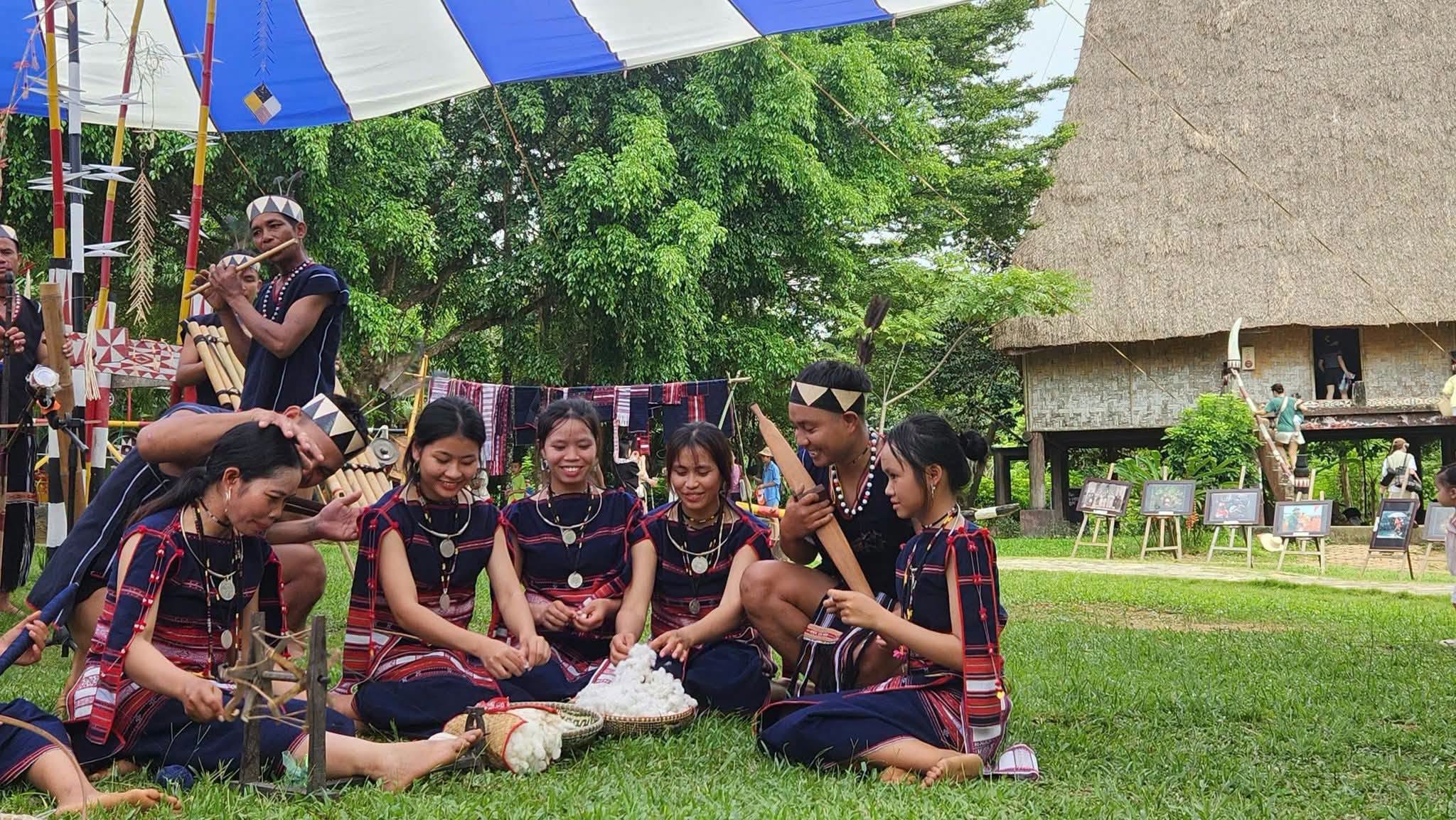
Hơmon, the Ba Na term for epic poetry, is a distinctive form of folk literature that emerged and has continued to exist as an integral part of the community’s spiritual life. Hơmon preserves many traces of early social structures and reflects a strong belief in animism. It serves as a spiritual and cultural link between human beings and their ancestors, between the past and the present, and between the visible and invisible worlds. According to traditional beliefs, these worlds are not separate but constitute two closely connected halves of a village community.
Hơmon is an important component of Ba Na cultural identity, reflecting the history, social life, indigenous knowledge, emotions, aspirations, and worldview of the community. Through epic narratives, the Ba Na explain the formation of the sky, earth, and humankind, interpret natural phenomena, recount wars and conflicts, and describe the customs, traditions, and social relationships of their people.
Themes and Characters in Hơmon
Hơmon is associated with legendary and mythological heroes of the villages of the Central Highlands in general and the Ba Na people in particular. Prominent figures include Diông, Dư, Đăm Noi, and many other heroic characters.
A hơmon work is often composed of numerous episodes and sections that are connected to form a complete epic. However, individual sections may also be performed separately and retain a relatively independent position within the overall narrative.
The formation and transmission of hơmon have taken place over a long period of time. Epic storytellers play a particularly important role in this process. They must possess exceptional memory to recall narratives that may continue for many nights, as well as a deep understanding of the history, customs, beliefs, language, and community life of their people.
During performances, storytellers may add details, develop scenes, and adapt their delivery according to their own knowledge, imagination, language skills, and artistic style. As a result, different versions of the same epic may exist, while still preserving traditional plots, themes, characters, verbal formulas, and narrative structures.
The central content of many hơmon works generally revolves around three major events in the life of a hero: marriage, labor, and warfare, with warfare representing the most important and central mission.
Marriage and the Taking of a Wife
Marriage is a common motif in the epics of many ethnic groups. However, in hơmon, it does not usually describe ordinary marriages. Instead, it is associated with extraordinary and challenging situations, such as:
- Taking a woman as a wife by force, as in the epic Diông Trong Yuăn.
- Recovering a wife who has been taken away, as in Diông Dư.
- Rescuing a kidnapped woman and then marrying her, as in Đăm Noi and Kon Kra – Kon Krung.
The practice of taking women by force was relatively common in ancient societies and survived in various forms among certain communities until more recent times. In hơmon, this motif is not presented as an isolated event but is placed within the broader life story of the hero.
The taking of a wife is often connected with territorial expansion, the enhancement of authority, the gathering of followers, the acquisition of wealth, revenge, and the settlement of debts or disputes.
Labor and Production
Labor in hơmon is often portrayed in a highly imaginative and supernatural manner. It may appear through agricultural calendars in Biă Brâu, seasonal changes in the natural landscape in Diông Dư, or scenes of farming and production found in many other Ba Na epics.
Labor is not merely an activity necessary for survival. It also represents a test of the hero’s physical strength, determination, and abilities before undertaking more important responsibilities, particularly the struggle to defend the village and protect the community.
Warfare and the Protection of the Community
Warfare is the greatest mission undertaken by epic heroes. The purposes of war can generally be divided into three categories: fighting to collect debts, to seek revenge, and to obtain a wife.
The battles are described in a fierce and heroic manner, reflecting issues of great importance to the community, including honor, property, human resources, marriage, family relationships, and the survival of the village.
Wars are often organized and led by individuals who possess high social standing, physical strength, courage, intelligence, and leadership abilities within the community.
Through the image of the epic hero, hơmon emphasizes the connection between individual strength and collective responsibility. The hero does not fight solely for personal interests but also represents the honor, prosperity, and safety of the entire village.
Performance Spaces and Transmission
Hơmon is primarily presented through sung storytelling, in which the performer plays a decisive role in the creation, transmission, and teaching of epic traditions. In addition to the storyteller, the audience and the performance setting are also essential elements that sustain the vitality of this art form.
Hơmon performances take place in spaces closely associated with community life, such as communal houses, family homes, fields, upland farms, and during family rituals including weddings, funeral ceremonies, and communal religious events.
Storytellers are not necessarily required to follow a fixed ritual calendar. They may perform according to inspiration and circumstance, especially during agricultural leisure periods after the farming season, at annual festivals, or while resting after a hard day of work in the fields.
Epics are transmitted through nights of storytelling. Listeners who enjoy the narratives gradually memorize individual episodes and passages before recounting them to others. Family traditions and the community’s cultural environment are important conditions for preserving, nurturing, and developing the Ba Na epic heritage.
Each storyteller may embellish, adjust, and creatively interpret the narrative according to personal thinking, life experience, linguistic ability, and performance style. Consequently, several versions of the same story may exist, while still retaining the traditional motifs, characters, verbal patterns, and principal themes.
The Art of Hơmon Storytelling
Hơmon is usually performed at night. The storyteller may sit or lie down while performing. Epic singers must generally possess good health, a strong voice, and exceptional memory because each performance may last for several hours and, in some cases, continue over many nights.
During the performance, the storyteller takes on multiple roles and divides the narrative into different sections. They carefully determine pauses, breathing points, melodic embellishments, filler words, and changes in vocal tone to make the story vivid and engaging.
Voice, rhythm, intonation, emotional expression, narrative structure, pauses, and changes in tone are essential artistic tools. These elements enable the performer to express the grandeur, heroism, and dramatic power of the characters and events described in the epic.
Hơmon combines musical performance with orally transmitted language. Its language has both narrative and lyrical qualities, alternating between prose and verse, often following a parallel or balanced rhetorical structure.
The language of hơmon is rich in imagery, rhythm, metaphor, and comparison. Images of plants, animals, forests, mountains, and natural phenomena are frequently used to describe human beings, emotions, and changes in social life.
Epic performers generally employ two basic forms of expression:
- Hơri: ordinary speaking or storytelling, usually used to introduce characters, connect events, and lead the narrative forward.
- Hơmon: singing lines or passages of verse, also known as pơđơk, combined with filler words and particles to enhance the melody, rhythm, and emotional quality of the performance.
Through the combination of sung recitation and spoken narration, folk artists can tell long stories involving numerous characters and interconnected events. Listeners learn about the creation of the sky, earth, and human beings, spiritual beliefs, religious concepts, the formation and development of society, community relationships, customs, and traditional practices.
The narrative is often organized into chapters and sections, with a relatively clear beginning, development, and conclusion. The storyteller may pause after an event or an important detail has reached a natural point of completion, creating a “chapter” or “episode” within the larger work. This structure allows lengthy epics to continue over many nights while maintaining coherence and dramatic appeal.
Community Participation in Epic Performances
During storytelling sessions, listeners often sit in groups around a fire, attentively following the narrative as it moves from one event to another. The performance creates a special sense of immersion between the storyteller, the audience, and the world of the epic characters.
The storyteller becomes deeply absorbed in the lives of the characters, while listeners experience suspense, joy, sadness, anxiety, and excitement as the story unfolds. The audience is not merely a passive recipient. Their reactions provide inspiration and energy for the storyteller. In many cases, listeners almost directly enter the world of the epic, feeling that the characters are present within the community, living and breathing in the same space, and sometimes even interacting with the audience.
This close relationship between storyteller and audience encourages both sides to follow the narrative to its very end, regardless of how many nights the performance may take. It is one of the forces behind the Ba Na tradition of storytelling that continues “through long days and deep nights.”
Through the actions and experiences of epic characters, listeners learn about appropriate relationships between people and nature, between individuals and the community, and among members of society. Epic storytelling sessions also provide knowledge about the material and spiritual lives of ancestors, traditional production methods, and ways of interacting with the natural and social environment.
The Contemporary Value of Hơmon
In contemporary society, hơmon continues to exist as a cultural, social, and recreational need among the Ba Na people. It remains an important environment for nurturing ethnic consciousness, community sentiment, solidarity, and intergenerational connections.
The storyteller and the audience maintain a close interactive relationship during the performance and transmission of the epic. Both contribute to the preservation of the humanistic and aesthetic values reflected in the narratives.
Hơmon does not merely recount the past. It also helps the community understand its origins, history, moral principles, responsibilities, and traditional standards of behavior.
With its system of heroic characters, rich narratives, expressive language, and distinctive performance techniques, hơmon is an important body of folk knowledge for the study of Ba Na history, culture, society, belief systems, and indigenous knowledge.
For its outstanding historical, cultural, and scientific values, Hơmon Epic Poetry of the Ba Na People in Gia Lai Province, together with Hơmon Epic Poetry of the Ba Na – Rơ Ngao People in Kon Tum Province, was included in the National Intangible Cultural Heritage List by the Minister of Culture, Sports and Tourism in 2014.
Heritage Information
| Category | Information |
|---|---|
| Name of heritage | Hơmon Epic Poetry of the Ba Na People in Gia Lai Province |
| Type of heritage | Folk literature |
| Location | Gia Lai Province |
| Recognition document | Decision No. 4205/QD-BVHTTDL |
| Date of recognition | December 19, 2014 |
Hơmon is a living heritage that emerged from community life and continues to survive through memory, storytelling voices, cultural spaces, and the participation of successive generations of the Ba Na people. More than a collection of stories about legendary heroes, hơmon is a comprehensive cultural portrait of the history, beliefs, society, worldview, and spiritual life of a distinctive Central Highlands community.