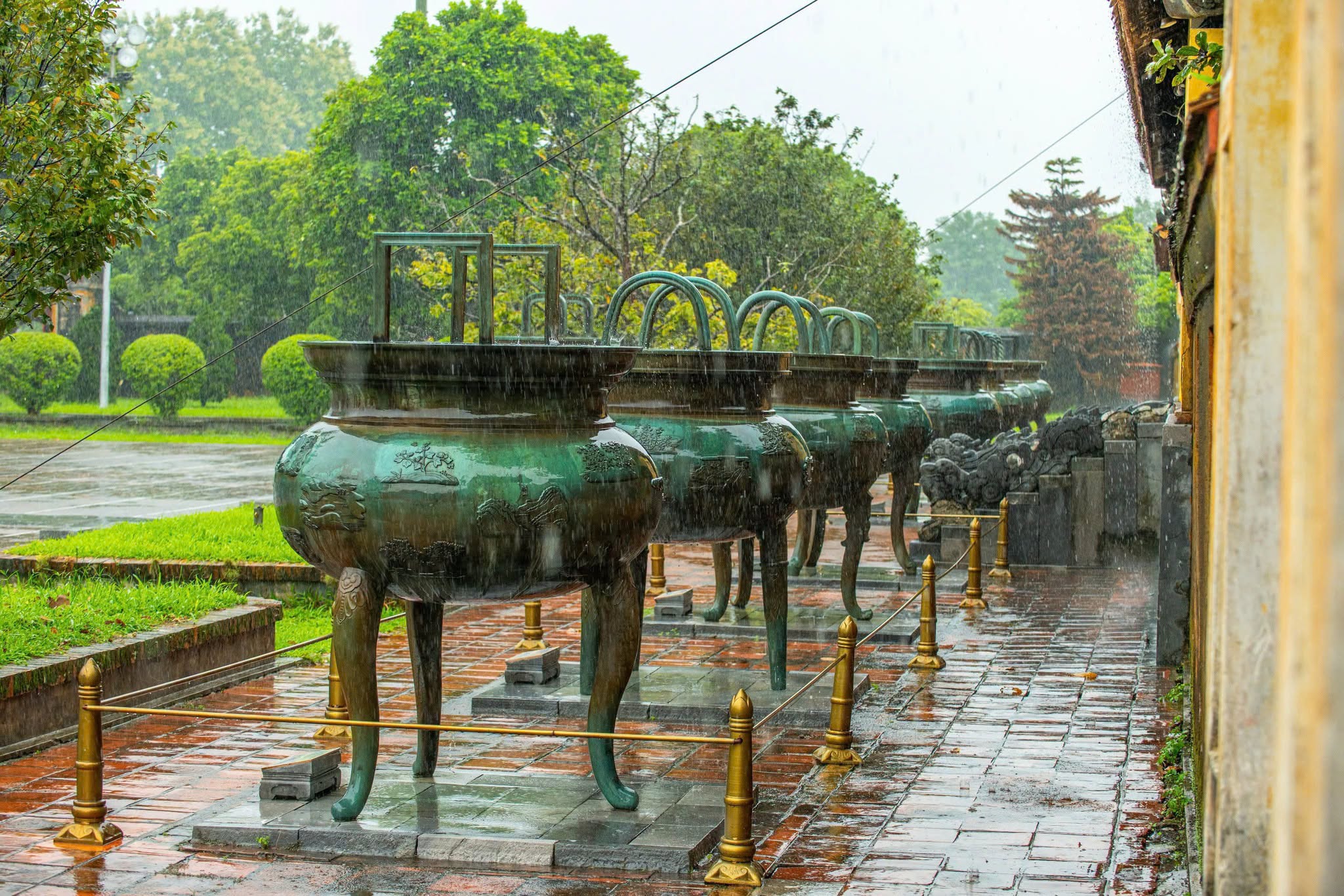
The Nine Dynastic Urns’ Embossed Panels at Hue Imperial Palace represent one of Vietnam’s most remarkable documentary heritage collections, comprising 162 embossed images on the Nine Dynastic Urns, known in Vietnamese as Cửu Đỉnh. These monumental bronze vessels were commissioned during the reign of Emperor Minh Mang and cast between 1835 and 1837. Each embossed image is an independent artistic composition depicting characteristic aspects of Vietnam’s natural environment, geography, history, local products, daily life, and cultural traditions during the first half of the 19th century.
Prominently displayed in the courtyard of the Temple of the Nguyen Dynasty Emperors (The To Mieu) within Hue Imperial Palace, the Nine Dynastic Urns symbolize imperial authority and the Nguyen Dynasty’s aspiration for permanence. At the same time, they represent an extraordinary achievement in Vietnamese bronze casting, reflecting the technical expertise, artistic imagination, and craftsmanship of traditional artisans.
Through their 162 embossed images, the urns preserve an extensive body of knowledge about Vietnam, ranging from mountains, rivers, seas, plants, and animals to transportation systems, military equipment, and products associated with different regions of the country.
The carefully selected and arranged images form a distinctive visual documentary collection, frequently described as a “bronze encyclopedia” of Vietnam in the early 19th century. Their significance extends beyond artistic beauty to the ways in which they record contemporary perceptions of territory, nature, culture, and society during an important period of Vietnamese history.
On May 8, 2024, at the Tenth General Meeting of the Memory of the World Committee for Asia and the Pacific (MOWCAP), held in Ulaanbaatar, Mongolia, Vietnam’s nomination entitled “The Nine Dynastic Urns’ Embossed Panels at Hue Imperial Palace” was approved and officially inscribed on the UNESCO Memory of the World Asia-Pacific Regional Register.
This recognition reaffirmed the exceptional importance of Hue’s cultural heritage within Vietnam and the wider international community, while opening new opportunities for studying historical knowledge preserved through imagery on ancient metal artifacts.
Historical Origins of the Nine Dynastic Urns and Their Place in Hue Imperial Palace
The Nine Dynastic Urns were commissioned by Emperor Minh Mang, the second emperor of the Nguyen Dynasty, in 1835, during a period when the imperial government was consolidating its administrative institutions, strengthening centralized governance, and establishing symbols of dynastic authority.
Following an elaborate manufacturing process, the nine bronze urns were completed in 1837 and installed in the courtyard of The To Mieu, below Hien Lam Pavilion, within the Hue Imperial Palace complex.
In East Asian political and ceremonial traditions, bronze ritual vessels have long symbolized sovereign power, political legitimacy, and the enduring authority of a ruling dynasty.
The concept of nine monumental bronze vessels carries particular significance, historically associated with supreme authority and the unity of a state.
Emperor Minh Mang’s decision to commission the Nine Dynastic Urns therefore went beyond the creation of ceremonial objects for an imperial ancestral temple. The project expressed aspirations for the Nguyen Dynasty’s longevity, the country’s prosperity, and the stability and unity of the Vietnamese state.
The number nine was deliberately chosen for its symbolic meaning.
In traditional East Asian thought, nine is frequently associated with nobility, completeness, supreme authority, and permanence. The production of nine bronze urns, each decorated with a carefully organized system of embossed images, demonstrates meticulous planning in ceremonial symbolism, architecture, and artistic design.
The collection consists of nine vessels named Cao Urn, Nhan Urn, Chuong Urn, Anh Urn, Nghi Urn, Thuan Urn, Tuyen Urn, Du Urn, and Huyen Urn.
The urns stand in a horizontal arrangement in the courtyard of The To Mieu. Each rests on a substantial stone pedestal and faces the ancestral worship spaces associated with the Nguyen emperors.
Their arrangement creates a solemn and harmonious setting within the architectural composition of The To Mieu and Hien Lam Pavilion.
Among the nine vessels, Cao Urn occupies the central position and stands approximately three meters forward of the others, honoring Emperor Gia Long, the founder of the Nguyen Dynasty.
The names of the urns correspond to the temple names associated with Nguyen emperors.
Cao Urn is associated with Emperor Gia Long, Nhan Urn with Emperor Minh Mang, Chuong Urn with Emperor Thieu Tri, Anh Urn with Emperor Tu Duc, Nghi Urn with Emperor Kien Phuc, Thuan Urn with Emperor Dong Khanh, and Tuyen Urn with Emperor Khai Dinh.
The remaining two vessels, Du Urn and Huyen Urn, were not assigned corresponding emperors within this ancestral worship system before the Vietnamese monarchy ended in 1945.
The naming and arrangement of the urns reflect the Nguyen Dynasty’s understanding of dynastic succession, connecting generations of emperors through a ceremonial system of symbolic objects.
However, the significance of the Nine Dynastic Urns extends far beyond the imperial family.
The embossed images decorating their surfaces broaden the meaning of the collection to encompass the natural environment, geographical landmarks, local products, and everyday life of different regions throughout Vietnam.
In terms of scale, the Nine Dynastic Urns represent one of the outstanding achievements of Vietnamese bronze casting during the early 19th century.
According to published descriptions of the collection, the urns measure approximately 2.3–2.5 meters in height, with body circumferences ranging from 4.64 to 4.72 meters and individual weights of approximately 1,935–2,061 kilograms.
Producing bronze vessels of such dimensions and weight required considerable technical knowledge, including material preparation, mold design, furnace operation, molten-metal casting, and surface finishing.
Bronze-casting artisans in Hue, particularly craftsmen associated with the region’s longstanding metalworking traditions, contributed to the creation of vessels combining monumental scale with remarkable precision.
Although the urns form a unified collection, they are not identical in appearance.
Their handles display different designs, including square, rounded, and twisted forms resembling ropes. The legs also vary, with some featuring curved, crouching forms and others appearing straighter and more robust.
These variations give each urn its own identity while preserving the overall visual harmony of the collection.
Most importantly, each urn bears 18 embossed images arranged in three horizontal tiers around its body.
Together, the nine vessels display 162 embossed images, forming a substantial and exceptionally diverse visual documentary collection.
These images are not merely decorative motifs. They were selected according to specific themes, reflecting contemporary ideas about the universe, the natural world, national territory, and Vietnamese society.
The combination of the nine urns’ dynastic symbolism and the documentary content of their 162 embossed images is what makes the collection particularly significant.
Since their completion, the Nine Dynastic Urns have remained closely associated with the ceremonial and architectural environment of The To Mieu.
Despite nearly two centuries of historical change, the vessels have been preserved in their traditional setting, serving as important evidence of Nguyen Dynasty artistry, technological achievement, and political thought.
The 162 Embossed Images and Their Artistic, Historical, and Geographical Significance
The most distinctive feature of the Nine Dynastic Urns is their collection of 162 embossed images, each conceived as an independent composition with a recognizable subject, carefully balanced layout, and refined artistic details.
The images depict a wide range of subjects drawn from Vietnam’s natural environment and daily life, illustrating the country’s diversity during the first half of the 19th century.
According to the commonly presented classification, the 162 images are organized into 18 thematic groups of nine images each, corresponding to the nine bronze urns.
Their subjects encompass celestial bodies and natural phenomena, mountains, rivers, canals, estuaries, animals, birds, food crops, vegetables, flowers, fruit trees, medicinal plants, valuable timber species, transportation, weapons, and other natural and cultural products.
This thematic organization demonstrates that the images were not selected randomly but arranged according to a deliberate system of classification and representation.
Together, they create a relatively comprehensive visual account that combines symbolic subjects with familiar elements of everyday life.
The collection includes the sun, moon, stars, prominent mountains, major rivers, seas, coastal entrances, and waterways.
It also depicts dragons, tigers, leopards, peacocks, pheasants, whales, hawksbill turtles, and numerous other animals.
Plant life is represented by rice, glutinous rice, onions, garlic chives, mung beans, jackfruit trees, mango trees, lotus flowers, jasmine, agarwood, ky nam resinous wood, and various valuable timber species.
Boats, wheeled vehicles, cannons, and other weapons appear alongside these natural subjects, providing visual references to transportation, production, and military technology during the period.
This extraordinary variety has led scholars and heritage interpreters to describe the Nine Dynastic Urns as a bronze encyclopedia, in which every embossed panel conveys information about a particular aspect of nature, geography, or cultural life.
Cao Urn, the centrally positioned vessel, features numerous subjects of particular national significance.
Its upper tier includes images of a dragon, jackfruit tree, rice plant, onion, crape myrtle flower, and pheasant.
The dragon symbolizes authority and nobility, while rice, jackfruit, and onions represent familiar products of Vietnam’s agricultural landscape.
The pheasant and crape myrtle flower introduce additional elements of traditional symbolism and artistic refinement.
The middle tier of Cao Urn includes representations of the East Sea, Vinh Te Canal, the sun, Ben Nghe River, and Thien Ton Mountain, together with the name of the urn.
These subjects possess considerable geographical and historical significance.
The East Sea represents the maritime environment associated with Vietnam’s territory and coastal communities, while the sun symbolizes light, life, and the natural order.
Ben Nghe River is associated with the waterways of southern Vietnam, whereas Thien Ton Mountain is a landmark of historical significance.
Particularly noteworthy is the representation of Vinh Te Ha, or Vinh Te Canal, an important transportation and irrigation project in southwestern Vietnam.
The canal is associated with the development of transportation, agricultural expansion, and frontier administration during the Nguyen Dynasty.
Its name is linked to Chau Thi Te, the wife of Thoai Ngoc Hau Nguyen Van Thoai, who played an important role in organizing the canal’s construction.
The inclusion of Vinh Te Canal on Cao Urn indicates that the Nguyen court considered the waterway a significant achievement in territorial development, transportation, and irrigation.
The canal’s name also preserves the historical association of a woman with an important geographical landmark and public infrastructure project.
The lower tier of Cao Urn depicts ironwood, a tiger, a multi-rope boat, a cannon, agarwood, and a softshell turtle.
These images combine valuable natural resources, wildlife, transportation, and military equipment.
Ironwood and agarwood represent valuable forest products; the tiger and turtle reflect the animal world; the boat illustrates water transportation; and the cannon represents military technology.
Taken together, the embossed images on Cao Urn present a condensed visual representation of the country’s natural environment, resources, and important aspects of national life.
Nhan Urn, associated with Emperor Minh Mang, also features a rich variety of images.
Its upper tier depicts the parasol tree, ky nam, glutinous rice, langsat fruit, lotus flower, and peacock.
These subjects combine timber trees, valuable natural products, staple crops, flowers, and birds, illustrating the diversity of the natural world.
Ky nam, a highly prized form of resinous agarwood, has long held considerable value in the history of trade and cultural practices, while glutinous rice is closely associated with Vietnamese agriculture and traditional cuisine.
Lotus flowers and peacocks possess strong aesthetic qualities and frequently appear in traditional decorative arts.
The middle tier of Nhan Urn includes the South Sea, Pho Loi Canal, the moon, Perfume River, and Ngu Binh Mountain.
Among these, the Perfume River and Ngu Binh Mountain are particularly important geographical and cultural symbols of Hue.
The Perfume River is closely connected to the historical development of Hue and plays a defining role in the city’s landscape.
Ngu Binh Mountain is a prominent feature of Hue’s traditional geomantic setting and contributes to the distinctive scenery surrounding the former imperial capital.
Their inclusion on Nhan Urn reflects the relationship between nature, history, and the symbolic landscape of the Nguyen Dynasty’s capital.
The lower tier includes a whale, garlic chives, a multi-storey boat, a wheeled cannon, a leopard, and a hawksbill turtle.
The whale, known in Vietnamese coastal traditions as Ca Ong, or the revered Whale Deity, evokes the beliefs and maritime culture of fishing communities.
The multi-storey boat and wheeled cannon illustrate transportation and military equipment known during the period.
Other animal representations, including the leopard and hawksbill turtle, further emphasize the diversity of Vietnam’s natural environment.
Chuong Urn, associated with Emperor Thieu Tri, includes images of jasmine, mango, cardamom, mung beans, pickling onions, and a chicken on its upper tier.
These familiar subjects represent food sources, spices, cultivated plants, and domestic animals.
The middle tier features Kim Phung Mountain, Loi Nong Canal, symbols associated with the Five Elements, Gianh River, and the West Sea.
Gianh River occupies an important place in Vietnamese history, having been associated with the historical division between Dang Trong and Dang Ngoai during periods of political separation.
Loi Nong Canal reflects the importance of irrigation networks in agricultural life.
The symbols of the Five Elements demonstrate the influence of traditional East Asian cosmological thought on contemporary understandings of nature and the universe.
The images on Chuong Urn therefore expand the documentary scope of the collection, combining natural landscapes with philosophical and historical concepts.
The remaining vessels, Anh Urn, Nghi Urn, Thuan Urn, Tuyen Urn, Du Urn, and Huyen Urn, are likewise decorated with distinct groups of embossed images.
Together, all nine urns form a coordinated but non-repetitive system of visual representations encompassing many aspects of Vietnam.
Importantly, the geographical locations and natural products represented are not confined to the imperial capital of Hue.
They originate from numerous regions across the country.
From mountains, rivers, and coastal entrances to trees, animals, and regional products, the images reveal the Nguyen court’s interest in the geographical extent and natural resources of the Vietnamese state.
The subjects are rendered in a concise artistic style that emphasizes distinctive characteristics rather than attempting to reproduce every detail with photographic realism.
As a result, viewers can identify the principal features and meanings of the subjects despite the relatively small size of individual panels.
The artistic significance of the embossed panels lies primarily in the masterful combination of bronze-casting technology and sculptural design.
Producing sharply defined raised images on the curved surfaces of massive bronze vessels required precision in both design and mold preparation.
Artisans had to calculate the position, proportions, and relief depth of each motif to ensure that the images were aesthetically pleasing and structurally compatible with the vessels.
Some images feature the flowing lines of plants and flowers, while others emphasize the strength and solidity of animals, mountains, or weapons.
This diversity of lines and forms creates a rich visual rhythm across the bronze surfaces.
The achievement is particularly remarkable because the embossed images are not independent artworks attached to the vessels. They are integral components of monumental cast-metal objects.
Each image had to function as a complete composition while remaining harmonious with the overall decorative scheme of the Nine Dynastic Urns.
Beyond their technical sophistication, the panels reflect an interaction between folk culture and scholarly culture.
Familiar elements of everyday life, such as rice plants, chickens, onions, tigers, boats, and rivers, were incorporated into objects carrying the highest ceremonial significance within the imperial court.
These ordinary subjects appear alongside cosmological symbols, mythical creatures, and geographical landmarks associated with political and historical meaning.
The result is a visual synthesis of practical community knowledge and the symbolic systems of classical Confucian scholarship.
In terms of historical and geographical value, the embossed panels provide visual evidence of how the Nguyen Dynasty identified and represented important elements of the country’s territory.
Images of mountains, rivers, seas, and canals can be examined alongside contemporary geographical descriptions, historical maps, and written records.
Such comparisons may help researchers investigate historical place names, landscape changes, and transportation networks.
In terms of cultural significance, the Nine Dynastic Urns reflect traditional ideas about nature, the cosmos, and humanity’s relationship with the surrounding environment.
The sun, moon, Five Elements, and mythical creatures illustrate concepts that were deeply influential in East Asian intellectual and cultural traditions.
Meanwhile, the depictions of food crops, medicinal plants, valuable timber, and animals preserve information about natural resources and material life.
In terms of scientific and technological history, the embossed panels demonstrate how Vietnamese artisans and scholars observed, classified, and visually represented information during the early 19th century.
Depictions of transportation, boats, wheeled vehicles, and weapons can contribute to studies of historical technology and production.
Images of plants and animals offer comparative material for research into historical knowledge of the natural world.
The collection is also valuable for understanding Vietnamese artistic traditions, calligraphy, and metalwork decoration.
The combination of images and Chinese characters on the bronze surfaces identifies individual subjects and demonstrates how written language was incorporated into an imperial artistic monument.
From a regional historical perspective, the Nine Dynastic Urns also reflect cultural contact and interaction between Vietnam and other East Asian societies.
Bronze ritual vessels have a long history in East Asian civilization, but the Nine Dynastic Urns in Hue possess distinctive features in their form, decorative content, and visual representation of knowledge.
Vietnamese artisans inherited elements of the broader East Asian bronze-vessel tradition while developing a collection firmly rooted in the country’s geography, environment, and history.
The result is a work that combines regional cultural influences with a recognizable Vietnamese identity.
For this reason, the Nine Dynastic Urns are valued not only for their monumental scale and technical execution but also as an exceptional documentary source concerning Vietnam’s cultural history.
Another defining characteristic of the collection is its authenticity and uniqueness.
According to heritage descriptions, the Nine Dynastic Urns have remained in their original ceremonial setting at The To Mieu despite nearly two centuries of historical upheaval.
The embossed images were created as integral parts of the vessels during their original manufacture rather than added during later periods.
The survival of these original artifacts within a clearly identifiable historical architectural setting preserves the relationship between documentary content, artistic form, and ceremonial function.
This continuity gives the embossed panels exceptional significance for research into Vietnamese history, geography, art, and culture during the first half of the 19th century.
UNESCO Recognition in 2024 and the Preservation of the Nine Dynastic Urns
On May 8, 2024, in Ulaanbaatar, Mongolia, the Tenth General Meeting of the Memory of the World Committee for Asia and the Pacific (MOWCAP) officially approved Vietnam’s nomination, “The Nine Dynastic Urns’ Embossed Panels at Hue Imperial Palace.”
The decision resulted in the inscription of the 162 embossed images on the UNESCO Memory of the World Asia-Pacific Regional Register.
This recognition marked an important milestone in identifying and celebrating the documentary significance of Hue’s cultural heritage while broadening understanding of historical records preserved on metal surfaces.
Unlike many documentary heritage collections commonly associated with ancient books, woodblocks, imperial archives, or handwritten manuscripts, the Nine Dynastic Urns preserve information through images and inscriptions cast directly into bronze artifacts.
This characteristic makes the collection especially distinctive, demonstrating that historical memory and human knowledge can be preserved through a wide variety of physical forms.
The embossed images possess both artistic value and documentary significance, recording information about the natural environment, geography, and social life.
This combination allows the Nine Dynastic Urns to transcend their original function as imperial ceremonial objects and become an important resource for historical and cultural research.
It is important to distinguish that the collection was inscribed on the Memory of the World Asia-Pacific Regional Register, rather than the International Memory of the World Register.
This recognition is also separate from the designation of the Complex of Hue Monuments as a UNESCO World Heritage Site in 1993.
The Complex of Hue Monuments was recognized for the outstanding value of its imperial architecture, historical landscape, and cultural significance.
The Nine Dynastic Urns’ Embossed Panels, by contrast, were recognized for their documentary value, uniqueness, and the significance of the information preserved through their images.
These two forms of recognition complement one another, highlighting the diverse heritage values of Hue.
For historical research, the 2024 inscription provides further opportunities to examine the 162 embossed images as visual documentary evidence of Vietnam in the early 19th century.
Representations of mountains, rivers, seas, canals, and geographical landmarks can be compared with historical maps, geographical texts, and archival records to investigate how the Nguyen Dynasty understood and represented national territory.
Images of plants, animals, and regional products can contribute to research into environmental history, economic activities, and traditional knowledge.
Depictions of boats, wheeled vehicles, and weapons offer additional evidence for studies of technology, transportation, and military history.
For art-historical research, the embossed panels provide valuable material concerning Vietnamese sculptural traditions and bronze-casting techniques during the Nguyen Dynasty.
The study of composition, line, form, and manufacturing methods can help clarify the technical expertise and aesthetic preferences of Hue’s traditional metalworkers.
For cultural studies, the urns offer insight into the imperial court’s understanding of nature, the universe, territory, and national symbolism.
The coexistence of the sun, moon, Five Elements, mythical creatures, agricultural crops, and regional products illustrates the interaction between traditional philosophical ideas and practical knowledge.
These qualities make the Nine Dynastic Urns suitable for interdisciplinary research involving history, geography, art history, cultural studies, and the natural sciences.
From a conservation perspective, the Nine Dynastic Urns present particular challenges because they are large bronze artifacts displayed in an outdoor heritage environment.
Although bronze is a durable material, its surface remains vulnerable to environmental influences over time.
Humidity, rainfall, temperature fluctuations, dust, and corrosive agents can affect the metal surfaces, particularly the fine details of the embossed images.
Conservation work therefore requires material analysis, environmental monitoring, and regular assessments of the artifacts’ physical condition.
Cleaning, surface treatment, and other conservation interventions must be carried out using appropriate professional methods to protect the original fabric of the vessels.
Alongside physical conservation, the digitization of all 162 embossed images is particularly important for preserving information and supporting research.
High-resolution photography, three-dimensional scanning, and structured digital databases can record the form, surface details, dimensions, and location of individual images.
Digital documentation can support conservation planning while making the collection more accessible to researchers in Vietnam and abroad.
Multilingual interpretation is another valuable approach to communicating the heritage’s significance to a wider audience.
Many of the embossed images are identified by Chinese-character inscriptions associated with historical place names, plant and animal species, and traditional cultural concepts.
Accurate interpretation therefore requires expertise in Han-Nom studies, history, geography, biology, and cultural studies.
Transcription, translation, identification of historical locations, and comparison with other documentary sources can help clarify the information preserved on the urns.
For cultural tourism, the Nine Dynastic Urns are an important attraction within Hue Imperial City.
The solemn courtyard of The To Mieu, with its carefully arranged bronze vessels, creates a setting of considerable historical and aesthetic significance.
Viewed from a distance, the collection impresses visitors through its monumental scale and dignified appearance.
At closer range, the embossed images reveal a rich visual world of celestial bodies, mountains, rivers, plants, animals, and traditional forms of transportation.
Each image can be understood as a small story about a particular natural feature, geographical location, or aspect of Vietnamese life.
Together, the 162 panels form a broader visual account of how Vietnamese people in the early 19th century understood and represented the world around them.
Specialized guided tours, enlarged photographic displays, interactive maps, and digital interpretation could help visitors explore the collection in greater depth.
Educational programmes for students and young visitors could also use the Nine Dynastic Urns as a visual resource for learning about Vietnamese history, geography, art, and culture.
Through familiar subjects such as rice plants, chickens, the Perfume River, Ngu Binh Mountain, and Vinh Te Canal, learners can discover connections between historical knowledge and surviving cultural artifacts.
Interpretation should also place the urns within the wider architectural and ceremonial context of The To Mieu, Hien Lam Pavilion, and Hue Imperial Palace.
This broader perspective helps visitors understand that the Nine Dynastic Urns are not isolated museum objects but integral components of the Nguyen Dynasty’s architectural, historical, and symbolic landscape.
Beyond their tourism value, UNESCO recognition has also contributed to greater public awareness of the importance of protecting exceptional documentary heritage.
The embossed images on the Nine Dynastic Urns are irreplaceable historical records, created within a specific cultural and political context and preserved across generations.
Conserving the collection therefore involves more than protecting bronze artifacts. It also means safeguarding the knowledge, information, and historical memory embodied in their surfaces.
Nearly two centuries after their creation, the Nine Dynastic Urns remain at Hue Imperial Palace as enduring evidence of Nguyen Dynasty bronze-casting craftsmanship and symbolic artistic expression.
From the refined details of individual panels to the carefully organized system of 162 images, the collection reflects the creativity of Vietnamese artisans and the aspiration to represent the country’s natural and cultural richness.
The Nine Dynastic Urns’ Embossed Panels at Hue Imperial Palace are not only masterpieces of Nguyen Dynasty bronze casting but also an exceptional visual documentary record of Vietnam’s natural environment, geography, history, and culture during the first half of the 19th century. Their inscription on the UNESCO Memory of the World Asia-Pacific Regional Register in 2024 further affirms their significance as an important part of Vietnam’s cultural memory and the documentary heritage of the Asia-Pacific region.
Quick Information
| Item | Details |
|---|---|
| Heritage name | The Nine Dynastic Urns’ Embossed Panels at Hue Imperial Palace |
| Vietnamese name | Những bản đúc nổi trên chín đỉnh đồng ở Hoàng cung Huế |
| Alternative names | Embossed Panels on the Nine Dynastic Urns, Cuu Dinh at Hue Imperial Palace |
| Location | The To Mieu Courtyard, Hue Imperial City, Hue, Vietnam |
| Heritage type | Documentary heritage represented through embossed bronze images |
| Dynasty | Nguyen Dynasty |
| Commissioning emperor | Minh Mang |
| Casting began | 1835 |
| Completion year | 1837 |
| Number of urns | 9 |
| Names of the urns | Cao, Nhan, Chuong, Anh, Nghi, Thuan, Tuyen, Du, and Huyen |
| Total embossed images | 162 |
| Images per urn | 18 |
| Image arrangement | Three horizontal tiers on each urn |
| Material | Bronze |
| Height | Approximately 2.3–2.5 m |
| Weight | Approximately 1,935–2,061 kg per urn |
| Main subjects | Nature, geography, flora and fauna, regional products, transportation, weapons, and cultural symbols |
| Outstanding values | History, geography, fine arts, bronze-casting techniques, and traditional knowledge |
| Preservation status | Original artifacts preserved at Hue Imperial Palace |
| UNESCO recognition | Memory of the World Asia-Pacific Regional Register |
| Registering body | Memory of the World Committee for Asia and the Pacific (MOWCAP) |
| Recognition date | May 8, 2024 |
| Related heritage | Complex of Hue Monuments, The To Mieu, Hien Lam Pavilion |