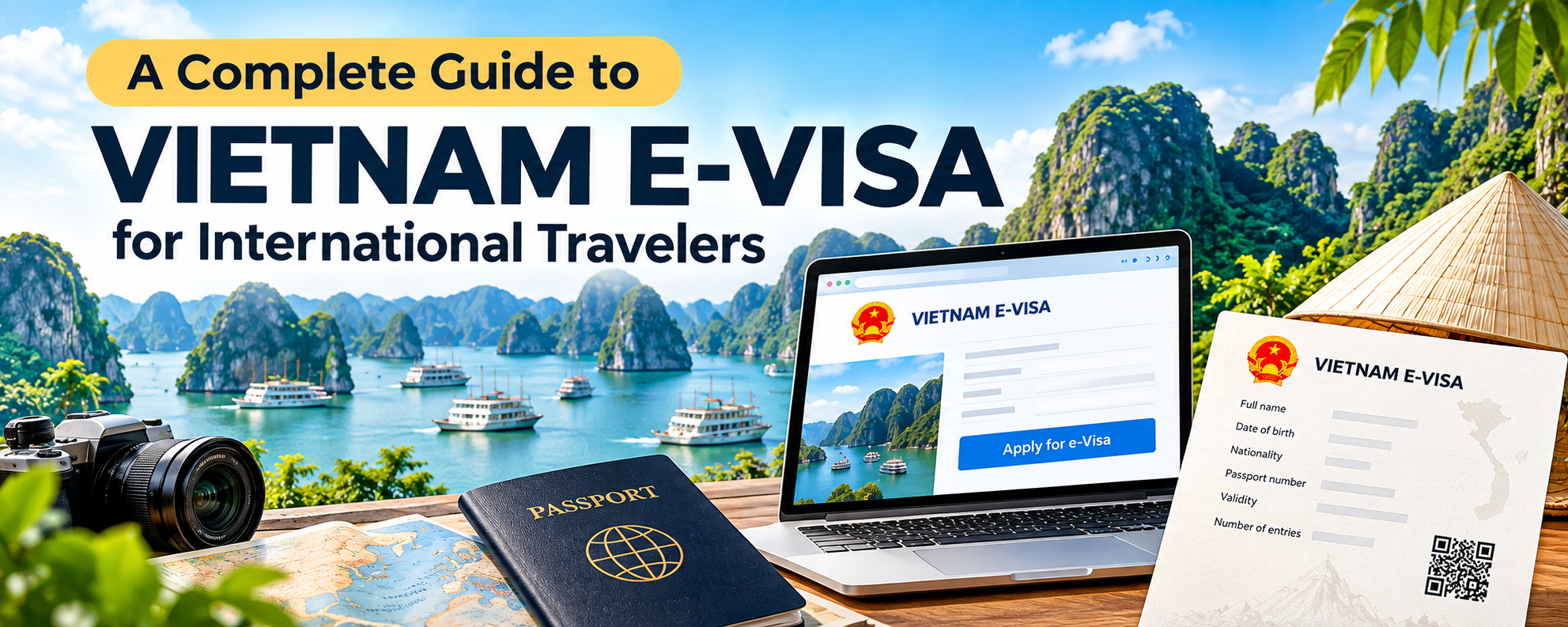
The Vietnam electronic visa (Vietnam e-Visa) is a convenient option for foreign nationals planning to visit Vietnam for tourism, business, or other purposes permitted under Vietnamese law. The application process is completed online, allowing travelers to submit their information, pay the visa fee, and receive their results without visiting a Vietnamese embassy or consulate.
Vietnam e-Visas are available for stays of up to 90 days, with single-entry and multiple-entry options. This flexibility makes the e-Visa suitable for international visitors planning a holiday, exploring different destinations, or traveling across Southeast Asia.
In this guide, Travelin.vn explains the requirements, application process, fees, processing times, and important travel tips to help international visitors prepare for their trip to Vietnam.
What Is a Vietnam e-Visa?
A Vietnam e-Visa is an electronic visa issued by Vietnam’s immigration authorities through an official online application system.
Instead of submitting documents in person at a Vietnamese diplomatic mission, eligible foreign nationals can complete the application online, upload the required documents, pay the visa fee, and check their application results electronically.
Key information about the Vietnam e-Visa:
- Validity: Up to 90 days.
- Entry options: Single entry or multiple entries.
- Application method: Online.
- Eligibility: Foreign nationals who meet Vietnam’s e-Visa requirements.
- Issuing authority: Vietnam Immigration Department.
- Official website: https://evisa.gov.vn
Vietnam offers electronic visas to citizens of all countries and territories. However, visa approval and permission to enter Vietnam remain subject to Vietnamese immigration laws and regulations.
Who Needs a Vietnam e-Visa?
Foreign nationals who plan to enter Vietnam and are not eligible for visa-free entry may need to obtain a visa before traveling.
A Vietnam e-Visa may be suitable for:
- International tourists visiting Vietnam for sightseeing and holidays.
- Travelers visiting friends or relatives.
- Business visitors attending meetings, conferences, or events.
- Travelers planning to enter Vietnam more than once during their trip.
- Visitors who wish to stay longer than the visa-free period available to their nationality.
Important: Not all international visitors need an e-Visa. Vietnam maintains visa exemption policies for citizens of certain countries, subject to specific conditions and permitted lengths of stay.
Before applying, travelers should check whether they qualify for visa-free entry to avoid unnecessary application fees.
Vietnam e-Visa Requirements
Foreign nationals applying for a Vietnam e-Visa must meet several basic requirements.
Applicants generally need to:
- Hold a valid passport or an internationally recognized travel document accepted for the application.
- Not fall under any category of persons prohibited from entering Vietnam.
- Provide accurate personal information and travel details.
- Submit their application through Vietnam’s official electronic visa system.
- Pay the required visa application fee.
Travelers are advised to have a passport valid for at least six months from their intended arrival date to minimize potential difficulties with airlines and immigration procedures.
Documents Required for a Vietnam e-Visa
Before starting the application, travelers should prepare the necessary documents and travel information.
1. Valid passport
Applicants need a valid passport containing clear and accurate personal information.
All information entered into the e-Visa application must match the passport used for travel.
2. Passport-style photograph
Prepare a recent portrait photograph that meets the online system’s requirements.
The photograph should clearly show the applicant’s face, looking directly at the camera, without glasses.
3. Passport information page
Applicants must upload a clear photograph or scan of the passport page containing their personal information.
The image should be readable, complete, and free from glare or obstruction.
4. Travel information
Applicants should prepare the following details:
- Intended arrival date in Vietnam.
- Intended departure date.
- Expected port of entry.
- Accommodation address in Vietnam.
- Purpose of travel.
5. Online payment method
A payment card or another payment method accepted by the official application system is required to complete the visa fee payment.
How to Apply for a Vietnam e-Visa Online
The Vietnam e-Visa application process can be completed in several straightforward steps.
Step 1: Visit the official Vietnam e-Visa website
Access the official electronic visa portal:
Alternatively, visit:
Select the electronic visa application option for foreign nationals and carefully read the instructions before proceeding.
Travelers should use official government websites rather than unfamiliar third-party services.
Step 2: Upload your photograph and passport information page
The application system requires a recent portrait photograph and an image of the passport information page.
Make sure both images meet the file format, size, and quality requirements displayed on the website.
Blurry, incomplete, or incorrectly formatted images may result in delays or requests for additional information.
Step 3: Complete the application form
Enter all required personal and travel information, including:
- Full name as shown in the passport.
- Date of birth.
- Gender.
- Nationality.
- Passport number.
- Passport issue and expiration dates.
- Purpose of entry.
- Intended arrival and departure dates.
- Port of entry.
- Accommodation address in Vietnam.
Check all information carefully before submitting the application.
Even small errors in names, passport numbers, or dates may cause problems during visa processing or immigration checks.
Step 4: Review the application and pay the visa fee
After completing the application form, review all submitted information.
If the details are correct, proceed with the online payment according to the system’s instructions.
Once the application has been submitted, save the application reference code and any other information needed to check its status.
Step 5: Check your application status
Applicants can check their e-Visa status through the official electronic visa portal.
Application status page:
https://evisa.gov.vn/e-visa/search
Travelers may be required to provide their application reference code, email address, date of birth, and verification code.
Step 6: Download your approved e-Visa
If the application is approved, travelers can download their electronic visa from the official system.
Before departure, carefully check:
- Full name.
- Passport number.
- Nationality.
- Visa validity dates.
- Number of permitted entries.
- Other information printed on the visa.
Travelers should save a digital copy and print a paper copy to present when required during airline check-in or immigration procedures.
Vietnam e-Visa Fees
Vietnam e-Visa fees depend on the type of visa requested.
| Visa Type | Government Fee |
|---|---|
| Single-entry e-Visa | USD 25 |
| Multiple-entry e-Visa | USD 50 |
These are the government e-Visa fees and do not include additional service charges that may be collected by third-party visa agencies.
Important: The visa application fee is non-refundable if the application is refused.
Applying directly through the official government portal can help travelers avoid unnecessary intermediary service fees.
Vietnam e-Visa Processing Time
According to Vietnam’s published administrative procedures, the standard processing period is three working days after the relevant authority receives the required application information and fee.
However, actual processing times may be longer in certain circumstances, including:
- Incomplete or inaccurate application information.
- Photographs or passport images that do not meet requirements.
- Additional verification by immigration authorities.
- Public holidays or periods of high application volume.
Travelin.vn recommends applying at least 7 to 10 days before the intended departure date to allow additional time for unexpected delays.
Travelers should avoid relying on an estimated approval date when making non-refundable travel arrangements.
Vietnam e-Visa Entry Points
Travelers holding a valid Vietnam e-Visa may enter or leave the country through designated international border checkpoints approved by the Vietnamese government.
These include selected airports, land border crossings, and seaports.
International airports
Some of the major international airports used by foreign visitors include:
- Noi Bai International Airport.
- Tan Son Nhat International Airport.
- Da Nang International Airport.
- Cam Ranh International Airport.
- Phu Quoc International Airport.
- Cat Bi International Airport.
- Phu Bai International Airport.
Land border crossings
Selected international land border checkpoints include:
- Moc Bai International Border Gate.
- Huu Nghi International Border Gate.
- Lao Cai International Border Gate.
- Ha Tien International Border Gate.
- Lao Bao International Border Gate.
- Mong Cai International Border Gate.
International seaports
Travelers arriving in Vietnam by cruise ship or other sea transportation may use designated international seaports that accept electronic visas.
The list of approved e-Visa entry and exit points may change.
Travelers should verify the latest information through the official Vietnam e-Visa portal before making travel arrangements.
Important Things to Know Before Traveling with a Vietnam e-Visa
To avoid unnecessary difficulties when entering Vietnam, travelers should keep the following points in mind.
Check your passport details: Your name, date of birth, nationality, and passport number on the e-Visa must match your travel document.
Verify visa validity: You may only use the visa within its approved validity period. The actual validity granted may be shorter than the maximum 90 days.
Choose the correct entry option: If you plan to leave Vietnam and return during the same trip, consider applying for a multiple-entry e-Visa.
Keep copies of your documents: Save your e-Visa electronically and carry a printed copy together with your passport.
Respect your permitted stay: Do not remain in Vietnam beyond the period authorized by immigration authorities.
Use official websites: Be cautious of websites that imitate government immigration portals or charge excessive service fees.
Check your visa if your passport changes: If you receive a new passport after your e-Visa has been approved, verify the applicable visa requirements before traveling.
An approved e-Visa does not automatically guarantee entry into Vietnam. Final admission is determined by immigration authorities at the border, subject to applicable entry requirements.
Frequently Asked Questions About the Vietnam e-Visa
Can I apply for a Vietnam e-Visa myself?
Yes. Eligible foreign nationals can apply directly through the official Vietnam e-Visa portal without using a travel agency or visa service provider.
How long is a Vietnam e-Visa valid?
A Vietnam e-Visa may be issued for up to 90 days. The actual validity period is shown on the approved visa.
Can I enter Vietnam multiple times with an e-Visa?
Yes. Vietnam offers both single-entry and multiple-entry electronic visas.
Travelers should select the option that best matches their planned itinerary.
Do I need an e-Visa if my country has a visa exemption agreement with Vietnam?
Not necessarily.
If you qualify for visa-free entry and your intended stay falls within the permitted exemption period, you may not need to apply for an e-Visa.
Can I extend my Vietnam e-Visa while staying in Vietnam?
An e-Visa is not automatically extendable through the standard online application process.
In certain circumstances, foreign nationals already in Vietnam may be considered for a new visa when sponsored by an eligible organization or individual under Vietnamese law.
Travelers who need to stay longer should contact the relevant immigration authorities before their permitted stay expires.
What happens if my e-Visa application is rejected?
If an application is refused, the government visa fee is not refunded.
Applicants should review the information available through the official system before considering a new application.
Can I enter Vietnam by land with an e-Visa?
Yes, provided that the intended border checkpoint is included in Vietnam’s approved list of e-Visa entry points.
Do I need to print my Vietnam e-Visa?
Travelers are advised to print a copy of their approved e-Visa and carry it with their passport.
A paper copy can be useful if a mobile device is unavailable or internet access is limited.
Can children apply for a Vietnam e-Visa?
Children traveling to Vietnam must meet the applicable immigration and visa requirements.
Parents or guardians should follow the official application instructions regarding children, individual passports, and accompanying travelers.
Official Vietnam e-Visa Website and Support
Travelers can find official information and submit their applications through the following government channels.
Official Vietnam e-Visa Portal: https://evisa.gov.vn
Vietnamese e-Visa Portal: https://thithucdientu.gov.vn
Responsible Authority: Vietnam Immigration Department, Ministry of Public Security.
Support Email: foreigners@xuatnhapcanh.gov.vn
Technical Support Email: technical_support@immigration.gov.vn
Travelers should always refer to official government sources for current visa regulations, application fees, entry requirements, and approved border checkpoints.
Conclusion
The Vietnam e-Visa offers international travelers a convenient way to prepare for their visit without completing traditional visa application procedures at an embassy or consulate.
With an online application process, validity of up to 90 days, and single-entry or multiple-entry options, the electronic visa provides flexibility for tourists and other eligible visitors planning a trip to Vietnam.
Before traveling, visitors should check whether they qualify for visa-free entry, prepare accurate application documents, apply well in advance, and review the latest immigration requirements.
Travelin.vn encourages international travelers to use official government resources and plan their journey carefully for a smoother arrival in Vietnam.
Disclaimer: This article is provided by Travelin.vn for general travel information and reference purposes only. It does not constitute legal or immigration advice and does not replace official instructions or decisions issued by Vietnamese authorities. Visa policies, application fees, processing times, and entry requirements may change without prior notice.