


Nha Xa Silk Weaving Village, located in Duy Tan Ward, Ninh Binh Province, formerly part of Ha Nam Province, is one of the historic silk-weaving communities of Vietnam’s Red River Delta. Situated along the Red River, the village is renowned for a weaving tradition believed to date back to the late thirteenth and early fourteenth centuries, with origins associated with the history and cultural heritage of the Tran Dynasty.
With a history traditionally traced back more than 700 years, Nha Xa silk has developed a distinctive reputation for its softness, refined weaving techniques, diverse colors, and wide range of designs. From traditional silk fabrics to scarves, ao dai dresses, and contemporary fashion accessories, local artisans have continually adapted their craft to changing lifestyles and consumer preferences.
According to local legend, silk weaving in Nha Xa is associated with Tran Khanh Du, a prominent military commander of the Tran Dynasty who is traditionally credited with teaching villagers how to cultivate mulberry trees, raise silkworms, reel silk, and weave fabric. This story remains an important part of the village’s cultural memory, reflecting the community’s respect for the origins of its traditional craft.
Today, although much of the silk yarn used in production is sourced from specialized silk-producing regions such as Bao Loc in Lam Dong Province, Nha Xa continues to maintain important stages of the weaving process, including yarn preparation, fabric weaving, dyeing, and finishing.
Alongside traditional craftsmanship, some local workshops have adopted modern machinery and production technologies to improve efficiency and meet contemporary market demands.
Another notable feature of Nha Xa’s heritage is its traditional knowledge of dyeing fabrics with natural materials. Local accounts describe the historical use of betel leaves, cu nau tubers, tree bark, and other plant-based ingredients to produce different colors.
These techniques contribute to the village’s cultural identity and offer opportunities to explore natural dyeing methods in contemporary textile production.
More than a center of silk manufacturing, Nha Xa represents a long-established craft community where weaving knowledge, family traditions, and cultural memories have been passed down through generations.
History and Development of Nha Xa Silk Weaving Village
Nha Xa’s silk-weaving tradition developed within the cultural landscape of the Red River Delta, where mulberry cultivation, silkworm rearing, and textile production historically played important roles in rural economic life.
Silk has long been valued for its softness, light weight, and distinctive appearance.
Traditional silk-producing communities not only supplied fabrics for clothing and household use but also contributed to the exchange of goods and the development of specialized handicraft skills.
Nha Xa is among the villages that have maintained this tradition across many generations.
Origins of Silk Weaving During the Tran Dynasty
According to local tradition, silk weaving in Nha Xa originated around the late thirteenth or early fourteenth century, during the Tran Dynasty.
The village’s origin story is closely associated with Tran Khanh Du, a historical military commander of the Tran period.
Local legend holds that he taught villagers how to grow mulberry trees, raise silkworms, reel silk threads, and weave fabrics, establishing the foundations of the craft.
Building on these early techniques, local residents gradually developed their weaving skills and accumulated practical knowledge.
Over time, silk production became an important part of the village’s identity.
However, the direct connection between Tran Khanh Du and the introduction of weaving to Nha Xa is primarily preserved through local tradition.
It should therefore be distinguished from historical events independently established through documentary evidence.
Nevertheless, the story remains culturally significant, expressing the community’s appreciation for its craft origins and the people traditionally associated with them.
More Than Seven Centuries of Weaving Tradition
Based on its traditionally accepted origins, Nha Xa’s silk-weaving heritage spans more than 700 years.
Throughout this period, the village has experienced numerous changes in economic conditions, production methods, and consumer markets.
What began as household-based weaving gradually developed into a network of workshops and producers with varying levels of specialization.
Techniques for preparing yarn, operating looms, dyeing fabrics, and finishing textiles were refined through continuous practice.
In many families, weaving knowledge was passed from one generation to the next.
These inherited skills became an important part of the community’s collective knowledge.
Silk products also carried cultural significance beyond their commercial value.
They were associated with clothing, traditional dress, and aspects of Vietnamese social and cultural life.
From Traditional Handlooms to Modern Production
As the textile industry developed, Nha Xa’s production methods gradually changed.
In earlier periods, many stages of weaving relied heavily on manual labor.
Artisans spent considerable time preparing yarn, arranging threads, and operating traditional looms.
Today, some workshops use machinery and supporting equipment to increase productivity and improve consistency.
Modern equipment can also help producers fulfill larger orders and meet more demanding production schedules.
Nevertheless, the experience of skilled workers remains important.
Selecting suitable yarn, determining weaving structures, controlling fabric quality, and finishing products all require technical knowledge.
The combination of inherited craftsmanship and modern technology allows Nha Xa to maintain its traditional identity while responding to contemporary market conditions.
Changes in Silk Yarn Supply
Historically, silk weaving was often closely connected with local mulberry cultivation, silkworm rearing, and silk reeling.
As textile production became more specialized, different stages of the supply chain increasingly developed in separate regions.
According to local descriptions, much of the silk yarn currently used by Nha Xa workshops is purchased from specialized silk-producing areas, including Bao Loc in Lam Dong Province.
Using externally sourced yarn allows local producers to concentrate on their strengths in weaving, dyeing, and fabric finishing.
This reflects the evolution of traditional crafts within a modern economy, where different regions specialize in particular production stages.
Although the source of raw materials may change, the distinctive value of Nha Xa silk remains closely associated with weaving techniques, yarn handling, and finishing quality.
Traditional Silk Weaving Techniques and Natural Dyeing Methods
Producing a finished silk fabric involves several interconnected stages, from selecting raw materials to preparing yarn, weaving, dyeing, and finishing.
Each stage influences the softness, strength, color, texture, and appearance of the final product.
Silk weaving requires an understanding of fiber properties, technical control of weaving equipment, and careful quality inspection throughout the production process.
Selecting and Preparing Silk Yarn
The principal traditional material used in silk weaving is silk yarn.
Silk is a natural protein fiber produced by silkworms during cocoon formation.
After suitable reeling and processing, silk filaments can be prepared for weaving into different types of fabric.
For weaving workshops, yarn quality is one of the most important factors affecting the finished textile.
The yarn must be assessed for uniformity, cleanliness, strength, and suitability for the intended weaving structure.
Before weaving begins, the threads may undergo winding, warping, and arrangement according to technical requirements.
These preparation stages require precision to reduce tangling, thread breakage, and weaving defects.
Properly prepared yarn contributes to a more consistent fabric surface and smoother production.
Traditional Silk Weaving on Looms
Silk weaving involves interlacing two systems of threads, the warp and the weft, to create a continuous fabric.
In traditional weaving, artisans operate looms to control the movement and interlacing of these threads.
Thread uniformity, weaving density, and tension directly affect the structure of the fabric.
If the threads are arranged incorrectly or the tension is inconsistent, defects may appear in the finished silk.
Patterned fabrics require more complex weaving arrangements.
Artisans must organize the threads and operate the loom so that the intended motifs appear clearly and consistently.
The process requires technical knowledge, attention to detail, and an understanding of fabric structure.
Today, some Nha Xa workshops use mechanical or modern weaving equipment alongside traditional methods.
Although production technology has evolved, precision and fabric quality remain essential to the craft.
The Art of Dyeing Silk with Natural Materials
One of the distinctive aspects of Nha Xa’s weaving heritage is its traditional knowledge of plant-based dyeing.
According to local accounts, materials historically used for dyeing included betel leaves, cu nau tubers, tree bark, and various other botanical ingredients.
Different plants can produce different colors depending on how pigments are extracted and applied.
The resulting shades may also vary according to fiber preparation, dye concentration, processing conditions, and the use of mordants or other dyeing auxiliaries.
Cu nau, a traditional plant-derived dye material, has been used in Vietnamese textile practices to create brown tones.
Working with natural dyes requires experience in controlling ingredient proportions, soaking times, temperature, and color development.
The dyeing process must also be adapted to the properties of the fibers being treated.
Not all natural dyes have the same colorfastness.
Resistance to washing, light, and fading depends on the dye formulation, fixation method, treatment process, and conditions of use.
Similarly, using plant-derived ingredients does not automatically make an entire dyeing process environmentally sustainable.
Its environmental impact also depends on material sourcing, auxiliary chemicals, water consumption, and wastewater treatment.
Nevertheless, preserving and studying traditional dyeing knowledge remains valuable for cultural heritage and the development of distinctive textile products.
Finishing and Quality Inspection
After weaving and dyeing, fabrics undergo appropriate finishing processes.
Depending on the product, these may include washing, cleaning, surface treatment, flattening, and quality inspection.
For silk, softness, drape, color consistency, and surface uniformity are particularly important.
Patterned fabrics must also be examined to ensure that decorative motifs are correctly formed and continuous.
Defects such as broken threads, uneven weaving, or inconsistent dyeing can affect the quality and commercial value of the textile.
Once finishing is complete, fabrics are sorted and prepared for sale or further processing.
They may be used in garment manufacturing, fashion accessories, or sold as finished fabric.
Combining Traditional Skills with Modern Technology
As Nha Xa’s weaving industry has developed, local workshops have increasingly combined traditional knowledge with modern production equipment.
Contemporary machinery can help control weaving speed, increase output, and improve fabric consistency.
New design methods and color-processing techniques also expand the range of possible products.
However, modernization does not necessarily eliminate the value of traditional craftsmanship.
Knowledge of yarn characteristics, weaving structures, dyeing techniques, and finishing remains important to the quality and identity of Nha Xa silk.
The continued integration of these skills with modern technology supports both heritage preservation and economic development.
Nha Xa Silk Products and Their Cultural Significance
Over generations, Nha Xa has developed a diverse range of textiles and silk products for clothing, accessories, and other purposes.
Variations in material, weaving structure, color, and design demonstrate the creativity of local artisans and the village’s ability to adapt to changing markets.
Plain Silk and Patterned Silk Fabrics
Plain silk is one of the familiar product categories associated with Nha Xa.
These fabrics emphasize softness, surface consistency, and the ability to display colors attractively.
Depending on the yarn and weaving technique, silk fabrics may vary in sheen, thickness, texture, and drape.
Patterned silk is produced through weaving structures designed to create decorative motifs on the fabric surface.
These patterns may draw inspiration from geometric forms, natural imagery, or traditional Vietnamese decorative designs.
The combination of colors and woven patterns allows the fabrics to be used in a wide range of garments.
They can be suitable for traditional clothing as well as contemporary fashion.
Dui Silk and Other Woven Fabrics
Alongside conventional silk fabrics, Nha Xa’s product range has been described as including dui textiles and other woven materials.
Dui is commonly associated with a naturally textured appearance and a relatively rustic aesthetic.
It is often used in clothing designs that emphasize comfort and understated elegance.
However, it is important to distinguish genuine silk-based dui fabrics from products marketed under similar names but made with different fiber compositions.
Local descriptions also mention linen fabrics.
Linen should be distinguished from silk because it is made from a different type of fiber and has different material properties.
The variety of textiles available allows producers to serve different customer needs.
Clear information about fiber composition is essential so buyers can make informed choices.
Silk Scarves, Ao Dai, and Fashion Accessories
Nha Xa silk is used to produce a variety of garments and fashion accessories.
Silk scarves are practical products that can be worn or purchased as gifts.
The traditional Vietnamese ao dai, when made from silk, represents a connection between textile craftsmanship and one of Vietnam’s most recognizable forms of national dress.
Other products may include handbags, fabric accessories, and decorative textile items.
These applications demonstrate how traditional silk weaving can remain relevant in contemporary fashion.
For finished garments and accessories, fabric quality, colorfastness, shape retention, and tailoring techniques all influence the overall product.
The Cultural Value of Silk Weaving
Nha Xa’s silk-weaving tradition carries cultural significance through its history, specialized techniques, and the knowledge preserved within the community.
Selecting yarn, operating looms, producing woven patterns, dyeing fabrics, and finishing textiles all require skills developed through generations of experience.
Silk also has deep connections with Vietnamese cultural life.
Historically, silk textiles were used in clothing, household objects, and ceremonial contexts.
Today, silk continues to appear in fashion, gifts, traditional dress, and products associated with Vietnamese cultural identity.
For Nha Xa, maintaining silk weaving is therefore more than a commercial activity.
It is also a way of preserving community memories and the technical knowledge inherited from earlier generations.
Information Concerning Intangible Cultural Heritage Recognition
Some descriptions of Nha Xa state that the village’s silk-weaving tradition was recognized as part of Vietnam’s National Intangible Cultural Heritage in 2016.
This is a significant claim, but the exact heritage designation, recognition date, and official decision should be checked against the records published by the relevant cultural authorities.
Until those details are independently verified, the 2016 date should be treated as information reported in local descriptions rather than as a confirmed national heritage listing.
Regardless of the precise designation, Nha Xa’s longstanding weaving tradition and the knowledge preserved by its artisans remain important elements of local cultural heritage.
Economic Importance and the Development of the Nha Xa Silk Brand
Silk weaving provides employment and income opportunities for households, workshops, and businesses involved in the production chain.
Beyond weaving itself, activities such as design, dyeing, garment production, distribution, and retail also contribute economic value.
According to local accounts, Nha Xa silk products have been sold domestically and have reached international markets.
As competition increases, brand development, consistent quality, and transparency about fiber composition become increasingly important.
E-commerce, online product promotion, and connections with fashion and tourism businesses can create additional opportunities.
However, market expansion should be accompanied by the preservation of traditional techniques and continued attention to product quality.
Visiting Nha Xa Silk Village and Preserving Its Craft Heritage
Located along the Red River, Nha Xa Silk Weaving Village retains elements of a traditional craft community in northern Vietnam.
Its character is shaped by textile workshops, weaving activities, and the everyday lives of local residents.
For travelers interested in Vietnamese handicrafts and cultural heritage, Nha Xa is a worthwhile place to explore as part of a journey through the traditional craft villages of Ninh Binh Province.
Exploring the Atmosphere of a Traditional Silk Village
A visit to Nha Xa offers opportunities to learn about the village’s weaving history, its associations with the Tran Dynasty, and the development of silk production over generations.
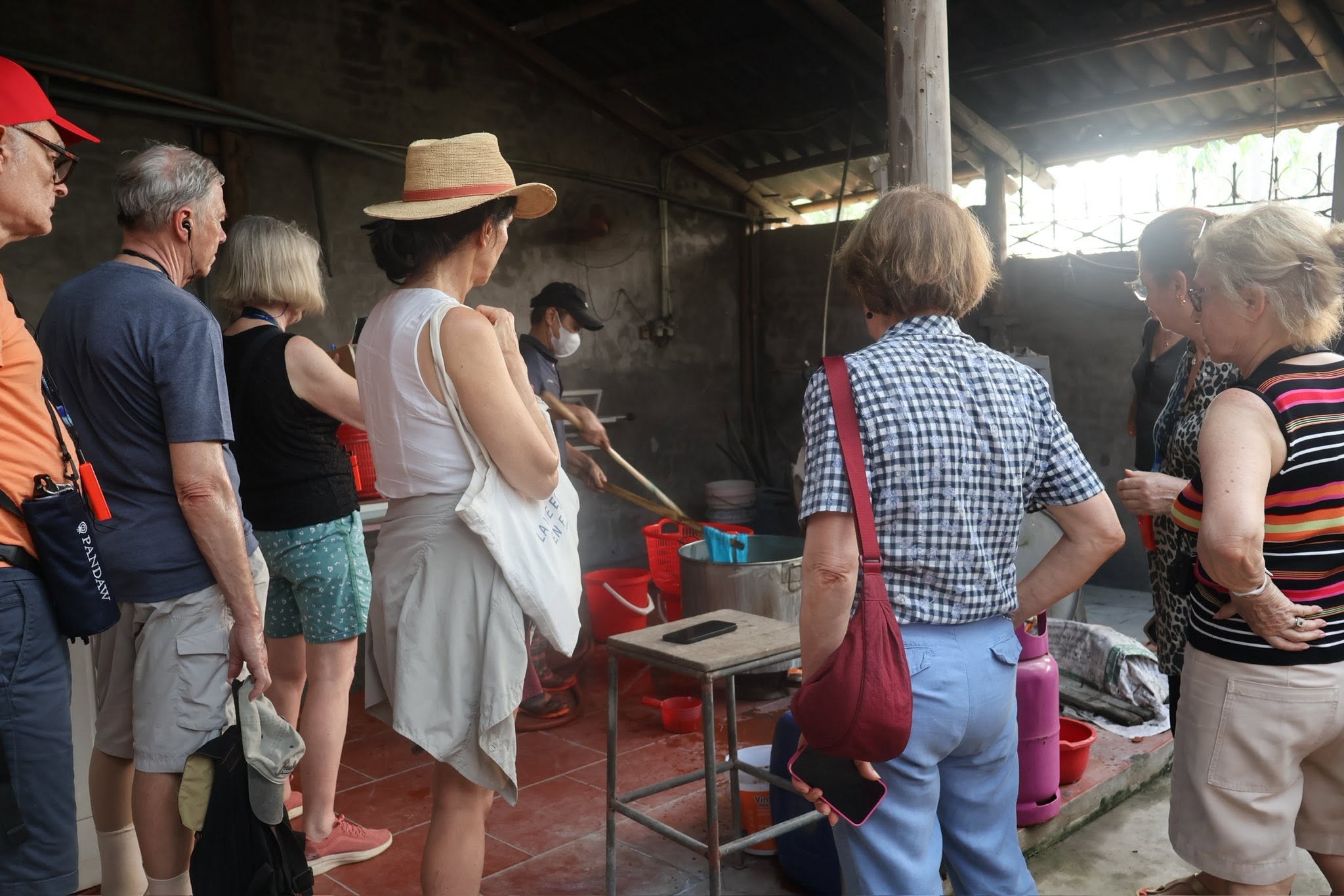
At workshops that are able to welcome visitors, travelers may observe weaving, dyeing, and fabric-finishing activities.
The rhythmic sounds of looms, neatly arranged yarn, and colorful silk fabrics help create the atmosphere of a working textile village.
Observing these processes provides insight into the skill and effort required to produce finished silk.
Transforming fine silk threads into a smooth, continuous fabric involves numerous carefully controlled stages.
The process depends on technical precision, experience, and consistent attention to quality.
Learning About Silk Weaving and Dyeing Techniques
One potential visitor experience in Nha Xa is learning about the stages of traditional silk production.
At suitable workshops, visitors may be introduced to raw materials, yarn preparation, loom operation, and the techniques used to create woven patterns.
Traditional dyeing methods using plant-based ingredients are also of interest to travelers who appreciate handicrafts.
Learning how colors are extracted, applied, and fixed can reveal the relationship between traditional experience and technical knowledge.
Where appropriate programs are available, visitors may be able to try simple weaving activities or observe dyeing demonstrations under professional guidance.
However, not every production facility offers visitor programs or hands-on experiences.
Travelers should contact workshops in advance to confirm visiting arrangements, operating schedules, and any safety requirements.
Choosing Nha Xa Silk Products as Souvenirs
Nha Xa offers a variety of silk products suitable for personal use, clothing, and gifts.
Scarves, silk fabrics, and fashion accessories are among the options associated with the village.
For travelers interested in traditional Vietnamese clothing, silk intended for tailoring an ao dai may be particularly appealing.
When purchasing silk, visitors should ask about fiber composition, weaving methods, dye quality, and care instructions.
Not every textile sold in a silk-weaving village necessarily consists of 100% natural silk.
Some fabrics may contain blended fibers or alternative materials to achieve different prices, textures, and practical characteristics.
Checking product labels and discussing material composition with the seller can help buyers select suitable products.
Natural silk fabrics should be cleaned and stored according to the manufacturer’s instructions to reduce the risk of damage to the fibers or colors.
Preserving Weaving Skills for Future Generations
The long-term preservation of Nha Xa’s weaving heritage depends on transmitting traditional knowledge to younger generations.
Weaving, dyeing, and finishing techniques reflect skills accumulated over centuries of practice.
As production technologies evolve, some specialized manual techniques may become less common.
Without continued practice and documentation, these skills could gradually disappear.
Training younger artisans is therefore an important part of heritage preservation.
Recording traditional fabric patterns, preserving weaving equipment, and documenting the experiences of skilled craftspeople can also help maintain the village’s cultural memory.
Improving working conditions is equally important.
Workshops should pay attention to equipment safety, noise control, ventilation, and appropriate wastewater treatment for dyeing activities.
These measures can contribute to a more sustainable industry while improving product quality and protecting workers.
Developing Craft Tourism and Modern Commerce
Nha Xa has potential to develop cultural tourism based on its weaving history and traditional silk production.
Visitor programs could combine historical introductions, weaving demonstrations, explanations of natural dyeing techniques, and exhibitions of finished textiles.
When organized appropriately, these activities can also create opportunities for local producers to sell products directly to visitors.
Alongside tourism, digital commerce and online marketing can help Nha Xa silk reach customers beyond the local area.
Developing a strong brand narrative based on the village’s traditionally reported 700-year history, technical expertise, and cultural identity may enhance the appeal of its products.
However, commercial development should be supported by transparent product information, reliable quality standards, and continued preservation of distinctive craft techniques.
The combination of traditional weaving, product innovation, and experiential tourism can create new opportunities for Nha Xa while helping protect its heritage.
Nha Xa Silk Weaving Village is one of the notable centers of traditional silk craftsmanship in Vietnam’s Red River Delta. With origins traditionally traced back more than 700 years to the Tran Dynasty and a local legend associated with General Tran Khanh Du, the village has preserved its weaving heritage through generations of economic and social change. Today, the combination of inherited craftsmanship, modern production technology, creative product development, and expanding markets is opening new possibilities for local artisans. Beyond its elegant silk fabrics, Nha Xa offers a meaningful connection between Vietnam’s textile traditions and contemporary life, enriching the cultural heritage and tourism potential of Ninh Binh Province.
Quick Information
| Item | Details |
|---|---|
| Village name | Nha Xa Silk Weaving Village |
| Vietnamese name | Làng nghề dệt lụa Nha Xá |
| Alternative name | Nha Xa Silk Village |
| Current location | Duy Tan Ward, Ninh Binh Province, Vietnam |
| Province before the 2025 administrative reorganization | Ha Nam Province |
| Geographical setting | Area along the Red River |
| Cultural region | Red River Delta, northern Vietnam |
| Craft type | Traditional silk-weaving village |
| Main craft | Silk weaving, dyeing, and textile finishing |
| Traditional origins | Late thirteenth to early fourteenth century |
| Reported craft history | More than 700 years, according to local tradition |
| Historical figure associated with the origin legend | Tran Khanh Du |
| Traditionally associated activities | Mulberry cultivation, silkworm rearing, silk reeling, and weaving |
| Characteristic material | Silk yarn |
| Present-day yarn supply according to local accounts | Specialized silk-producing regions, including Bao Loc, Lam Dong |
| Production stages | Yarn preparation, warping, weaving, dyeing, finishing, and quality inspection |
| Traditional techniques | Loom weaving, patterned weaving, and fabric dyeing |
| Natural dye materials mentioned in local accounts | Betel leaves, cu nau tubers, tree bark, and other plant-based materials |
| Fabric products | Plain silk, patterned silk, dui textiles, and other woven fabrics |
| Fashion products | Scarves, ao dai, handbags, and accessories |
| Markets | Domestic and international markets, according to local accounts |
| Reported national intangible heritage recognition | 2016, pending verification against official records |
| Cultural significance | Silk-weaving knowledge, dyeing techniques, intergenerational skills transmission, and village history |
| Tourism potential | Workshop visits, weaving demonstrations, and introductory craft experiences |
| Shopping advice | Check fiber composition, dye quality, and product care instructions |
| Visitor advice | Contact workshops in advance to confirm visiting arrangements |
| Development priorities | Craft preservation, design innovation, e-commerce, and cultural tourism |







