Address: Marble Mountains area, Da Nang, Vietnam.
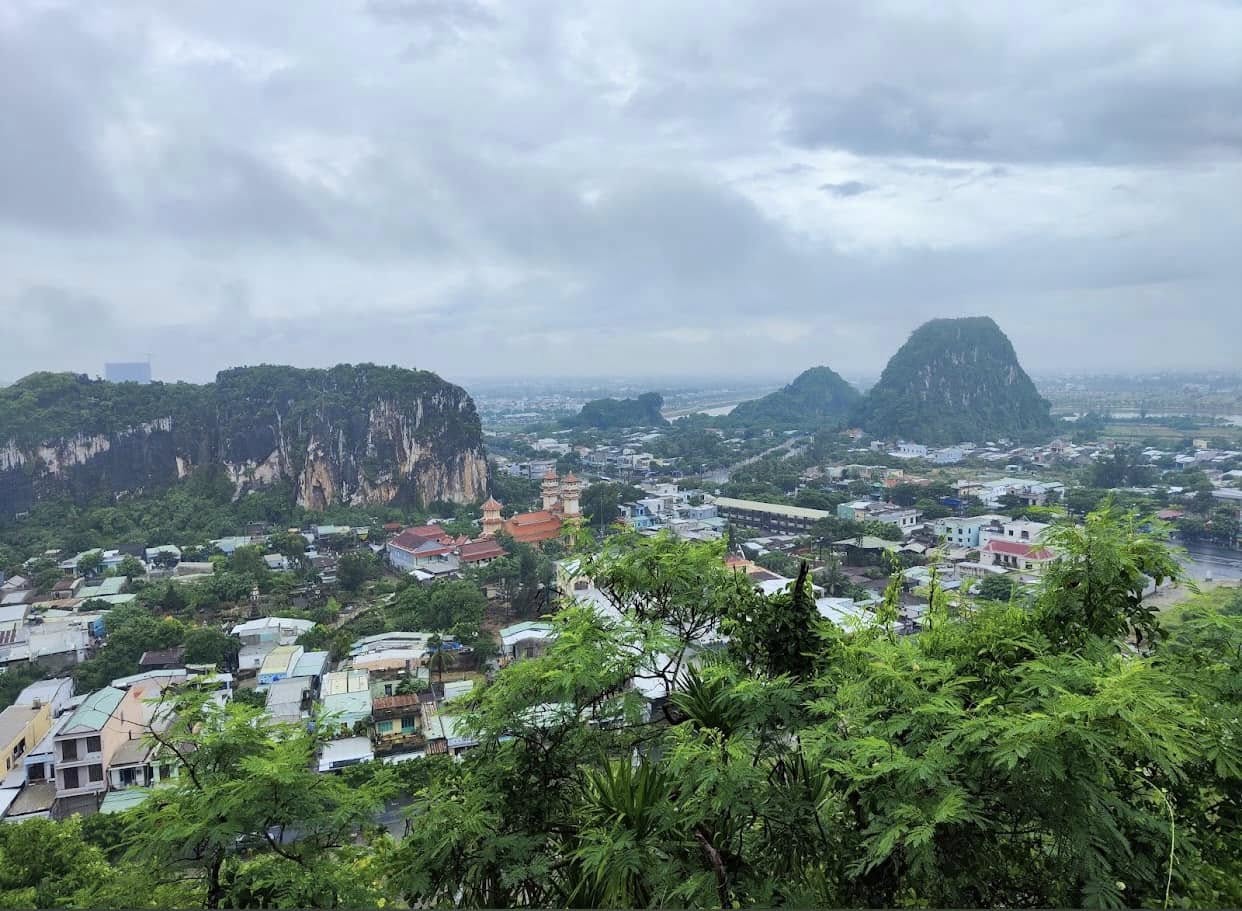
Located about 11 km southeast of central Da Nang, Marble Mountains is one of the most distinctive landscapes in central Vietnam. The complex consists of five limestone mountains rising from the coastal plain, creating a remarkable setting where geology, Buddhist spirituality, folk traditions, revolutionary history and traditional craftsmanship come together.
The five mountains are known as Kim Son, Moc Son, Thuy Son, Hoa Son and Tho Son, corresponding to the five elements of Eastern philosophy: Metal, Wood, Water, Fire and Earth. To the east lies Non Nuoc Beach, while the Cam Le River is to the west. Hoi An lies to the south and Son Tra to the north.
Locally, the area is also known as Non Nuoc. The mountains contain numerous caves, rocky crevices and natural openings, together with a network of pagodas, temples, shrines and historical sites that preserve many layers of the region’s cultural heritage.
From Ancient Islands to Marble Mountains
According to geological traditions associated with the area, the coastal plain of Quang Nam developed through the uplift of the southern Truong Son Range and sediment deposited by the Thu Bon River and its tributaries. In earlier geological periods, the rocky formations that became Marble Mountains were believed to have stood as separate islands surrounded by the sea.
As the coastal plain gradually developed, these rocky islands became connected to the mainland, while the shoreline moved farther east. Today, the sea is approximately 800 meters from the foot of Thuy Son.
The mountains lie along the northern edge of the southern Truong Son region and consist primarily of limestone. Under the influence of tropical weather, heavy rainfall and long-term erosion, the limestone gradually developed into cliffs, caves, crevices and unusual underground formations.
Unlike many famous cave systems where stalactites and stalagmites densely cover the ceilings and floors, the caves of Marble Mountains are often located along mountain slopes or near the summits. Many contain natural openings that allow sunlight and fresh air to enter. As a result, the interiors can be spacious, well ventilated and naturally illuminated. Huyen Khong Cave is one of the best examples of this distinctive character.
A stone inscription at Linh Ung Pagoda recalls the unusual geological origin of the area:
“Phù nhất thiên nhiên dĩ tiên ngũ hành hải đảo
Nhất thiên niên hậu, vi ngũ hành nhất danh sơn”
The inscription evokes the transformation of a former island landscape into the famous mountain complex now known as Marble Mountains.
The Legend of the Five Mountains
Marble Mountains is surrounded by legends explaining the origin of its five peaks. One of the best-known stories tells of an old fisherman who came by boat from the northern coast and settled near the sea in the area of present-day Da Nang.
One morning, as he prepared to go fishing, a violent storm suddenly struck. Amid the waves and thunder, he saw a giant dragon emerge from the sea. A large egg fell from beneath the dragon before it disappeared back into the ocean.
When the storm ended, a Golden Turtle came ashore. It dug a hole in the sand, placed the egg inside and told the old man that it was a drop of the Dragon King’s blood and that he must protect it. Before leaving, the turtle gave him one of its claws and told him to place it beside his ear whenever he needed guidance.
The old man carefully guarded the egg. One day, when armed men approached the site, he followed the turtle’s instructions and suddenly transformed into a great tiger, frightening the attackers away.
Later, the egg continued to grow until its shell shone like an enormous jewel. One night, the attackers returned and set fire to the old man’s hut. He called upon the Golden Turtle and was taken into a large, cool cave.
A miracle then occurred. The egg broke into five pieces, which became the five marble mountains. From inside the egg emerged a beautiful young girl, believed in the legend to be a drop of the Dragon King’s blood.
The old man raised the girl as his daughter. Birds and wild animals became her companions, bringing her milk from the mountain springs, fruit from the forest and cotton from distant places to make her clothes.
According to the legend, these five mountains became the peaks that still stand east of Da Nang, known today as Non Nuoc and Marble Mountains.
The Five Mountains and Their Names
Marble Mountains has been known by several names throughout history. Historical sources influenced by classical Chinese scholarship mention names such as Ngu Uan Son, Pho Da Son and Bach Hoa Ngu Chi, with the latter evoking the image of five mountains resembling the fingers of a giant hand pressing into the earth.
In 1825, during his visit to the area, Emperor Minh Mang named the five mountains according to the Five Elements: Kim, Moc, Thuy, Hoa and Tho.
The French later referred to the area as Marble Mountains, while local people continued to use the familiar name Non Nuoc.
The five mountains also have traditional local names:
- Thuy Son, to the north, also known as Chua Mountain.
- Moc Son, to the east, also known as Mong Ga Mountain.
- Tho Son, to the northwest, also known as Da Chong Mountain.
- Kim Son, to the west, also known as Dung Mountain.
- Hoa Son, to the south, also known as Ong Chai Mountain.
Among the five, Thuy Son is the best known and the most developed for tourism. However, the cultural and historical value of Marble Mountains extends far beyond a single peak. Each mountain contains its own caves, pagodas, historical sites and stories.
Thuy Son: The Main Gateway to Marble Mountains
Located in the northern part of the complex, Thuy Son is the largest and most prominent of the five mountains. It covers approximately 7 hectares, rises to around 120 meters and has three peaks arranged at different elevations. These peaks are traditionally associated with the three stars of Tam Thai, giving the mountain another name, Tam Thai Mountain.
The three main areas of Thuy Son are Thuong Thai, Trung Thai and Ha Thai.
Thuong Thai, the highest area in the northwest, includes Vong Giang Dai, Tam Thai Pagoda, Tam Ton Pagoda, Tu Tam Pagoda, the Hanh Cung area, Hoa Nghiem Cave, Huyen Khong Cave and Linh Nham Cave.
Trung Thai is slightly lower and includes the Heaven Gate, also known as Van Can Nguyet Quat Gate, together with Van Thong, Thien Long and Thien Phuoc Dia caves.
Ha Thai, on the eastern side, contains Vong Hai Dai, Linh Ung Pagoda, Xa Loi Tower and Tang Chon Cave.
Visitors can reach Thuy Son from two main directions. The western entrance has 156 stone steps leading toward Tam Thai Pagoda, while the eastern entrance has 108 steps leading toward Linh Ung Pagoda. A popular route is to enter from the west, explore the pagodas and caves, then descend toward the eastern side.
Vong Giang Dai
After climbing the 156 steps from the western entrance, visitors reach the ancient Tam Quan gate of Tam Thai Pagoda. Turning left leads toward Vong Giang Dai, a high viewpoint overlooking the surrounding rivers and countryside.
The route is relatively narrow and follows natural stone steps. At the viewpoint stands an old stone stele made from Tra Kieu stone, approximately 2 meters high and 1 meter wide. Three Chinese characters reading “Vong Giang Dai” are carved in its center, together with a date corresponding to the 18th year of Minh Mang’s reign, the seventh lunar month of 1837.
From the viewpoint, visitors can see the winding rivers, lowlands, Go Noi and the distant Truong Son Range, revealing the close relationship between Marble Mountains and the broader landscape of Quang Nam.
Tam Thai Pagoda
Tam Thai Pagoda stands on a relatively level area of the mountain and faces southwest. It is one of the oldest pagodas in Marble Mountains and was historically recognized as a national temple.
According to the Hai Ngoai Ky Su by Thich Dai San, the monk visited Tam Thai Pagoda in 1695 while returning to China. This suggests that the pagoda had already existed before that time and has a history of more than three centuries.
The original structure was reportedly built with bamboo, thatch and other temporary materials before being rebuilt in brick and tile. A major storm destroyed the pagoda in 1901, and it was rebuilt in 1907 with contributions from Buddhist followers.
Tam Thai Pagoda is also associated with several patriotic movements, including the Can Vuong and Duy Tan movements, the anti-tax movement and the Nghia Hoi of Quang Nam. During the revolutionary period, the site was also used for secret activities. Historical records note that a clandestine meeting of the Quang Nam and Da Nang Provincial Party Committee was held here in August 1937.
The pagoda has undergone several restorations, including a major restoration in 1995, while retaining architectural elements reminiscent of historic pagodas and royal architecture in Hue.
Hoa Nghiem and Huyen Khong Caves
From Tam Thai Pagoda, visitors can continue toward Hoa Nghiem Cave. A historic gate bearing the three characters “Huyen Khong Quan” stands near its entrance. A statue of Guanyin holding a vase of sacred nectar and an old stele dated 1700 are also found nearby.
Beyond Hoa Nghiem lies Huyen Khong Cave, one of the most famous caves in Marble Mountains.
The entrance path descends more than 20 stone steps into a large chamber with an almost circular shape. The cave is approximately 25 meters in circumference and 16 meters high. Five natural openings in the ceiling allow sunlight and air to enter.
The shafts of light passing through the vegetation above create constantly changing patterns across the cave walls, giving Huyen Khong an atmosphere very different from enclosed cave systems.
Inside stands an approximately 3-meter-high statue of Shakyamuni Buddha, created in 1960 by Nguyen Chat, a sculptor from the Non Nuoc stone-carving village. Below it is an altar dedicated to Ksitigarbha Bodhisattva.
Other areas of the cave are associated with folk beliefs and local religious traditions, including altars dedicated to Ngoc Phi, Loi Phi and Trang Nghiem Tu.
Huyen Khong also preserves memories of the revolutionary period. During the resistance against the French, the cave was used as a secret base. During the Vietnam War, the area was connected with military activities, shelter and combat operations.
Historical records mention the X2 campaign on the night of August 22 and into the early morning of August 23, 1968, associated with hero Phan Hiep. Following the battle, the unit received a First-Class Military Exploit Order, while Phan Hiep was later recognized as a Hero of the People’s Armed Forces.
Linh Nham, Van Thong and Thien Long Caves
Linh Nham Cave, also known as Ngoc Hoang Thuong De Cave, lies at a higher elevation and faces west. Its religious function changed over time, with worship eventually focusing on the Jade Emperor, accompanied by altars dedicated to Nam Tao and Bac Dau.
A natural rock formation known as the Heaven Gate creates a passage between the areas around Tam Thai and Linh Ung pagodas. Walking between the massive rock formations can feel like moving through a giant natural rock garden.
Between the two gates lies Van Thong Cave, sometimes called the road to heaven. The cave is located high on the mountainside, with approximately 40 meters between the cave entrance and summit. The route is winding and narrow in places, but reaching the top rewards visitors with broad views of the surrounding sea and sky.
Thien Long Cave is located on the mountainside near the eastern Heaven Gate. Its rugged interior contains rock formations resembling a dragon’s mouth and connects with the Wind Cave area of Tang Chon, where cool air enters from the direction of Non Nuoc Beach.
Vong Hai Dai and Linh Ung Pagoda
From Thien Long Cave, stone steps lead toward Vong Hai Dai, a viewpoint overlooking the sea. A historic stone stele bearing the three characters “Vong Hai Dai” stands here, also associated with the 18th year of Minh Mang’s reign.
On clear days, visitors can see the sea and Cham Island in the distance.
Further down the mountain is Linh Ung Pagoda, one of the oldest Buddhist sites in Marble Mountains. Built against the mountain wall and facing the sea, the pagoda has played an important role in the religious history of the area.
According to historical records, its predecessor was a small hermitage established by a monk known as Quan Chanh, whose secular name was Buu Dai, inside Tang Chon Cave. Under Emperor Gia Long, the site was expanded and named Ngu Che Ung Chon Tu. In 1825, during the sixth year of Minh Mang’s reign, it was rebuilt in brick and tile, recognized as a national temple and renamed Ung Chon Tu.
The pagoda has undergone several restorations, including a major one in 1985, while retaining many historic features and royal inscriptions.
Tang Chon and Am Phu Caves
Behind Linh Ung Pagoda is Tang Chon Cave, whose name refers to a place containing the truth of the universe. The cave is approximately 10 meters long and 7 meters wide and is naturally ventilated through openings above.
Several smaller chambers are found inside, including Tam Thanh, Wind Cave, Chiem Thanh Cave, Ray Cave and Ban Co Cave. Religious altars occupy different areas of the cave.
Chiem Thanh Cave is particularly noteworthy for two sandstone sculptures in the Indochina artistic style, believed to date from around the first half of the 10th century. These works provide evidence of the early presence of Cham culture in Marble Mountains.
Am Phu Cave, located at the foot of Thuy Son, is one of the largest caves in the complex. Its broad chamber, high ceiling and natural openings create a cool interior.
The name Am Phu, meaning the underworld, is associated with Buddhist folk traditions concerning the afterlife, King Yama and the various levels of hell. Different sections of the cave are named after these legendary realms.
The cave also has a revolutionary history. During the resistance against the French, local guerrillas used it as a shelter. During the Vietnam War, it served as a base, medical station and operational area for revolutionary forces.
Historical records describe a battle on December 24, 1968, when a five-member suicide squad fought inside the cave against a much larger American force. The battle lasted until near evening before the unit withdrew from the cave. The records also describe another encirclement in 1971, when forces inside the cave received outside assistance and eventually escaped.
These stories have made the cave system an important part of the historical memory of Marble Mountains.
Kim Son, Hoa Son and the Western Area
While Thuy Son is the most familiar part of Marble Mountains, the western area reveals another layer of the landscape’s history and culture.
The five mountains are divided by Le Van Hien Street into two broad areas: Thuy Son and Moc Son to the east, and Kim Son, Hoa Son and Tho Son to the west.
The western area lies about 2 kilometers east of Thuy Son, the Non Nuoc stone-carving village and Non Nuoc Beach. It lies along the Da Nang to Hoi An corridor and contains the Co Co River, rice fields, villages, pagodas, caves and historical sites.
Thai Son Pagoda and Tam Thanh Cave are located on Su Van Hanh Street. The pagoda was established in 1959 and was originally known as Khuon Hoi Hoa Long. After 1975 it became known as Thai Son Pagoda. A small cave lies nearby, with Tam Thanh Cave reached after following the rock wall for approximately 40 meters.
Hoa Son consists of two peaks, Duong Hoa Son and Am Hoa Son, sharing a common base but forming separate rocky masses. Am Hoa Son lies beside the Co Co River and was historically connected with river transportation between Da Nang and Hoi An. Duong Hoa Son contains a through-cave and several Buddhist sites.
Linh Son Pagoda originated as a small hermitage established by monk Hue Nhat in 1960. The hermitage was replaced by a tiled pagoda in 1964. The temple is associated with several Buddhist figures and also carries memories of wartime destruction and reconstruction.
Huyen Vi Cave is another historical cave. It was discovered during the reign of Emperor Le Canh Hung, and in 1825 Emperor Minh Mang ordered the three Chinese characters “Huyen Vi Dong” to be carved into the rock. The cave extends approximately 70 meters and contains narrow, winding sections and natural rock formations resembling dragons, turtles, Buddha figures and other forms.
Kim Son and Quan The Am Pagoda
Kim Son lies beside the Co Co River. In the past, the area contained Ben Ngu, a landing place where royal boats reportedly stopped during imperial visits to Marble Mountains.
Kim Son has a rounded shape resembling an inverted bell, with steep western slopes and vegetation growing among the rock formations.
During the war, its elevated position also gave it military significance. Historical records describe fighting in August 1968 involving local revolutionary forces.
At the foot of Kim Son stands Quan The Am Pagoda, whose history is closely connected with the discovery of Quan Am Cave by Venerable Thich Phap Nhan in 1956. The pagoda was initially established near the cave before being relocated to a larger site at the foot of Kim Son in 1960.
Today, the pagoda is associated with the Quan The Am Festival, one of the most important Buddhist cultural festivals in Marble Mountains.
Quan Am Cave is a dark cave, contrasting with the naturally illuminated caves of Thuy Son. A series of natural stone steps leads into the mountain. The cave is approximately 50 meters long, 10 meters wide and between 15 and 20 meters high.
Its most striking feature is a natural stalactite formation resembling Guanyin Bodhisattva holding a vase of sacred nectar. Other natural formations are interpreted as bamboo, clouds, Thiện Tai, Dong Tu, dragons and peacocks.
At the end of the cave lies Cam Lo Lake, a clear, cool pool deep inside the mountain.
Ung Nhien Pagoda, Pho Da Son and Tho Son
Ung Nhien Phat Tong Pagoda was built in 1989 near the foot of Am Hoa Son beside the Co Co River. The quiet temple is known for an approximately 5-meter-high statue of Shakyamuni Buddha made of cement.
Nearby is Cam Nhien Spring, also known locally as Gieng Moi, which is said to retain clear water throughout the year. The area also contains Kim Cang Cave, with a Buddha image influenced by Cham sculpture, and Ba Tho Cave, now associated with Amitabha Buddha.
At the end of Duong Hoa Son is Pho Da Son Pagoda and Cave. The cave passes through the mountain from north to south, creating a secluded environment and allowing visitors to view both sides of Duong Hoa Son.
The small pagoda inside the cave is dedicated to Shakyamuni, Guanyin and Mahasthamaprapta. Local people also know it as Co Dan Pagoda, and the source describes it as a distinctive nunnery within the Non Nuoc Buddhist complex.
Tho Son lies to the northwest. Its terrain forms a long, sloping mountain with steep rock walls and relatively sparse vegetation. On its southeastern side is Bo De Cave, whose narrow entrance opens into a passage leading upward.
During the resistance period, the cave was used as a natural underground base. Historical records describe French forces surrounding the cave in 1947, using smoke and explosives in an attempt to force those inside out.
Long Hoa Pagoda stands on the northern slope of Tho Son and was established in 1992. A large rock formation approximately 30 meters high near the pagoda resembles Maitreya Buddha. The temple worships Maitreya, Shakyamuni, Guanyin and Ksitigarbha.
The area has also been associated with a proposed “Long Hoa Dai Canh” project intended to create a larger landscape and spiritual complex around the foot of Hoa Son.
Ong Chai Shrine and the Ancient River Route
Ong Chai Shrine is believed to have been built during the reign of Emperor Gia Long, around 1802 to 1819. The shrine was historically associated with taxation of merchant vessels traveling along the Co Co River between Hoi An and Da Nang.
As the river gradually silted up, its importance as a transportation route declined and the shrine was eventually abandoned.
Its name is connected with a folk story about a father and son who made their living as fishermen around Hoa Son. The story has been passed down as part of the local explanation for the shrine’s name.
Today, the story of Ong Chai Shrine adds another layer of folk memory to the western area of Marble Mountains, alongside its pagodas, caves and traces of the historic Co Co River.
Quan The Am Festival: A Distinctive Cultural Tradition
The Quan The Am Festival originated from the discovery of a natural stalactite formation resembling Guanyin Bodhisattva inside Quan Am Cave by Venerable Thich Phap Nhan in 1956.
In 1962, during the inauguration of a new pagoda, a ceremony honoring Guanyin was held on the 19th day of the second lunar month. Over time, the ceremony developed into a traditional festival.
From 1991 onward, the event was organized on a larger scale under the name Quan The Am Festival, Marble Mountains, Non Nuoc, taking place over three days from the 17th to the 19th day of the second lunar month.
According to the source, the festival was recognized as one of Vietnam’s national folk festivals in 1999.
The festival has two principal components. The religious ceremonies follow Buddhist traditions, while the festival activities include cultural performances, sports, recreation and community exchanges.
Beyond its religious significance, the event represents an interaction between Buddhist culture and local folk traditions, attracting Buddhist followers, residents of Da Nang and visitors from many other places.
Non Nuoc Stone-Carving Village
At the foot of Marble Mountains lies the Non Nuoc Stone Carving Village, one of Da Nang’s most distinctive traditional craft communities.
The origins of the craft are associated with the former Quang Khai commune, now within the Hoa Quy area. An inscription at Pho Khanh Pagoda in Ai Nghia, dated 1678, records the birthplace of a stone-carving artisan from Quang Khai, suggesting that stone carving and stone inscription work had existed in the area since at least the 17th century.
According to local traditions, craftsmen migrated from Thanh Hoa and established themselves in the area. In the beginning, they primarily carved inscriptions, stone steles, mortars and simple household objects. Over time, their skills developed into more sophisticated sculpture and stone handicrafts.
During the reign of Emperor Tu Duc, artisans from Marble Mountains were reportedly summoned to the imperial capital to participate in stone carving for palaces and royal tombs.
The source also records a story that during the Vietnam War, some Non Nuoc stone craftsmen secretly transported marble slabs to contribute to the construction of the Ho Chi Minh Mausoleum.
Today, Non Nuoc stone products range from sculptures inspired by Cham culture, including Apsara, Ganesha and Lakshmi, to statues of Buddha and Guanyin and smaller objects such as rings, bracelets, vases, tea sets, jewelry boxes, incense vessels and decorative pieces.
Craftsmen also produce works inspired by Western artistic traditions, from classical figures such as Venus to sculptures of internationally known personalities.
Non Nuoc stone products have traveled with visitors to many countries and have become an important part of the cultural identity of Marble Mountains.
The Western Side: A Less Explored Dimension of Marble Mountains
Most first-time visitors naturally concentrate on Thuy Son because it has the most accessible network of caves, pagodas and viewpoints. Yet the significance of Marble Mountains extends across all five peaks.
Kim, Moc, Thuy, Hoa and Tho form a unified cultural landscape, with each mountain containing its own combination of natural scenery, history, spirituality and local traditions.
The western area in particular has potential for nature-based and rural tourism. The Co Co River, rice fields, wetlands, villages, pagodas and caves create a landscape quite different from the rocky mountains and coastal scenery of the eastern side.
Around Quan The Am Pagoda and the foot of Kim Son, relatively open agricultural landscapes combine with mountains, waterways, ponds, villages and religious sites. Together, these elements create opportunities for experiences that connect natural scenery with local culture and community life.
The western side also preserves historical traces, including the tomb of the mother of General Tran Quang Dieu, the temple of Princess Ngoc Lan, the former Ben Ngu royal landing site and locations associated with revolutionary history such as Ba Tho Cave, Co Dan Pagoda and Bo De Cave on Tho Son.
Modern roads now provide connections between this area and Da Nang, Hoi An, Non Nuoc and the central Marble Mountains area, making it possible to create a broader sightseeing route rather than visiting Thuy Son alone.
Marble Mountains: Where Nature and History Meet
The appeal of Marble Mountains does not come from a single statue, pagoda or cave. Its value lies in the relationship between an entire landscape and the many layers of history that have developed within it.
There are limestone mountains and caves shaped by geological processes over immense periods of time. There are pagodas that have stood for centuries. There are legends of the Dragon King, the Golden Turtle and the miraculous egg. There are traces of Cham culture, stories associated with the Nguyen dynasty and the activities of patriotic scholars. There are also caves and mountains that became revolutionary bases during wartime.
At the foot of the mountains, the Non Nuoc stone-carving village continues a traditional craft passed down through generations. The Quan The Am Festival connects Buddhist belief with local folk culture, while the rivers, fields and villages of the western side reveal another face of the landscape.
For first-time visitors to Da Nang, Thuy Son is perhaps the most convenient starting point. But to understand Marble Mountains more fully, the journey can be expanded to include Kim Son, Hoa Son, Tho Son, the western historical sites, Non Nuoc stone-carving village and the cultural space surrounding Quan The Am.
Marble Mountains is therefore more than a famous tourist attraction. It is a natural and cultural heritage landscape, where limestone, caves, Buddhism, folk beliefs, history and community life have developed together over centuries.
A visit here is not simply a walk up stone steps into a cave or pagoda. Each turn reveals another layer of the story, from ancient landscapes and folk legends to wartime memories and the stone-carving traditions that have remained connected to the mountains for generations.
Marble Mountains, Non Nuoc, continues to embody a distinctive meeting point between nature and human culture, shaped together over hundreds and thousands of years.