


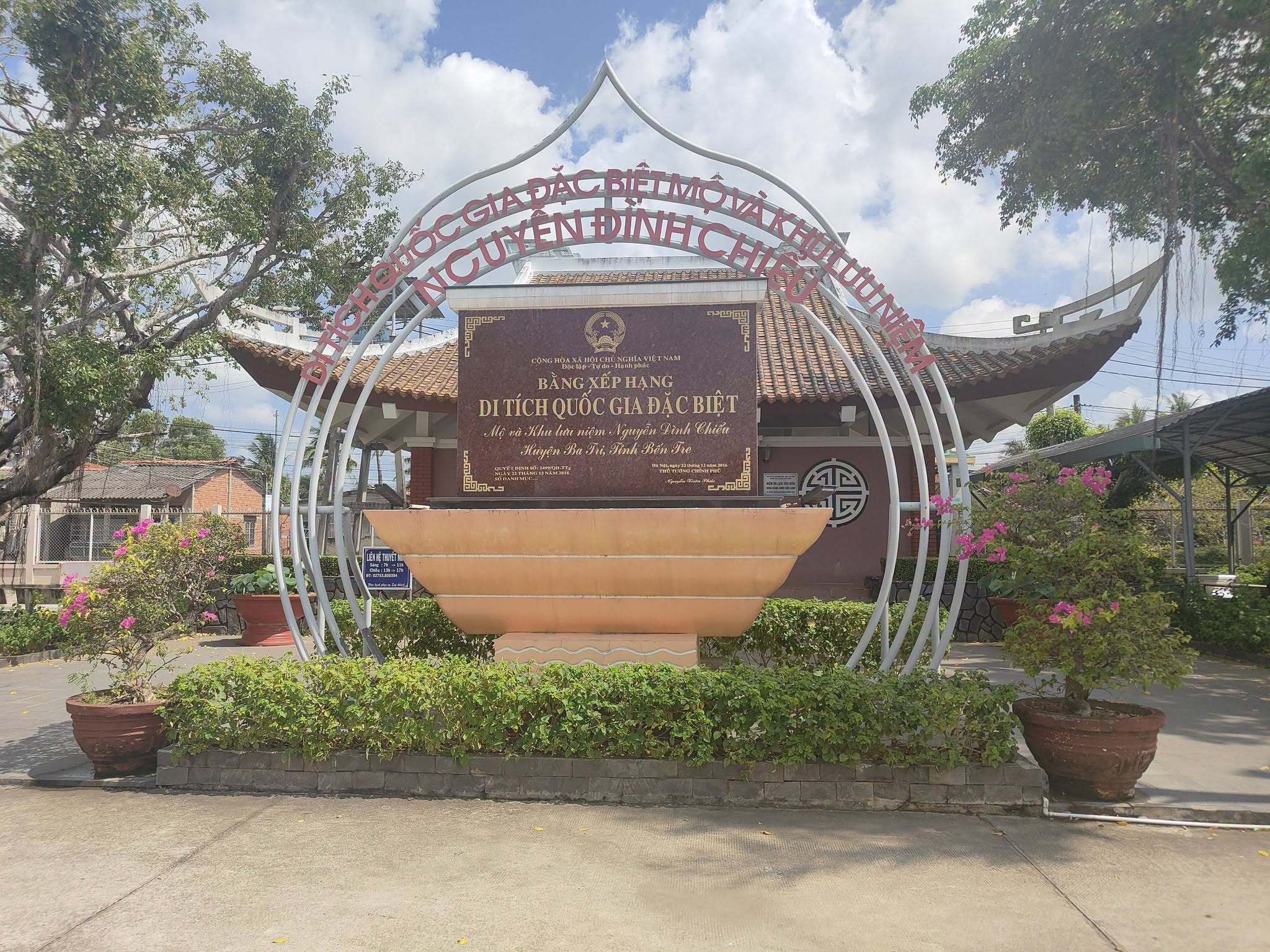
The Special National Relic of the Nguyen Dinh Chieu Memorial Site and Tomb is located in Ba Tri Commune, Vinh Long Province. It is the resting place of Nguyen Dinh Chieu, his wife Le Thi Dien, and their daughter Nguyen Thi Ngoc Khue, better known as the poet Suong Nguyet Anh.
Nguyen Dinh Chieu (1822–1888), often respectfully called Do Chieu or Cu Do Chieu, was a patriotic poet, teacher, physician, and an influential intellectual in southern Vietnam during the 19th century. He lost his eyesight while still young, but continued teaching, practicing medicine, writing, and supporting the patriotic movement in Cochinchina during the French invasion.
Rather than taking up arms as a military commander, Nguyen Dinh Chieu fought through literature, education, medicine, and moral principles. His writings became a powerful voice for the people and for those who resisted foreign invasion.
Nguyen Dinh Chieu and the Image of the Hero
Nguyen Dinh Chieu holds a distinctive place in 19th-century Vietnamese literature because he brought ordinary farmers and common people into the center of patriotic literature.
In Van Te Nghia Si Can Giuoc, he portrayed farmers who normally worked the fields but willingly stood up to defend their villages when the enemy arrived. Through these figures, he created a different image of the hero, one whose patriotism grew from attachment to family, community, homeland, and country.
Nguyen Dinh Chieu did not personally lead soldiers into battle, but he stood firmly on the side of those who did. Through poetry and prose, he recorded the struggle, affirmed the righteousness of the resistance, and preserved the memory of those who sacrificed their lives.
He wrote about figures such as Truong Dinh and Phan Ngoc Tong, as well as many anti-French resistance fighters in southern Vietnam. His understanding of heroism therefore extended beyond the traditional idea of loyalty to a monarch, placing greater emphasis on the people, homeland, and nation.
His major works include Luc Van Tien, Duong Tu – Ha Mau, Ngu Tieu y thuat van dap, Van Te Nghia Si Can Giuoc, and Luc Tinh Si Dan Tran Vong Van. Most of his works were written in chu Nom, which was close to the spoken language of Vietnamese people and helped his writings circulate widely through oral storytelling, recitation, and poetry.
A Poet, Teacher, Physician and Patriotic Thinker
Nguyen Dinh Chieu’s legacy goes far beyond literature. After losing his eyesight, he continued to teach and practice medicine, becoming a respected figure among local communities in southern Vietnam.
His work Ngu Tieu y thuat van dap reflects both his medical knowledge and his understanding of the ethical responsibilities of physicians. Written in verse, the work presents ideas about medicine, medical ethics, and responsibility toward patients.
This combination of literature, education, medicine, and moral thought helps explain why local people have long called him Cu Do Chieu, a respectful name recalling his role as a teacher.
The memorial complex covers approximately 14,187.9 square meters and includes a stele house, a new temple, the former temple, the family tomb area, and exhibition spaces. The main construction and restoration phase took place between 2000 and 2002.
The Stele House is a two-story structure with traditional decorative motifs. At its center stands a large monolithic green stone stele bearing an inscription honoring Nguyen Dinh Chieu on the front and his biography on the back.
The New Temple rises about 21 meters and features traditional symbols associated with Nguyen Dinh Chieu, including lotus flowers, scrolls, writing brushes, and bronze-drum motifs. A bronze statue of the poet stands on the upper level.
Two of his best-known lines are prominently displayed:
“Chở bao nhiêu đạo thuyền không khẳm,
Đâm mấy thằng gian bút chẳng tà.”
The image of a pen that “does not bend” expresses his belief that a writer must preserve integrity and moral courage. Reliefs inside the temple depict episodes connected with the anti-French resistance in southern Vietnam, placing Nguyen Dinh Chieu within the broader history of the period.
The Old Temple, built in 1972, preserves a more traditional architectural appearance and predates the larger memorial complex constructed in the early 2000s.
The Tombs of Nguyen Dinh Chieu and His Family
The tomb area is perhaps the most solemn part of the site. Restored from 1958, it contains the tombs of Nguyen Dinh Chieu, his wife Le Thi Dien, and their daughter Nguyen Thi Ngoc Khue, known as Suong Nguyet Anh.
A distinctive detail often pointed out to visitors is the symbolism on the tombstones. Nguyen Dinh Chieu’s tomb bears the character “Nhat” (日), meaning sun, while his wife’s bears “Nguyet” (月), meaning moon. The pairing of the two characters has become a memorable feature of the family tombs.
Suong Nguyet Anh, born in 1864, later became a prominent woman writer and the editor of Nu Gioi Chung, an influential newspaper for women in early 20th-century Cochinchina. Her remains were reinterred in the family burial area in 1959.
The memorial site therefore preserves the memory of not only Nguyen Dinh Chieu but also a family closely connected with the cultural life of southern Vietnam.
The complex also includes an exhibition space displaying photographs, documents, publications, and materials related to Nguyen Dinh Chieu and his legacy. Visitors can explore works such as Luc Van Tien, Duong Tu – Ha Mau, Ngu Tieu y thuat van dap, and Van Te Nghia Si Can Giuoc.
The annual memorial activities are held from July 1 to July 3, corresponding to Nguyen Dinh Chieu’s birth on July 1, 1822 and death on July 3, 1888. Traditional activities include incense offerings, memorial readings, Van Tien poetry recitation, performances of Luc Van Tien – Kieu Nguyet Nga, cai luong theatre, traditional food competitions, and folk games.
In 2026, the site also hosted activities commemorating the 204th anniversary of Nguyen Dinh Chieu’s birth and the 138th anniversary of his death, together with poetry, reading, and documentary exhibitions.
Historical and Cultural Significance
The Nguyen Dinh Chieu Memorial Site and Tomb is more than the resting place of a famous poet. It preserves the memory of a remarkable figure in the cultural and intellectual history of 19th-century Vietnam.
Nguyen Dinh Chieu was a poet, teacher, physician, and one of the prominent voices of patriotic literature in southern Vietnam. At a time when the country was under foreign invasion, he chose to stand with ordinary people, defend moral values through literature, honor those who resisted, and preserve the memory of those who died.
His legacy lies not only in his literary works but also in the character of the writer himself. For Nguyen Dinh Chieu, literature was inseparable from morality, intellectuals had a responsibility to society, and beauty had to be connected with goodness.
That is perhaps the most meaningful impression visitors can take from the memorial site: a man who lost the physical light of his eyes continued to preserve the inner light of a voice and a pen that refused to surrender.
Recognizing its outstanding historical, cultural, and ideological values, the Nguyen Dinh Chieu Memorial Site and Tomb was classified as a Special National Relic under Decision No. 2499/QD-TTg dated December 22, 2016. The site is now located in Ba Tri Commune, Vinh Long Province, within the area that formerly belonged to Ben Tre Province.


