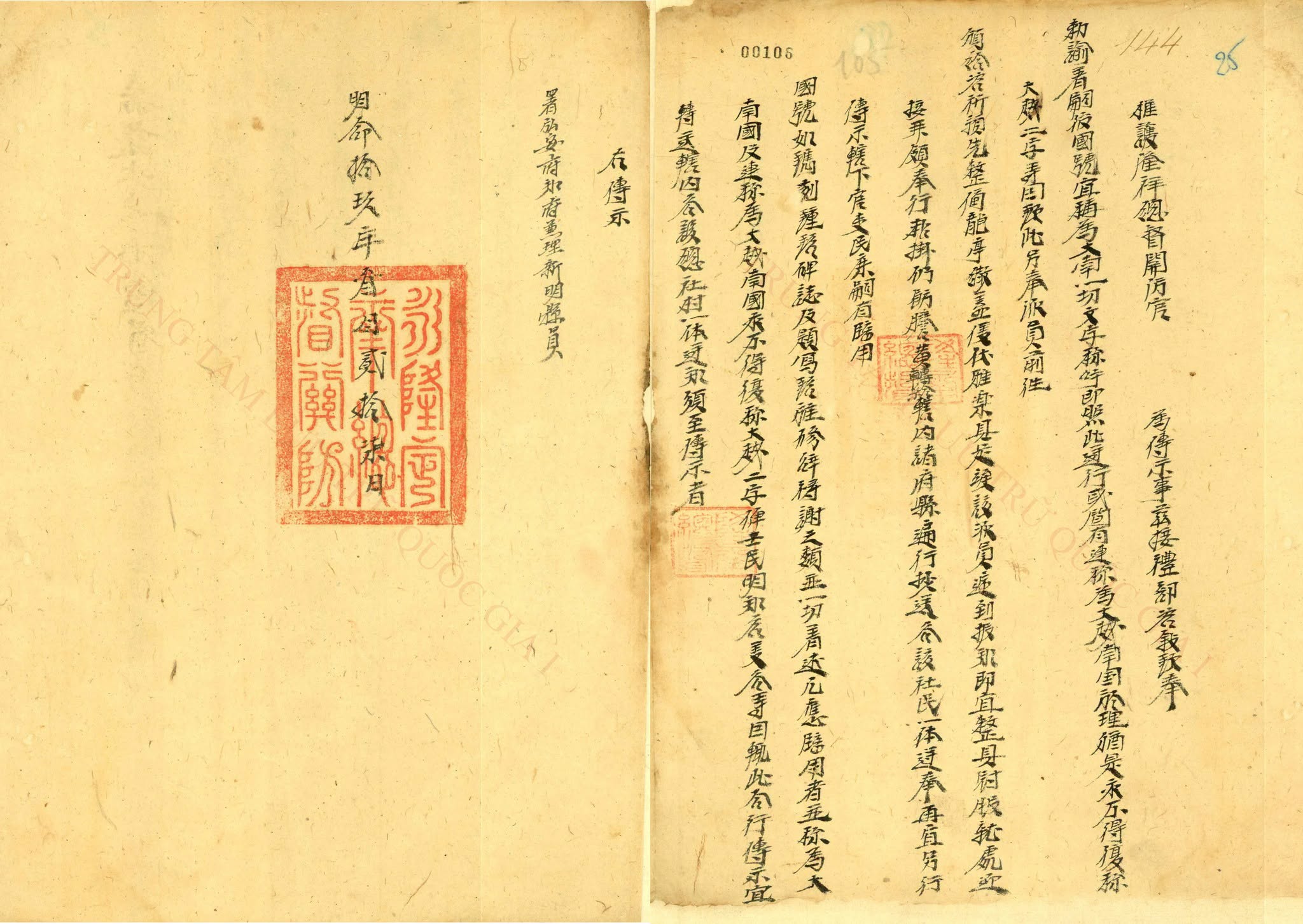
The Nguyen Dynasty Imperial Archives are among Vietnam’s most valuable collections of documentary heritage, preserving original administrative records produced during the Nguyen Dynasty (1802–1945). Their most distinctive feature is the presence of handwritten imperial annotations and approvals in red ink, providing direct evidence of how Vietnamese emperors governed the country and made decisions on matters of state.
Unlike official historical chronicles compiled after events had taken place, the Imperial Archives consist of documents created and used in the daily administration of the royal court. Individual records may contain reports submitted by officials, imperial instructions, official seals, dates, administrative references, and handwritten decisions, making them exceptionally valuable primary historical sources.
The collection is currently preserved at the National Archives Center No. 1 in Hanoi. It comprises 773 archival volumes containing approximately 85,000 documents and hundreds of thousands of pages of historical material.
The records cover an extensive range of subjects, including politics, military affairs, diplomacy, economics, education, culture, law, public administration, social welfare, and territorial management.
Of particular importance are documents concerning the Nguyen court’s administration, surveys, and exercise of state authority over the Hoang Sa (Paracel) and Truong Sa (Spratly) Islands. These records provide important historical evidence for research into Vietnam’s maritime activities and territorial sovereignty.
In 2014, the Nguyen Dynasty Imperial Archives were inscribed on the UNESCO Memory of the World Asia-Pacific Regional Register. In 2017, the collection received further international recognition through its inscription on the Memory of the World International Register.
This recognition highlights the exceptional significance of the archives for understanding Vietnamese history and preserving the documentary memory of humanity.
What Are the Nguyen Dynasty Imperial Archives? Origins and Historical Development
The term Chau Ban refers to a category of official administrative documents associated with the governance of Vietnam under its imperial system, particularly records reviewed or approved directly by the emperor using red ink.
Within the Nguyen Dynasty’s administrative structure, important matters of state were routinely reported or submitted to the emperor by ministries, central government institutions, provincial authorities, and other officials.
After reviewing a document, the emperor could approve a proposal, amend its contents, request further information, or issue instructions on how the matter should be handled.
These decisions were often recorded in red ink and became an integral part of the original administrative document.
The term Chau Ban is therefore closely associated with the use of vermilion ink in imperial document approval.
The Nguyen Dynasty Imperial Archives were created throughout the existence of the dynasty, beginning with the accession of Emperor Gia Long in 1802 and continuing until Emperor Bao Dai’s abdication in 1945.
During these 143 years, the Nguyen government produced a vast quantity of records to support the administration of the country.
The documents originated from various levels of government, including central ministries, provincial authorities, military institutions, and specialized administrative agencies.
Their contents range from major issues such as foreign relations, national defense, and government organization to specific matters involving taxation, flood control, disaster relief, official appointments, and legal disputes.
The collection includes documents issued by the emperor, reports and petitions submitted for imperial consideration, and certain records concerning diplomatic relations.
Common categories of documents include:
Tau, So, and Bieu (Memorials, Petitions, and Formal Submissions): Documents presented to the emperor by officials or administrative institutions to report developments, propose policies, or request decisions.
Chieu, Chi, and Du (Imperial Edicts, Orders, and Proclamations): Official documents expressing the emperor’s decisions, instructions, or commands on important matters.
Administrative Copies, Extracts, and Transmitted Instructions: Records used to communicate imperial decisions to the institutions responsible for implementation.
Each category followed particular conventions of language, presentation, and administrative function.
Together, these documents reflect the organization and operation of Vietnam’s centralized imperial government during the final period of the country’s monarchical system.
The Imperial Archives therefore preserve not only the outcomes of administrative decisions but also evidence of how those decisions were proposed, reviewed, amended, and implemented.
A Collection of 773 Volumes and the Remarkable Handwritten Annotations of Vietnamese Emperors
The surviving Nguyen Dynasty Imperial Archives comprise 773 volumes, containing approximately 85,000 documents and hundreds of thousands of pages.
They constitute one of the most important surviving collections of original administrative records from a Vietnamese imperial dynasty.
The documents reflect the activities of the royal court under successive emperors, from Gia Long, Minh Mang, Thieu Tri, and Tu Duc to the final rulers of the Nguyen Dynasty.
According to descriptions of the heritage collection, the surviving archives preserve imperial annotations associated with 10 of the dynasty’s 13 emperors.
Records bearing the direct approvals of rulers whose reigns were particularly brief or marked by political upheaval may not survive in the existing collection.
The reigns of Minh Mang and Tu Duc are especially well represented, providing extensive documentation of government administration during periods of significant political and social change.
The defining characteristic of the archives is the presence of handwritten imperial decisions in vermilion ink.
These annotations demonstrate that documents were examined by the emperor and provide valuable insight into the decision-making process, administrative priorities, and governing styles of individual rulers.
Depending on the nature of the issue, emperors employed several forms of annotation and approval.
Chau Phe: Written Imperial Annotations
Chau Phe refers to the emperor’s handwritten comments or instructions added directly to an administrative document using red ink.
These annotations might contain a brief command, an approval, an assessment of an official’s proposal, or instructions for resolving a particular matter.
They could appear at the beginning of a document, in the margins, or beside the relevant passage.
This form of annotation provides especially direct evidence of the emperor’s personal involvement in government administration.
Chau Diem: Imperial Red Dots
Chau Diem refers to the use of a red ink dot to indicate an imperial selection or approval.
Such marks may appear in documents concerning appointments, personnel assessments, official selections, or other matters requiring the emperor’s confirmation.
Chau Khuyen: Imperial Red Circles
Chau Khuyen refers to the practice of drawing a red circle around a character, name, or passage.
Depending on the administrative context, the circle could indicate selection, approval, or particular attention to the marked content.
Chau Mat: Imperial Corrections and Deletions
Chau Mat refers to the use of red ink strokes to delete, reject, or amend parts of a document.
These marks help researchers identify revisions and understand how proposals were modified during the decision-making process.
Other Forms of Imperial Approval
The Imperial Archives also preserve additional forms of annotation, correction, endorsement, and transmission of imperial instructions.
Their use varied according to administrative conventions and the practices of different reigns.
The diversity of these annotations demonstrates that document processing within the Nguyen court followed established procedures and involved several methods of recording imperial decisions.
For historians, the handwritten comments and red ink marks are particularly valuable because they provide direct access to how rulers responded to specific administrative problems.
Some documents reveal imperial concern for public welfare, disaster relief, famine prevention, and the recovery of communities affected by natural disasters.
Others contain strict instructions concerning official misconduct, financial administration, legal enforcement, and bureaucratic discipline.
Additional records illustrate the emperor’s involvement in diplomacy, defense, and territorial administration.
Together, these handwritten annotations offer insights into the governing priorities and administrative practices of successive Nguyen emperors.
The Imperial Archives as a Comprehensive Record of Vietnamese Society in the 19th and 20th Centuries
The greatest value of the Nguyen Dynasty Imperial Archives lies in their originality and the extraordinary breadth of their historical information.
Unlike official chronicles that were compiled, selected, and organized by historians, the Imperial Archives were created during the actual process of government administration.
Consequently, they frequently record events, problems, and decisions at the time they occurred.
Politics and Government Administration
The archives preserve information concerning the organization of the imperial court, the functions of ministries and administrative agencies, official appointments, and decisions relating to government management.
These records allow researchers to examine the structure of central and provincial government, the responsibilities of officials, and changes in administrative institutions under different emperors.
Documents bearing imperial annotations are especially useful for understanding the relationship between the emperor and government agencies during the decision-making process.
Economics, Finance, and Trade
Numerous documents address taxation, state finances, agricultural production, land management, commercial activities, and economic policy.
They record tax collection, the allocation of public resources, adjustments to financial regulations, and problems arising in production and trade.
These materials provide important evidence for studying the Vietnamese economy during the 19th and early 20th centuries.
Public Welfare and Social Administration
The Imperial Archives contain extensive information about the lives of ordinary people, particularly during periods of natural disasters, epidemics, crop failures, and economic hardship.
Documents concerning emergency relief, tax reductions, flood-control repairs, disaster recovery, and the stabilization of local communities reveal how the imperial government received and addressed social problems.
Other records provide information about population management, labor, agricultural activities, and relationships within local communities.
Military Affairs and National Defense
Records concerning military organization, troop deployment, defensive construction, frontier administration, and territorial protection provide valuable information about Nguyen Dynasty defense policies.
These documents help researchers understand the military challenges Vietnam faced during a period of major political and geopolitical change in Asia and beyond.
Diplomacy and International Relations
The archives document Vietnam’s diplomatic and commercial relations with neighboring countries and Western powers.
They contain information relating to China, Thailand, Indonesia, Singapore, the Philippines, France, Britain, Spain, and other countries.
Their contents include commercial exchanges, diplomatic contacts, official correspondence, and issues arising from Vietnam’s relations with foreign states.
These records are particularly useful for studying the history of diplomacy, international trade, and Vietnam’s growing interaction with global developments during the 19th century.
Education, Culture, and Religion
The collection also preserves information concerning Confucian education, imperial examinations, the recruitment of scholars, educational institutions, and cultural and religious activities.
Documents relating to ceremonies, temples, customs, and religious administration help reconstruct the spiritual and cultural life of Vietnamese society.
They also reflect changes in intellectual thought, cultural practices, and educational policies across different historical periods.
Law and Judicial Administration
Records concerning legal proceedings, disciplinary measures, dispute resolution, and the enforcement of administrative regulations provide insight into the Nguyen legal system.
They enable researchers to investigate how the imperial government applied laws, supervised officials, and maintained social order.
Taken together, the Nguyen Dynasty Imperial Archives form an extensive body of administrative evidence documenting Vietnam’s transition from a traditional imperial society toward the modern era.
Historical Documents Concerning the Hoang Sa and Truong Sa Islands
One of the most significant aspects of the Nguyen Dynasty Imperial Archives is the preservation of documents concerning the administration and exercise of Vietnamese state authority over maritime territories, particularly the Hoang Sa (Paracel) and Truong Sa (Spratly) Islands.
Researchers have identified surviving imperial records that directly concern the Nguyen court’s activities in the Hoang Sa area, including the dispatch of personnel to conduct surveys, take measurements, prepare maps, and carry out official assignments.
According to descriptions of the collection, approximately 19 notable imperial documents are associated with the administration and exercise of sovereignty in relation to Hoang Sa and Truong Sa.
The precise number may vary depending on the scope of the inventory and subsequent historical research.
The documents show that the Nguyen government organized maritime activities such as surveying sea routes, measuring geographical features, identifying islands, recording natural conditions, and producing maps for administrative purposes.
Some records also concern the establishment of markers, construction-related activities, and the collection of marine resources under official instructions.
A particularly important example is an imperial document dated June 21, 1838, during the reign of Emperor Minh Mang.
This document is frequently cited in research concerning the Nguyen court’s surveys of Hoang Sa.
According to published descriptions, the 1838 expedition recorded 25 islands, including 13 surveyed for the first time during that mission.
These details provide evidence of the organized character of maritime surveys undertaken under the Nguyen Dynasty.
Beyond surveying and administration, the Imperial Archives also contain records relating to maritime rescue and assistance.
Certain documents describe the court’s responses to ships encountering difficulties at sea, including vessels belonging to Vietnamese and foreign sailors.
Such materials contribute to research on maritime history, navigation, rescue activities, and the historical administration of offshore territories.
In the study of territorial sovereignty, the Imperial Archives provide original historical evidence of state administration and the exercise of authority during particular periods.
Their significance should be examined alongside other historical sources, including official chronicles, geographical records, historical maps, diplomatic correspondence, and related documents.
Comparing these sources helps establish the historical context, meaning, and evidentiary value of individual records, contributing to a more comprehensive understanding of Vietnam’s maritime history and territorial claims.
Language, Calligraphy, and the Authenticity of the Imperial Archives
In addition to their historical contents, the Nguyen Dynasty Imperial Archives are highly significant for the study of language, writing systems, and calligraphy.
Throughout the Nguyen period, official administrative writing underwent important changes in both language and script.
Most documents were written in classical Chinese, the principal written language of imperial administration and scholarship in Vietnam.
Some records employed Nom script, a writing system developed by Vietnamese scholars to represent the Vietnamese language.
From the late 19th to the early 20th century, as political and cultural conditions changed, the archives also began to include documents written in French and Quoc Ngu, the Romanized Vietnamese writing system.
The presence of these four writing systems reflects the transformation of Vietnam’s administrative practices, educational traditions, and linguistic environment.
Most early documents were handwritten using traditional brushes and followed established conventions of official correspondence.
Skilled clerks and officials trained in classical Chinese participated in drafting, copying, and presenting the records.
Their handwriting, page layouts, official seals, and imperial annotations provide valuable material for studying the history of calligraphy and administrative document production.
The emperors’ red ink annotations and the seals of government institutions are particularly important in establishing documentary authenticity.
Many records preserve dates, the names of originating institutions, the identities of officials submitting reports, and traces of subsequent administrative processing.
These features help historians verify provenance and compare the documents with other historical sources.
From the perspective of diplomatics and textual studies, the archives reveal the structure, conventions, and processing procedures of official documents under the Nguyen Dynasty.
For sigillography, the study of seals, the collection provides evidence of administrative authority and the organization of state institutions.
For genealogical and biographical research, the names, titles, positions, and hometowns of officials help reconstruct the lives and careers of historical figures.
From the perspective of material studies, the paper, ink, handwriting techniques, and methods of preservation offer information about traditional document production and use.
The Imperial Archives are therefore not only historical records but also interdisciplinary resources for research in the humanities and social sciences.
Preservation of the Nguyen Dynasty Imperial Archives at the National Archives Center No. 1
Over more than a century of historical change, the Nguyen Dynasty Imperial Archives have faced considerable risks of deterioration, damage, and loss.
Because most documents were written on paper, they are particularly vulnerable to humidity, temperature fluctuations, light exposure, insects, and other environmental factors.
Political upheaval, warfare, and varying storage conditions also affected the preservation of the collection.
Nevertheless, a substantial body of original documents survived and was transferred through successive periods, becoming one of Vietnam’s most valuable archival collections.
Today, the Nguyen Dynasty Imperial Archives are preserved at the National Archives Center No. 1 in Hanoi, part of Vietnam’s state archival system.
The center is responsible for preserving, managing, and facilitating appropriate access to important historical records.
Conservation activities include inventorying, classification, archival arrangement, restoration of damaged documents, and the maintenance of suitable storage conditions.
Fragile materials require specialized treatment to minimize further damage to the original paper, ink, seals, and imperial annotations.
Alongside physical preservation, the digitization of the Imperial Archives plays an essential role in safeguarding their contents.
Through high-resolution photography, electronic databases, transcription, and translation, the information contained in the documents can be made more accessible to researchers and the public.
Digital reproductions also reduce the need to handle original materials, helping protect them from unnecessary deterioration.
The publication of research, thematic exhibitions, and presentations of selected documents further contributes to public understanding of the collection.
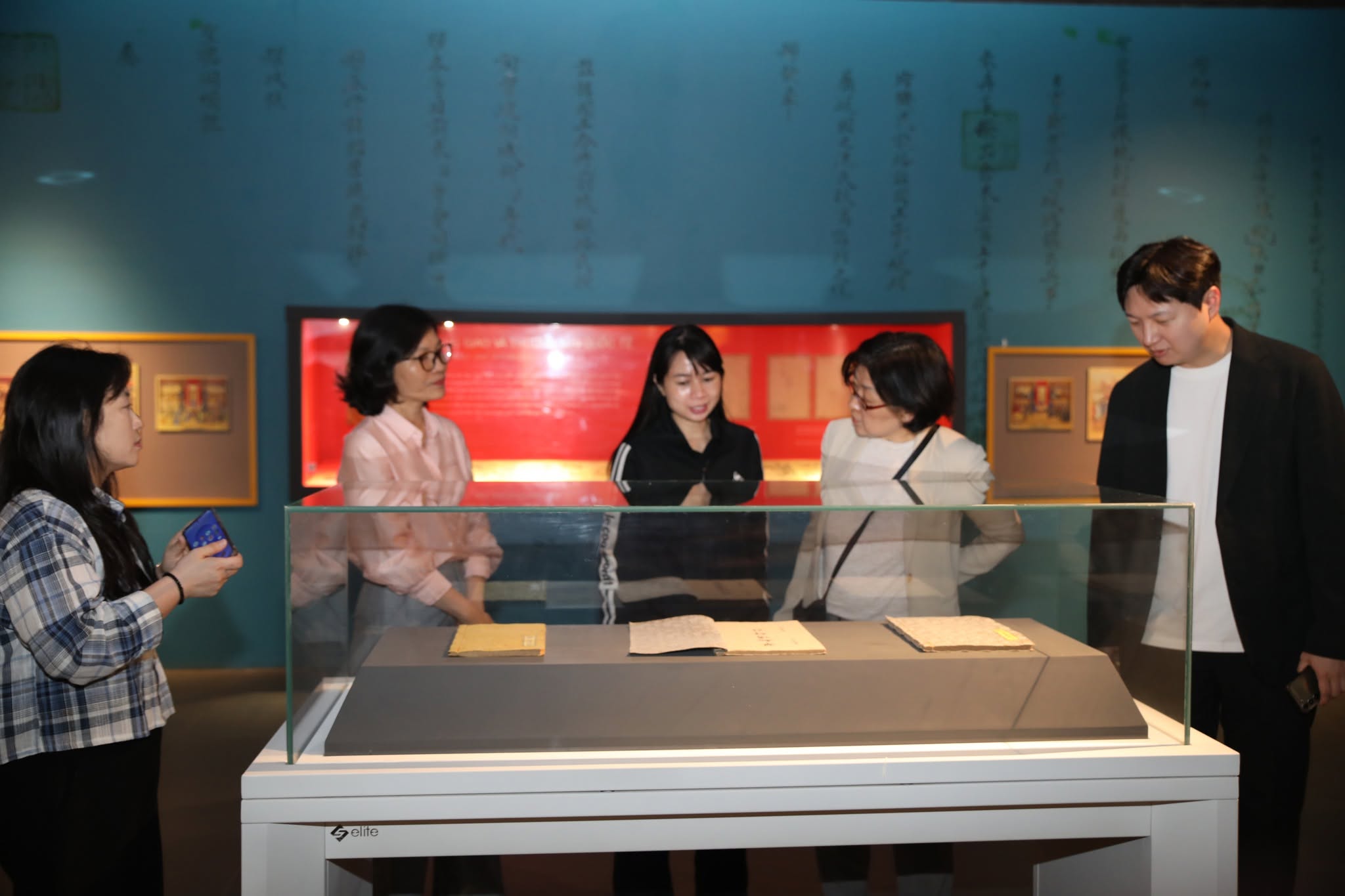
For visitors interested in Vietnamese history and culture, exhibitions featuring the Nguyen Dynasty Imperial Archives in Hanoi offer opportunities to explore the operation of the imperial government through original records, reproductions, and interpretive materials.
However, access to original archival documents is subject to the preservation and consultation regulations of the responsible institution.
UNESCO Recognition in 2014 and 2017: The International Significance of the Nguyen Dynasty Imperial Archives
The authenticity, originality, historical depth, and exceptional documentary value of the Nguyen Dynasty Imperial Archives have earned them international recognition.
In 2014, the collection was inscribed on the UNESCO Memory of the World Asia-Pacific Regional Register.
On July 30, 2014, a certificate presentation ceremony was held in Hanoi, acknowledging the importance of preserving and promoting this remarkable body of historical records.
During the ceremony, UNESCO representatives emphasized the collection’s ability to connect present-day audiences with earlier periods of history, offering insight into Vietnam’s political institutions, cultural life, and enduring intellectual traditions.
In 2017, the Nguyen Dynasty Imperial Archives were subsequently inscribed on the Memory of the World International Register.
This recognition confirmed the collection’s significance not only for Vietnamese history but also for the broader study of administration, culture, and international relations.
A defining characteristic of the archives is their original nature and the presence of handwritten decisions by Vietnamese emperors.
In many cases, researchers can examine administrative decisions as they were recorded at the time, rather than relying solely on historical accounts compiled later.
This provides exceptional opportunities for studying the practical operation of government and the relationship between rulers and officials.
The collection also documents major transformations in Vietnam during the 19th and early 20th centuries, from traditional imperial administration to the growing influence of international trade, colonialism, and changing political institutions.
Its diverse contents support research across numerous fields, including political history, economics, diplomacy, education, culture, language, and social administration.
The records concerning Hoang Sa and Truong Sa remain particularly important sources for studying Vietnam’s maritime history and territorial administration.
UNESCO recognition has also helped raise awareness of the importance of documentary heritage in modern society.
Unlike architectural monuments or archaeological objects that can be appreciated primarily through their physical appearance, documentary heritage preserves historical memory through written records, official documents, and traces of human activity.
The pages of the Nguyen Dynasty Imperial Archives, with their classical Chinese characters, official seals, and imperial red ink annotations, demonstrate how a state recorded its decisions, administered its territory, and transmitted important information across generations.
The Nguyen Dynasty Imperial Archives are far more than the administrative records of a dynasty that ended in 1945. They constitute an irreplaceable documentary memory of Vietnam, helping present and future generations understand the country’s governance, social life, cultural development, and historical transformations during the transition to the modern era.
Quick Information
| Item | Details |
|---|---|
| Heritage name | Nguyen Dynasty Imperial Archives |
| Vietnamese name | Châu bản triều Nguyễn |
| Heritage type | Documentary heritage; original imperial administrative records |
| Historical period | 1802–1945 |
| Dynasty | Nguyen Dynasty |
| Collection size | 773 volumes containing approximately 85,000 documents |
| Number of pages | Hundreds of thousands of archival pages |
| Emperors represented | Imperial annotations associated with 10 of the 13 Nguyen emperors, according to heritage descriptions |
| Writing systems | Classical Chinese, Nom, French, and Quoc Ngu |
| Materials | Primarily paper, writing ink, and vermilion ink |
| Distinctive feature | Original handwritten imperial annotations and approvals in red ink |
| Forms of imperial annotation | Chau Phe, Chau Diem, Chau Khuyen, Chau Mat, and other forms |
| Main subjects | Politics, administration, economics, military affairs, diplomacy, law, education, culture, society, and territorial management |
| Notable historical records | Documents concerning the administration and exercise of sovereignty over the Hoang Sa and Truong Sa Islands |
| Preserving institution | National Archives Center No. 1 |
| Current location | Hanoi, Vietnam |
| UNESCO regional inscription | 2014 |
| UNESCO international inscription | 2017 |
| UNESCO programme | Memory of the World |
| Outstanding significance | Original administrative records, Nguyen Dynasty history, imperial handwriting, and Vietnam’s modern historical development |