At the foot of the Marble Mountains in Da Nang, Non Nuoc Stone Carving Village is one of Central Vietnam’s best-known traditional craft villages. Over generations, stone carving here has developed from a craft producing everyday household objects into a diverse art form closely connected with local culture, livelihoods, tourism, and the artistic heritage of the Marble Mountains.
According to Phu Bien Tap Luc by Le Quy Don, the area that later became the stone-carving village was formerly known as Quan Khai Dong Giap and Quan Khai Tay Giap and was established around the 18th century. According to traditional accounts, Huynh Ba Quat, originally from Thanh Hoa, was the person who brought stone carving to the area and is regarded as the founder of the craft.
From Everyday Stoneware to Fine Art
In its early period, only a limited number of people in the area were skilled in stone working. Products were mainly made to serve local daily needs, including rice-pounding mortars, grain-grinding mortars, and stone funerary steles.
By the early 19th century, the construction of palaces, tombs, and other architectural works under the Nguyen Dynasty created new opportunities for the craft to develop. The reputation of local artisans gradually grew. According to the source, some skilled craftsmen were granted the rank of Cuu Pham by the court, while others were invited to work in different parts of the country.
From a practical craft serving everyday needs, stone working gradually expanded into artistic production. Techniques of carving, shaping, and finishing were passed down through families, creating a distinctive craft tradition in Non Nuoc.
Stone Materials and the Transformation of the Craft Village
In the past, the main raw material was quarried directly from the Marble Mountains. The local marble was available in various colors and patterns, including red, black, and white, and was relatively fine and easy to carve.
However, continued quarrying threatened the landscape and historical and cultural values of the Marble Mountains. According to the source, from 1990 the Quang Nam-Da Nang provincial authorities no longer permitted stone extraction from the Marble Mountains. Artisans therefore began sourcing stone from other parts of the country.
Today, stone is supplied from various localities, including Thanh Hoa, Nghe An, Thai Nguyen, and other areas. The change in raw materials has required artisans to adapt to different types of stone while also expanding their possibilities in terms of form, scale, and carving techniques.
From a Rough Stone Block to a Finished Artwork
Stone carving is a demanding process that combines technical skill, physical labor, and artistic ability. Once a suitable block of stone has been selected, the artisan first identifies an appropriate surface for the base, establishes reference points, and sketches the intended form.
For works requiring a high degree of artistic precision, artisans may first create a clay model. Once the model meets the desired requirements, the design is transferred to the actual stone. Following the preliminary drawing, the artisan begins rough carving, gradually forming the basic shape of the work.
Once the rough form is complete, detailed carving and decoration begin. Lines, motifs, and small elements are carefully worked with specialized tools. The piece is then ground, refined, and polished.
Each type of product has its own technical requirements. More intricate works require precise control over the force of each strike, the depth of every carved line, and the characteristics of the stone itself. This is the stage where an artisan’s experience and craftsmanship are most clearly expressed.
A Diverse Collection of Non Nuoc Stone Products
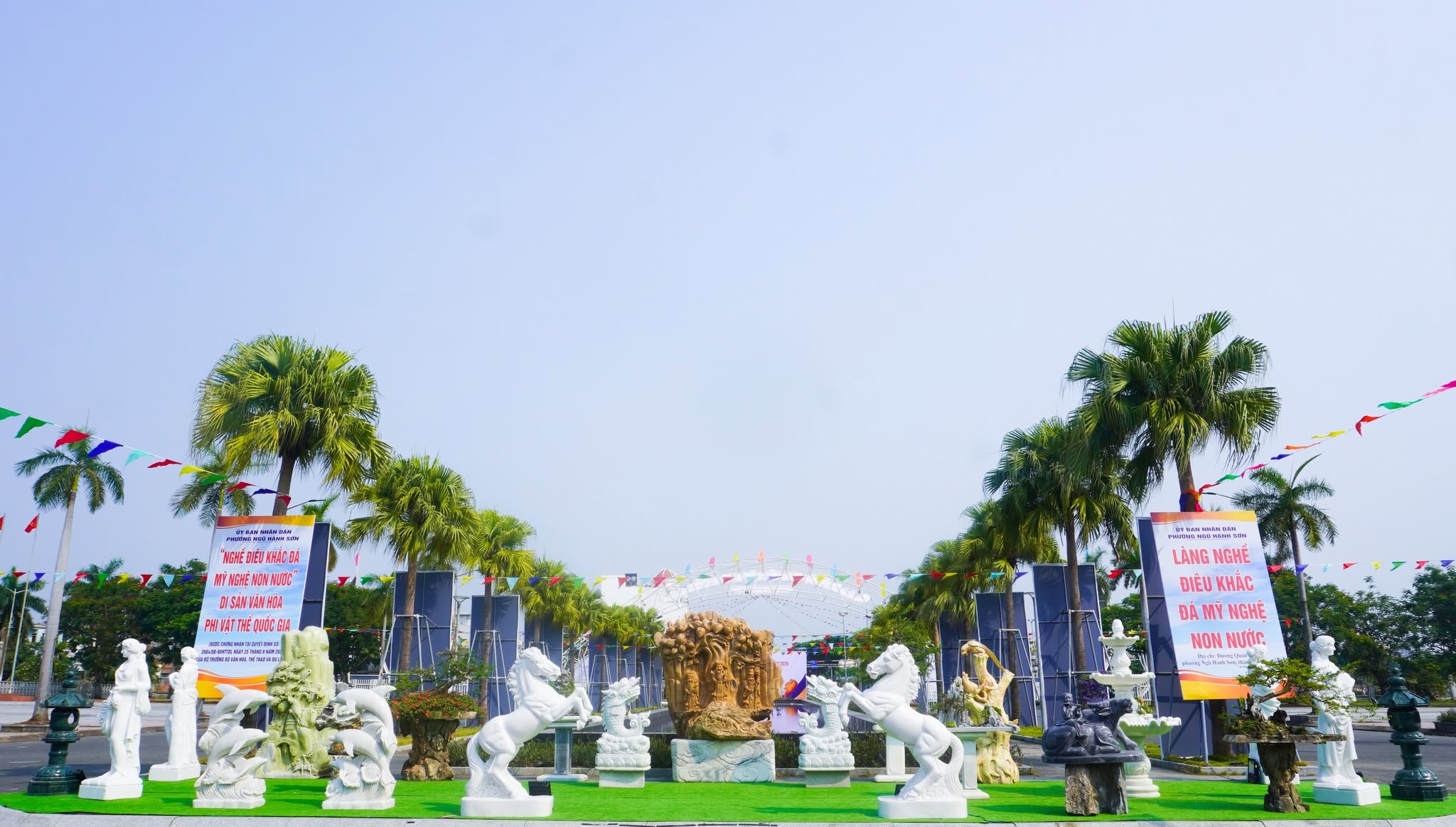
The village produces a wide variety of items, ranging from traditional household objects such as pestles and mortars to small decorative and jewelry pieces, including bracelets, rings, bead necklaces, paperweights, animal figures, and other ornaments.
Large-scale sculptures are another distinctive feature of the village. These include statues of Bodhisattva Guanyin, deities, figures inspired by Champa culture, lions, eagles, fish, and many other forms drawn from nature and religious imagery.
The variety of subjects allows artisans to work with stones of different colors, patterns, and physical characteristics. An ordinary block of stone can be transformed into a Buddhist figure, a sacred animal, a human form, a natural motif, or a delicate piece of jewelry.
Today, products are also developed to meet contemporary demand while retaining traditional techniques. Visitors can find compact souvenirs such as bracelets, rings, bead necklaces, decorative statues, ornamental vessels, and stone paintings alongside large-scale sculptures.
A Cultural Meeting Point at the Foot of the Marble Mountains
Located within the cultural landscape of the Marble Mountains and influenced by the long history of Champa culture in Central Vietnam, Non Nuoc stone carving reflects an artistic exchange between Vietnamese and Champa cultural traditions.
The imagery found in the works may draw from Vietnamese beliefs, daily life, and artistic traditions while also incorporating motifs associated with the Champa cultural landscape that has long existed in Central Vietnam.
A Non Nuoc stone artwork is therefore more than a product of carving, polishing, and shaping. It also reflects choices of imagery, proportions, line treatment, and the artisan’s ability to reveal the natural beauty of each piece of stone. Through the finished work, artisans express both their accumulated technical knowledge and their personal artistic sensibility.
The village itself offers a distinctive experience for visitors. From the quiet atmosphere of the pagodas on the Marble Mountains to the rhythmic sounds of chisels striking stone, visitors encounter both the contemplative character of the landscape and the lively rhythm of traditional craftsmanship.
A Craft Village Connected with Tourism and Community Life
Non Nuoc Stone Carving Village lies within the tourism landscape of the Marble Mountains, creating a close relationship between traditional craftsmanship and tourism. Products made here are sold not only throughout Vietnam but also carried by visitors to destinations around the world.
According to the source, Non Nuoc stone products have reached France, the United States, Australia, and other international markets. International customers have also commissioned large and heavy works, which are carefully packed and transported by sea.
Stone carving therefore plays an important role in the economic and social life of the local community. The craft creates employment, makes use of local labor, and contributes to the shift from simple manual work toward skilled craftsmanship.
The source also identifies several notable artisans, including Nguyen Long Buu, Nguyen Viet Minh, Nguyen Sang, and Le Ben. Many families have continued the craft for several generations, creating a strong network of knowledge transmission within the community.
From Traditional Craft to International Recognition
From its early production of practical household objects, Non Nuoc stone carving has gradually developed into a craft with significant artistic and commercial value. Its products are now found not only in the domestic market but also in international markets.
According to the source, merchants and visitors from Hong Kong, Japan, South Korea, Taiwan, Australia, France, Canada, the Netherlands, and the United States have visited the village. Some contracts were reportedly worth hundreds of thousands of US dollars.
These developments demonstrate the vitality of a traditional craft in a changing market. Yet the value of the village lies not only in production and commercial revenue. More importantly, it preserves a body of knowledge and technical skills in stone carving that has been transmitted through generations.
Every chisel mark, carved line, and polishing process reflects the patience and experience of the artisan. The combination of skilled hands, accumulated knowledge, and an understanding of the material transforms rough stone into works bearing the distinctive character of Non Nuoc.
National Intangible Cultural Heritage
Non Nuoc Fine-Art Stone Carving Village was included in Vietnam’s National Intangible Cultural Heritage List in 2014, according to the source, with the craft located in Hoa Hai Ward, Ngu Hanh Son District, Da Nang.
The recognition reflects the craft’s values in several areas, including its representative character within the local community, its cultural identity, human creativity, intergenerational transmission, and long-term vitality.
Today, at the foot of the Marble Mountains, stone carving continues to be preserved and developed. Artisans and younger generations maintain traditional techniques while creating new products, bringing Non Nuoc stone art closer to contemporary life and international markets.
After nearly four centuries, Non Nuoc Stone Carving Village has become an integral part of the cultural landscape of the Marble Mountains. The stones carved, shaped, and polished by generations of artisans are not simply handicrafts. They preserve memories of a traditional occupation, a craft community, and a long relationship between people and the land of Da Nang.
Basic Information
| Item | Details |
|---|---|
| Craft village | Non Nuoc Fine-Art Stone Carving Village |
| Location | At the foot of the Marble Mountains, Da Nang |
| History | According to the source, established around the 17th-18th centuries |
| Craft founder | Huynh Ba Quat, originally from Thanh Hoa |
| Traditional raw material | Stone quarried from the Marble Mountains |
| Current raw materials | Stone sourced from various provinces in Vietnam |
| Products | Stone sculptures, religious objects, decorative items, jewelry, souvenirs, and fine-art works |
| Techniques | Rough shaping, carving, detailing, decoration, grinding, and polishing |
| Cultural setting | Marble Mountains, Da Nang |
| Values | Traditional craftsmanship, sculpture, community culture, economy, and tourism |
| Heritage status | National Intangible Cultural Heritage, 2014 |