Blacksmithing is a long-standing traditional craft of the Nùng An people in Cao Bang Province. Centered in Quảng Uyên Commune, the craft has been preserved through generations and remains closely connected with the community’s daily life, agricultural production, customs, beliefs, and traditional knowledge.
For the Nùng An, a forge is more than a place where iron is shaped into tools. It is also a space where ancestral knowledge is transmitted, family traditions are maintained, and generations of craftsmen learn to understand fire, iron, water, and the rhythm of the hammer.
Origins and Cultural Traditions
According to local traditions, the Nùng An blacksmithing craft has more than one explanation for its origins. One account traces the craft to migration from China, while another associates it with weapons-forging activities during the period of the Mạc dynasty in the 16th century. These accounts have been preserved through local memory and oral traditions.
Each household forge traditionally maintains an altar for the craft and ancestors. Offerings may be made on the first and full-moon days of the lunar month, while larger rituals take place during Tết and on the 15th day of the seventh lunar month.
Before beginning or restarting work, some families perform a ritual at the forge, often involving offerings of pomelo leaves and other items. Rituals marking the opening or closing of the forge may involve a ritual specialist known locally as a thầy tào, as well as family members, clan representatives, or village elders.
These practices reflect the close relationship between the craft, family lineage, spiritual beliefs, and community life.
The Traditional Forge and Its Tools
A traditional Nùng An forge is relatively simple in appearance but carefully adapted to the demands of the craft. The furnace is built from clay and generally reaches about waist height. Air is supplied through a horizontal piston bellows, while the forge is equipped with heavy round and pointed anvils weighing approximately 150 to 200 kilograms.
The essential tools include large and small hammers, tongs, chisels, saws, files, grinders, and a water tank used during the forging and tempering process.
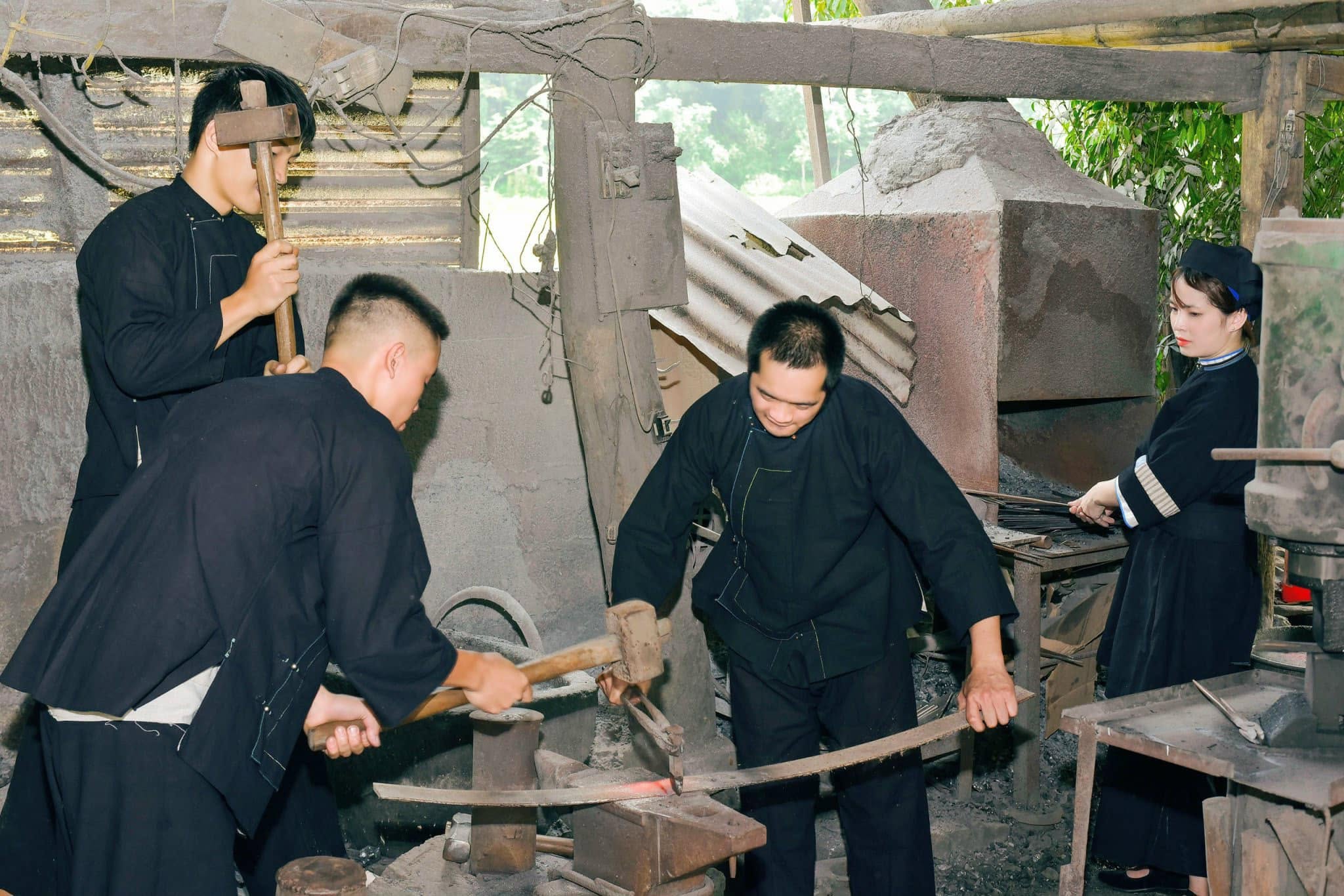
A typical forge may have two or three workers. The master craftsman directs the process, while assistants manage the fire, hold and turn the iron, and coordinate the hammering.
The craft depends not only on physical strength but also on precise coordination. When shaping a piece of heated iron, several workers may work together, with three using large hammers while another uses a smaller hammer to guide the work under the direction of the master.
From Iron to Finished Tools
The process begins with selecting and sorting iron. In the past, charcoal was commonly used as fuel, while coal is now more widely used.
The iron is heated until it reaches the appropriate temperature before being placed on the anvil. The craftsmen then hammer, stretch, bend, cut, and shape the metal according to the intended product.
One traditional technique known locally as dồn sắt is regarded as a distinctive part of the craft in Phúc Sen. The technique requires experience in controlling the heated metal and coordinating the sequence of hammer blows.
After the basic shape has been formed, the product undergoes planing, filing, grinding, and polishing. The most demanding stage is tôi, or quenching. The heated metal is cooled in water at a carefully controlled moment. Although ordinary water may be used, the precise timing and temperature are part of the craftsman’s knowledge and are traditionally kept within families.
Quenching may be repeated several times before the final polishing and finishing stages. A well-finished product can develop a characteristic blue sheen. Craftsmen may also use corn husks and old cloth to protect finished tools from rust.
A Diverse Range of Traditional Products
Nùng An blacksmiths traditionally make around 30 types of tools and implements. These include knives, hammers, axes, sickles, hoes, ploughshares, harrows, saws, chisels, planes, scissors, and various agricultural implements.
Among the products most frequently ordered are knives, hammers, hoe blades, and grass-cutting tools.
These implements are designed primarily for practical use in agriculture and everyday life. Their value therefore lies not only in their appearance but also in their durability, balance, sharpness, and suitability for demanding work.
From local markets in Cao Bang, products have reached Bắc Kạn, Lạng Sơn, Tuyên Quang, Thái Nguyên, and other northern provinces. Nùng communities who migrated for economic settlement have also helped introduce the craft and its products to areas such as Lâm Đồng, Gia Lai, Kon Tum, Đắk Lắk, Bình Dương, and Bình Phước. Products have also been traded across the border with China.
Knowledge Passed Down Through Generations
Blacksmithing knowledge among the Nùng An has traditionally been transmitted within families. Fathers teach sons how to select iron, control the fire, recognize the proper temperature, coordinate hammering, shape tools, and perform quenching and finishing.
Beyond the visible techniques, craftsmen must develop an understanding of the behavior of iron under heat. The color of the metal, the sound of the hammer, the resistance of the material, and the timing of each stage all become part of an accumulated body of practical knowledge.
This knowledge is rarely written down. Instead, it is learned through observation, repetition, direct practice, and participation in the forge.
As a result, the forge becomes an important setting for intergenerational transmission. Younger members gradually acquire not only technical skills but also the discipline, patience, precision, and responsibility associated with the craft.
Cultural and Economic Values
For the Nùng An community, blacksmithing is closely associated with the history of settlement and agricultural life in the northern mountains. The tools produced by the craft have supported farming and everyday activities, while the craft itself has provided livelihoods for generations of families.
The forge is also connected with ancestor worship, oral traditions, community relationships, and traditional concepts of work and craftsmanship. The sound of the hammer, the glow of the furnace, and the coordinated labor of craftsmen form part of the cultural landscape of Nùng An villages.
Through the transmission of techniques from one generation to another, the craft contributes to maintaining community identity while also adapting to changing markets and production conditions.
A Living Heritage of Nùng An Culture
The blacksmithing craft of the Nùng An people is not simply a traditional method of making agricultural tools. It represents a body of knowledge built through generations of interaction with iron, fire, water, and manual labor.
Its distinctive techniques, family-based transmission, ritual practices, and role in everyday life demonstrate how traditional craftsmanship can remain closely connected with the cultural identity of a community.
The craft was recognized as National Intangible Cultural Heritage under Decision No. 446/QĐ-BVHTTDL dated January 29, 2019.
Basic Information
| Information | Details |
|---|---|
| Heritage | Nùng An Blacksmithing |
| Ethnic community | Nùng An |
| Location | Quảng Uyên Commune, Cao Bang Province |
| Main products | Knives, hammers, axes, sickles, hoes, ploughshares, harrows and other agricultural tools |
| Traditional materials | Iron, charcoal or coal, water |
| Transmission | Family and community-based apprenticeship |
| Heritage category | Traditional craftsmanship |
| Recognition | National Intangible Cultural Heritage |
| Recognition decision | Decision No. 446/QĐ-BVHTTDL, January 29, 2019 |