
Royal Literature on Hue Royal Architecture is a distinctive form of Vietnamese documentary heritage, comprising poems, literary inscriptions, and large Chinese characters carved, inlaid, gilded, or otherwise incorporated directly into royal architectural structures during the Nguyen Dynasty (1802–1945). Beyond their literary significance, these works reflect the political philosophy, cultural traditions, aesthetic ideals, and intellectual life of Vietnamese emperors, scholars, and artisans.
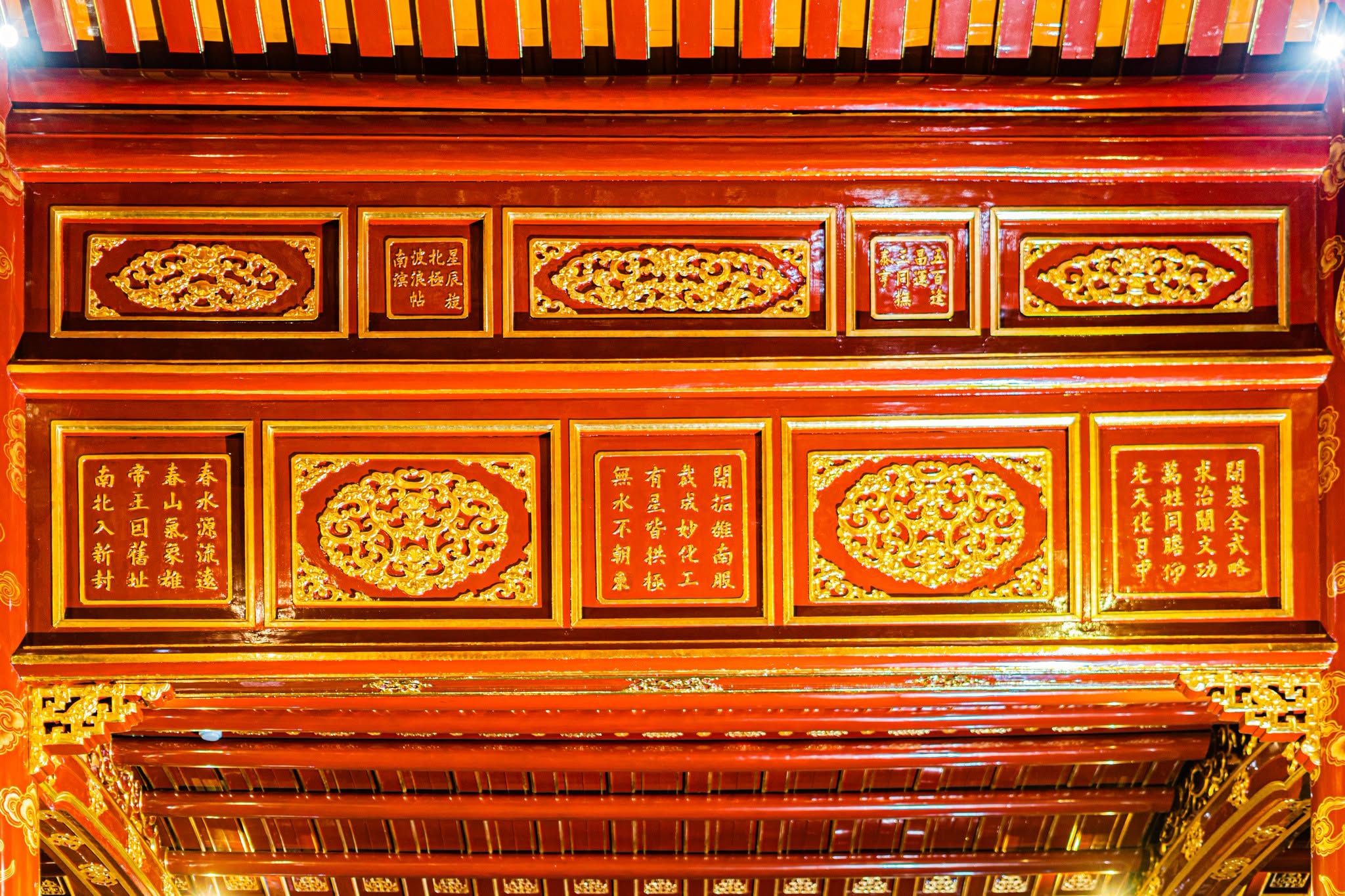
The most remarkable feature of this heritage is the decorative tradition known as “Nhat Thi Nhat Hoa” (One Poem, One Painting) and “Nhat Tu Nhat Hoa” (One Character, One Painting), in which a panel containing a poem or large Chinese character alternates with a painted or decorative panel, creating continuous ornamental compositions across palaces, temples, and royal buildings.
The Chinese-language poems were rendered through sophisticated traditional techniques, including woodcarving, mother-of-pearl inlay, red lacquer and gold gilding, enamelwork, and ceramic mosaic decoration. This harmonious combination of literature, calligraphy, painting, and architecture established a distinctive artistic style associated with the imperial capital of Hue.
According to heritage documentation, the surviving royal architectural structures in Hue preserve approximately 2,679 panels containing poetry and literary inscriptions, together with a substantial number of corresponding decorative panels. This remarkable collection provides valuable insight into the cultural and artistic life of the Nguyen Dynasty across generations.
On May 19, 2016, Royal Literature on Hue Royal Architecture was inscribed on the UNESCO Memory of the World Asia-Pacific Regional Register.
This recognition affirmed the exceptional value of a documentary heritage tradition in which literature was preserved not only in manuscripts and books but also directly within historic architectural structures.
Historical Origins and Distribution of Royal Literature in Hue
Hue is a region with a long history, shaped by the interaction of various cultural and intellectual traditions throughout Vietnam’s development. Its geographical position between northern and southern Vietnam, together with centuries of cultural exchange, contributed to the formation of its distinctive cultural identity.
Hue’s cultural heritage reflects the influence of Confucianism, Buddhism, indigenous beliefs, and Vietnamese folk traditions.
From the 17th century onward, Hue gradually emerged as an important political and cultural center of Dang Trong, the southern realm governed by the Nguyen lords.
In 1636, Lord Nguyen Phuc Lan moved his administrative headquarters to Kim Long, marking a new stage in the development of the Hue region. In 1687, the Nguyen lords transferred their headquarters to Phu Xuan, which gradually became an important political center.
At the beginning of the 19th century, following Emperor Gia Long’s reunification of the country and the establishment of the Nguyen Dynasty in 1802, Hue was selected as the imperial capital.
Extensive planning and construction projects transformed the city into a major royal center, with the development of the Imperial City, Forbidden Purple City, palaces, ancestral temples, ceremonial altars, imperial tombs, and cultural institutions.
These architectural complexes were carefully integrated into the surrounding landscape, particularly the Perfume River, Ngu Binh Mountain, and the area’s network of hills, rivers, and lakes.
During the Nguyen Dynasty, traditional Vietnamese architecture continued to develop, particularly in timber construction, interior decoration, woodcarving, lacquerwork, gilding, and decorative inlay.
One of the defining characteristics of Hue royal architecture was the incorporation of Chinese-language poetry and literary inscriptions into architectural compositions.
Rather than appearing exclusively in manuscripts or printed books, literary works were carved or decorated directly onto architectural components, including ornamental wooden panels, decorative friezes, horizontal lacquered boards, and other structural elements.
Poems, literary passages, and large Chinese characters were arranged alongside decorative paintings, creating artistic compositions that combined visual beauty with intellectual and philosophical meaning.
This decorative tradition flourished during the Nguyen Dynasty, particularly under Emperors Minh Mang, Thieu Tri, and Tu Duc, when imperial literature and architectural decoration achieved notable artistic sophistication.
Today, the surviving collection is preserved across numerous structures within the Complex of Hue Monuments, especially in the Imperial City, Forbidden Purple City, ancestral temples, and imperial tombs.
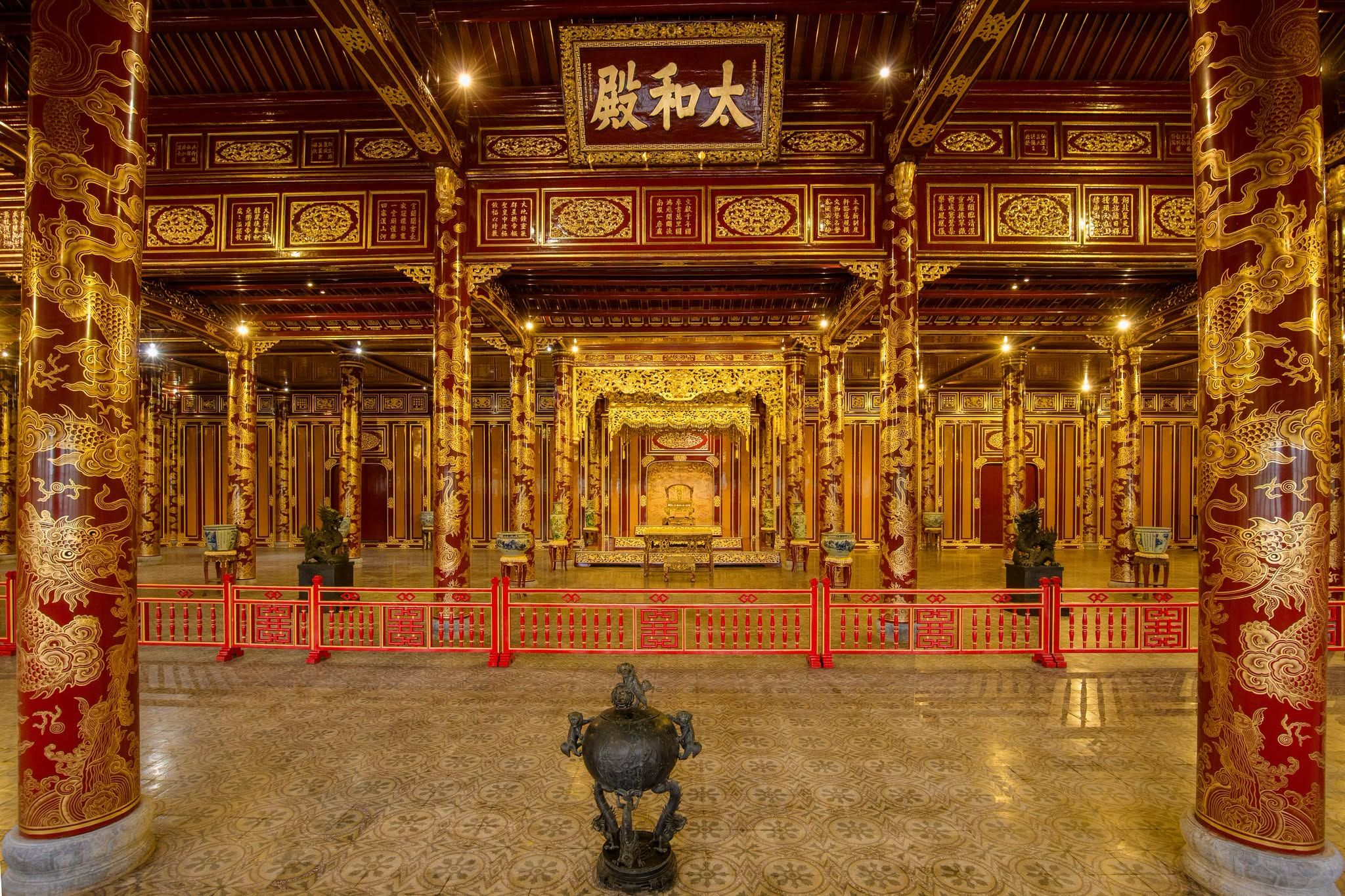
Within the Imperial City, important buildings associated with this decorative tradition include Thai Hoa Palace, The To Temple, Trieu To Temple, Hung To Temple, and Hien Lam Pavilion.
Thai Hoa Palace was one of the most important ceremonial buildings of the Nguyen court, where major imperial ceremonies were held. Its decorative programme reflects political ideals, court rituals, and the symbolic authority of the dynasty.
The To Temple served as a place of worship for the Nguyen emperors and possesses considerable historical, architectural, and ceremonial significance. Other structures, including Trieu To Temple, Hung To Temple, and Hien Lam Pavilion, also contribute to the distinctive artistic character of Hue’s royal precinct.
Beyond the palace complex, Chinese-language poetry and literary inscriptions can be found in the architectural and commemorative settings of several Nguyen imperial tombs, including the tombs of Gia Long, Minh Mang, Thieu Tri, Tu Duc, and Dong Khanh.
Depending on the structure and its historical period, literary works were incorporated into architectural components, commemorative features, and decorative details. Their subjects frequently include nature, moral philosophy, ancestral remembrance, and reflections on human existence.
The Tomb of Tu Duc is particularly notable for its literary atmosphere, reflecting the personal sentiments of an emperor renowned for his appreciation of poetry.
Chinese inscriptions are also found at cultural, religious, and ceremonial sites in Hue, including Thien Mu Pagoda, the Temple of Literature, and the Imperial Academy.
However, the broader distribution of Chinese inscriptions throughout Hue should be distinguished from the specific collection recognized by UNESCO.
Wars, natural disasters, and historical upheavals have damaged or destroyed many royal structures over time. Nevertheless, the substantial number of surviving literary panels continues to provide an exceptional source for studying Nguyen Dynasty literature, architecture, and decorative arts.
The Art of “One Poem, One Painting”, Calligraphy, and Imperial Decorative Techniques
The most distinctive artistic characteristic of Royal Literature on Hue Royal Architecture is the decorative arrangement known as “Nhat Thi Nhat Hoa”, meaning “One Poem, One Painting”.
Another related form is “Nhat Tu Nhat Hoa”, or “One Character, One Painting”, in which a panel featuring a large Chinese character alternates with a pictorial panel.
Poetry and painting panels were generally arranged in carefully organized sequences, forming balanced decorative bands across architectural components.
A panel containing a Chinese poem might be followed by a painted or carved image, then another poem or inscription. Ornamental borders separated the panels and created a harmonious visual rhythm.
The pictorial panels frequently depict familiar subjects from traditional Vietnamese and East Asian decorative arts, including dragons, phoenixes, cranes, lotus flowers, chrysanthemums, plum blossoms, auspicious objects, clouds, mountains, rivers, trees, and floral motifs.
The traditional Four Gentlemen, comprising plum blossom, orchid, chrysanthemum, and bamboo, also appear as decorative subjects associated with seasonal beauty and admired moral qualities.
Importantly, the images do not necessarily illustrate the poems placed beside them.
In many cases, the paintings function as independent decorative compositions, creating a visual balance between written language and imagery.
This arrangement gives each decorative sequence both literary significance and artistic richness.
The inscriptions are commonly found on ornamental wooden panels, decorative friezes, and upper architectural sections, particularly in the interiors and exteriors of royal buildings.
Other forms of Chinese writing also appear on horizontal inscribed boards, paired calligraphic inscriptions, columns, and additional decorative components.
Their placement suggests that poetry was often considered during the original design and construction of royal buildings rather than simply added as an afterthought.
In terms of materials, wood was one of the most important foundations of Hue royal architecture.
Artisans used durable timber, including ironwood and other valued hardwoods, to construct architectural components and ornamental panels.
Chinese characters were carefully carved into wooden surfaces and subsequently finished using traditional lacquer, gilding, or colored decorative techniques.
The carving required considerable precision to preserve both the meaning of the text and the aesthetic proportions of the calligraphy.
In many buildings, poetry panels were set against red lacquered and gilded surfaces, creating the rich and dignified appearance associated with Vietnamese imperial architecture.
Mother-of-pearl inlay was another important technique used to create characters and decorative motifs.
Artisans selected, cut, and fitted iridescent shell fragments into wooden surfaces, producing intricate designs that shimmered as the light changed.
This technique demonstrated the high level of craftsmanship achieved by traditional Vietnamese artisans.
Another remarkable form of decoration was Hue Phap Lam enamelwork, a sophisticated technique involving colored enamel applied to a metal base.
Phap Lam developed as a distinctive feature of Nguyen Dynasty decorative arts and was used on architectural elements such as roof ridges, roof ornaments, and other prominent details.
Its vibrant colors, glossy surfaces, and intricate patterns enriched the visual character of the imperial architectural complex.
Ceramic mosaic decoration was also widely employed, using fragments of pottery, porcelain, and other decorative materials to create images, patterns, or written characters on architectural surfaces.
This technique was particularly suitable for exterior locations exposed to tropical weather conditions.
In addition to wood, enamel, and ceramic materials, Chinese inscriptions within Hue’s royal environment were also produced on stone and metal, expanding the range of materials available for studying Nguyen Dynasty writing and decorative arts.
From a calligraphic perspective, the literary panels demonstrate the artistic refinement and technical skill of imperial craftsmen.
Characters had to be accurate in meaning while remaining harmonious with the dimensions, proportions, and placement of each panel.
Different Chinese calligraphic traditions, including regular, running, and clerical scripts, contributed to the diversity of the surviving inscriptions.
A single poetry panel in Hue’s royal architecture therefore embodies several artistic dimensions simultaneously.
It is a literary work, an expression of calligraphy, a product of traditional craftsmanship, and an integral component of an architectural composition.
This synthesis established the distinctive character of the “One Poem, One Painting” tradition, transforming imperial buildings into spaces where literature and visual art became inseparable.
Literary Themes and the Historical and Cultural Values of the Nguyen Dynasty
The literary content preserved on Hue royal architecture reflects many aspects of Nguyen Dynasty intellectual and spiritual life, ranging from political philosophy and Confucian ethics to national identity, appreciation of nature, and reflections on human existence.
Some works are associated with the literary activities of Nguyen emperors, particularly Minh Mang, Thieu Tri, and Tu Duc, who were known for their contributions to imperial literature.
The collection also reflects the intellectual influence of court officials and Confucian scholars.
However, the authorship of individual works should be established through textual evidence, historical dating, and Han-Nom scholarship rather than assuming that every inscription was composed personally by an emperor.
One important theme is the affirmation of Vietnam’s cultural traditions and national identity.
Poems addressing this subject express pride in the country’s origins, long history, territory, and literary civilization.
A well-known poem discussed in studies of the inscriptions at Thai Hoa Palace includes the following lines:
“Van hien thien nien quoc,
Xa thu van ly do,
Hong Bang khai tich hau,
Nam phuc nhat Duong Ngu.”
These verses emphasize the country’s long-standing cultural traditions and convey an ideal of national prosperity and good governance.
The poem uses historical and symbolic references to express pride in Vietnam’s heritage and its place within the intellectual traditions of East Asia.
Another prominent theme is the philosophy of governance and responsibility toward the people.
Numerous poems and inscriptions address the duties of rulers, the moral conduct of officials, and principles of social administration.
Common subjects include the importance of the people, agricultural development, education, public discipline, and the ethical responsibilities of government.
These themes reflect the political and moral values of Confucian scholars within the Nguyen court.
Consequently, the inscriptions were not merely decorative. They also conveyed messages concerning responsible government and the ideals of imperial leadership.
The beauty of nature and the landscapes of Hue formed another major source of literary inspiration.
Poems frequently describe mountains, rivers, seasonal scenery, gardens, lakes, and celebrated landscapes.
Emperor Thieu Tri is particularly associated with the collection known as “Than Kinh Nhi Thap Canh” (Twenty Scenic Views of the Imperial Capital), celebrating 20 notable landscapes of Hue.
These poems express admiration for the natural environment while also documenting aspects of the capital’s scenery, cultural life, and architectural setting during the 19th century.
For researchers studying urban history and cultural landscapes, such literary works provide valuable insight into how historical figures perceived and described the imperial capital.
Other compositions explore human existence, moral reflection, and the uncertainties of historical change.
The Tomb of Tu Duc offers a particularly significant example of the relationship between literature and the personal reflections of an emperor.
Tu Duc was renowned for his literary interests and left numerous compositions expressing his thoughts on life, history, and personal responsibility.
Works associated with his tomb complex, including Khiem Cung Ky, provide insight into his intellectual outlook, historical circumstances, and reflections on the challenges of his reign.
From a historical perspective, Royal Literature on Hue Royal Architecture constitutes an important primary source for studying Nguyen Dynasty literature, ideology, and artistic expression.
Unlike literary works transmitted through successive manuscript or printed editions, many inscriptions were created directly on architectural components during the construction or decoration of the buildings.
They are therefore both textual documents and physical elements of historical monuments.
Each poetry panel occupies a particular location within an architectural space and is closely connected to its surrounding colors, materials, decorative patterns, and structural composition.
When removed from its original setting, a panel may lose part of its historical context and artistic meaning.
This close relationship between text and architecture is one of the collection’s defining characteristics.
The surviving inscriptions also provide important material for comparison with manuscripts, printed texts, and other Han-Nom historical sources.
In certain cases, architectural inscriptions may preserve textual variants or supplementary information of scholarly value.
However, because many buildings have undergone repair, restoration, and reconstruction, the authenticity and originality of individual panels must be assessed through conservation records and specialized research.
Beyond their literary and historical importance, the inscriptions document the development of traditional craftsmanship, including woodcarving, lacquerwork, gilding, mother-of-pearl inlay, enamelwork, and ceramic mosaic decoration.
Through the surviving works, researchers can examine production techniques, material characteristics, calligraphic styles, and aesthetic preferences associated with different historical periods.
The outstanding value of Royal Literature on Hue Royal Architecture therefore lies in the close relationship between documentary content, artistic craftsmanship, and architectural space.
Together, these elements form a distinctive heritage tradition within Vietnamese cultural history.
UNESCO Recognition in 2016 and the Heritage’s Place Among Nguyen Dynasty Documentary Collections
On May 19, 2016, Royal Literature on Hue Royal Architecture was inscribed on the UNESCO Memory of the World Asia-Pacific Regional Register.
This recognition acknowledged the exceptional documentary significance of the collection in the fields of literature, history, calligraphy, and architectural art.
The inscription belongs specifically to the Memory of the World Asia-Pacific Regional Register (MOWCAP) and should not be confused with inscription on the international Memory of the World Register.
The 2016 recognition further strengthened Hue’s position within Vietnam’s cultural and documentary heritage landscape.
Previously, the Complex of Hue Monuments had been inscribed on the UNESCO World Heritage List in 1993 for its outstanding historical, architectural, and urban planning values.
Recognition of the royal literary inscriptions added another dimension to the understanding of Hue’s heritage.
While the palaces, ancestral temples, and imperial tombs demonstrate the physical achievements of Nguyen Dynasty architecture, the poetry and literary inscriptions reveal the intellectual, literary, and spiritual traditions associated with those structures.
This heritage also has important connections with two other major documentary collections from the Nguyen Dynasty: the Woodblocks of the Nguyen Dynasty and the Nguyen Dynasty Imperial Archives.
The Woodblocks of the Nguyen Dynasty preserve texts carved onto wooden printing blocks for publication and scholarly compilation. This collection was inscribed on the Memory of the World International Register in 2009.
The Nguyen Dynasty Imperial Archives preserve original administrative records, including documents bearing handwritten imperial decisions in red ink. They were recognized on the Asia-Pacific Regional Register in 2014 and the International Register in 2017.
Royal Literature on Hue Royal Architecture, meanwhile, preserves literary compositions and philosophical ideas directly on royal architectural structures.
Although these three documentary heritage collections differ in materials, functions, and methods of preservation, they collectively provide valuable evidence of the Nguyen Dynasty’s political, cultural, and intellectual life.
The woodblocks illustrate the compilation and transmission of knowledge.
The imperial archives document the administration and governance of the country.
The literary inscriptions reveal the poetic traditions, intellectual ideals, and artistic expressions of the royal court.
Studying these collections together offers a more comprehensive understanding of Vietnamese political history, education, culture, and art during the 19th and early 20th centuries.
UNESCO recognition in 2016 also helped raise awareness of the importance of documentary heritage.
Not all documentary heritage survives in the form of books, manuscripts, or archival files. Texts carved or incorporated into architectural structures can also preserve historical information, intellectual traditions, and cultural memory of lasting significance.
In Hue, the Chinese poems displayed across royal palaces and temples establish a remarkable connection between literature, people, and the built environment.
This relationship is central to the heritage’s international significance.
Conservation and Promotion of Royal Literature on Hue Royal Architecture
Over the centuries, the literary inscriptions of Hue’s royal architecture have been affected by warfare, natural disasters, climatic conditions, and historical upheavals.
Many buildings have been damaged or destroyed, resulting in the loss of poetry panels and decorative elements.
Even where inscriptions survive, the tropical climate, high humidity, heavy rainfall, and environmental changes can damage wood, lacquer, gilding, enamelwork, and decorative inlays.
Conservation efforts must therefore address two closely related objectives: preserving the documentary content of the inscriptions and protecting their original materials and artistic forms.
One of the most important tasks is the systematic inventory, examination, and assessment of individual literary panels throughout the architectural complex.
Recording each panel’s location, content, materials, production techniques, and condition provides the foundation for appropriate conservation strategies.
Where characters have faded or become damaged, Han-Nom scholarship can assist in identifying the original text and comparing it with related historical sources.
Conservation is also closely connected with the preservation of traditional craftsmanship, including woodcarving, lacquerwork, gilding, mother-of-pearl inlay, and Phap Lam enamelwork.
Restoration projects must carefully consider the historical characteristics of each building and employ materials and techniques appropriate to its original construction.
Traditional skills at risk of disappearing require continued research, documentation, revival, and transmission to younger generations of artisans.
The application of digital technology represents another important direction for safeguarding the collection.
High-resolution photography, three-dimensional scanning, Chinese character transcription, translation, and digital database development can help preserve and share information contained in the inscriptions.
Digital documentation also supports academic research, comparative analysis, conservation monitoring, and educational activities.
Alongside physical and digital preservation, specialized research plays a vital role in identifying the content, authorship, chronology, and artistic significance of individual works.
The publication of books, organization of exhibitions, academic conferences, and multilingual interpretation programmes can make the heritage more accessible to Vietnamese and international audiences.
Projects that present Royal Literature on Hue Royal Architecture alongside the Nguyen Dynasty Woodblocks and Imperial Archives can also offer a more comprehensive picture of Nguyen Dynasty history and culture.
For cultural tourism, exploring the literary inscriptions on palaces, temples, and imperial tombs provides a distinctive experience for visitors to Hue.
Rather than admiring architectural structures alone, visitors can discover the messages conveyed through poetry, calligraphy, and decorative imagery.
Interpretive programmes, thematic exhibitions, and digital experiences can help explain Chinese-language inscriptions that may otherwise be difficult for contemporary audiences to understand.
However, tourism development must be balanced with monument protection, particularly by minimizing physical contact with original architectural components and decorative surfaces.
Conserving this heritage means more than protecting objects that have survived for centuries. It also means safeguarding the knowledge, craftsmanship, and cultural traditions associated with their creation.
Within Vietnam’s rich cultural heritage, Royal Literature on Hue Royal Architecture provides an extraordinary example of the relationship between literature and the visual arts.
Each poetry panel is a historical text. Every written character represents an expression of calligraphic art, while each carved, gilded, or inlaid composition reflects the remarkable skills of traditional artisans.
Through this collection, future generations can gain insight into the intellectual world of the Nguyen Dynasty, from political philosophy and national identity to appreciation of nature and reflections on human life.
Amid the historic palaces, ancestral temples, and imperial tombs of Hue, poems carved into architecture continue to tell the story of Vietnam’s history, culture, and artistic traditions across the centuries.
Quick Information
| Item | Details |
|---|---|
| Heritage name | Royal Literature on Hue Royal Architecture |
| Vietnamese name | Thơ văn trên kiến trúc cung đình Huế |
| Location | Complex of Hue Monuments, Hue City, Vietnam |
| Heritage type | Documentary heritage; Chinese-language poetry and literary inscriptions on architecture |
| Historical dynasty | Nguyen Dynasty |
| Main period of creation | 1802–1945 |
| Collection size | Approximately 2,679 literary panels, according to heritage documentation |
| Writing system | Classical Chinese |
| Decorative traditions | Nhat Thi Nhat Hoa (One Poem, One Painting); Nhat Tu Nhat Hoa (One Character, One Painting) |
| Materials | Wood, red lacquer, gold leaf, mother-of-pearl, enamelwork, ceramics, and other materials |
| Artistic techniques | Woodcarving, inlay, lacquerwork, gilding, enameling, and decorative mosaic |
| Representative monuments | Thai Hoa Palace, The To Temple, Trieu To Temple, Hung To Temple, Hien Lam Pavilion, and selected imperial tombs |
| Historical figures | Nguyen emperors and scholars, particularly Minh Mang, Thieu Tri, and Tu Duc |
| Main themes | Governance, cultural traditions, morality, nature, and philosophical reflections |
| Outstanding values | Literature, history, calligraphy, architecture, and imperial decorative arts |
| UNESCO recognition | Memory of the World Asia-Pacific Regional Register |
| Registering body | UNESCO Memory of the World Committee for Asia and the Pacific (MOWCAP) |
| Recognition date | May 19, 2016 |
| Related heritage | Complex of Hue Monuments, Woodblocks of the Nguyen Dynasty, Nguyen Dynasty Imperial Archives |