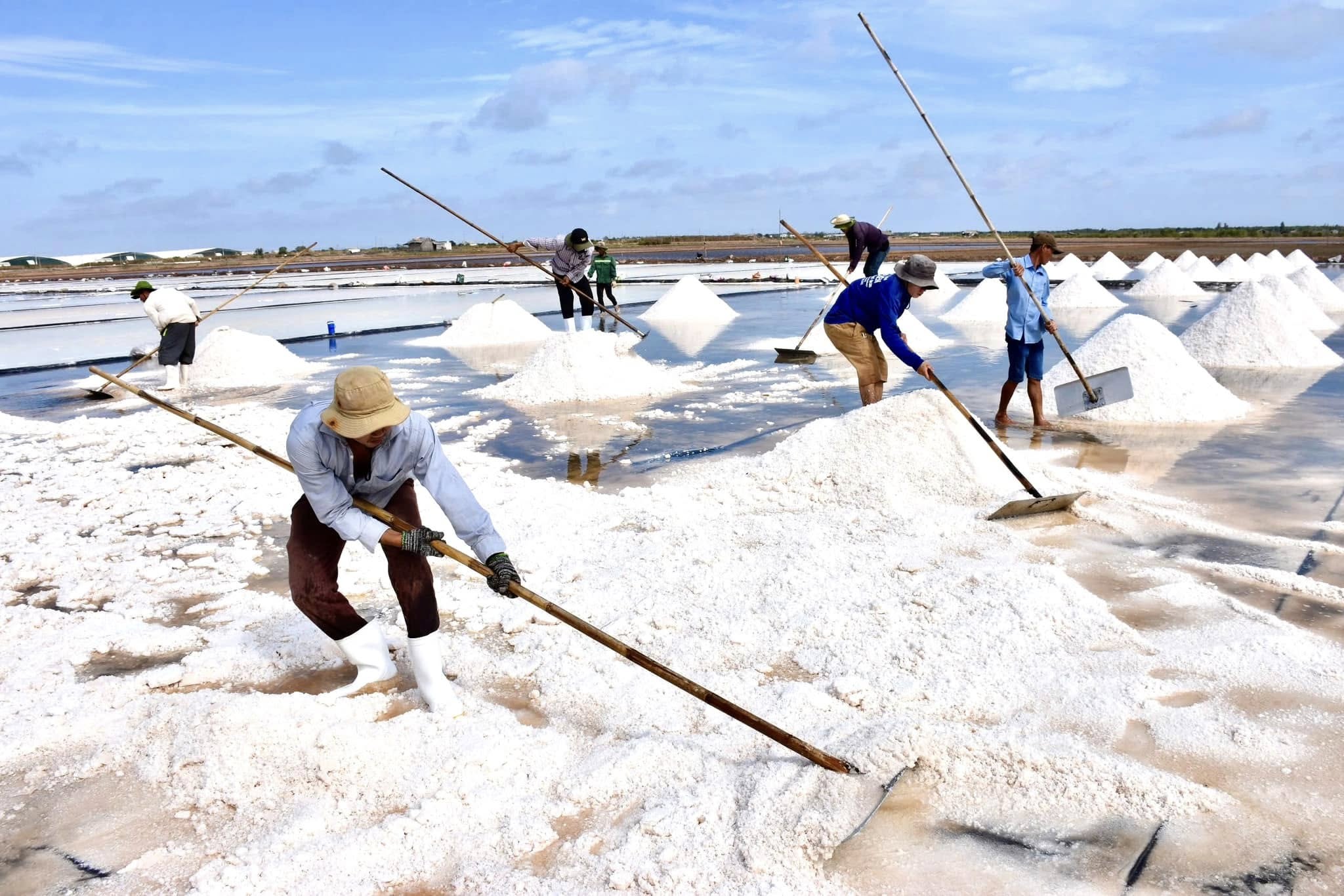
Bac Lieu has a long history of salt making and is known for the experience accumulated by generations of salt farmers. Salt production has traditionally been concentrated in coastal areas such as Vinh Hau, Vinh Thinh, Long Dien Dong, Dien Hai, and Long Dien Tay, covering more than 2,400 hectares.
Historically, Bac Lieu salt was known as Ba Thac salt, a name derived from an old term referring to the area south of the Hau River. Later, local people also called it Long Dien salt, as Long Dien became one of the largest and best-known salt-producing areas in Bac Lieu.
The history of the salt trade is also reflected in local place names. Tu Muoi, once a system of salt storage houses stretching for nearly one kilometer along the Bac Lieu River, and Dong Me Canal, now known as April 30 Canal, were associated with transporting salt from the coastal fields toward the town. From there, salt was carried by boats to the commercial port of Saigon or upstream along the Hau River toward Cambodia.
Natural Conditions Behind Bac Lieu Salt
Bac Lieu salt is traditionally described by local people as having a “sweet aftertaste”, rather than the strong bitter or harsh taste associated with salt from some other coastal areas. This characteristic is connected with the natural conditions of the region.
The coastline is low and relatively flat, without coastal limestone mountains, creating favorable conditions for bringing seawater into canals, reservoirs, and salt fields. The hot and sunny climate supports evaporation from the salt fields and the crystallization of salt.
The clay content of the saline soil used for salt production is relatively high, helping reduce the loss of seawater through seepage. The salinity of the seawater, semi-diurnal tidal regime, and dense river network, including the Ganh Hao, Chua Phat, and Cai Cung river mouths, also facilitate the intake of seawater into the salt fields.
The Salt-Making Season and Traditional Knowledge
The salt-making season in Bac Lieu takes place during the dry season and lasts approximately five months, beginning in early November. Over generations, salt farmers have developed and transmitted a complete body of production knowledge, from bringing seawater into the fields and storing it to increasing its salinity, evaporating the water, crystallizing the salt, harvesting, and preserving the finished product.
The traditional vocabulary of the craft also reflects its different stages. Tùa xà nụ was the former term for the water-intake reservoir. Xí kề, sa kề, di kề, and kề chánh referred to different evaporation ponds used to increase salinity. Kề chuối referred to the settling pond, while sa kết tinh referred to the crystallization field.
In the past, when salt fields extended across hundreds or even thousands of hectares, landowners hired salt workers to perform different tasks. Alongside workers performing manual labor were experienced technical workers known as Tầng khạo.
Preparing the Salt Fields
Before production begins, salt farmers carefully prepare and reinforce the surface of the fields. Grass, organic matter, and other impurities are removed, after which the ground is leveled and compacted.
The surface is reinforced using a mixture of sandy coastal clay and nước chạt, seawater that has been filtered to remove impurities and has a higher salinity than ordinary seawater. The salinity is gradually increased to create a level surface and reduce water seepage.
A traditional salt field generally includes a water reservoir, several evaporation ponds, a settling pond, and crystallization fields. The proportion of land allocated to each area depends on the size of the field and the production requirements.
The ponds are arranged according to a sequence of increasing salinity. Water passes through different storage and evaporation areas before reaching the crystallization fields. This arrangement makes effective use of the large salt fields while reducing the labor required during production.
Four Main Stages of Bac Lieu Salt Making
Traditional Bac Lieu salt production uses a static solar evaporation method with four principal stages: water intake, water storage, water evaporation, and salt crystallization.
Water Intake
During high tide, seawater is directed through the natural canal network into the salt fields and water-storage areas. Gates along the canals regulate the flow and help retain water when the tide recedes.
In the traditional layout, water first enters the main intake reservoir, followed by evaporation ponds numbered from 6 down to 1, then the settling pond, and finally the crystallization field. The ponds are often arranged in staggered patterns according to the actual shape of the salt field rather than in perfect geometric blocks. The crystallization area is generally divided into more regular and evenly shaped plots to facilitate evaporation and harvesting.
In the past, salt farmers commonly brought seawater into the reservoir around the ninth and tenth days of the lunar month, when they believed seawater salinity was highest. Today, larger tides may be used to reduce pumping costs, while farmers rely on experience to control and increase salinity during the production process.
Water Storage
The seawater is stored in deep and spacious reservoirs. Here, impurities settle while the water is retained as a stable supply for production during periods without high tides.
At this stage, seawater has a salinity of approximately 2.5° Baumé.
Water Evaporation
The seawater is then transferred from the main canals to evaporation areas. In the traditional Bac Lieu method, this process consists of three stages known as Xa Ke, Nhi Ke, and Xep Chuoi.
Each stage has a different evaporation period, generally around one day, one to two days, and two to four days respectively. During the process, water gradually evaporates, salinity increases, and impurities settle.
The sequence of Xa Ke, Nhi Ke, and Xep Chuoi is a distinctive feature of Bac Lieu’s traditional salt-making technique. It is also an important stage in determining the quality of the final salt crystals.
Salt Crystallization
After passing through the evaporation stages, the water becomes nước chạt, a concentrated brine with a much higher salinity than seawater. When the salinity reaches approximately 25°–28° Baumé, salt begins to crystallize strongly. At around 28°–30° Baumé, different grades of salt continue to form.
The crystallization process produces a variety of products, including raw salt, white salt, black salt, and gypsum. The remaining concentrated liquid, known as nước ót, can be returned to the reservoir for further use.
Bac Lieu raw salt grains can range from approximately 1 to 15 millimeters and may appear white, grayish, yellowish, pinkish, or black depending on the type and crystallization conditions. White salt is classified into different grades, with some products meeting Vietnamese and export standards.
Traditional and Modern Crystallization Methods
Bac Lieu currently has two main crystallization methods: crystallization directly on the salt field and crystallization on plastic sheets.
In the traditional method, water from the Xep Chuoi evaporation area is transferred to the crystallization plots. The traditional crystallization surface is made of compacted soil, which is harrowed and exposed to sunlight before receiving the concentrated brine. Crystallization generally takes 10 to 15 days. The remaining brine can be discharged into canals or returned to the reservoir for reuse.
The newer method uses plastic sheets laid over the crystallization surface. This technique reduces crystallization time to approximately seven to nine days and can produce salt that is whiter and brighter, with fewer impurities and lower moisture content. It can also increase productivity and improve commercial value.
After crystallization, salt is collected and moved to the edge of the field, where it is covered with nylon sheets or coconut leaves. It is stored in clean, dry, well-drained areas and kept away from chemicals or other materials that could negatively affect its quality.
Tools and the Evolution of Salt Making
Traditional Bac Lieu salt making uses a range of tools adapted to the conditions of the salt fields, including hoes, spades, soil rollers, embankment compactors, leveling tools, salt shovels, salt rakes, baskets, wheelbarrows, cart ramps, and salt-storage jars.
As production techniques have developed, some tools have also been improved. Mechanical pumps have replaced manual water lifting, wheeled rollers have replaced traditional soil rollers, and plastic sheets have been introduced for crystallization.
These changes help reduce physical labor, increase productivity, and improve salt quality while retaining the essential technical principles of traditional salt production.
Beliefs and Rituals of the Salt Farmers
Salt making in Bac Lieu is closely connected with local customs and beliefs. Each year, during seasonal transitions and communal-house ceremonies, salt farmers traditionally make offerings to heaven, earth, and deities, praying for favorable weather and successful production.
During the production process, farmers also observe certain traditional taboo days, including the fifth, fourteenth, and twenty-third days of the lunar month. In particular, when concentrated brine is transferred to the crystallization field, a simple ritual is performed to pray for favorable weather and protection from unexpected rain and wind that could damage the salt crop.
Salt as Part of Bac Lieu’s Cultural Heritage
According to the source, Bac Lieu produces three main groups of salt: silver salt, white salt, and black salt. Bac Lieu salt is traditionally described as having a less bitter and less harsh taste, with an average sodium chloride content of approximately 96.3% and relatively low magnesium chloride content. These characteristics contribute to its distinctiveness compared with salt produced in some other coastal regions.
The value of the craft, however, extends beyond the salt itself. Salt making reflects part of the history of land reclamation in Bac Lieu and the long process through which generations adapted to the coastal environment and built their livelihoods.
The salt fields preserve knowledge about weather, tides, seawater, soil, evaporation, and crystallization. The craft also provides employment and contributes to household and local economies while encouraging cooperation among community members.
Women also play an important role in the division of labor involved in salt production. Through the craft, values such as diligence, responsibility, respect for time, and community solidarity are passed between generations. The history of Ba Thac salt, known today as Bac Lieu salt, has also become part of local folk literature and traditional stories.
With its outstanding values in traditional knowledge, production techniques, community life, and coastal culture, Salt Making in Bac Lieu was included in Vietnam’s National Intangible Cultural Heritage List by the Minister of Culture, Sports and Tourism under Decision No. 2746/QD-BVHTTDL dated September 30, 2020.
Basic Information
| Item | Information |
|---|---|
| Heritage | Salt Making in Bac Lieu |
| Main areas | Coastal salt-producing areas of Bac Lieu |
| Notable areas | Vinh Hau, Vinh Thinh, Long Dien Dong, Dien Hai, Long Dien Tay |
| Historical names | Ba Thac salt, Long Dien salt |
| Traditional method | Static solar evaporation |
| Main stages | Water intake, water storage, water evaporation, salt crystallization |
| Products | Silver salt, white salt, black salt, gypsum, concentrated brine |
| Values | Traditional knowledge, production techniques, community culture, economic value |
| Heritage status | National Intangible Cultural Heritage |
| Recognition | Decision No. 2746/QD-BVHTTDL, September 30, 2020 |