Tân Hiệp Ancestral Elders Communal House, also known as the Ancestral Elders Shrine, is located in Xóm Giữa, Bãi Làng Village, Tân Hiệp Commune, on Cù Lao Chàm. It is an important religious structure of the island community, built to worship the tiền hiền and hậu hiền, the pioneers and later generations credited with reclaiming land, establishing the village and building the local community. The shrine also honors deities believed to protect residents in their daily lives and during journeys at sea.
According to accounts from local elders, the monument was built relatively early, around the late 18th or early 19th century. Although no surviving document establishes its exact construction date, the monument remains an important source for understanding settlement, land reclamation and religious traditions among the people of Cù Lao Chàm.
Location and Access
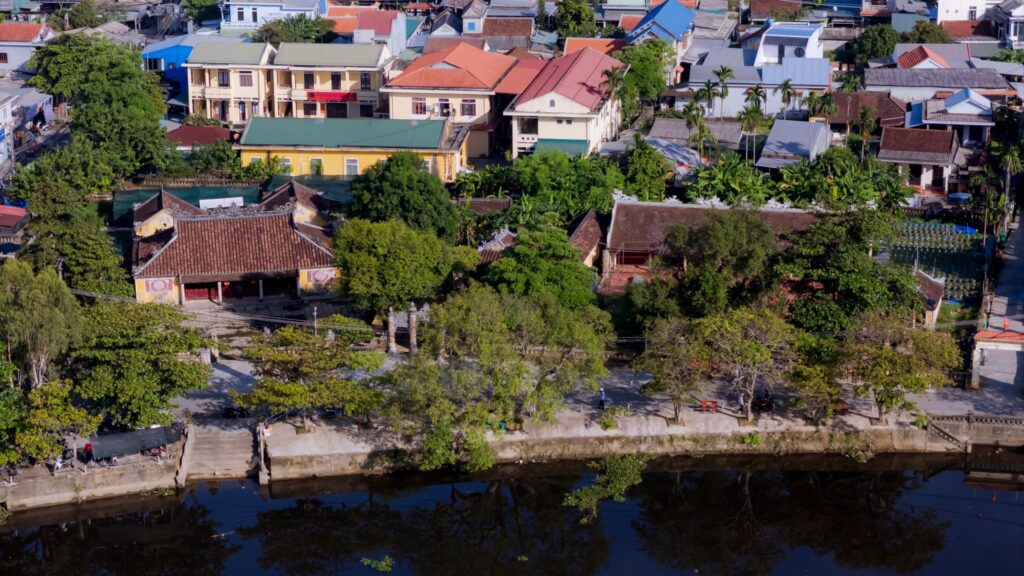
The Tân Hiệp Ancestral Elders Communal House is located in Xóm Giữa, Bãi Làng Village, Tân Hiệp Commune. It is bordered by a local path to the west, residential houses to the east and north, and Bãi Làng Primary School to the south.
From Bãi Làng Pier, follow the concrete coastal road southeast for slightly more than 200 meters. At the section where a drainage culvert flows toward the sea, turn left and continue for approximately 50 meters to reach the monument.
Cù Lao Chàm and the Formation of the Island Community
Cù Lao Chàm has been known by various names throughout history, including Pulaucham, Chiêm Bất Lao, Tiêm Bút Loa, Tiêm Bích Loa and Đại Chiêm Dư. The archipelago consists of several large and small islands, including Hòn Lao, Hòn Tai, Hòn Khô, Hòn Lá, Hòn Mồ, Hòn Dài and Hòn Ông. Located about 15 kilometers from the mainland, the islands form an arc facing the coast.
For centuries, Cù Lao Chàm has served as a natural protective barrier for Đại Chiêm estuary, an area closely associated with the ancient port town of Hội An. Đại Nam nhất thống chí described Cù Lao Chàm as a “protective screen of Đại Chiêm estuary,” noting that residents of Tân Hiệp lived on the southern slopes of the mountains. The island had cultivable land, while domestic and foreign seafarers used Cù Lao Chàm as a landmark and regularly stopped there to obtain firewood and fresh water during their journeys.
Historical records and archaeological discoveries indicate that people inhabited Cù Lao Chàm from a very early period. Stone artifacts discovered at the Bãi Ông archaeological site, including quadrangular axes, shouldered axes, chipped tools and grinding stones, indicate human presence on the islands approximately 3,000 years ago.
As communities settled on the islands, they established religious spaces to honor ancestors and pioneers who had reclaimed land, established villages and helped create a stable community. This was also a common tradition among Vietnamese communities when settling and developing new areas. Communal houses and shrines served not only as places of worship but also as community spaces where people expressed their hopes for safety and prosperity.
The Tân Hiệp Ancestral Elders Communal House emerged within this historical context, reflecting how the island community organized its social and spiritual life.
History and Objects of Worship
No surviving documents currently provide an exact construction date for the monument. Based on accounts collected from elderly residents, the building is believed to have existed since approximately the late 18th or early 19th century.
The communal house was originally established to worship the tiền hiền and hậu hiền, the pioneers and later generations credited with reclaiming land, establishing the village and developing the community. It also honors deities associated with the sea and waterways, who were traditionally believed to protect residents in their daily lives and during maritime journeys.
Of particular importance are the ancestral tablets on the main altar, which bear the titles of several Phục Ba Generals. According to the monument’s historical materials, “Phục Ba General” (伏波將軍) was a title associated with people who were believed to have conquered the dangers of the sea or possessed exceptional maritime skills, allowing them to withstand storms during sea voyages.
The historical materials also note that at least three figures in Chinese history were granted the title of Phục Ba General: Lộ Bác Đức, Mã Viện and Trịnh Thành Công. Therefore, the specific identity of the Phục Ba figure worshipped at the Tân Hiệp Ancestral Elders Communal House has not been definitively established by the surviving materials.
Two additional altars on either side of the main altar are dedicated to the Tả ban liệt vị and Hữu ban liệt vị, reflecting the traditional structure of communal religious worship.
Architecture of the Tân Hiệp Ancestral Elders Communal House
The monument is relatively substantial in scale compared with other religious structures on Cù Lao Chàm. It was constructed mainly from locally available materials such as lime, bricks, stone and coral.
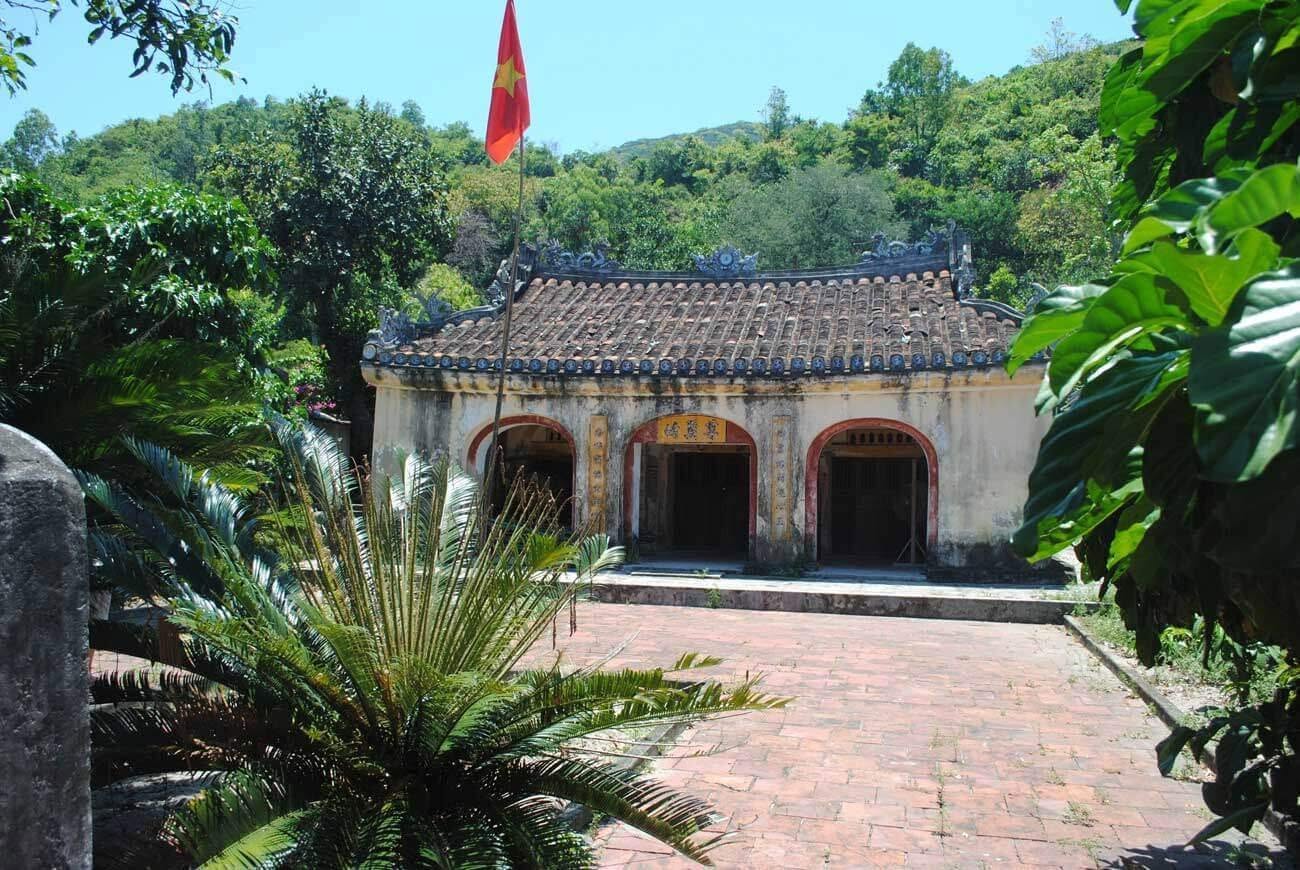
Unlike many traditional Vietnamese communal houses that feature wooden columns and roof frames, this structure was built using a vaulted construction technique, without a wooden column-and-beam system. Its roof is covered with traditional yin-yang tiles, while the ridge is decorated with the motif of two dragons contesting a pearl. The gable ends are elegantly shaped with decorative motifs including flowers, leaves, fish tails and dragon faces.
The interior is spacious and divided into several sections by substantial masonry pillars. The central section contains the main altar and lacquered-gilded wooden ancestral tablets. Additional worship spaces are arranged on either side.
Numerous Chinese-character parallel inscriptions appear on the walls and pillars, praising the merits of the ancestral pioneers, later generations and deities. One inscription compares the achievements of the pioneers in reclaiming the land to the vastness of the sea and describes their virtues as being as weighty as mountains. Another expresses the hope that, through divine protection, the mountains will remain safe and the sea will remain calm.
The monument also preserves lacquered and gilded wooden horizontal boards donated by trading houses in Hội An. One of them bears the inscription “Hải Bất Dương Ba” (海不揚波), meaning “the sea does not raise waves,” while another bears “Đức Phối Càn Khôn” (德配乾坤), expressing the idea of virtue reaching heaven and earth.
In front of the communal house is a spacious red-brick courtyard with a large screen wall. The entrance gate is tall and crowned with a lotus-shaped decorative design, creating a distinctive focal point at the front of the monument.
Preserved Artifacts
The monument retains several historical and artistic artifacts, including:
- Three wooden ancestral tablets, carved and decorated with lacquer and gold leaf, bearing the titles of Phục Ba Generals.
- Two large horizontal boards, lacquered and gilded, donated by businesses from Hội An.
Together with the Chinese-character inscriptions and architectural decorations, these artifacts reflect the close relationship between the island community, maritime life, religious traditions and the historic trading port of Hội An.
Historical, Scientific and Cultural Value
The Tân Hiệp Ancestral Elders Communal House is important for understanding the process of settlement, land reclamation and the establishment of stable communities on Cù Lao Chàm. It also contributes to the study of religious practices among island residents, particularly the tradition of worshipping ancestral pioneers, later generations and protective deities.
Architecturally, the monument represents a distinctive form within the religious heritage of Hội An and Cù Lao Chàm. Its vaulted construction using locally available materials, yin-yang tiled roof and traditional decorative motifs distinguish it from many timber-framed communal houses elsewhere in central Vietnam.
As part of the religious and cultural heritage system of Tân Hiệp, the monument enriches the network of historical and religious structures on Cù Lao Chàm and provides insight into the community life of generations of island residents.
Conservation and Restoration
In 1997, specialists from the Hội An Centre for Heritage Management and Preservation conducted a survey of the monument, assessed its values and prepared an initial documentation record. Subsequent work included architectural measurement and the establishment of a protected area as part of the preparation of a scientific heritage dossier.
Because the building had suffered serious deterioration and was considered important to the heritage of Cù Lao Chàm, the Hội An Town People’s Committee and the Hội An Centre for Heritage Management and Preservation, in cooperation with local authorities, carried out a major restoration in 2001. Following the restoration, the communal house was strengthened and restored to a more stable and imposing condition, allowing its religious and cultural functions to continue.
Quick Information
| Item | Information |
|---|---|
| Name | Tân Hiệp Ancestral Elders Communal House |
| Other name | Ancestral Elders Shrine |
| Location | Xóm Giữa, Bãi Làng Village, Tân Hiệp Commune, Cù Lao Chàm |
| Heritage type | Architectural and Artistic |
| Estimated date | Late 18th to early 19th century |
| Objects of worship | Ancestral pioneers, later generations, Phục Ba Generals and deities associated with the sea |
| Architecture | Vaulted construction, yin-yang tiled roof, two dragons contesting a pearl |
| Notable artifacts | 3 wooden ancestral tablets and 2 lacquered-gilded horizontal boards |
| Survey and documentation | 1997 |
| Major restoration | 2001 |
| Values | Settlement history, land reclamation, religious traditions and architecture of the Cù Lao Chàm community |
| Access | From Bãi Làng Pier, follow the coastal concrete road for slightly over 200 m, then turn left and continue about 50 m |