


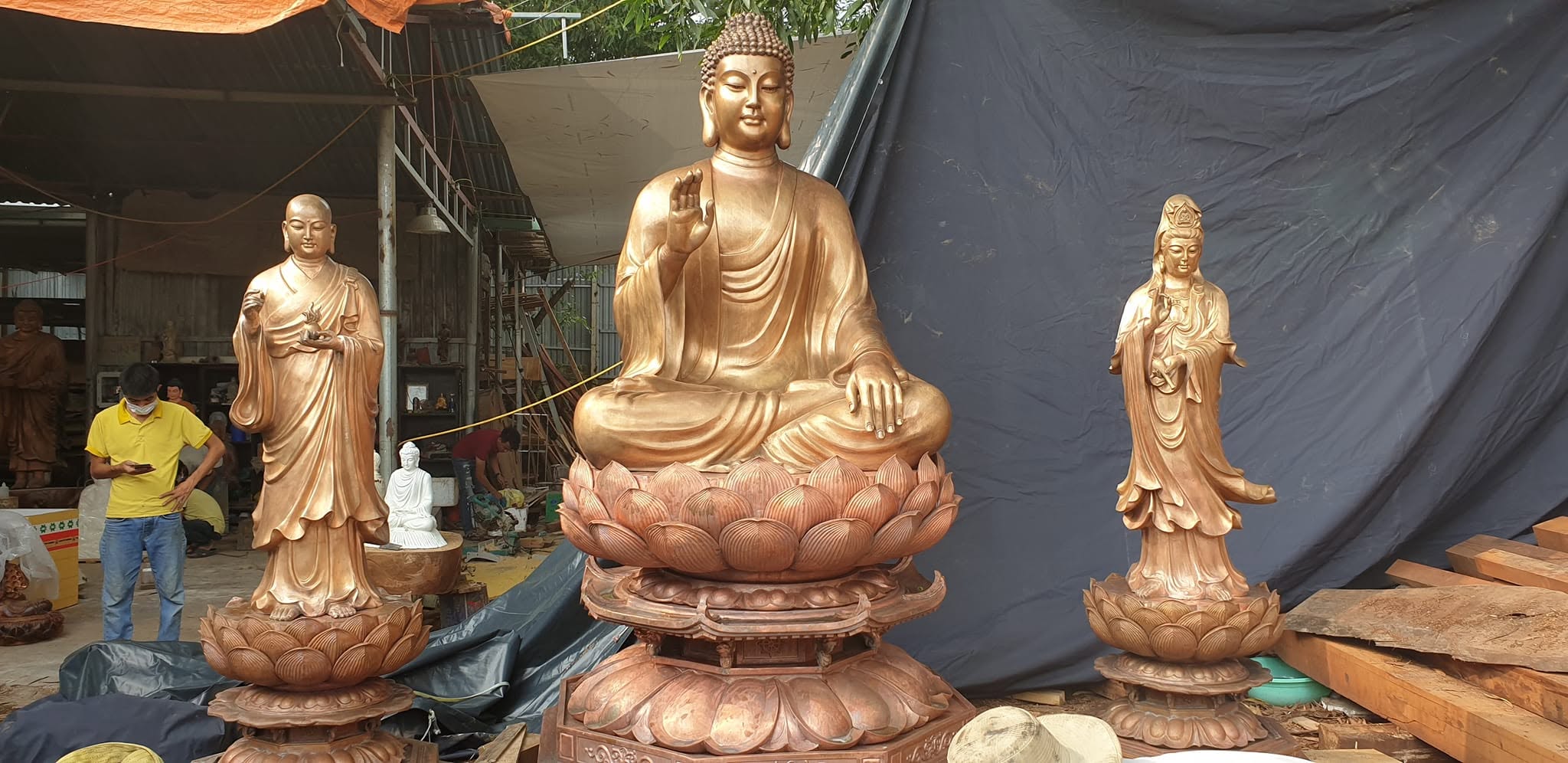
Tong Xa Bronze Casting Village, located in Y Yen Commune, Ninh Binh Province, formerly part of Y Yen District in Nam Dinh Province, is one of Vietnam’s renowned traditional bronze casting centers. With a history spanning many generations, the village has developed from a community of skilled metalworkers into an important center for bronze handicrafts, religious objects, sculptures, and large-scale artistic works. Its enduring reputation reflects the craftsmanship, technical knowledge, and artistic creativity passed down through generations of local artisans.
Situated in the cultural landscape of the Red River Delta, Tong Xa is known for its bronze casting workshops, where artisans transform molten metal into objects of both practical and artistic value. From incense burners, ceremonial vessels, and bronze bells to Buddhist statues, historical figures, and monumental sculptures, the village produces a wide variety of works requiring precision, patience, and specialized expertise.
One of Tong Xa’s defining characteristics is its ability to combine traditional bronze casting techniques with modern production equipment. While machinery supports various manufacturing processes, essential artistic tasks such as model making, decorative carving, detailed shaping, and surface finishing still depend heavily on the experience and skill of individual craftsmen. This balance between tradition and innovation has enabled Tong Xa to preserve its cultural identity while expanding its production capabilities.
Beyond its economic importance, Tong Xa Bronze Casting Village is closely associated with the worship of its traditional craft founder, community festivals, and the cultural traditions of northern Vietnam. It also offers opportunities for visitors interested in exploring Vietnamese craftsmanship, learning about bronze casting techniques, and discovering the everyday life of a traditional artisan community.
History of Tong Xa Bronze Casting Village and the Tradition of Honoring the Craft Founder
The bronze casting tradition of Tong Xa has a long history closely connected with the development of traditional handicrafts in the Red River Delta. According to local oral traditions, the origins of the craft are associated with Zen Master Nguyen Minh Khong, a revered historical and religious figure honored by several Vietnamese bronze casting communities as a founding master of their profession.
In local legends, Nguyen Minh Khong is credited with teaching villagers essential bronze casting techniques, including preparing raw materials, making molds, melting metals, and producing bronze objects for everyday and religious use. Some traditional accounts place the introduction of these techniques around the twelfth century. However, these stories belong primarily to the village’s oral heritage, and the precise date when bronze casting first appeared in Tong Xa has not been conclusively established through historical documentation.
From its early artisanal beginnings, bronze casting gradually became an important source of livelihood for local families. Craftsmen accumulated knowledge through practical experience, refining their methods of mold making, alloy preparation, temperature control, and post-casting treatment. These skills were traditionally passed from one generation to the next, creating a continuous craft heritage within families and artisan lineages.
As the craft developed, the range of products made in Tong Xa expanded considerably. Earlier production focused largely on household utensils and religious objects, while later generations introduced more elaborate decorative works, bronze statues, relief sculptures, and architectural ornaments. Changing market demands encouraged artisans to improve their techniques, develop new designs, and undertake increasingly complex projects.
An important aspect of the village’s cultural identity is the tradition of honoring the founder of the bronze casting craft. For local artisans, the founding master represents not only the origins of their profession but also the values of dedication, technical excellence, creativity, and respect for inherited knowledge.
According to local customs, ceremonies honoring the craft founder are traditionally held around the middle of the second lunar month. These occasions provide opportunities for craftsmen, their families, and other community members to participate in religious rituals, express gratitude to previous generations, and maintain the customs associated with their profession.
The annual observances also strengthen relationships among artisan families. They create opportunities for experienced craftsmen and younger generations to exchange knowledge, celebrate their shared heritage, and reinforce a collective sense of responsibility for preserving the village’s reputation.
Over many generations, bronze casting has become an essential part of Tong Xa’s history and cultural identity. The legends surrounding Nguyen Minh Khong, the continuation of specialized production techniques, and the close relationships among artisan families have helped sustain the craft through changing economic and social conditions.
Tong Xa – A Center of Bronze Handicrafts and Metal Casting Artistry
From a traditional handicraft village, Tong Xa has developed into a significant center for bronze production and decorative metalwork, bringing together numerous workshops and a skilled local workforce. Bronze casting provides employment across a wide range of activities, including product design, model making, mold preparation, metal melting, casting, mechanical processing, decorative carving, and surface finishing.
According to figures previously published in descriptions of the village, Tong Xa has been reported to have approximately 150 to 170 bronze handicraft production establishments, with thousands of workers involved in production and related activities. These figures are historical references and should not be interpreted as verified statistics for 2026. Although the number and scale of businesses may change over time, bronze casting continues to play an important role in the village’s economic and cultural life.
Tong Xa’s development has been shaped by its ability to respond to changing market demands. In addition to maintaining traditional product lines, local workshops have expanded into architectural decoration, interior furnishings, religious monuments, and artistic sculpture. This diversification requires a detailed understanding of metal properties, casting techniques, structural considerations, and aesthetic requirements.
The Traditional Bronze Casting Process
Producing a bronze object generally begins with understanding the intended design and preparing an appropriate model. For familiar household or ceremonial objects, artisans may use traditional patterns refined over many years. More elaborate sculptures and decorative works often require detailed drawings, scale models, or specially created prototypes to establish their proportions and artistic composition.
Once the design has been completed, craftsmen prepare the casting mold. Depending on the product’s size, complexity, and the casting method used, molds may be made from materials capable of withstanding the temperature of molten metal. Mold preparation is one of the most important stages because it directly affects the shape, dimensional accuracy, and surface details of the finished object.
The metal is then selected and prepared according to the technical requirements of the product. Copper may be used as a principal component or combined with other metals to create suitable alloys. Alloy composition influences strength, casting behavior, surface color, and finishing characteristics, making material selection an essential part of the production process.
The next stage involves melting the metal in a furnace. Craftsmen must carefully control the melting conditions, manage impurities, and prepare the mold before pouring. The casting process requires precision to minimize defects such as trapped air, incomplete filling, and irregularities in the finished shape.
After the metal has solidified and cooled sufficiently, the casting is removed from its mold and inspected. Excess material is trimmed away, imperfections are corrected, and the surface is prepared for further processing. Depending on the product, additional work may include engraving, decorative carving, polishing, coloring, or applying specialized surface treatments.
For objects with intricate patterns or complex sculptural details, the finishing stage can require considerable time and expertise. The quality of the final product depends not only on the casting itself but also on the craftsmanship applied during these subsequent stages.
Combining Traditional Craftsmanship with Modern Technology
A distinctive feature of bronze production in Tong Xa is the integration of traditional skills with modern equipment. Machinery may assist with model preparation, mold production, material handling, mechanical processing, and surface treatment. These technologies can improve productivity, enhance precision, and make it possible to manufacture larger and more technically demanding works.
Nevertheless, many important stages still rely on the judgment of experienced artisans. Evaluating the proportions of a statue, refining facial expressions, carving ornamental details, and creating a balanced surface finish require artistic sensitivity as well as technical knowledge.
These abilities are developed through years of observation, practice, and direct participation in the craft. Experienced craftsmen often recognize subtle differences in form and finish that cannot be assessed through mechanical measurements alone.
In bronze handicraft production, quality is determined by more than material strength or durability. A well-made object must also demonstrate balanced proportions, precise details, appropriate surface treatment, and a coherent artistic composition.
Complex products may require collaboration among designers, model makers, casting specialists, and finishing artisans. Each contributes different expertise, and the success of the finished work depends on the coordination of these skills.
This combination of technical knowledge and artistic creativity has enabled Tong Xa to produce everything from small decorative objects to large bronze sculptures intended for religious buildings, cultural institutions, and public spaces.
Traditional Bronze Products and Tong Xa’s Contribution to Monumental Art
The reputation of Tong Xa Bronze Casting Village is closely associated with the diversity of its products. From familiar religious objects to large-scale sculptures, the village’s craftsmanship demonstrates the versatility of bronze casting and its continuing relevance in Vietnamese cultural life.
Traditional Religious Objects and Decorative Bronze Products
One of Tong Xa’s most recognizable product categories is bronze religious and ceremonial objects. These are used in family ancestral altars, clan worship houses, communal houses, temples, pagodas, and other religious buildings.
Typical products include bronze incense burners, ceremonial vessels, candlesticks, bells, drums, horizontal inscription plaques, parallel couplets, and coordinated altar sets decorated with traditional motifs.
The production of religious objects requires careful attention to proportion, symmetry, and ornamentation. Dragons, phoenixes, lotus flowers, clouds, and other traditional patterns are frequently incorporated into decorative designs, contributing to the solemn and refined appearance of the finished pieces.
Depending on their intended use and aesthetic style, bronze objects may be polished to reveal their metallic sheen or treated to achieve an aged or traditional surface appearance. The selection of finishing techniques is an important part of the overall design.
Beyond religious objects, Tong Xa workshops also produce bronze drums, decorative panels, relief sculptures, mythical animal figures, and various interior ornaments. These products are used in homes, cultural buildings, memorial sites, and architectural projects.
Their diversity allows artisans to apply traditional casting methods to a wide range of contemporary needs while retaining recognizable elements of Vietnamese decorative art.
Buddhist Statues, Historical Figures, and Bronze Sculpture
Another important area of production in Tong Xa is bronze sculpture, including Buddhist statues, historical figures, religious characters, and ornamental works.
This type of craftsmanship requires close coordination between metal casting techniques and sculptural design. The artisan must understand the intended figure’s proportions, posture, expression, and overall composition before transforming the model into bronze.
For Buddhist statues and religious sculptures, particular attention is given to facial expressions, symbolic gestures, robes, and the harmonious presentation of the figure. These details contribute to the spiritual and artistic character of the work.
Statues representing historical personalities require different considerations. Their design may need to reflect documented visual references, established artistic conventions, and the specific commemorative purpose of the monument.
Large sculptures present additional technical challenges involving structural stability, weight distribution, transportation, and installation. Some works must be divided into separate sections for casting before being assembled and finished as a unified composition.
Such projects require cooperation among artisans, technicians, designers, and installation specialists. The ability to undertake complex assignments illustrates how traditional bronze casting knowledge can be adapted to modern artistic and engineering requirements.
Tong Xa Artisans and Major Cultural Monuments
Tong Xa’s bronze casting capabilities are often discussed in connection with major Vietnamese monuments and sculptural projects.
Works frequently mentioned in descriptions of the village include the King Ly Thai To Monument in Hanoi, Buddhist sculptures at Bai Dinh Pagoda, the Saint Giong Monument in Soc Son, and sculptural components associated with memorial works commemorating the Dien Bien Phu Victory.
These monuments hold important historical, cultural, and artistic significance. Their production involves demanding requirements for design accuracy, structural strength, material durability, and visual quality.
The participation of bronze casting artisans in projects of this scale demonstrates the potential for traditional metalworking techniques to contribute to contemporary monumental art.
However, major monuments commonly involve multiple organizations and specialized teams responsible for design, modeling, casting, finishing, transportation, and installation. References to Tong Xa’s contribution should therefore be understood in relation to the specific work undertaken by individual workshops or artisans, rather than as evidence that the village was solely responsible for an entire monument.
The broader significance lies in the development of the village’s technical capabilities. The transition from producing everyday objects to participating in sophisticated sculptural work illustrates the adaptability of traditional bronze casting and the ambition of its craftsmen.
By combining inherited techniques with modern production methods, Tong Xa artisans have helped maintain the relevance of Vietnamese bronze craftsmanship in both traditional and contemporary artistic contexts.
Cultural Heritage, Village Tourism, and the Preservation of Tong Xa Bronze Casting
For the people of Tong Xa, bronze casting is more than an economic activity. It is an important element of local identity, family tradition, and community life.
Specialized knowledge of mold making, alloy preparation, casting, surface treatment, and decorative carving has been accumulated over generations. Much of this expertise has traditionally been transmitted through direct practice, with younger workers learning by observing experienced artisans and gradually taking part in increasingly complex tasks.
Learning the craft requires patience, discipline, and a willingness to develop practical skills over time. Craftsmen must understand material properties, technical procedures, equipment operation, and the artistic requirements of different products.
Because bronze casting involves furnaces, high temperatures, molten metal, and industrial machinery, occupational safety is also an essential part of professional training.
The village’s cultural traditions help reinforce the relationships between generations of artisans. Ceremonies honoring the craft founder and other community gatherings provide opportunities to celebrate shared achievements and maintain the values associated with the profession.
These practices contribute to the continuity of the craft by linking technical knowledge with a broader sense of cultural responsibility.
Exploring the Bronze Casting Workshops of Tong Xa
For travelers interested in traditional Vietnamese handicrafts, Tong Xa offers a distinctive cultural experience.
The village’s production environment provides opportunities to understand how metalworking techniques and artistic creativity come together to produce objects ranging from small decorative pieces to elaborate bronze sculptures.
At workshops that welcome visitors, travelers may be able to observe selected stages of the production process, such as model preparation, mold making, mechanical finishing, and decorative carving.
These experiences offer insight into the skill and effort involved in transforming raw metal into finished works of art.
One particularly interesting aspect of a workshop visit is observing the detailed finishing process. On the surface of a bronze statue or ceremonial vessel, seemingly minor elements such as ornamental lines, facial features, or decorative patterns may require extensive manual refinement.
Watching artisans work on these details can reveal the importance of patience, precision, and artistic judgment in traditional metal craftsmanship.
Visitors may also learn about the history of the village, the legends surrounding its craft founder, and the role of bronze casting in the lives of local families.
Such stories add cultural depth to the experience, helping travelers understand that the significance of a traditional handicraft lies not only in its finished products but also in the people, skills, and traditions behind them.
Small bronze statues, decorative panels, ornamental objects, and other handcrafted products may also be available as souvenirs.
When purchasing bronze handicrafts, visitors should consider the material, dimensions, manufacturing method, surface finish, and care instructions to ensure that the product meets their expectations.
Visitor Safety and Practical Considerations
Because bronze casting is an industrial craft involving high temperatures and specialized machinery, not every workshop is suitable for public visits.
Travelers interested in exploring Tong Xa should contact workshops or local hosts in advance to confirm whether visits are available and what activities can be observed safely.
Visitors should follow all instructions provided by workshop staff and avoid entering restricted production areas. Furnaces, molten metal, lifting equipment, and industrial machinery can present serious hazards, even when operations appear routine to experienced workers.
Observing from designated safe areas is the most appropriate way to appreciate the craft without interfering with production or putting workers and visitors at risk.
Preserving Traditional Skills and Supporting Sustainable Development
As industrialization continues and modern manufacturing technologies become more widely available, Tong Xa Bronze Casting Village faces both opportunities and challenges.
Modern equipment can increase productivity, improve accuracy, and support the production of larger or more complex works. At the same time, the growing use of technology creates a need to preserve the manual skills and artistic knowledge that distinguish traditional bronze craftsmanship.
Training younger generations is therefore essential to the long-term future of the village. Experienced artisans possess not only practical techniques but also specialized knowledge of materials, production challenges, decorative styles, and problem-solving methods developed through years of work.
Documenting these skills, encouraging apprenticeships, and supporting opportunities for practical training can help ensure that valuable craft knowledge continues to be passed down.
Environmental protection and occupational safety are equally important. Bronze casting may generate heat, dust, emissions, noise, and industrial waste, depending on the materials and technologies used.
Workshops should therefore pay attention to appropriate emissions control, waste collection and treatment, safe equipment operation, and working conditions that protect the health of employees and surrounding communities.
Developing a strong regional identity for Tong Xa’s products can also support the village’s future. Handicrafts with clear origins, consistent quality, and reliable information about their materials and production methods are better positioned to build consumer trust.
For artistic bronze products, the combination of craftsmanship, design quality, and cultural storytelling can create a distinctive appeal.
Craft village tourism offers another possible direction for development. Carefully organized visits, demonstrations, exhibitions, and opportunities to meet artisans can introduce traditional metalworking to a wider audience.
However, tourism should be developed in ways that respect the working environment, prioritize visitor safety, and provide meaningful benefits to local craftspeople.
In the long term, the sustainable development of Tong Xa will depend on maintaining a balance between traditional knowledge, technological innovation, product quality, environmental responsibility, and community participation.
When these elements are developed together, the village can continue to create economic opportunities while preserving the cultural values that have shaped its identity over generations.
Tong Xa Bronze Casting Village stands as an important center of traditional Vietnamese metal craftsmanship. From the legends of Zen Master Nguyen Minh Khong to the inherited techniques of mold making, metal casting, and decorative carving, the village represents a living tradition of skill, creativity, and cultural continuity. Its diverse range of products, ability to undertake complex sculptural projects, and potential for cultural tourism demonstrate how traditional craftsmanship can remain relevant in modern society. More than a place of production, Tong Xa is a cultural destination that preserves and celebrates the artistry of Vietnamese bronze casting for present and future generations.
Quick Information
| Item | Details |
|---|---|
| Village name | Tong Xa Bronze Casting Village |
| Vietnamese name | Làng nghề đúc đồng Tống Xá |
| Current location | Y Yen Commune, Ninh Binh Province, Vietnam |
| Former administrative location | Y Yen District, Nam Dinh Province |
| Heritage type | Traditional craft village |
| Main craft | Bronze casting and decorative bronze craftsmanship |
| History | Long-established tradition associated with legends dating to the twelfth century |
| Traditional craft founder | Zen Master Nguyen Minh Khong |
| Craft founder commemoration | Traditionally held around the middle of the second lunar month |
| Historical production scale | Approximately 150–170 establishments in previously published accounts; not verified for 2026 |
| Main materials | Copper and suitable copper-based alloys |
| Traditional products | Bronze incense burners, ceremonial vessels, candlesticks, bells, and drums |
| Decorative products | Bronze panels, relief sculptures, mythical animal figures, and ornaments |
| Sculptural products | Buddhist statues, historical figures, and commemorative sculptures |
| Main techniques | Model making, mold preparation, metal melting, casting, mechanical processing, and finishing |
| Production characteristics | Combination of traditional craftsmanship and modern equipment |
| Frequently referenced monuments | King Ly Thai To Monument, sculptures at Bai Dinh Pagoda, Saint Giong Monument, and selected commemorative works |
| Cultural significance | Craft founder worship, inherited technical knowledge, and community traditions |
| Tourism experiences | Workshop visits, learning about casting techniques, and exploring bronze handicrafts |
| Visitor advice | Arrange visits in advance and follow workshop safety requirements |
| Preservation priorities | Craft training, environmental protection, product quality, and sustainable craft tourism |







