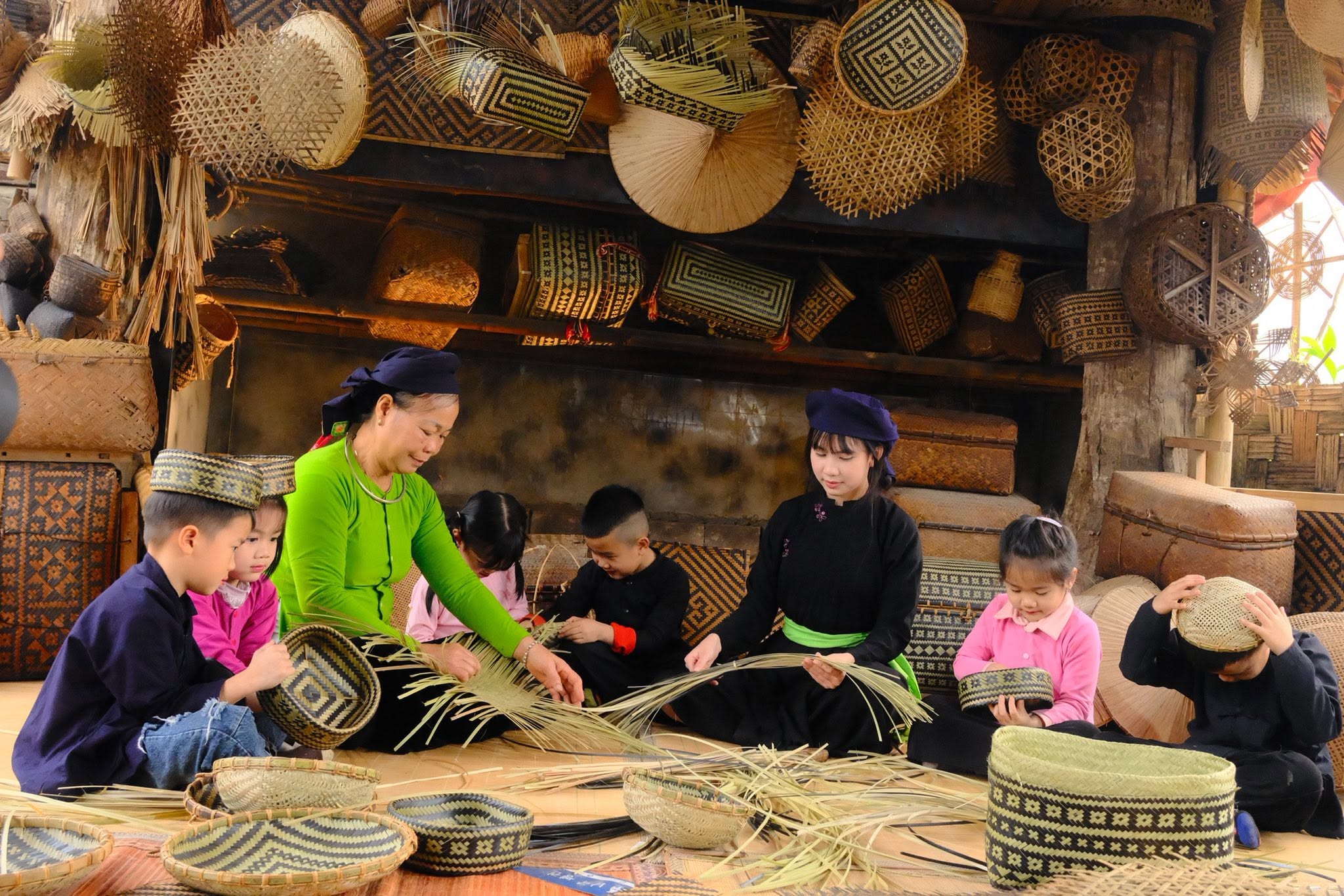
In Nghia Do Commune, Lao Cai Province, basketry has been preserved among the Tay community for generations and remains closely connected with everyday life. From familiar bamboo, rattan, and other forest materials, Tay craftspeople create essential household and agricultural implements such as baskets, trays, sieves, winnowing trays, carrying baskets, and woven containers.
Behind these seemingly simple objects lies a rich body of traditional knowledge accumulated through generations of settlement. From selecting raw materials and determining the appropriate time for harvesting to splitting bamboo, preparing strips, weaving, and preserving finished products, every stage reflects the community’s adaptation to its natural environment and mountainous agricultural way of life.
With its distinctive values in traditional craftsmanship, folk knowledge, and community culture, Tay Basketry in Nghia Do Commune, Lao Cai Province was included in the National Intangible Cultural Heritage List by the Minister of Culture, Sports and Tourism under Decision No. 1353/QD-BVHTTDL dated May 14, 2025.
Basketry from the Resources of the Forest
Through generations of settlement, the Tay people of Nghia Do have developed extensive knowledge of collecting and using naturally available resources, particularly bamboo and rattan species.
Bamboo, nứa, giang, and rattan are selected to make a wide range of objects suited to the terrain and agricultural practices of mountain communities. Baskets, trays, winnowing trays, and sieves are used in processing agricultural products, while larger baskets, carrying containers, and backpacks serve transportation, storage, and everyday household needs.
These woven objects are generally lightweight, durable, and practical. They respond directly to the needs of agricultural life while demonstrating how the Tay community has made effective use of natural resources to create objects suited to its living environment.
Basketry is therefore not separate from the community’s economic life. It has become an integral part of household activities and agricultural production.
The Family Hearth as a Space for Transmission
The main setting for practicing basketry is within the family and village community. The craft is often practiced during periods when agricultural work is less demanding, particularly in the evening after a day’s work.
In the family setting, when members gather around the hearth, activities such as splitting bamboo, preparing strips, and weaving can take place. This familiar domestic environment also becomes a natural space for teaching and transmitting the craft.
Knowledge is not primarily passed on through formal theoretical instruction. Instead, it is transmitted through oral guidance, observation, and hands-on practice.
Children may encounter the craft from an early age through simple tasks such as splitting bamboo, shaving strips, or preparing materials. As they grow older, they gradually learn how to harvest and process materials and practice basic weaving techniques. Their skills are then progressively developed until they can produce more complex objects.
Learning the craft requires patience, precision, and refined manual skills. Through years of practice, knowledge and techniques are passed from one generation to the next, allowing the tradition to continue within the community.
Knowledge of Selecting and Processing Materials
One of the most important aspects of basketry is the ability to recognize and process suitable materials.
The Tay people have developed knowledge of selecting bamboo, nứa, and giang according to their age, strength, and quality. Straight, strong stems with little evidence of disease or insect damage are generally preferred. The timing of harvesting is also selected carefully to reduce the risk of termites and increase the durability of the material.
After harvesting, bamboo and other materials are cut into sections, split into strips, and evenly shaved. Among these stages, splitting and shaving the strips are particularly important because the uniformity of the strips directly affects the structure, durability, and appearance of the finished product.
Experienced craftspeople can adjust the thickness, width, and flexibility of the strips according to the type of object being made. These skills are largely acquired through long-term practice and passed from one generation to another within the community.
Smoking and Drying Bamboo Strips Above the Hearth
In addition to crafting techniques, the Tay community has preserved traditional methods for storing and protecting raw materials and finished products.
One notable method is drying and smoking bamboo and rattan strips above the kitchen hearth. The warmth and smoke help dry the materials naturally, reduce moisture, mold, and insects, and create a distinctive color.
This preservation technique is closely connected with the traditional household environment. The kitchen loft, traditionally used for storing food, can also become part of the process of preparing materials for basketry.
Through practical experience, the community has developed preservation methods suited to its climate and living conditions, helping extend the lifespan of woven products.
Weaving Patterns and Decorative Motifs
Tay basketry in Nghia Do features a diverse range of weaving techniques, adapted according to the intended use and structural requirements of each product.
Techniques such as nong mot, nong doi, and nong ba are used for different purposes. Nong mot is suitable for relatively flat surfaces, while nong doi and nong ba create stronger structures for objects that need to withstand greater loads.
This flexibility demonstrates the adaptability of Tay craftspeople to different functional requirements.
Woven objects are not designed solely for practical use. Some products feature decorative patterns created directly during the weaving process by changing the arrangement of the strips. Motifs such as tomato flowers, lozenge flowers, cross-shaped flowers, and fox-eye patterns add distinctive visual elements.
These patterns enhance the aesthetic value of the objects while also reflecting the community’s visual thinking, aesthetic traditions, and cultural identity.
The Woven Cradle and Traditional Concepts of Life
Some basketry products are closely connected with the social customs and spiritual life of the Tay community. One notable example is the traditional practice of weaving cradles for infants.
The cradle is first and foremost a practical object used to care for babies. In traditional beliefs, however, it also carries symbolic meanings associated with life and the child’s spiritual essence, or via.
According to the transmitted custom, the number of woven openings in a cradle differs according to the child’s gender: a cradle for a boy traditionally has seven openings, while one for a girl has nine.
After completion, the cradle is smoked before being used. This serves a practical purpose in preserving the material while also being associated with traditional spiritual beliefs concerning the protection of the child.
The cradle demonstrates that basketry is not merely a means of producing practical household objects. It is also connected with customs, beliefs, and spiritual values passed down within the community.
A Craft Rooted in Community Life
Tay basketry in Nghia Do emerged from practical needs but gradually became an important part of the community’s cultural identity.
Every product embodies several layers of knowledge: understanding forest plants, harvesting experience, craftsmanship, shaping techniques, and aesthetic principles. These forms of knowledge do not exist separately. They are transmitted within families, villages, and through shared work.
The early involvement of children creates a natural connection between generations. Beginning with simple tasks, learners gradually master more advanced techniques while developing patience, precision, and manual dexterity.
As modern life continues to change, maintaining basketry therefore means more than preserving a traditional method of production. It also means safeguarding a body of indigenous knowledge closely connected with the natural environment and way of life of the Tay people.
From Bamboo Strips to Cultural Heritage
Tay basketry in Nghia Do illustrates the close relationship between people and nature. From familiar materials gathered in the surrounding environment, the community has created objects that are both practical and aesthetically distinctive.
More importantly, the craft continues through everyday community life. Evenings around the family hearth, the preparation of bamboo strips, children’s first experiences with weaving, and the knowledge passed down by older generations form a continuous chain of transmission.
With its values in traditional knowledge, craftsmanship, social customs, aesthetics, and Tay cultural identity, Tay Basketry in Nghia Do Commune, Lao Cai Province was included in the National Intangible Cultural Heritage List under Decision No. 1353/QD-BVHTTDL dated May 14, 2025.
From bamboo strips, rattan fibers, and skilled hands, a part of Tay cultural life continues to be preserved. It is also a story of how a mountain community has made use of natural resources, adapted to its environment, and passed knowledge from one generation to the next.
Basic Information
| Information | Details |
|---|---|
| Heritage name | Tay Basketry |
| Location | Nghia Do Commune, Lao Cai Province |
| Community custodians | Tay community |
| Practice setting | Families and village communities |
| Main materials | Bamboo, nứa, giang, and rattan |
| Typical products | Baskets, trays, winnowing trays, sieves, carrying baskets, woven containers, cradles, and other woven objects |
| Key techniques | Nong mot, nong doi, nong ba; splitting and shaving strips; drying and smoking materials above the hearth |
| Decorative motifs | Tomato flowers, lozenge flowers, cross-shaped flowers, fox-eye patterns |
| Transmission method | Oral transmission combined with hands-on practice |
| Key values | Folk knowledge, traditional craftsmanship, social customs, aesthetics, and Tay cultural identity |
| Heritage status | National Intangible Cultural Heritage |
| Recognition | Decision No. 1353/QD-BVHTTDL dated May 14, 2025 |