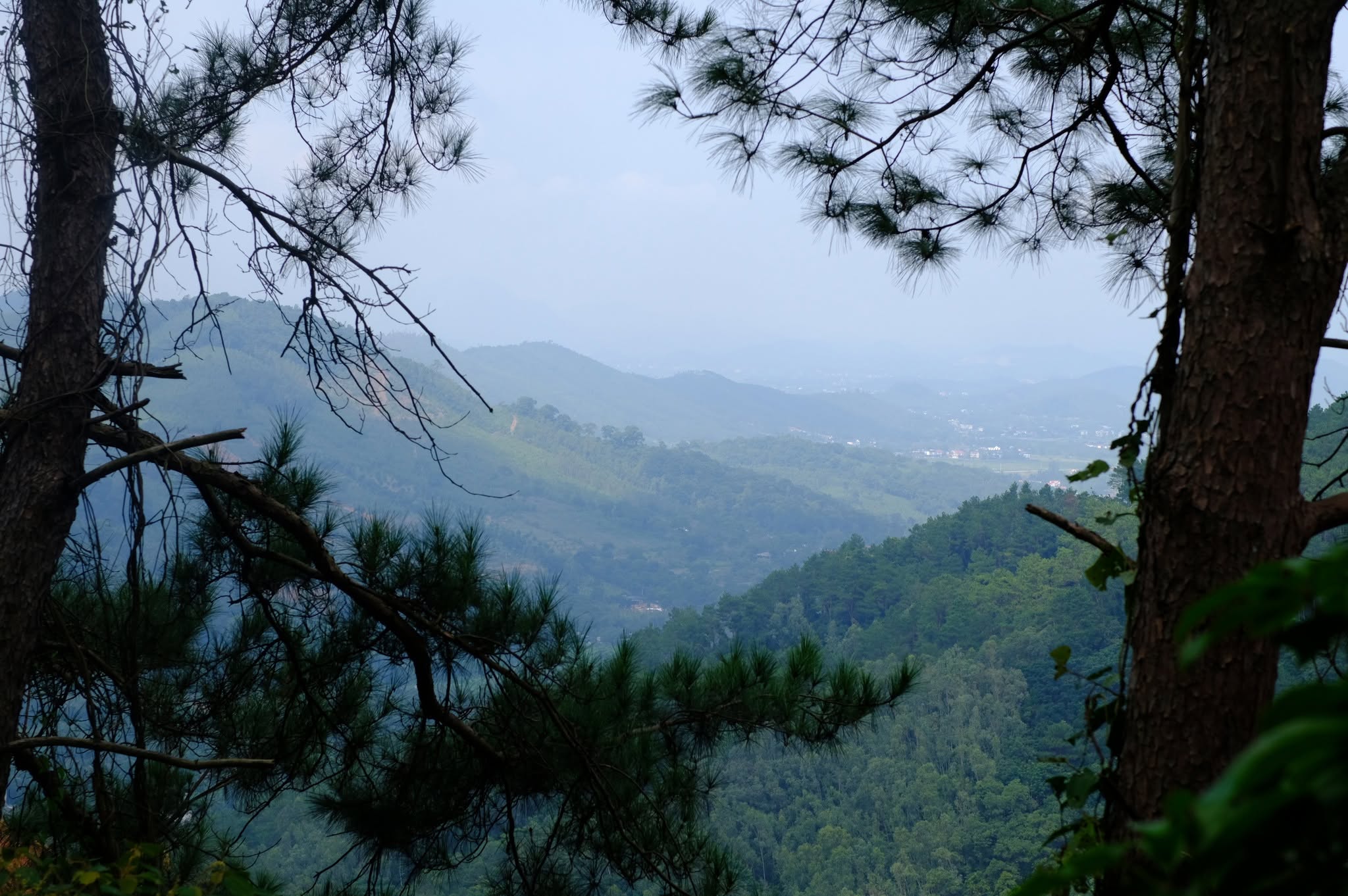
Also known as the Tây Thiên Scenic Area, the Tây Thiên–Tam Đảo Historical Relic and Scenic Landscape is located in the Tam Đảo Mountain Range, Đại Đình Commune, Phú Thọ Province. The site lies within a broad basin-like valley of the Tam Đảo Range, with elevations ranging from approximately 54 to 1,100 meters above sea level and a total area of around 11 square kilometers. It is a remarkable complex where mountain landscapes, religious monuments, folk-belief sites, and valuable archaeological remains exist in close connection with one another.
The name Tam Đảo refers to three prominent peaks in the mountain range: Phù Nghì, approximately 1,250 meters high; Thiên Thị, also known as Kim Thiên, approximately 1,585 meters high; and Thạch Bàn, also approximately 1,585 meters high. Rising above the surrounding sea of mountain clouds, these three peaks form the distinctive natural image of Tam Đảo, while also creating a diverse environment of ravines, streams, forests, and steep mountain terrain.
The Tây Thiên Scenic Area is concentrated mainly along the slopes of Thạch Bàn Mountain. It extends for approximately 11 kilometers along the mountainside and is about 1 kilometer wide. Following the Tây Thiên Stream and the surrounding mountain slopes is a system of religious structures, sacred sites, and archaeological remains, including Thõng Temple, Cậu Temple, Cô Temple, Thượng Temple, Tây Thiên Pagoda, and the Temple of the Tam Đảo Mountain Deity, together with foundations, architectural materials, and artifacts scattered throughout the forest.
The close relationship between the natural environment and the monument system gives Tây Thiên outstanding historical, cultural, archaeological, architectural, religious, and spiritual significance. It is both a pilgrimage destination and an important site for studying the formation and development of religious practices, folk beliefs, and Buddhism in the midland and mountainous regions of northern Vietnam.
The Monument Complex on Tây Thiên Mountain
Thõng Temple
Thõng Temple is situated at the foot of the mountain on a relatively broad and elevated area of land. It is regarded as the starting point of the Tây Thiên monument route. Built in a traditional architectural style, the temple serves as a transitional space between the residential area at the foot of the mountain and the system of temples and pagodas located deeper in the forest.
In front of the temple is a long stone platform and stairway system forming three entrances, separated by four large dragon sculptures. Beyond this is a restored four-pillared ceremonial gate, constructed in the traditional style using stone. Passing through the gate, visitors enter a spacious stone-paved courtyard.
The main sanctuary has a Đinh-shaped layout, consisting of a three-bay front worship hall with two side compartments and a rear sanctuary extending behind it. The altar dedicated to the Holy Mother marks the beginning of the sacred space associated with the worship of the Tây Thiên National Mother throughout the scenic area.
Cậu Temple and Cô Temple
From Thõng Temple, a stone path follows the stream for more than 1 kilometer to Cậu Temple. The site was once occupied by a small shrine, which was later replaced by the present worship structure. Inside the main sanctuary is an altar housing statues of three young boys believed to guard the mountain entrance.
According to local legend, Cậu Temple is associated with Trường Sinh Ravine, where “Cậu” is said to have stayed to recruit and provide for troops in support of the Tây Thiên National Mother. The temple was renovated in 1993 and remains an important stop along the pilgrimage route into Tây Thiên.
Approximately 2 kilometers beyond Cậu Temple is Cô Temple, located near Bạc Waterfall and beside the Giải Oan Stream, an upper section of the Trường Sinh Stream. The area around the temple is open and shaded by trees, with a flowing stream contributing to the characteristic mountain scenery of Tây Thiên.
The temple is dedicated to Cô Bé, who, according to local tradition, is a spiritual figure said to have assisted the National Mother in protecting and helping the people and the country. The Giải Oan Stream and an ancient well near the temple contribute to a sacred setting associated with the belief in purification and the symbolic washing away of worldly burdens before continuing toward the higher sanctuary area.
The Thượng Temple Area
The Thượng Temple area occupies a higher position on the mountainside and serves as one of the principal centers of Tây Thiên’s spiritual landscape. It represents an intersection of folk beliefs and religious traditions, with the worship of the Tây Thiên National Mother at its heart.
The temple is built on a series of natural terraces on Thạch Bàn Mountain. The rear of the site rests against the mountain, while mountain ridges descend on either side. The front opens toward a broad and unobstructed landscape. Forests, mountain clouds, streams, and steep slopes create a sacred environment closely integrated with nature.
The temple faces southwest. Its ceremonial entrance is designed in the four-pillared style, with connecting walls between the main pillars and the side pillars to form the principal gateway for pilgrims. The wall surfaces are decorated with motifs of the Azure Dragon, White Tiger, vegetation, and seasonal imagery, symbolizing the surrounding natural world and the four seasons.
The courtyard is paved with stone, with a central sacred pathway leading toward the main sanctuary. Along this pathway are the characters Phúc, Lộc, and Thọ, representing blessings, prosperity, and longevity, arranged vertically.
The main sanctuary follows a Đinh-shaped layout, comprising three main bays and two large side compartments. Its façade is balanced by a two-tiered roof structure with eight gracefully curved roof sections.
A horizontal lacquered board bearing the inscription “Temple of the Tây Thiên National Mother” hangs in the central section of the upper roof structure. The statue of the National Mother occupies the central position inside the sanctuary. The figure is depicted seated on a pedestal, with both legs hanging straight down and both hands resting on the knees. Her right hand holds a folded fan, giving the statue a solemn and dignified appearance.
In addition to Thượng Temple, the area contains several other religious structures that were built or added at later periods, including the Mountain Deity Shrine, Cô Chín Temple, Địa Mẫu Temple, the Temple of the Three Holy Mothers, and the Left and Right Guardian Halls.
Tây Thiên Pagoda
Tây Thiên Pagoda is one of the most important religious structures within the scenic complex. The original ancient pagoda no longer survives in its entirety. Among the most notable remaining architectural traces are an old three-entrance gate and a horizontal plaque bearing the name “Tây Thiên Thiền Tự,” meaning Tây Thiên Zen Pagoda.
The gateway has a three-peaked structure incorporating elements of both Buddhist and Confucian architecture. Its design shares certain similarities with the gateway of Kim Liên Pagoda in Nghi Tàm, Hanoi, although it is smaller and simpler in scale. The smooth-planed and sharply joined wooden details, together with its decorative features, suggest that the structure reflects an artistic style dating from around the nineteenth century.
The present pagoda was newly built approximately 20 meters to the left of the former pagoda foundation. Although the entrance gate and main pagoda were constructed with modern materials, they retain the traditional architectural form. The Buddhist statues are arranged according to the common layout found in pagodas throughout the Red River Delta.
The Patriarch’s House was built in the style of a traditional stilt house, combining traditional and modern elements in its structural components and decoration. Behind the pagoda is a stupa garden containing three stupas with inscriptions identifying Cương Sơn Zen Master, Cúc Khê Zen Master, and Giác Nghĩa.
Approximately 100 meters from the stupa garden is the Thạch Bàn area, where a large freestanding rock lies amid the mountain terrain. The surface of the rock bears markings known locally as a chessboard, associated with a folk legend that immortals once descended to this place to play chess.
Temple of the Tam Đảo Mountain Deity
From Tây Thiên Pagoda, a path following the mountainside leads to the Temple of the Tam Đảo Mountain Deity. According to legend, the mountain deity once assisted a rain-invoking ceremony during the reign of King Trần Nhân Tông and was subsequently granted the title Thanh Sơn Đại Vương, or Great King of the Green Mountain.
During the Early Lê Dynasty, under the reign of King Lê Nhân Tông, in the eighth year of the Thái Hòa era, corresponding to 1450, the court sent the high-ranking official Lê Khắc Phục to perform a ritual offering to the deity. This event was recorded on an inscription carved directly into a rock face approximately 700 meters from the temple along a mountain path.
The present temple is relatively small, with an almost square floor plan consisting of one main bay and two side compartments. It stands on a raised foundation and features a two-tiered roof with eight roof sections. Surrounded by forests and mountain scenery, the temple continues to preserve the tradition of mountain-deity worship within the sacred landscape of Tây Thiên.
The Rock Inscription
One of the notable relics in the Tây Thiên area is a cliff inscription, locally known as the Rock Inscription. The text was carved directly into a sloping, ivory-colored rock beside the stream. The rock is approximately 5 meters long and 3 meters high, forming a natural canopy that protects the inscription from direct exposure to rain and sunlight.
The inscription contains a total of 121 Chinese characters, carved in regular script and arranged in 11 vertical lines. The longest line contains 16 characters, while the shortest contains three. The carved strokes remain relatively deep and clearly recognizable. Particularly notable are the three large characters “Bát Nhã Tuyền,” meaning Prajñā Spring, carved at the end of the inscription.
The inscription is an important source of information for studying the history, religious practices, and spiritual activities of the Tây Thiên area. It also demonstrates how historical events and place names were once recorded directly on rock surfaces within this mountainous landscape.
Archaeological, Historical, and Cultural Significance
Tây Thiên is an area where the natural environment is closely integrated with a system of historical, cultural, and religious monuments. The surviving remains reveal that the site was used and developed continuously over many centuries.
Archaeological discoveries at Tây Thiên indicate that the main periods represented by the remains range from approximately the thirteenth and fourteenth centuries to the nineteenth and twentieth centuries, with evidence from the Trần Dynasty being particularly significant. Archaeologists have uncovered fragments of terracotta stupas, architectural materials, and Vietnamese ceramics dating from the Trần Dynasty through the Nguyễn Dynasty, including a substantial number of artifacts from the Trần period.
The terracotta stupa fragments are believed to have formed parts of burial stupas for Buddhist monks and display artistic characteristics associated with the Lý–Trần period. Foundations and architectural materials also indicate that Tây Thiên once contained substantial religious structures, with multiple terraces and building platforms arranged according to the natural contours of the mountainside.
Based on historical records and archaeological findings, Tây Thiên is recognized as a site of considerable importance in the history of Buddhism and spiritual life in northern Vietnam. Its sacred landscape reflects the interweaving of Buddhism, Mother Goddess worship, mountain-deity worship, and various forms of local folk belief.
The legends surrounding the Tây Thiên National Mother, the network of temples and pagodas, the Trần-period Buddhist remains, and the archaeological artifacts together create a rich and multilayered cultural heritage. Among these elements, the worship of the Tây Thiên National Mother continues to hold a particularly prominent place in the spiritual life of local communities and pilgrims.
In addition to its historical and cultural values, the Tây Thiên landscape is shaped by mountains, forests, streams, waterfalls, and paths that follow the slopes. The natural terrain not only creates the scenic beauty of the area but also influenced the arrangement of religious and spiritual structures across different levels of the mountainside.
Tây Thiên is therefore more than a pilgrimage destination associated with worship and religious practice. It is also an important setting for research into settlement history, archaeology, architecture, Buddhism, and folk beliefs in the northern Vietnamese midlands.
With its outstanding historical, cultural, archaeological, architectural, religious, spiritual, and natural landscape values, the Tây Thiên–Tam Đảo Historical Relic and Scenic Landscape in Tam Đảo District, Vĩnh Phúc Province was recognized as a Special National Monument by the Prime Minister under Decision No. 2367/QĐ-TTg dated December 23, 2015.