The Vietnamese Heroic Mother Monument Complex is a major cultural, historical, and artistic landmark located on Cam Mountain in Quang Phu Ward, Da Nang City, Central Vietnam. The monument was built to honor and commemorate Vietnamese Heroic Mothers whose extraordinary sacrifices and contributions helped shape the country’s struggles for independence and national reunification.
Covering more than 16 hectares, the complex is distinguished by its monumental granite sculpture inspired by the portrait of Nguyen Thi Thu, one of Vietnam’s most revered Heroic Mothers and a powerful symbol of maternal sacrifice, resilience, and patriotism.
More than an impressive work of monumental sculpture, the site serves as a place of remembrance, historical education, and national gratitude. The image of a mother extending her arms, the emotionally expressive sculptural details, and the carefully arranged memorial spaces create a solemn atmosphere that recalls the losses of war and the Vietnamese people’s enduring aspirations for peace.
Today, the Vietnamese Heroic Mother Monument Complex is one of the most significant historical attractions in southern Da Nang. It welcomes residents, students, educational groups, and visitors who come to learn about Vietnam’s history and express their gratitude to earlier generations.
History and Significance of the Vietnamese Heroic Mother Monument
The Vietnamese Heroic Mother Monument Complex is situated on Cam Mountain in Quang Phu Ward, Da Nang City, within the historical territory of the former Quang Nam Province.
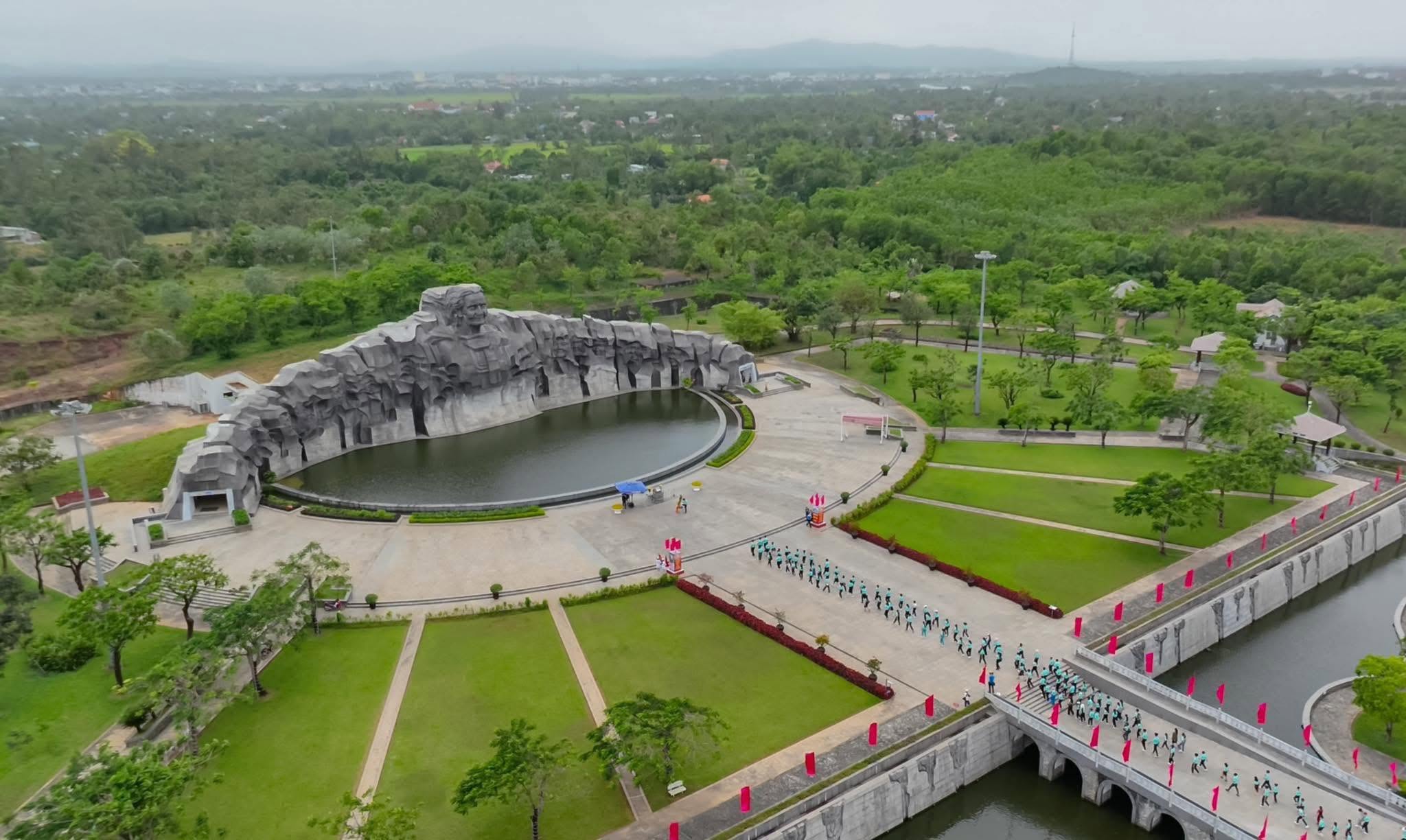
Occupying more than 16 hectares, the site was designed as an integrated architectural, sculptural, and landscaped memorial complex. Its principal components include the central monument, memorial exhibition hall, ceremonial square, ornamental lake, eight symbolic pillars, pedestrian pathways, landscaped gardens, and supporting facilities.
The architectural arrangement follows a central axis leading toward the main monument, creating a dignified setting that emphasizes the site’s commemorative purpose. Its substantial scale and hillside location make it a distinctive architectural landmark in southern Da Nang.
The monument was conceived to honor Vietnamese mothers whose love, courage, resilience, and sacrifices played an essential role in the country’s struggle for independence and reunification.
The selected design was developed from a concept by artist and sculptor Dinh Gia Thang, with the central figure modeled after Vietnamese Heroic Mother Nguyen Thi Thu, a remarkable woman from the historic Quang Nam region.
Nguyen Thi Thu is widely remembered for the extraordinary losses she endured during Vietnam’s wars. Nine of her sons, one son-in-law, and two grandchildren died in the country’s two major resistance wars.
Her story represents the profound and often silent sacrifices made by countless Vietnamese mothers who sent their husbands, children, and loved ones to serve their country.
Behind each loss were years of waiting, personal grief, and remarkable strength as these women continued working, caring for their families, and contributing to their communities.
Choosing Nguyen Thi Thu as the inspiration for the monument was therefore more than a tribute to one individual. Her image represents the thousands of Vietnamese Heroic Mothers across the country whose lives were marked by extraordinary courage and sacrifice.
The monument’s central figure combines the gentle, compassionate appearance of a mother with the symbolic stature of the Vietnamese nation.
From its artistic concept to the organization of its surrounding spaces, the entire complex communicates themes of maternal love, patriotism, sacrifice, and reunion.
Rather than simply commemorating the past, the monument also reminds present and future generations of the value of independence, peace, and the lives they enjoy today.
Architecture and Major Features of the Monument Complex
The most prominent feature of the complex is its monumental central sculpture, constructed primarily from granite.
According to descriptions of the project, approximately 20,000 tons of stone and concrete were used in its construction.
The monument takes the form of a mountain, rising to its greatest height at the center before gradually descending toward both sides.
This architectural composition expresses the idea of the mother as an inexhaustible source of life, a spiritual foundation, and a symbol of the nation’s enduring strength.
At the center stands a sculpted bust of Nguyen Thi Thu, measuring more than 18 meters in height.
Her face conveys kindness and compassion, while also expressing determination, resilience, and the emotional depth of a life shaped by historical events.
The sculpture relies on powerful yet restrained artistic expression, emphasizing the dignity and character of the Vietnamese mother rather than elaborate decorative details.
Viewed from a distance, her portrait merges with the mountain-like stone structure behind it, creating an impression of permanence and strength.
Extending outward from the central portrait are two enormous curved wings, suggesting a mother opening her arms to protect and welcome her children home.
The surfaces of these wings incorporate sculptural images of people, representing generations of Vietnamese descendants from the country’s northern, central, and southern regions gathering around their mother.
This is one of the monument’s most meaningful artistic concepts, expressing the aspirations for peace, national reunification, and family togetherness.
The mother is portrayed not only as a symbol of wartime grief but also as an embodiment of love, compassion, forgiveness, and the spiritual strength of the Vietnamese people.
In front of the main sculpture lies a large ceremonial square, designed with a formal entrance, central approach, ceremonial grounds, and landscaped features leading toward the monument.
The square provides a setting for remembrance ceremonies, incense offerings, and cultural or historical events on important commemorative occasions.
Its spacious layout allows delegations, organizations, and members of the public to participate in ceremonies of gratitude and remembrance in a dignified atmosphere.
Along the main approach are 30 clusters of stone lamps surrounded by landscaped lawns.
According to the monument’s symbolic interpretation, the number 30 represents three decades of prolonged resistance and recalls the years during which many mothers waited anxiously for news of their husbands and children from the battlefield.
These stone lamps contribute both to the architectural rhythm of the approach and to the deeper historical meaning of the memorial.
Walking along this route, visitors experience a gradual transition from the surrounding landscape into the solemn central commemorative space.
Another notable feature is the semicircular lake in front of the monument, covering nearly 1,000 square meters.
The water creates an open visual foreground that balances the immense scale of the granite sculpture behind it.
Together, the lake, ceremonial square, and monument form a carefully composed architectural setting with strong symbolic significance.
The reflection of the mountain-shaped monument on the water evokes tranquility and permanence, while the curved shoreline softens the otherwise monumental composition.
The lake also strengthens the relationship between sculpture, architecture, and the natural landscape.
The complex includes another distinctive architectural feature known as the Eight Legendary Pillars.
According to project descriptions, each pillar stands approximately 11.2 meters tall and measures about 1.65 meters in diameter, with surfaces decorated by various carved images.
The pillars function as a symbolic gateway to the monument.
The number eight carries several interpretations, most notably its association with the eight Vietnamese words used by President Ho Chi Minh to honor Vietnamese women:
“Anh hùng – Bất khuất – Trung hậu – Đảm đang”
These qualities are commonly translated as “Heroic – Indomitable – Loyal and Kind-hearted – Resourceful.”
They celebrate the strength, determination, compassion, and dedication of Vietnamese women, particularly during periods of national struggle.
In traditional cultural interpretations, the number eight is also associated with prosperity, reunion, and favorable outcomes.
The Eight Legendary Pillars enrich the complex’s architectural language and reinforce its symbolic message.
Beyond its principal structures, the monument complex features landscaped gardens, pedestrian pathways, and extensive green spaces.
According to local descriptions, many trees were donated by provinces and cities across Vietnam, representing the shared gratitude of communities throughout the country toward Vietnamese Heroic Mothers.
The trees, lawns, and open spaces create a peaceful environment appropriate for reflection and remembrance.
Behind the monument is a stone garden featuring poems and inscriptions honoring Vietnamese mothers.
These literary works, presented on stone surfaces, connect poetry and cultural expression with the architecture and surrounding landscape.
The garden offers visitors a quiet place to reflect on the historical memories and emotional significance of the monument.
Memorial Exhibition Hall and Stories of Vietnamese Heroic Mothers
Inside the main monument is the Memorial Exhibition Hall dedicated to Vietnamese Heroic Mothers.
This space preserves photographs, historical documents, and artifacts relating to the lives, contributions, and sacrifices of women who supported Vietnam’s struggles for independence and reunification.
According to available descriptions, the exhibition area covers approximately 950 square meters.
It is one of the most meaningful components of the entire complex, allowing visitors to explore the personal histories behind the monumental sculpture.
The memorial hall has been described as a place where the names of nearly 50,000 Vietnamese Heroic Mothers are recorded, based on the commemorative records referenced in the exhibition materials.
Each name represents a personal story of family love, patriotism, courage, and profound loss.
The commemorative displays express national gratitude toward mothers whose contributions and sacrifices were particularly significant during wartime.
At the same time, they remind visitors of the human cost of conflict and the importance of preserving peace.
In addition to the commemorative records, the exhibition includes historical photographs, documentary materials, and everyday objects associated with the lives of Vietnamese Heroic Mothers.
Among the artifacts described are a bronze cooking pot used to prepare food for soldiers, a traditional weaving loom, ceremonial flower vases, and household objects from the wartime period.
Although modest in appearance, these objects offer powerful insights into the daily lives of women on the home front.
They evoke images of mothers who worked to support their families while also contributing to the resistance through food preparation, textile production, sheltering revolutionary personnel, and supplying essential provisions.
Through these personal stories and historical artifacts, visitors gain a deeper understanding of the quiet sacrifices that helped shape the nation’s history.
The exhibition is therefore more than a collection of historical objects. It provides a meaningful connection between collective memory and individual human experience.
Ordinary household items make the history of war more tangible, accessible, and emotionally resonant.
For students and educational groups, the Memorial Exhibition Hall offers a valuable setting for learning about Vietnamese history, revolutionary traditions, and the importance of gratitude toward previous generations.
Cultural, Artistic, and Educational Significance
The Vietnamese Heroic Mother Monument Complex holds an important place in the cultural, historical, and spiritual life of Vietnam.
Above all, it is a national place of remembrance dedicated to mothers who made extraordinary sacrifices for the country’s independence, freedom, and reunification.
Through the image of Nguyen Thi Thu and the memorial records preserved within the complex, the monument helps safeguard historical memories while honoring the resilience and patriotism of Vietnamese women.
From an architectural and artistic perspective, the complex is a remarkable example of large-scale public sculpture.
Its monumental granite construction, symbolic mountain-shaped composition, and carefully integrated landscape create a distinctive artistic identity.
The combination of the mother’s portrait, the two sweeping wings, the ceremonial square, and the semicircular lake forms a unified architectural and sculptural composition.
Each component serves not only a physical or functional purpose but also communicates ideas about maternal love, sacrifice, peace, and reunion.
Unlike monuments centered on a single isolated sculpture, this complex is organized as a sequence of interconnected spaces.
Visitors can experience the artwork from multiple perspectives, beginning with the expansive ceremonial square, continuing through the memorial exhibition, and extending into the landscaped areas surrounding the main monument.
This spatial arrangement allows the historical and emotional messages of the site to unfold gradually.
The complex also plays an important educational role, particularly for younger generations.
Photographs, artifacts, personal stories, and commemorative inscriptions help students and visitors understand the experiences of ordinary people during wartime and the often-overlooked contributions of mothers and families.
These encounters encourage appreciation for peace, a sense of civic responsibility, and respect for those whose sacrifices shaped the country’s history.
The Vietnamese Heroic Mother Monument Complex is also a venue for remembrance ceremonies, incense offerings, and commemorative activities during major national and local occasions.
Such programs may be organized to mark important historical anniversaries, cultural events, and educational initiatives.
The spacious ceremonial square can also accommodate artistic performances, community gatherings, and large-scale commemorative events.
On these occasions, the monument becomes a meeting place for different generations who come together to remember the past and honor Vietnamese Heroic Mothers.
These activities help preserve the Vietnamese tradition of “Uong nuoc nho nguon”, meaning “When drinking water, remember its source,” an expression of gratitude toward those whose efforts and sacrifices made present achievements possible.
Visiting the Vietnamese Heroic Mother Monument Complex
A visit to the Vietnamese Heroic Mother Monument Complex combines architectural appreciation, historical discovery, and meaningful cultural reflection.
From the ceremonial square, visitors can admire the entire central sculpture, with Nguyen Thi Thu’s portrait rising above the sweeping stone wings.
The composition creates the powerful impression of a mother welcoming her children home.
This viewpoint provides one of the clearest perspectives on the scale, symbolism, and artistic vision of the monument.
The enormous stone structures, reflective water, and surrounding hills together create a striking memorial landscape.
After exploring the main sculpture, visitors can continue into the Memorial Exhibition Hall.
Through photographs, historical documents, and artifacts, they can learn about the lives, sacrifices, and contributions of Vietnamese Heroic Mothers.
For school groups and university students, this is a meaningful destination for historical education and cultural learning.
With grounds extending across more than 16 hectares, the complex also offers spacious landscaped areas, tree-lined paths, and open courtyards.
Visitors can explore the ceremonial square, semicircular lake, Eight Legendary Pillars, and surrounding gardens.
The stone garden behind the monument is another noteworthy stop, featuring poems and inscriptions dedicated to Vietnamese mothers.
Those visiting during commemorative occasions may have the opportunity to observe incense-offering ceremonies and cultural activities organized at the site.
The solemn atmosphere of these events adds another dimension to the visitor experience, encouraging reflection on Vietnam’s history and national traditions.
The monument can also be included in a broader cultural and historical itinerary through southern Da Nang.
The Martyrs’ Cemetery in the Quang Phu area is a meaningful destination for remembrance and historical reflection.
Ky Anh Tunnels are associated with revolutionary activities during the war against the United States, while Van Thanh – Confucius Temple preserves the Confucian educational heritage and scholarly traditions of the historic Quang Nam region.
Visitors interested in ancient architecture can explore the Khuong My Cham Towers, an important complex reflecting the artistic and religious traditions of the Champa civilization.
For coastal scenery and community culture, Tam Thanh Beach and Tam Thanh Mural Village offer opportunities to experience fishing village life and colorful public art.
Phu Ninh Lake is another attractive destination for travelers seeking natural landscapes and a relaxing excursion.
Combining these attractions provides a broader perspective on the history, culture, architecture, and natural heritage of southern Da Nang.
The Vietnamese Heroic Mother Monument Complex is located on Le Thanh Tong Street, Quang Phu Ward, Da Nang City.
According to approximate geographical references, the site is around 70 kilometers south of Da Nang International Airport and 35 kilometers north of Chu Lai Airport.
Visitors can travel by private car, motorcycle, or hired vehicle. Upon reaching the Cam Mountain area, access roads lead toward the monument complex.
For organized groups, educational institutions, or visitors wishing to arrange incense-offering ceremonies, contacting the site management in advance is recommended.
As the complex is a place of historical and spiritual remembrance, visitors should wear respectful clothing and behave appropriately.
Inside the Memorial Exhibition Hall, visitors should maintain a quiet atmosphere and avoid touching historical artifacts or exhibition displays.
Photography should follow the regulations displayed in exhibition areas and spaces used for ceremonial activities.
Visitors should also avoid littering or damaging trees, sculptures, and landscaped features.
Because the grounds are extensive and include large outdoor areas, carrying drinking water and sun protection is advisable, particularly during hot weather.
Those wishing to learn more about the monument’s history and artistic symbolism may enquire about guided tours or interpretation services through the site management.
Quick Information About the Vietnamese Heroic Mother Monument
| Category | Information |
|---|---|
| Monument name | Vietnamese Heroic Mother Monument Complex |
| Current address | Le Thanh Tong Street, Quang Phu Ward, Da Nang City, Vietnam |
| Location | Cam Mountain area |
| Heritage type | Cultural, historical, artistic, and commemorative monument |
| Site area | More than 16 hectares |
| Design concept | Artist and sculptor Dinh Gia Thang |
| Central figure | Vietnamese Heroic Mother Nguyen Thi Thu |
| Height of central portrait | More than 18 meters |
| Main materials | Granite, concrete, and other construction materials |
| Stone and concrete volume | Approximately 20,000 tons, according to project descriptions |
| Memorial Exhibition Hall | Approximately 950 m² |
| Commemorative records | Nearly 50,000 Vietnamese Heroic Mothers, according to the referenced exhibition information |
| Semicircular lake | Nearly 1,000 m² |
| Eight Legendary Pillars | Approximately 11.2 m high and 1.65 m in diameter each |
| Main attractions | Central monument, Memorial Exhibition Hall, ceremonial square, lake, Eight Legendary Pillars, and stone garden |
| Distance from Da Nang International Airport | Approximately 70 km |
| Distance from Chu Lai Airport | Approximately 35 km |
| Exhibition opening days | Tuesday to Sunday, closed on Mondays |
| Morning hours | 7:30 AM–11:00 AM |
| Afternoon hours | 1:30 PM–4:30 PM |
| Admission | Free, according to the supplied information |
| Visitor guidelines | Dress respectfully, maintain a quiet atmosphere, and observe memorial regulations |
Standing against the natural landscape of Cam Mountain, the Vietnamese Heroic Mother Monument Complex is an enduring symbol of maternal love, patriotism, and the extraordinary sacrifices made by Vietnamese women during the country’s wars.
The compassionate face of Nguyen Thi Thu, the monument’s sweeping stone wings, and the personal stories preserved in the Memorial Exhibition Hall together create a deeply moving historical and artistic experience.
More than a monumental architectural achievement, the complex connects memories of the past with the lives of present generations, reminding visitors of the importance of independence, peace, and family reunion.
A visit to the Vietnamese Heroic Mother Monument is therefore more than a sightseeing excursion. It is an opportunity to understand Vietnam’s history, honor those who sacrificed for their country, and experience the enduring tradition of gratitude that remains central to Vietnamese culture.
The complex is a meaningful destination on any journey exploring the historical and cultural heritage of southern Da Nang.