

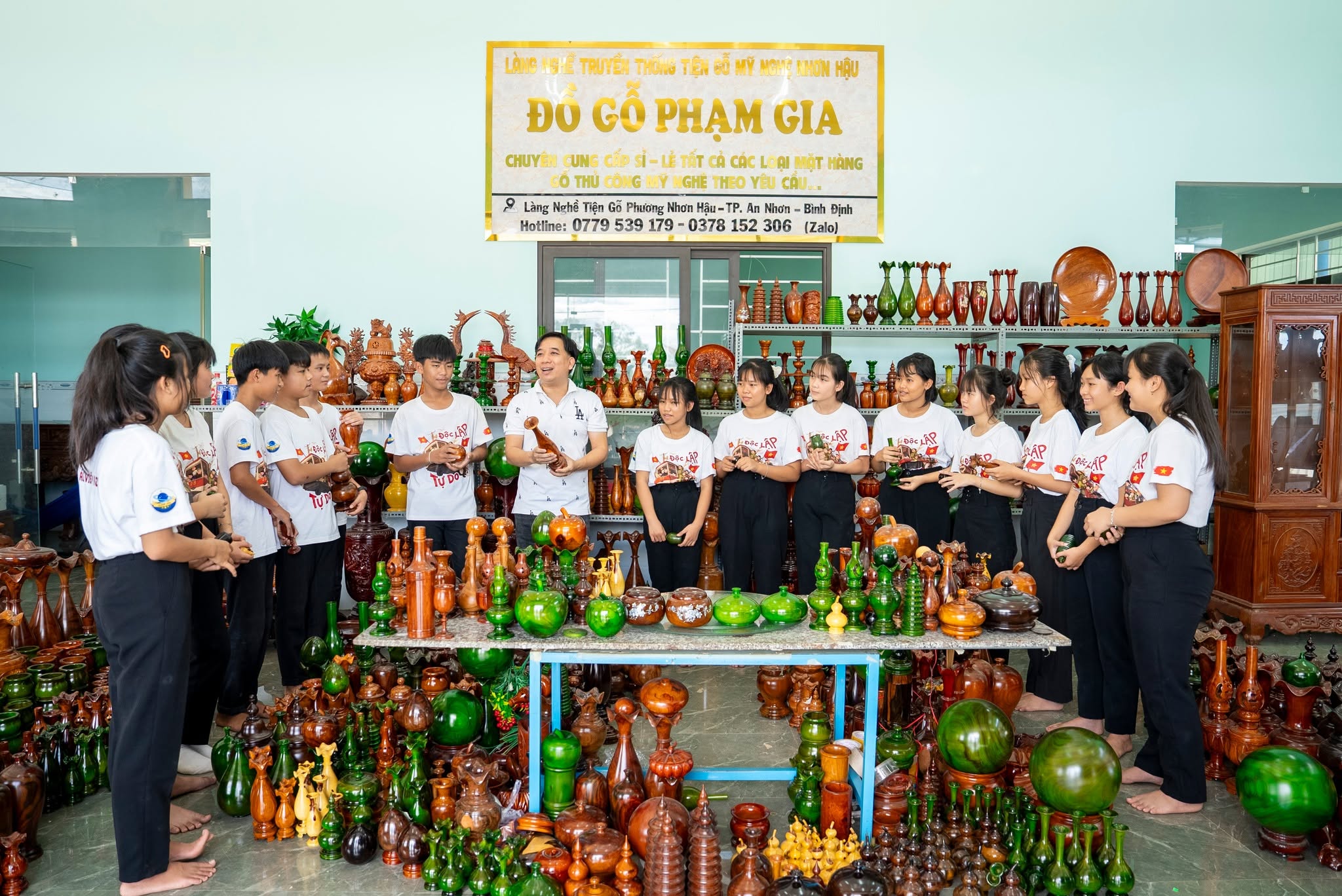
Bac Nhan Thap Traditional Woodturning Village is located in An Nhon Ward, Gia Lai Province, Vietnam, approximately 30 kilometers northwest of Quy Nhon. Situated in the Nhan Thap area, the village is known for its traditional woodturning techniques, which produce beautifully balanced, rounded, and intricately crafted wooden products reflecting the cultural heritage of An Nhon.
Originally, local artisans specialized in making furniture legs, rounded wooden columns, and altar lamps. Over time, they expanded their product range, explored new markets, and introduced their handicrafts to customers across Vietnam and several international markets.
Following major market disruptions, particularly declining exports and the rapid growth of online shopping, the village began searching for new opportunities. Craftspeople who once spent their days operating woodturning lathes are now learning to appear on camera, introduce their products through social media, and bring their traditional craft into the digital marketplace.
Overview of Bac Nhan Thap Woodturning Village
| Information | Details |
|---|---|
| Village name | Bac Nhan Thap Traditional Woodturning Village |
| Location | An Nhon Ward, Gia Lai Province, Vietnam |
| Traditional craft area | Nhan Thap |
| Distance | Approximately 30 km northwest of Quy Nhon |
| Traditional craft | Artistic woodturning |
| Original products | Furniture legs, rounded wooden columns, altar lamps |
| Later products | Toys, decorative objects, ashtrays, globes, tea sets, and artistic wooden products |
| Official craft village recognition | 2007 |
| Trademark registration | 2018 |
| Current scale | Approximately 60–70 active households, according to local information |
| Digital transformation | Around 20 households selling products online |
| Markets | Vietnam, China, Taiwan, Japan, and other markets |
| Development direction | Digital transformation, trade promotion, and craft village tourism |
From Simple Turned Wooden Products to Traditional Craftsmanship
Woodturning in Nhan Thap originally developed around everyday household products.
In the past, local artisans primarily produced furniture legs, rounded wooden columns for tables and cabinets, altar lamps, and other cylindrical wooden components.
Woodturning requires considerable precision. Craftspeople must carefully control each cut to create symmetrical shapes, smooth surfaces, and balanced proportions.
Even a small wooden object may require years of accumulated experience to achieve consistent curves and a refined finish.
A turning point came when Vietnam moved away from its centrally planned, subsidized economy.
Some younger craftspeople began actively searching for new markets. Traveling across Vietnam by train, they carried simple turned wooden products such as ashtrays, globes, tea sets, and decorative items to sell at tourist destinations.
Through these journeys, local artisans realized that woodturned products could serve purposes beyond household use. They could also become souvenirs, decorative objects, and meaningful gifts.
From a Family Craft to Artistic Wooden Products
Over the years, Bac Nhan Thap’s product range has become increasingly diverse.
The village’s distinctive craftsmanship lies in its ability to transform wood into rounded, symmetrical forms with elegant curves and carefully finished details.
Products from Bac Nhan Thap have been sold not only in An Nhon and neighboring areas but also in international markets, including China, Taiwan, and Japan.
Their value comes from more than the quality of the wood or the appearance of the finished product. It also reflects the skills and experience of the artisans.
Each craftsperson must understand the characteristics of different types of wood and know how to handle the material to prevent cracking, splitting, or distortion during turning.
Every finished piece therefore combines natural materials with generations of practical craftsmanship.
A Craft Village That Once Had More Than 100 Households
At its peak, Bac Nhan Thap had more than 100 households engaged in woodturning and related production activities.
The village experienced periods of strong demand, particularly from China and neighboring markets.
In 2007, Bac Nhan Thap was officially recognized as a traditional craft village.
In 2018, the village registered a trademark, providing a foundation for developing a stronger identity for its products.
However, changing market conditions brought significant challenges.
Market disruptions following the 2003 SARS outbreak, and especially the COVID-19 pandemic, severely affected export activities.
Inventories increased, orders declined, and many workshops were forced to close.
At the same time, consumer purchasing habits changed rapidly. Instead of visiting physical stores, more customers began searching for and ordering products online.
For a traditional craft village accustomed to waiting for customers to visit workshops, this meant learning how to reach buyers in the digital world.
When Traditional Craftspeople Entered Social Media
Faced with these challenges, several households began experimenting with online sales.
One of the early adopters of digital transformation in Bac Nhan Thap was Bui Quang Thang, owner of Pham Gia Wood Products in Bac Nhan Thap Residential Area.
In 2019, he began selling wooden products through Facebook.
By 2021, his business had expanded to TikTok, followed by investments in livestream selling on YouTube and other digital platforms.
This new approach allowed the workshop to reach customers without relying entirely on visitors coming directly to the village.
According to the information provided, once online sales became established, the workshop generated more than VND 100 million in monthly revenue.
For artisans accustomed to working beside a woodturning lathe, standing in front of a camera to introduce products represented a major change.
Yet that change opened new opportunities to reach customers and develop the business.
From Woodturning Lathes to Livestream Shopping
Digital transformation in Bac Nhan Thap has not been limited to a single workshop.
The experiences of early adopters gradually encouraged other craftspeople to explore online selling.
Artisans who previously focused entirely on production began appearing in videos, explaining the manufacturing process, introducing different wood materials, and demonstrating the craftsmanship behind their products.
Even older workshop owners started learning new skills.
Ngo Xuan Thao, owner of Truong Thinh Wood Products in Bac Nhan Thap Residential Area, is one example.
His workshop provides employment for approximately 15 workers.
When export activities were disrupted, he began teaching himself how to sell products through livestreams, despite having little previous experience in online commerce.
Alongside online sales, transparency about raw materials became increasingly important.
Providing information about wood origins, purchase invoices, and material traceability became part of the selling process.
According to the information provided, his workshop currently maintains monthly revenue exceeding VND 200 million.
These stories demonstrate that digital transformation involves much more than creating social media accounts.
Craftspeople must learn photography, video production, livestream presentation, customer communication, and online order management.
How Digital Technology Is Changing the Craft Village
According to local information, Bac Nhan Thap currently has approximately 60–70 active craft households, of which around 20 have adopted online sales.
This transformation has helped traditional wooden products reach a broader customer base.
Social media has also become a platform for sharing the stories behind the craft rather than simply advertising finished products.
A wooden tea set, decorative ornament, or carefully turned object can now be presented alongside footage of the artisan shaping the wood, the sound of the lathe, and stories about the village.
For traditional handicrafts, this connection is particularly meaningful.
Customers can see not only the finished item but also the process, skills, and dedication involved in creating it.
The Traditional Craft Exhibition House
Another important development in Bac Nhan Thap is the establishment of the Bac Nhan Thap Traditional Woodturning Craft Exhibition House.
The exhibition space displays products from more than ten major local workshops.
It is also intended to serve as a visitor attraction and a place to promote local handicrafts.
Some workshops use the exhibition house as a setting for livestream sales.
The space provides a more professional environment for product presentations while allowing businesses to introduce handicrafts produced by other households in the village.
What began as a place to preserve and display traditional products therefore has the potential to become a connection point between craftsmanship, commerce, and tourism.
Craftspeople Learning to Adapt
Digital transformation is gradually changing the familiar image of Bac Nhan Thap.
Alongside artisans working at woodturning lathes, more people are now standing in front of cameras.
They continue practicing their craft while learning how to communicate its value to customers.
Workshops have also begun developing products for different market segments.
According to the information provided, acacia wood is commonly used for mid-range products, while more valuable timber varieties are intended for premium customers and collectors.
This diversification reflects the village’s efforts to serve different customer groups rather than depend on a single export market.
Nevertheless, traditional woodturning skills remain the foundation of the village.
Machinery and digital platforms may change how products are manufactured, promoted, and sold, but their essential value continues to come from the knowledge and experience of the artisans.
From Traditional Handicrafts to Tourism Experiences
Bac Nhan Thap has considerable potential to combine traditional craftsmanship with experiential tourism.
Visitors could learn how a piece of timber is mounted on a woodturning lathe, observe artisans shaping curves and decorative details, and discover the characteristics of different wood varieties.
If developed into organized visitor experiences, craft village tourism could offer more than the opportunity to purchase souvenirs.
Travelers could learn about the people behind the products, the origins of the wood, the production process, and why even a seemingly simple wooden object requires considerable expertise.
The Traditional Craft Exhibition House could serve as a starting point for these experiences, connecting visitors with workshops throughout the village.
Such tourism activities could create additional markets for local products while helping preserve and share traditional knowledge.
These experiences represent development opportunities rather than guaranteed services currently available to all visitors.
A Traditional Craft Village Entering the Digital Age
Bac Nhan Thap has experienced many changes throughout its development.
From producing simple furniture legs and wooden columns, local artisans expanded into decorative objects, toys, souvenirs, and artistic handicrafts.
From domestic markets, their products reached customers overseas.
When export demand weakened, the village had to find another path forward.
Today, that path increasingly leads through digital platforms.
Facebook, TikTok, YouTube, and livestream shopping have become new tools for reaching customers.
Instead of waiting for buyers to visit their workshops, artisans can introduce their products to audiences far beyond the village through a smartphone or computer screen.
Yet the most remarkable aspect of this transformation is not the technology itself.
It is the ability of traditional craftspeople to adapt.
A traditional craft can continue to thrive when artisans find ways to keep their products relevant to contemporary life.
For Bac Nhan Thap, digital transformation is creating new opportunities for handmade wooden products to reach customers in Vietnam and international markets.
From the rhythmic sound of woodturning machines inside village workshops to the voices of artisans presenting products through livestreams, Bac Nhan Thap is continuing its story in the language of the digital age.
It is also a journey shared by younger craftspeople and experienced artisans who have devoted their lives to the trade, working together to preserve the distinctive woodturning heritage of Nhan Thap while introducing its craftsmanship to new generations of customers.